The boundary between traditional 2D precision and expansive virtual spaces has blurred, giving rise to platformer adventure hybrids. These games move beyond simple “jump and run” mechanics, tasking players with navigating complex, interconnected worlds that reward curiosity and mastery of movement. Whether you are scaling sheer cliffs to uncover hidden secrets or managing limited supplies while traversing treacherous environmental hazards, these titles define a modern style of play where every leap requires careful calculation. If you enjoy [url=https://gameturn.net/best-platform-action-games-mastering-combat-and-movement/]mastering platform action games[/url], you likely crave the fluidity and high-stakes traversal these hybrids offer.
In this guide, we break down what makes these crossovers so compelling. You will learn how to evaluate different gameplay loops, from open world exploration to intense survival scenarios, and gain practical advice on selecting titles that align with your preferred intensity. Whether you are looking for a relaxing, narrative-driven experience or a grueling, skill-based challenge, understanding these mechanics is the key to finding your next gaming obsession.
1. Mastering Platformer Adventure Hybrids Through Genre Evolution and Design
The modern gaming landscape has seen a fascinating shift as developers bridge the gap between traditional movement-based challenges and expansive digital worlds. Platformer adventure hybrids have emerged as a dominant category, blending the tight, responsive controls of side-scrolling classics with the freedom found in open world adventures. By merging these disparate design philosophies, creators are now offering players more than just a gauntlet of obstacles; they are crafting cohesive, interactive ecosystems where every leap feels purposeful.
1.1 Defining the Core Mechanics of the Hybrid Experience
1.1.1 The Integration of Precision Movement in Sandbox Environments
At the heart of the hybrid experience lies the marriage of environmental design and character mobility. Unlike traditional platformers that linearize movement, these titles place precision-based tasks within sprawling sandbox environments. This requires players to master advanced movement tech—such as wall-kicking, dashing, or grappling—to navigate vertical terrain. The challenge shifts from merely reaching a goal to understanding how your character’s kinetic capabilities interact with an expansive, often non-linear world map.
1.1.2 Evaluating the Convergence of Survival Loops and Vertical Level Design
Survival adventure games often lean heavily into verticality to heighten tension and complexity. When a developer forces you to manage resources while simultaneously navigating a precarious cliffside or a crumbling tower, the risk-reward ratio changes significantly. Verticality isn’t just an aesthetic choice; it becomes a tactical layer that dictates how you manage stamina, health, and inventory, turning the very act of climbing into a core survival loop.
1.2 Assessing Essential Gameplay Pillars for Modern Players
1.2.1 Mobility and Traversal Abilities as Progression Gates
In many of the best genre entries, traversal is the primary key to unlocking secrets. By treating mobility as a progression mechanic, games ensure that players feel a tangible sense of growth. You are not just getting stronger stats; you are gaining the literal reach required to access previously unreachable areas, which is a hallmark of well-designed best platform action games. This sense of discovery keeps engagement high as your toolkit expands alongside the environment’s complexity.
1.2.2 The Role of Environmental Interaction in Resource Acquisition
Modern hybrids go beyond simple navigation by making the world itself a source of survival goods. Whether it is harvesting rare plants from a high-altitude ledge or utilizing physics-based puzzles to unearth buried materials, environmental interaction is vital. Players learn to read the level design to predict where resources might be hidden, blending exploration with the pragmatic needs of staying alive.
1.3 Selecting the Ideal Title Based on Playstyle and Intensity
1.3.1 Balancing Precision Platforming Demands Against Casual Exploration
Not every hybrid demands frame-perfect execution. Some titles prioritize the flow of exploration, allowing players to soak in the atmosphere, while others act as rigorous tests of skill. Understanding whether you prefer a zen-like exploration experience or a high-pressure mechanical challenge is the most important step in finding your next favorite game.
1.3.2 Determining Preference Between Creative Sandbox Freedom and High Stakes Survival
Your playstyle preference will likely dictate which sub-genre you gravitate toward. Creative sandbox titles often trade the pressure of starvation or combat for the freedom of terraforming and building. Conversely, hardcore survival experiences use environmental hazards to force players into calculated decision-making, where one misplaced jump could result in the loss of hard-earned progress.
1.3.3 Comparing Control Schemes for Optimal Movement and Combat Accuracy
Finally, the feel of the controls remains the ultimate deciding factor. Because these games demand both precision movement and combat awareness, the controller configuration matters immensely. Players should look for titles that allow for button remapping or those that utilize haptic feedback to communicate the weight of traversal, ensuring that every interaction feels crisp and responsive during intense gameplay sequences.
2. Analyzing Top Tier Platformer Adventure Hybrids and Advanced Mastery

2.1 Categorizing the Leading Titles in Open World and Survival Play
The landscape of platformer adventure hybrids has evolved significantly, moving beyond linear paths to offer expansive experiences that cater to diverse playstyles. By categorizing these games based on their primary design philosophy, players can more effectively choose titles that align with their mechanical preferences, whether they crave high-octane agility or methodical resource management.
2.1.1 High Octane Action Hybrids Focused on Combat and Agility
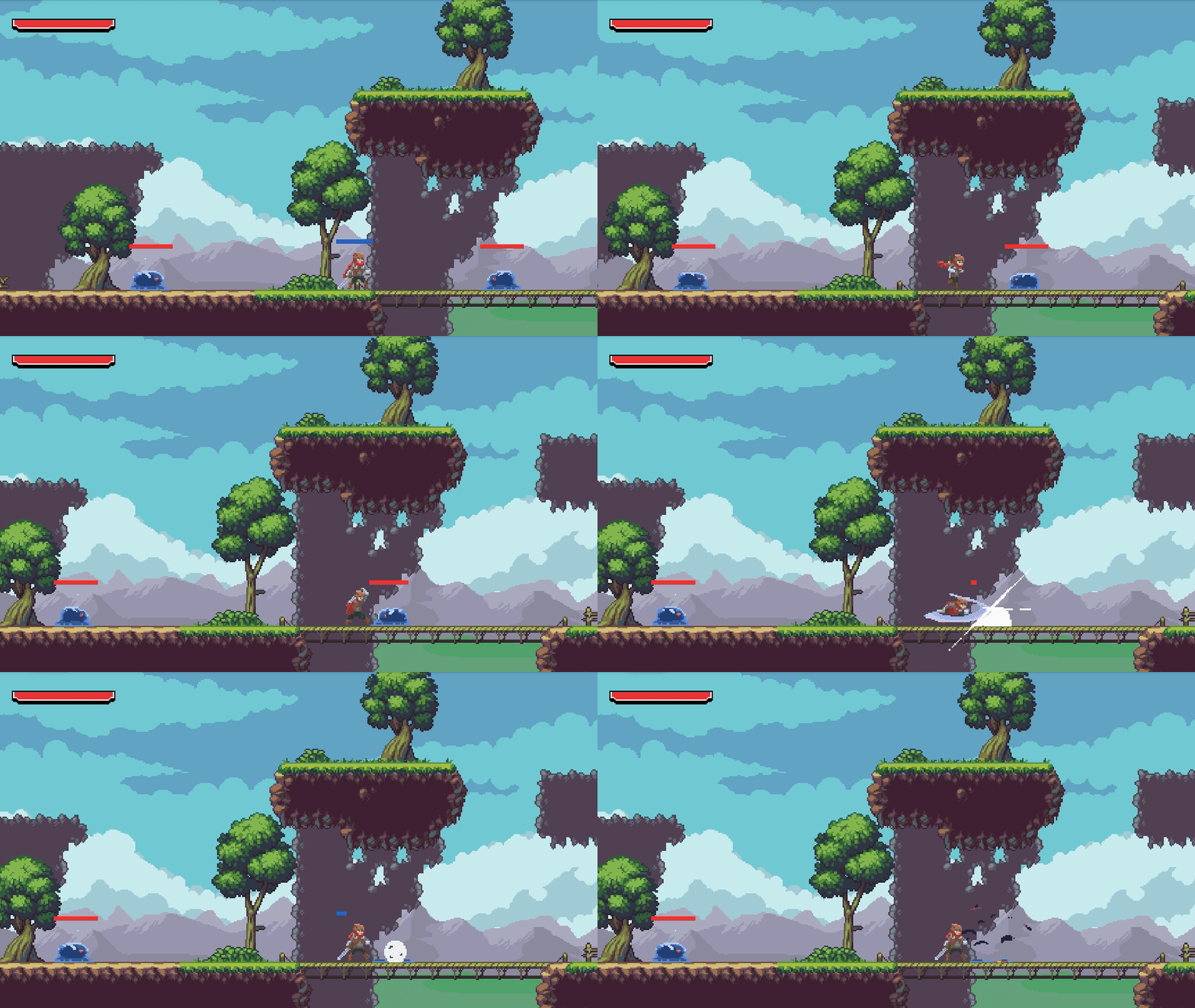
These titles prioritize momentum and fluid traversal. They often feature complex movement kits that allow players to dash, wall-run, and grapple across dangerous environments. Success in these games relies heavily on reflexive combat and the ability to link jumps with attacks, transforming the environment into an extension of the player’s combat potential.
2.1.2 Creative Sandbox Titles Emphasizing Vertical Base Building and Terraforming
In this sub-genre, the platforming mechanics serve a constructive purpose. Players use precision movement to reach remote locations for material gathering, then utilize that verticality to build elaborate, multi-layered bases. The appeal here lies in the intersection of exploration and structural creativity, where every ledge conquered brings new possibilities for expansion.
2.1.3 Hardcore Survival Experiences Utilizing Environmental Hazards and Resource Management
These games treat traversal as a high-stakes puzzle. Players must balance stamina, oxygen, or hunger levels while navigating treacherous terrain. Movement is rarely about speed here; instead, it is about careful planning. If you enjoy testing your limits in unforgiving landscapes, you can find a deep dive into these concepts in our guide on adventure survival crafting.
2.2 Strategies for Advanced Movement and World Interaction
Mastering these hybrids requires moving beyond basic inputs. Advanced players treat the game world as a playground, identifying unique ways to manipulate physics and environment design to bypass traditional barriers.
2.2.1 Chaining Traversal Abilities for Efficient Map Traversal and Resource Gathering
The most efficient explorers learn to chain mobility skills—such as double-jumping into a dash or sliding into a jump-kick—to maintain maximum velocity. By keeping your momentum consistent, you reduce travel time between resource-rich zones and minimize your vulnerability to environmental hazards or hostile entities.
2.2.2 Utilizing Verticality to Enhance Defensive Base Design and Strategic Planning
Verticality is not just for movement; it is a defensive asset. By building on high-altitude spires or subterranean shelves, players can limit enemy approach vectors, forcing threats into narrow choke points. Integrating jump pads or grappling hooks into your base layout further enhances this, allowing you to retreat or reposition quickly during raids.
2.3 Extending Longevity Through Community Engagement and Technical Optimization
The lifespan of a hybrid game often extends well beyond the initial campaign thanks to active development and community-driven content. Understanding how to refine your experience through settings and community resources is key to long-term enjoyment.
2.3.1 Identifying Quality Indie Gems Through Community Reviews and Modding Scenes
Independent developers frequently push the boundaries of genre hybridization. By engaging with dedicated forums or monitoring the Steam Workshop, you can discover mods that introduce new movement mechanics, fresh biomes, or expanded survival systems, keeping the gameplay loop feeling revitalized.
2.3.2 Troubleshooting Common Hardware and Controller Configurations for Hybrid Games
Because these games demand precise inputs, hardware performance is critical. Ensure your controller’s dead-zones are calibrated correctly to avoid drift during complex sequences. If you experience performance dips in dense open-world areas, consider disabling motion blur or lowering shadow quality to maintain the stable frame rates required for twitch-based platforming.
At their core, platformer adventure hybrids represent a perfect marriage of mechanical precision and boundless curiosity. Whether you are navigating intricate vertical puzzles or establishing a home base in a sprawling, procedurally generated wilderness, these games challenge you to master your movement while constantly adapting to the unpredictable nature of open worlds. By balancing the tension of survival adventure games with the satisfying loop of character progression and traversal upgrades, this genre continues to push the boundaries of what interactive exploration can feel like.
As you dive deeper into your own gaming journey, remember that the most rewarding experiences come from choosing titles that align with your preferred playstyle—be it high-octane combat or meditative, world-building exploration. For those ready to broaden their horizons, you might want to delve into our comprehensive guide on adventure survival crafting to further sharpen your mastery of these complex systems. Ultimately, the joy lies in the experiment: keep iterating on your movement techniques, explore the furthest reaches of your maps, and don’t be afraid to engage with the community to uncover hidden mechanics and optimization tips that will take your gameplay to the next level.