
There are ordinary internet posts, and then there are animal memes: tiny digital rescue teams arriving with a confused cat, an overexcited dog, or a quokka behaving as though posted rules are merely creative suggestions. The Facebook page “Smol Animal Memes” understands this assignment perfectly. Its collection of funny animal memes turns everyday pet behavior into comedy that is quick, familiar, and nearly impossible not to share.
When the original 43-post roundup was assembled, the page had already attracted more than 180,000 followers. That popularity is not difficult to explain. Animal humor crosses age groups, backgrounds, and even language barriers. A dog proudly carrying an object it clearly should not have, or a cat occupying the one place it was asked to avoid, needs very little translation.
These memes are cute, but cuteness is only the opening act. Their real strength is recognition. We see our own awkwardness, ambition, laziness, hunger, and social confusion reflected in creatures that have no idea they are performing an unusually accurate impression of us.
Why Funny Animal Memes Work So Well
They Deliver the Joke Before Our Attention Wanders Off
A successful meme has to work fast. The image establishes the situation, the caption changes its meaning, and the viewer gets the punch line in seconds. Research into meme sharing suggests that clear subjects, recognizable emotion, close-up framing, and limited text can make visual jokes easier to process and more likely to be passed along. Animals are ideal performers because their faces and body language can look dramatically expressive even when they are simply waiting for dinner.
That combination produces a compact comedy machine. One tilted head becomes “me pretending I understood the meeting.” A suspicious side-eye becomes “when the group chat suddenly goes quiet.” A cat staring into the distance becomes a philosopher who has seen the household budget and no longer believes in hope.
They Offer a Small Emotional Reset
Humor is not a substitute for sleep, therapy, exercise, or finally answering that email marked “gentle reminder.” Still, research has found that funny memes can support short-term coping and leave viewers feeling calmer or more content. Health organizations also note that positive interactions with companion animals may help reduce stress, ease loneliness, and improve mood, although benefits vary from person to person.
Funny pet memes borrow some of that warmth. We may not be petting the dog in the picture, but we recognize the affection, trust, and chaos surrounding it. For a moment, the feed stops feeling like an emergency broadcast and becomes a small neighborhood where everyone is laughing at the same orange cat.
They Turn Animals Into Lovable Stand-Ins for Human Problems
The best animal memes use gentle anthropomorphism: assigning human thoughts or motives to animals for comic effect. A dog with a daycare report card becomes the proud child bringing home straight A’s in “being a good boy.” A cat planted in the middle of a dining table becomes the relative who misunderstood “bring a centerpiece.” Rats driving tiny cars look like commuters who have finally achieved work-life balance.
We know the animals are not literally worried about deadlines, dating, or whether they sounded strange when they said “you too” after a server said “enjoy your meal.” The exaggeration is the joke. The animal gives our familiar anxiety a softer, sillier face.
The Stars of the 43-Meme Collection
Dogs: Enthusiasm With Absolutely No Indoor Voice
Dogs dominate many funny animal meme collections because they make emotions look enormous. Happiness becomes a full-body event. Curiosity involves the nose, ears, tail, and possibly a household lamp. Guilt may look convincing, although the missing sandwich remains missing.
One memorable image in the collection features a delighted dog with a purple unicorn toy, the kind of pairing that instantly creates a complete friendship story. Another dog appears to want praise more than a treat, proving that compliments remain a powerful currency. There is also a polite-looking dog carrying a bone, an airplane passenger peeking between seats, a tennis-ball fanatic, and a daycare student whose glowing report would make any pet parent start planning a graduation party.
The humor works because dogs often seem emotionally transparent. They greet people dramatically, campaign for snacks with impressive persistence, and treat a five-minute absence as a seafaring expedition from which their human has miraculously returned.
Cats: Elegant, Mysterious, and Standing on the Clean Laundry
Cat memes use a different comic engine. Where dogs often radiate enthusiasm, cats specialize in timing. They enter the frame like an unimpressed supervisor. They sit in inconvenient places with the confidence of someone who owns the deed. They stare at humans as though reviewing a disappointing quarterly report.
The collection includes cats with hilariously mismatched coat patterns, a feline causing trouble on a train roof, another appearing in an unlikely travel image, and a soot-covered adventurer who discovered that a chimney is not a luxury tunnel. Elsewhere, a cat occupies a basket, another becomes part of the dinner table, and one poses beside a drawing that captures its essence with brutal artistic accuracy.
These jokes succeed partly because online culture has built recognizable cat characters: the judgmental cat, the chaotic kitten, the mysterious void, and the famously unpredictable orange cat. They are playful stereotypes, not scientific personality categories. Coat color alone does not reliably determine temperament, no matter how many memes insist that orange cats share one communal brain cell.
The Supporting Cast Steals Several Scenes
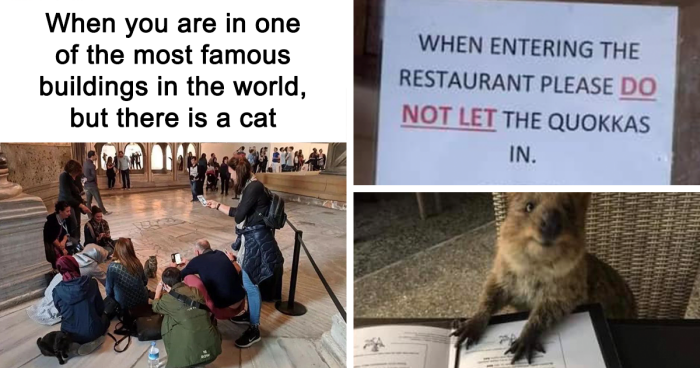
The page wisely does not limit comedy to cats and dogs. A cow resting with quadruplet calves provides wholesome farmyard drama. A quokka appears near a sign that might as well say, “This rule will be ignored by management.” A cat and mouse create an unexpected friendship tableau. Rats cruising in tiny cars look more relaxed than most drivers on a Monday morning, while sheep in a storybook landscape appear ready to claim the entire fantasy genre.
This variety matters. Animal humor becomes more surprising when the performer is not the usual household celebrity. A pigeon walking with purpose, a goat testing structural integrity, or a hamster pausing mid-crime can refresh a joke format we thought we already knew.
What the Memes Reveal About Living With Animals
Pets Learn Our Routines, and We Learn Theirs
Many jokes in the collection depend on a quiet truth: companion animals are excellent observers. They learn when breakfast happens, which cabinet holds treats, what sound a leash makes, and exactly how long they must stare before a human abandons the last bite of chicken.
Humans are learning too. We recognize the pre-zoomies crouch, the dramatic pause before a forbidden jump, and the suspicious silence that usually means someone has entered a closet. This shared routine creates the raw material for pet memes. The humor is not only “animals are strange.” It is “we know this particular kind of strange because we live with it every day.”
Dogs and Cats Are Individuals, Not Preset Characters
Memes love simple labels: dogs are loyal, cats are aloof, rabbits are nervous, and goats are freelance demolition experts. Real behavior is more complicated. Some cats follow their people from room to room, play fetch, and demand affection. Some dogs enjoy independence and prefer sniffing the yard to joining a family cuddle pile. Personality, early experiences, environment, health, and learning all influence behavior.
That individuality is actually good for comedy. The funniest moments often arrive when an animal ignores the script. The “aloof” cat becomes a lap magnet. The dignified dog panics over a cucumber-shaped object. The tiny pet develops the confidence of a nightclub bouncer. Surprise keeps the joke alive.
Training Should Be Kind, Not Content-Driven
Animals can learn through positive reinforcement, including food, play, praise, and other rewards they value. Training can strengthen communication and make grooming, travel, veterinary care, and daily routines easier. It should not become an excuse to frighten, confuse, or pressure an animal for a dramatic clip.
A wholesome meme captures personality without manufacturing distress. The funniest animal is a safe animal. A ten-second post is never worth forcing a pet into a costume it hates, cornering it for a “reaction,” or repeating a prank that produces fear.
How to Enjoy and Share Animal Memes Responsibly
Animal content can look harmless while hiding discomfort. Before sharing a clip, look beyond the caption. Is the animal trying to escape? Are its ears pinned, body tense, breathing unusual, or movements repetitive? Is a wild animal being handled as a prop? Is the joke based on an unsafe fall, forced interaction, or obvious panic?
Responsible viewers can keep the fun while refusing to reward harmful trends. Share posts that show normal play, voluntary interaction, enrichment, affection, clever editing, or accidental comedy. Avoid content that depends on pain, fear, obesity, dangerous breeding traits, or wild-animal exploitation. When a meme comes from a creator, photographer, rescue, or shelter, preserve the credit rather than cropping it away.
Funny animal memes can even do practical good. Shelters increasingly use humorous descriptions to help distinctive pets stand out. A witty post can turn an overlooked dog or cat into a local celebrity and introduce potential adopters to an animal’s real personality. Comedy attracts attention; responsible context helps that attention become compassion.
The Experience of Falling Into a 43-Meme Animal Spiral
Most people do not intentionally schedule time to study funny animal memes. It begins innocently. Someone sends a picture of a dog holding a plush unicorn with the seriousness of a knight protecting a sacred artifact. You smile, react with a heart, and return to work. Then the platform offers a second image. A cat is sitting where no cat was invited to sit. Naturally, you investigate.
Five minutes later, the original task has become historical fiction. You are now comparing the emotional range of three dogs, a cow, and one criminally confident quokka. The strange part is that the scroll rarely feels empty in the way random online browsing can. Each post activates a small memory. The praise-loving dog resembles the family pet who performed “sit” before anyone gave a command. The soot-covered cat recalls the afternoon a perfectly clean animal vanished for ten minutes and returned looking employed by a Victorian factory.
That recognition changes the experience from passive viewing into social storytelling. People tag siblings, message friends, and write comments such as, “This is literally your cat,” even when the only shared trait is sitting near a toaster with questionable intentions. The meme becomes shorthand for a relationship. Sending it says, “I know what makes you laugh,” or “I remember the animal we loved,” without requiring a long conversation.
There is also a pleasant reversal of power. Daily life asks people to be organized, articulate, punctual, and emotionally regulated. Animal memes celebrate the opposite. The dog is thrilled by a leaf. The cat has rejected the expensive bed in favor of the delivery box. The rat is driving a tiny vehicle without a license, insurance, or visible concern about fuel prices. Their priorities are gloriously uncomplicated.
Scrolling through all 43 images also reveals how personal humor can be. One viewer loves the sweet posts: unexpected friendships, proud pet parents, and animals sleeping in impossible positions. Another prefers chaos: the chimney expedition, the train delay, or the tiny creature openly violating a sign. Some people laugh hardest at captions that turn pets into anxious office workers. Others need no words; a perfectly timed stare is enough.
The best moment often arrives after the screen is closed. Pet owners look across the room and notice their own animal doing something equally ridiculous. A cat is folded into a box one size too small. A dog is waiting beside an empty bowl as if dinner has been delayed by several fiscal quarters. The internet collection suddenly feels less like a gallery and more like an invitation to pay attention.
That may be the most enjoyable experience these memes offer. They remind us that comedy is already happening nearby. It lives in routines, misunderstandings, dramatic greetings, failed jumps, stolen seats, and the solemn presentation of objects nobody requested. The page supplies 43 examples, but anyone who shares a home or neighborhood with animals knows the list is never truly finished.
Final Thoughts: Long Live the Tiny Internet Comedians
“Smol Animal Memes” succeeds because it understands that animal humor is more than random cuteness. The best posts combine expressive images, concise captions, recognizable human emotions, and genuine affection for the creatures involved. Dogs bring enthusiasm, cats bring impeccable timing, and the rest of the animal kingdom arrives prepared to steal the scene.
These 43 funny animal memes offer a cheerful break, but they also highlight the bond people build with animals and with one another. Share the wholesome ones, credit their creators, skip content that causes distress, and remember: somewhere nearby, a pet is currently doing something funnier than anything a marketing team could invent.
Note: Before publishing the accompanying gallery, confirm usage permission and preserve attribution for every meme, photograph, and original creator.