
Note: This article is based on publicly reported discussion, biblical references, animal biology, zoo examples, and research on same-sex behavior in wildlife. It is written for cultural analysis and entertainment.
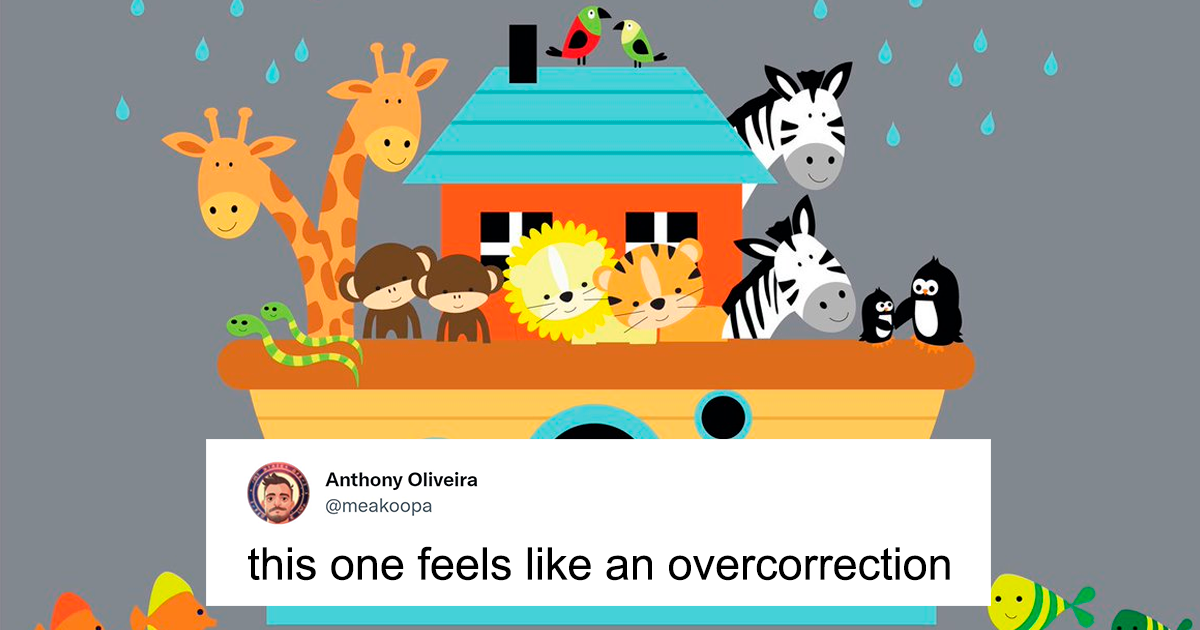
Noah’s Ark is supposed to be one of the simplest visual stories in the religious-storytelling toolbox: big boat, nervous bearded man, dramatic flood, rainbow finale, and animals entering two by two like the world’s most stressful school field trip. Yet a writer’s viral observation turned that familiar children’s-book scene into a surprisingly funny art-history scavenger hunt. The discovery? Many Noah’s Ark illustrations seem to show not a lion and a lioness, but two fully maned lions. In other words: gay lions on the ark.
The phrase “the error is systemic to the genre, it seems” became the perfect caption for the pattern. Once you notice it, you cannot unsee it. Board books, nursery murals, Sunday school posters, toys, puzzles, and cheerful rainbow-print illustrations often remember the male-female difference for chickens, cows, and sometimes elephants. But when the lions appear, both are frequently drawn with glorious, shampoo-commercial manes. If the purpose of the ark is species survival, the lion department may need a quick HR meeting.
Of course, the point is not that illustrators are secretly writing queer theology into toddler décoralthough, frankly, the mental image is delightful. The joke works because it sits at the intersection of Bible storytelling, children’s illustration, animal biology, and the internet’s unmatched talent for noticing tiny visual glitches. A mane is one of the most recognizable signs of a male lion, so two maned lions read as two males. That tiny detail transforms a familiar biblical scene into an accidental Pride parade with hooves, feathers, trunks, and at least one suspiciously fabulous pair of big cats.
How a Noah’s Ark Joke Became a Viral Cultural Moment
The observation is commonly associated with writer, critic, and scholar Anthony Oliveira, known online for combining literary analysis, queer cultural commentary, and a sense of humor sharp enough to cut through three layers of Sunday school felt board. While researching depictions of Noah’s flood and the ark, Oliveira noticed that many artists seemed to make the same mistake: the lions were not visually male and female. They were both male-coded.
The thread spread because it did what the best internet observations do: it made people laugh first, then made them think. The humor was simple. Genesis describes animals entering the ark in male-and-female pairs. Children’s illustrations are built around that “two by two” idea. But lions are one of the easiest animals for a casual viewer to sex visually because adult males typically have manes, while lionesses usually do not. So when an illustrator draws two lions with full manes, the image accidentally says, “Here come the husbands.”
That is not a small visual slip. It is a recurring one. And recurrence is where the joke grows legs, paws, and probably a tiny rainbow umbrella. One mistaken lion pair is funny. Ten mistaken lion pairs across books, toys, and murals become a genre convention. Suddenly, Noah’s Ark art is not just a cute religious image; it is a case study in how visual shortcuts, symbolic habits, and artistic assumptions travel from one illustrator to another.
Why the Lions Matter: The Biology Behind the Joke
The joke depends on basic lion biology. In most cases, adult male lions are identified by their manes, the thick hair surrounding the head, neck, and shoulders. Lionesses are usually mane-free, sleeker, and more often associated with hunting and communal cub-rearing in pride life. There are exceptions in nature, and biology loves exceptions because biology has never met a neat human category it did not want to politely ruin. Still, in mainstream illustration, a big mane is the standard visual shorthand for “male lion.”
That is why the Noah’s Ark lion mistake is so obvious. Artists often use animal features as quick labels. A rooster gets a comb. A peacock gets a grand tail. A bull gets horns. A male lion gets a mane. In children’s art, where images need to communicate instantly, these cues become exaggerated. The lion is not merely a lion; it is the lioniest lion possible. Golden fur, huge face, royal posture, dramatic mane. The problem arrives when the illustrator needs two lions and simply duplicates the iconic version.
In a way, the gay lions are born from branding. The male lion is the logo of lionhood. Ask someone to draw a lion from memory and many will draw a mane before they draw the body. Lionesses are biologically essential, socially fascinating, and often the main hunters, but in popular visual culture, the maned male lion gets the crown, the movie poster, the cereal box energy, and apparently both boarding passes for the ark.
The Biblical Detail: “Male and Female” Was the Assignment
The humor also works because the Noah story is so specific about pairs. In Genesis, Noah is instructed to bring living creatures into the ark to preserve them through the flood. The repeated cultural memory of the story is simple: animals come “two by two.” In many translations, the text emphasizes male and female animals. The ark is not just a floating zoo; it is a survival plan.
That makes the two-male-lion image comically inefficient from a literal reproduction standpoint. If every species is meant to repopulate after the flood, two male lions create a logistical problem. It is not impossible to imagine a more complex ecology, but that is probably not what the average board-book illustrator had in mind while choosing between soft watercolor and cheerful vector art.
Still, this is where the joke becomes more interesting than a simple “gotcha.” Noah’s Ark illustrations are rarely literal biological diagrams. They are symbolic images. They compress a dark, apocalyptic story into a child-friendly scene of animals, rainbows, and rescue. The flood narrative is heavy material: destruction, judgment, survival, loss, and renewal. Children’s versions soften it by focusing on the animals and the promise after the storm. In that softening process, accuracy often loses to cuteness.
Why Children’s Illustrations Keep Making the Same Mistake
1. The Iconic Animal Wins
Children’s art depends on instant recognition. A lioness may be more biologically accurate for a pair, but she can be mistaken for a large tan cat by a young viewer. A maned lion, on the other hand, announces itself from across the nursery. So illustrators reach for the most recognizable version twice. The result is two kings of the jungle, standing shoulder to shoulder, ready to repopulate the species through confidence alone.
2. Symmetry Looks Cute
Noah’s Ark scenes love symmetry. Two giraffes, two zebras, two elephants, two sheep. The animals are arranged like a cheerful checklist. When artists create paired compositions, they often mirror shapes for visual balance. A lion and lioness would create asymmetry. Two matching maned lions create a neat pair. The page looks tidy. The theology gets complicated. The lions look happily married.
3. Illustrators Borrow From Existing Visual Traditions
Artists often work within existing conventions. If earlier Noah’s Ark images showed two maned lions, later artists may repeat the formula without thinking deeply about it. That is how visual traditions spread. A small shortcut becomes a familiar pattern. A familiar pattern becomes “how Noah’s Ark looks.” Eventually, the gay lions are not a mistake in one picture; they are a recurring feature of the genre.
4. The Story Has Been Turned Into a Product Category
Noah’s Ark is not only a Bible story. It is a nursery theme, toy set, baby blanket pattern, puzzle, plush collection, wall decal, and gift item. Once a religious story becomes a product category, the visual language becomes even more simplified. Animals must be adorable. Colors must be gentle. The ark must look cozy instead of terrifying. The lion pair must be instantly lion-like. Accuracy quietly tiptoes off the boat.
Accidental Queerness in a Very Familiar Story
One reason the observation delighted so many people is that it found accidental queerness in a space often treated as rigidly traditional. Noah’s Ark art is usually associated with childhood, faith, innocence, and family-friendly religious teaching. The sudden realization that countless versions may contain same-sex animal pairs adds a playful twist. It does not mock faith itself. Instead, it shows how images can carry meanings their creators never intended.
This is especially funny because the rainbow is already central to Noah’s Ark imagery. In the biblical story, the rainbow appears as a sign of covenant after the flood. In modern culture, the rainbow is also a widely recognized symbol of LGBTQ+ pride. So when an ark illustration includes a rainbow above two male-coded lions, the internet naturally reacts with a knowing squint: “Are we sure this nursery wallpaper is not making a statement?”
The answer is probably no. Most of these images were likely created without any queer message in mind. But culture is full of accidental meanings. A symbol can belong to more than one story. A rainbow can be religious, meteorological, aesthetic, and queer all at once. Two lions can be an illustrator’s shortcut and a meme about gay animal couples. Meaning is not a locked box. It is more like a crowded boat in a storm: everyone brings baggage.
Same-Sex Animal Behavior Is Not Just an Internet Punchline
The Noah’s Ark lion joke also opens the door to a real biological topic: same-sex behavior in animals. Scientists have documented same-sex sexual behavior, pair bonding, courtship, parenting, and social affiliation in many species. Penguins are perhaps the internet’s favorite example, especially because several same-sex penguin pairs in zoos have successfully incubated eggs or raised chicks when given the opportunity.
One famous example is the story of Roy and Silo, two male chinstrap penguins at New York’s Central Park Zoo. Their pair bond inspired the children’s book And Tango Makes Three, which tells the story of two male penguins raising a chick. That book became beloved by many readers and repeatedly challenged by others, proving once again that nothing says “culture war” quite like a small bird family minding its own business.
Other examples include same-sex penguin pairs in zoos, female-female albatross pairs documented in research, and same-sex behaviors observed in primates, dolphins, giraffes, bonobos, insects, and many other animals. Scientists debate the functions of these behaviors, which may include bonding, social cohesion, practice, alliance-building, parenting opportunities, or other species-specific roles. The key point is simple: nature is far more varied than the tidy diagrams humans often make about it.
That does not mean we should turn every animal behavior into a direct lesson about human identity. Animals are not tiny people in costumes, no matter how persuasive a raccoon looks while stealing snacks. But it does mean the old claim that same-sex behavior is “unnatural” does not hold up well against observation. Nature contains abundance, variation, improvisation, and more plot twists than a streaming drama.
What the Gay Lions Reveal About Art, Assumptions, and Culture
The recurring maned-lion pair reveals how strongly humans rely on symbols. We draw not what we know, but what we recognize. A lion with a mane is more “lion” to the average viewer than a lioness, even though lionesses are equally lions and arguably do much of the pride’s practical work. The same thing happens across visual culture. We simplify, exaggerate, and repeat until the shortcut feels like truth.
That process can be harmless, funny, or revealing. In this case, it is all three. The gay lions are harmless because they are illustrations, not wildlife management plans. They are funny because the mistake is obvious once identified. They are revealing because they show how gendered visual cues shape even the most familiar images. The artists wanted “two lions.” Their mental library supplied “two male-looking lions.” The audience supplied laughter.
The joke also demonstrates how online cultural analysis can make old images feel new. Noah’s Ark has been illustrated countless times. Most viewers pass over the animals without inspection. But one careful observer asked, “Wait, are those both males?” That question turned a basic nursery image into a conversation about religious art, queer readings, biology, and children’s media. Not bad for a couple of cats who probably thought they were just there for the snacks.
Why This Story Works So Well for Readers
From an SEO and audience perspective, the topic has unusual staying power because it combines several irresistible elements. It has a famous Bible story, a funny visual mistake, a recognizable animal, a viral writer, a queer cultural angle, and a low-stakes controversy. Nobody needs a PhD to understand the punchline. Two manes equal two male lions. The ark assignment required male and female pairs. Whoops.
At the same time, readers who want more depth can find it. The topic can lead into conversations about visual literacy, LGBTQ+ representation, children’s books, scientific documentation of same-sex behavior in animals, and the way religious stories are softened for young audiences. That layered quality is what makes the story more than a meme. It is a small door into a larger room.
It also invites a generous kind of laughter. The funniest version of the joke is not “look how foolish religious art is.” It is “look how wonderfully human this mistake is.” Artists love shortcuts. Parents love cute animals. Children love big manes. The internet loves noticing patterns. And somewhere in the middle, two illustrated lions step proudly onto the ark like they registered early for the honeymoon suite.
Respecting Faith While Enjoying the Joke
Because Noah’s Ark is a religious story, it is worth handling the humor with care. People can laugh at a visual pattern without ridiculing believers. Religious art has always been interpreted, reinterpreted, stylized, simplified, and adapted to different audiences. Medieval artists dressed biblical figures like people from their own time. Renaissance painters gave sacred scenes local landscapes. Modern children’s books turn a catastrophic flood into a pastel animal parade. Interpretation is not new.
The gay lions simply add another layer of interpretationmostly accidental, but culturally lively. For some readers, the joke may feel like a harmless wink. For others, it may feel like a reminder that queer presence can appear even in places where it was not invited. For still others, it is just a funny animal drawing. All three readings can exist together without sinking the boat.
In fact, the best response may be curiosity. Why do we draw lions this way? Why do children’s stories simplify difficult material? Why do rainbows carry multiple meanings? Why does a tiny illustration error provoke such big reactions? Good cultural criticism often begins with a small detail and ends by showing how much that detail contains.
Experience Section: What the Noah’s Ark Lions Teach Us About Looking More Closely
There is a particular pleasure in discovering that a familiar image has been hiding a joke in plain sight. Many people grew up seeing Noah’s Ark on nursery walls, Sunday school worksheets, toy boxes, children’s Bibles, and cheerful wooden playsets. The image was so common that it almost became invisible. You saw the boat, the animals, the rainbow, and your brain filed it under “Bible story, cute version.” Nobody stopped to inspect the lions. Nobody asked whether the giraffes had packed enough leaves. Nobody questioned why predators and prey were standing together like they had just completed a corporate team-building retreat.
Then someone points out the manes, and the whole picture changes. That is the experience at the heart of this story: the sudden shift from passive viewing to active noticing. It is like realizing a background character in a movie has been doing something absurd for three scenes. The main plot remains the same, but your attention has been permanently rerouted. Every Noah’s Ark illustration becomes a tiny detective case. Are the lions both male? Are the peacocks both showing tails? Did the artist remember the cow but forget the lioness? Is that “female” lion just a maned lion with eyelashes, the ancient cartoon solution to gender?
This kind of noticing matters beyond the joke. Images teach us habits. Children learn from repeated visual patterns before they can explain them. If every “lion” looks male, children may unconsciously learn that the male version is the default version. If every family image looks one way, they may assume that is the only way families exist. If every story is softened until its hard edges disappear, they may miss the complexity that made the story powerful in the first place. A funny meme about gay lions can therefore become a reminder to look at the visual world more carefully.
There is also a joyful experience in seeing accidental inclusion. Many LGBTQ+ readers know what it feels like to search old stories for hints, subtext, echoes, and possibilities. Sometimes representation is explicit. Sometimes it is hidden. Sometimes it is accidental and wearing a mane. The Noah’s Ark lions are not a substitute for real queer stories, real queer characters, or honest conversations about identity. But they are a charming example of how culture can surprise us. Even in a highly traditional image, meaning can slip, stretch, and sparkle.
For parents, teachers, writers, and illustrators, the lesson is not “panic over every animal drawing.” The lesson is simpler and more useful: details matter. If you are telling a story visually, ask what your shortcuts communicate. If you are teaching children, invite questions instead of shutting them down. If a child asks why both lions have manes, you do not need to launch into a graduate seminar. You can say, “Good eye. Usually male lions have manes, so maybe the artist made a funny mistake.” That answer keeps the moment light while encouraging observation.
For readers, the experience is even easier: enjoy the joke, then keep looking. The world is full of tiny repeated assumptions. Some are silly. Some are serious. Some are sitting two by two under a rainbow, waiting for someone to notice.
Conclusion: The Ark Is Big Enough for the Joke
The viral observation about gay pairs of animals in Noah’s Ark illustrations works because it is funny, specific, and oddly revealing. It begins with a simple visual inconsistency: two maned lions where a lion and lioness might be expected. But from there, it opens into a wider conversation about children’s art, religious storytelling, animal biology, queer readings, and how cultural symbols take on lives of their own.
Noah’s Ark illustrations will probably continue to feature cheerful animals, impossible logistics, and rainbows bright enough to make a weather app jealous. Some artists will draw lionesses. Others will keep drawing two majestic maned lions, either by accident or because the tradition is already too strong. Either way, the internet has done what it does best: it has given us a tiny, hilarious lens through which to see a familiar story differently.
So the next time you pass a Noah’s Ark toy set or children’s mural, take a closer look at the lions. If they both have manes, smile. The ark may be crowded, the flood may be dramatic, and the theology may be ancientbut somewhere on deck, two lions are standing proudly beneath the rainbow, proving that even the oldest stories can still surprise us.