
Whether you are at a physical casino or exploring virtual gaming platforms, understanding the mathematics behind the action is the defining difference between a casual hobbyist and a prepared player. Many individuals view betting as a simple test of luck, but the most successful participants treat these activities as probability based betting games. By shifting your focus from intuition to cold, hard numbers, you can gain a much clearer picture of how various games actually function over the long term. From the mechanics of deck composition to the specific house edge on different table layouts, there is a tangible science to decision-making. In this guide, we will break down the essential concepts of casino mathematics, explore proven strategies for skill-based games, and provide the insights you need to refine your approach. For a broader look at how different games balance luck and tactical choices, you may want to review our guide on luck based casino challenges. Prepare to move beyond guessing and start playing with a clear strategic advantage.
1. The Mathematical Framework of Probability Based Betting Games
At its core, every casino game functions as a series of calculated risks governed by fixed mathematical principles. Understanding these mechanics is essential for any player looking to transition from casual entertainment to a more disciplined approach. Whether you are at a physical table or engaging with virtual options, the outcomes are not purely random; they are bound by laws of probability that dictate the long-term viability of every wager.
1.1 Deciphering the Core Mechanics of Casino Odds
Casino odds represent the relationship between the probability of a specific outcome occurring and the payout provided by the house. Every game is meticulously engineered to ensure that the mathematical reality favors the casino over time. By learning to calculate house edge, players can identify which games offer the most favorable conditions for their bankroll.
1.1.1 Calculating House Edge and Its Impact on Long-term Results
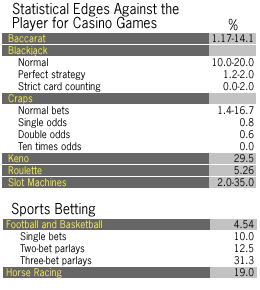
The house edge is the mathematical advantage built into every game, expressed as a percentage of the player’s initial bet. It is the reason why, in the long run, the house always makes a profit. For instance, in a standard game of American Roulette, the presence of both a 0 and a 00 space gives the house an edge of 5.26%. Players must understand that this edge applies to every spin or hand, making it a persistent tax on your capital that you must account for in your risk management gambling games strategy.
1.1.2 Understanding Return to Player Percentages
Return to Player (RTP) is the flip side of the house edge. If a game has an RTP of 96%, it theoretically returns 96 cents for every dollar wagered over millions of rounds. While high RTPs are desirable, they are long-term averages and do not guarantee results in short-term sessions. It is vital to view RTP as a measure of game efficiency rather than a promise of immediate success.
1.1.3 The Role of Variance and Volatility in Short-term Performance
Variance measures the gap between the theoretical RTP and the actual results you experience during a play session. A game with high volatility might offer massive, infrequent payouts, while low-volatility games provide steady, smaller wins. Understanding this balance is critical; it prevents the common mistake of assuming a “bad” losing streak signifies a broken game, when it is often just the expected result of high variance.
1.2 Strategic Analysis of High-Probability Casino Games
Moving from pure luck to skill-based play requires a deep dive into specific game mechanics. Some games allow players to influence the house edge through correct decision-making, while others are purely distributive.
1.2.1 Blackjack and the Implementation of Basic Strategy
Blackjack stands out because it allows for a reduction in the house edge through the use of a mathematically optimal “basic strategy.” By knowing exactly when to hit, stand, double down, or split based on your cards versus the dealer’s up-card, you narrow the statistical gap. Consistent application of this blackjack card strategy is the foundational requirement for any player aiming to minimize losses.
1.2.2 Baccarat Betting Dynamics for Banker and Player
Baccarat is often favored for its simplicity and low house edge, particularly when betting on the “Banker.” Because the Banker bet has slightly different winning probabilities due to the drawing rules, it remains the most mathematically sound wager. Smart players avoid the “Tie” bet, which, despite offering a higher payout, carries a significantly worse house advantage.
1.2.3 Roulette Probability Differences Between European and American Wheels
The distinction between European (single zero) and American (double zero) roulette is a primary lesson in probability. The European wheel lowers the house edge to roughly 2.7%, nearly half that of the American version. Choosing the right wheel is a simple but effective strategic decision that immediately improves your mathematical prospects.
1.2.4 Identifying High-Probability Bets in Craps
Craps can be intimidating, but it offers some of the best odds in the casino if you stick to specific bets. Wagers like “Pass Line” or “Come” bets carry a low house edge, while proposition bets in the center of the table typically have very poor odds. Focusing on these high-probability wagers allows for better table game strategy training, as it keeps your bankroll active longer.
1.2.5 Calculating Pot Odds and Expected Value in Poker
In poker, the game shifts to player-versus-player competition. Here, success is defined by Expected Value (EV)—the average amount a player expects to win or lose on a specific action. Calculating pot odds—the ratio of the current pot size to the cost of a call—helps determine if a play is mathematically profitable over the long term, moving the game from a gamble to a calculated exercise in risk assessment.
2. Advanced Strategic Frameworks and Risk Mitigation
2.1 Professional Betting Methods for Serious Players
Transitioning from a casual hobbyist to a serious player requires moving beyond intuition. Professional bettors treat probability based betting games as a portfolio management exercise, where the primary objective is to maximize long-term growth while minimizing the inevitable swings in variance.
2.1.1 Mastering Bankroll Management with the Kelly Criterion
Bankroll management is the most critical skill for any serious gambler. The Kelly Criterion is a mathematical formula used to determine the optimal size of a bet. By calculating the ratio of your edge to the odds offered, this strategy helps you grow your bankroll exponentially while theoretically preventing you from going bust. It is a rigorous approach that prevents over-betting, ensuring that you only stake a percentage of your funds that aligns with your calculated statistical advantage.
2.1.2 Identifying Positive Expected Value Scenarios
Success in betting comes down to finding situations where the probability of an outcome is higher than what the implied odds suggest. Identifying positive expected value (EV+) is the cornerstone of professional play. Whether you are analyzing a specific risk management gambling game or spotting a favorable card distribution in a game of skill, the goal remains the same: bet only when the math is in your favor. If a bet does not have a positive expectancy, the most strategic move is often to refrain from placing it entirely.
2.1.3 Calculating the Risk of Ruin Based on Edge Parameters
Even with a positive edge, a player can go broke if they are not careful. The “risk of ruin” refers to the probability of losing your entire bankroll before you can realize your long-term statistical advantage. By factoring in the size of your edge and the volatility of the game, you can determine how much of your total funds should be in play at any given time. Understanding this calculation allows you to adjust your stakes to ensure you remain in the game regardless of short-term losses.
2.2 Psychology and Common Pitfalls in Betting
Even the most mathematically sound strategy can fail if it is sabotaged by emotional decision-making. Recognizing the psychological traps inherent in casino environments is essential for maintaining discipline.
2.2.1 Why the Gambler’s Fallacy Misleads Players
The gambler’s fallacy is the erroneous belief that past events influence future outcomes in independent trials. Many players assume that after a long string of red in roulette, a black result is “due.” In reality, each spin is an independent event with fixed probabilities. Succumbing to this bias leads to poor betting decisions and often results in chasing losses, which is a fast track to draining your bankroll.
2.2.2 Deconstructing Betting Systems like Martingale
Many systems, such as the Martingale, promise guaranteed returns by doubling stakes after a loss. However, these systems ignore the reality of table limits and finite bankrolls. They are mathematically flawed because they risk significant capital for very small gains, failing to account for the reality of long losing streaks that inevitably occur in any betting environment.
2.2.3 Behavioral Biases that Override Mathematical Logic
Humans are naturally wired for patterns, which often clashes with the cold, hard math of probability. Confirmation bias—where we remember our wins while ignoring or rationalizing our losses—can create a false sense of skill. Maintaining a professional mindset requires auditing your decisions against the data rather than your emotional recollection of a session.
Mastering probability based betting games requires a fundamental shift in perspective: moving away from the allure of lucky streaks and toward a disciplined, data-driven approach. Throughout this guide, we have explored the critical importance of understanding house edge, Return to Player (RTP) percentages, and the necessity of rigorous risk management. Whether you are applying blackjack card strategy to gain a marginal advantage or utilizing advanced frameworks like the Kelly Criterion to protect your bankroll, success in the long run is defined by mathematics, not intuition.
Remember that the casino environment is specifically designed to exploit behavioral biases. By recognizing the dangers of the gambler’s fallacy and avoiding the false promises of negative progression betting systems, you position yourself as a more informed and controlled player. Ultimately, responsible gambling is about treating these games as a calculated exercise in probability rather than a source of reliable income. If you are looking to refine your approach further, you can explore our comprehensive guide on risk management gambling games to ensure your betting habits remain sustainable. Play with a clear head, stick to your pre-defined limits, and always prioritize the math over the momentum of the moment.

Pingback: Table Game Strategy Training: Master Casino Odds & Tactics - GameTurn