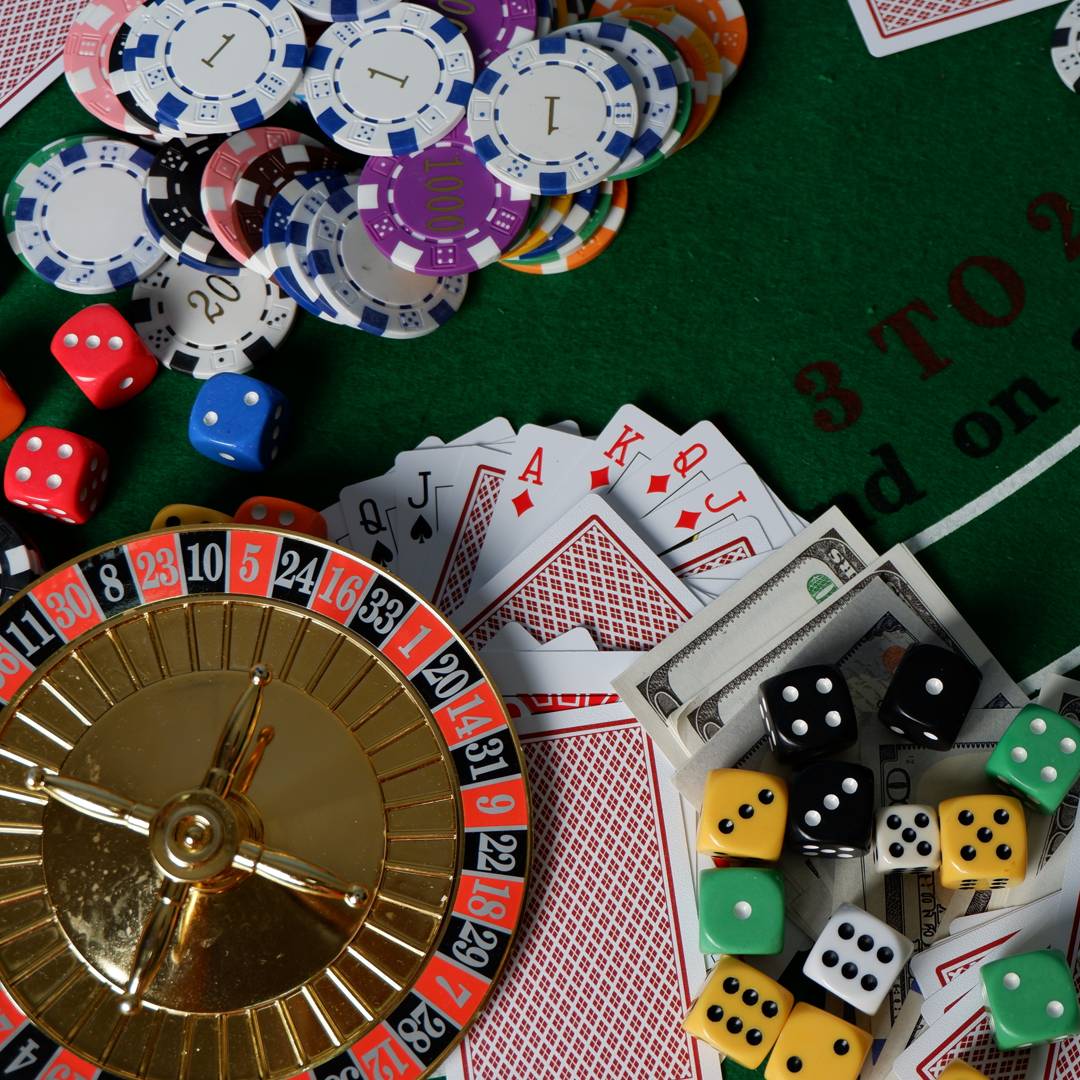
Stepping up to a casino table can be an intimidating experience, but true success in the pit rarely relies on luck alone. Comprehensive table game strategy training is the bridge between playing on impulse and making calculated, mathematically sound decisions. Whether you are aiming to refine your blackjack card strategy or looking to better understand the nuances of the house edge, learning how to analyze the game is your most powerful asset. This guide is designed to move you beyond basic intuition, providing the framework needed to recognize high-value opportunities and manage your bankroll with professional-grade precision. By mastering the fundamental logic behind probability based betting games, you will gain the clarity required to navigate short-term variance and improve your long-term results. We will break down how to categorize games by skill, utilize analytical tools, and implement the discipline necessary for consistent, informed gameplay in any casino environment.
1. Mastering Fundamentals and Mathematical Frameworks for Table Game Strategy Training
1.1 Deciphering the House Edge and Return to Player Metrics
1.1.1 Why independent events invalidate the Gambler’s Fallacy
To excel in probability based betting games, you must first discard the common myth known as the Gambler’s Fallacy. This is the false belief that if an event occurs more frequently than normal during a set period, it will happen less frequently in the future—or vice-versa. In reality, games like roulette or craps are composed of independent events; the wheel or the dice have no memory of previous outcomes. Each spin or roll is a fresh start, meaning your odds remain constant regardless of what happened previously. Understanding this independence is the foundation of sound logic in any casino environment.
1.1.2 Calculating expected value to identify high-RTP opportunities
Return to Player (RTP) and the House Edge are two sides of the same coin, representing the mathematical advantage the casino maintains over the long run. Expected Value (EV) is the key metric here: it measures the average amount a player can expect to win or lose per bet. A negative EV indicates an expected loss, while a positive EV—rare in casino games—would indicate a long-term profit. By analyzing the payout ratios against the actual probability of a win, you can identify games that offer the highest RTP, allowing you to maximize your bankroll longevity.
1.2 Categorizing Casino Games by Degree of Strategic Influence
1.2.1 Skill-based games where decision-making affects outcome probability
Not all casino games are equal in terms of player control. Games like blackjack are considered skill-based because your decisions—whether to hit, stand, double, or split—directly influence the probability of winning or losing a specific hand. Through rigorous table game strategy training, you can significantly lower the house edge by adhering to mathematically optimal plays.
1.2.2 Pure games of chance where optimal betting is the only strategy
Conversely, games like roulette or baccarat are largely governed by chance. In these scenarios, you cannot influence the outcome of the individual spin or deal. Your only real strategy lies in managing your bankroll and choosing wagers with the most favorable odds, such as sticking to even-money bets rather than high-risk, low-probability long shots.
1.3 Essential Tools for Analytical Gameplay
1.3.1 Utilizing basic strategy charts for blackjack optimization
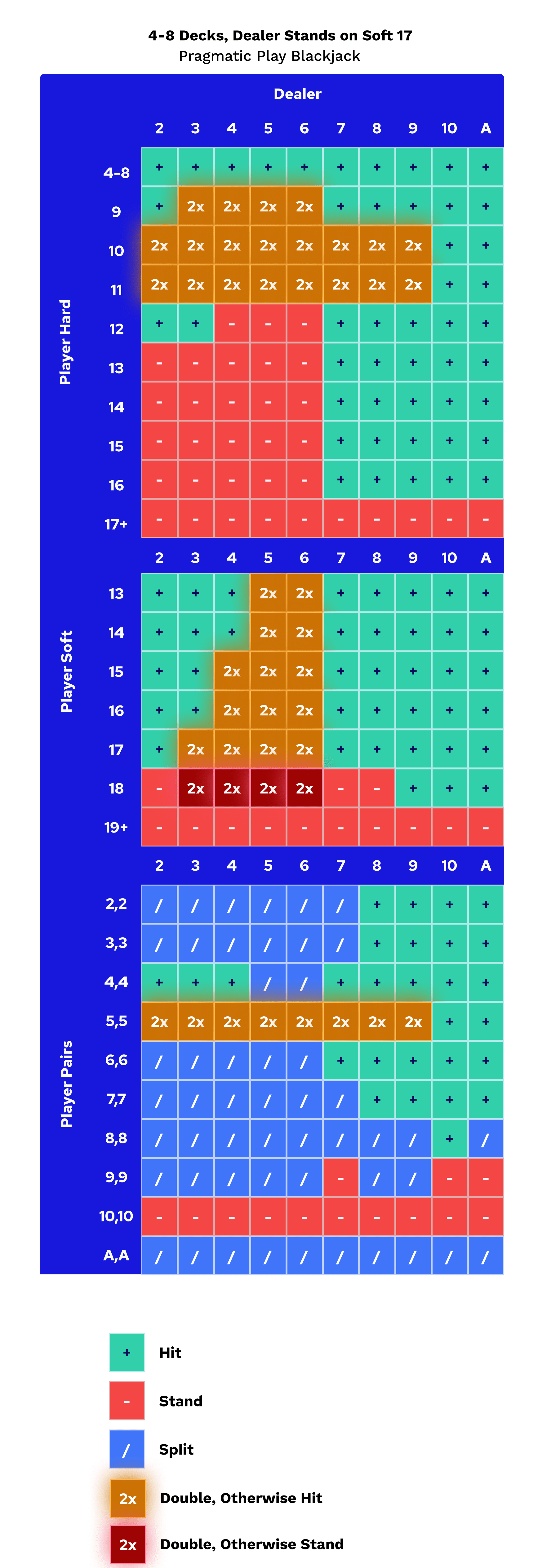
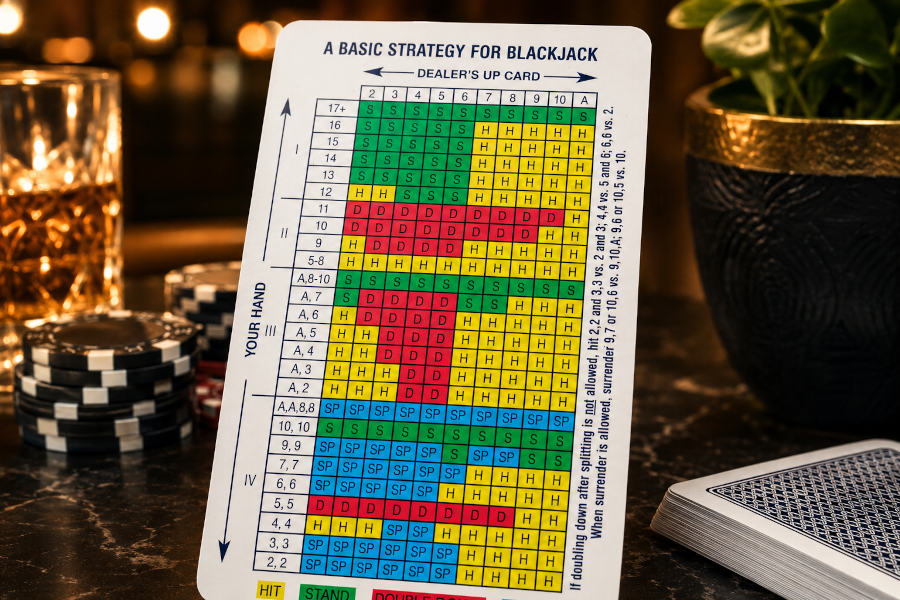
A blackjack card strategy chart is an essential tool for any player looking to reduce the house edge to its theoretical minimum. These charts provide a cheat sheet for every possible combination of your cards versus the dealer’s upcard. Consistent practice with a blackjack simulator allows you to commit these moves to muscle memory, ensuring you make the correct mathematical decision under pressure without hesitation.
1.3.2 Assessing game-specific rules such as deck counts and payout ratios
Small rule changes can drastically alter the math behind a game. For instance, a game that pays 3:2 for a blackjack is significantly more player-friendly than one paying 6:5. Similarly, fewer decks in play often improve your odds. Always audit the specific table rules before sitting down.
1.4 Managing Volatility and Variance in Short-Term Sessions
1.4.1 Understanding how standard deviation impacts bankroll swings
Volatility, or variance, describes the frequency and size of the fluctuations in your bankroll. Even with a perfect strategy, short-term luck can lead to significant swings. Understanding standard deviation helps you realize that losing streaks are a normal part of the game’s mathematical variance, not necessarily a failure of your strategy.
1.4.2 The necessity of large sample sizes to reach statistical expectancy
Because of this variance, long-term mathematical results only reveal themselves over large sample sizes. A single session of fifty hands is not enough to prove your strategy’s effectiveness. True risk management gambling games require a perspective that spans thousands of rounds, where the law of large numbers eventually aligns your actual results with the theoretical RTP.
2. Advanced Tactical Implementation and Professional Bankroll Management
2.1 Applying Disciplined Betting Systems to Extend Table Time
Mastering table game strategy training requires moving beyond simple hunches and toward disciplined, mathematical frameworks. Many novices are drawn to betting systems that promise to recover losses, but professional players know better. Understanding the mechanics of your wagers is essential for effective risk management in gambling games.
2.1.1 Identifying the limitations of negative progression systems like Martingale
Negative progression systems, such as the Martingale strategy, involve doubling your wager after every loss with the goal of recovering previous losses with a single win. While theoretically sound in a vacuum, these systems are fundamentally flawed due to table limits and the reality of finite bankrolls. A string of bad luck can quickly force you to exceed the table maximum or exhaust your funds, leading to catastrophic losses before the mathematical probability of a win can manifest.
2.1.2 Evaluating the stability of low-risk flat betting versus aggressive strategies
In contrast, flat betting—maintaining a consistent wager size regardless of previous outcomes—offers significantly more stability. While this approach does not provide the thrill of a rapid recovery, it effectively manages variance. By keeping your bet size steady, you ensure that you can survive natural downswings, allowing you to stay in the game long enough to benefit from the statistical edge provided by optimal strategy.
2.2 Psychological Discipline and Environmental Awareness
Success at the table is as much about managing your internal state as it is about knowing the odds. The casino environment is designed to induce fatigue and impulsive decision-making, which is why maintaining emotional neutrality is the hallmark of a seasoned player.
2.2.1 Maintaining emotional neutrality during losing streaks
Losing streaks are a statistical certainty, not a personal failing. When the game turns against you, the temptation to chase losses often leads to erratic betting. By practicing detachment, you ensure that your next move is dictated by logic and basic strategy, not by frustration or the desire to “get even” with the house.
2.2.2 The critical importance of pre-set stop-loss and profit-taking thresholds
Professional players treat their bankroll like a business budget. Before sitting down, define exactly how much you are willing to lose and, equally important, when you will walk away after a win. These pre-set boundaries prevent the “tilt” that follows a big win or the desperation that stems from a cold run.
2.3 Strategic Principles for Popular Casino Table Games
Every game carries a unique house edge that you can mitigate through proper execution. Whether you are using a blackjack simulator to practice or analyzing a craps table, your tactical choices determine your long-term outcome.
2.3.1 Blackjack protocols for splitting, doubling down, and hitting
Blackjack card strategy is the bedrock of low-house-edge play. Memorizing the basic strategy chart for your specific game—whether it involves single or multiple decks—is non-negotiable. Knowing precisely when to split pairs or double down based on the dealer’s up-card removes the guesswork and aligns your actions with the highest probability of winning.
2.3.2 Identifying the mathematical advantage of the Banker bet in Baccarat
Baccarat is often misunderstood, yet it offers some of the best odds in the house. The “Banker” bet consistently provides a lower house edge than the “Player” or “Tie” bets. Sticking exclusively to the Banker bet is the simplest and most effective strategy for casual and serious players alike.
2.3.3 Maximizing value in Craps through Pass Line and Odds wagers
Craps can be intimidating, but the most value is found in the simplest bets. By placing your wagers on the Pass Line and supplementing them with “Odds” bets, you take advantage of one of the few instances in the casino where the house has no additional edge on your supplemental wagers.
2.3.4 Roulette strategies for choosing between single-zero and double-zero tables
The difference between a European (single-zero) and American (double-zero) wheel is massive. A double-zero wheel significantly increases the house edge. Always seek out single-zero tables to ensure your probability-based betting remains as efficient as possible.
2.4 Financial Longevity through Systematic Bankroll Allocation
Without a structured approach to your finances, even the best strategy will eventually fail. Protecting your bankroll is the ultimate goal of table game strategy training.
2.4.1 Implementing the one-to-two percent risk rule per session
A standard rule for professional play is to never risk more than one to two percent of your total gambling bankroll in a single session. This buffer allows you to withstand multiple losing sessions without reaching a point where you feel pressured to play aggressively to recover.
2.4.2 Calculating session requirements based on table minimums and pace of play
Before you play, assess the table minimum in relation to your total funds. A game with a high minimum and a fast pace of play will deplete a small bankroll rapidly. Ensure your bankroll supports at least several hundred rounds of play to allow for standard statistical variance to balance out.
Mastering table game strategy training is not about chasing guaranteed wins, but rather about refining your decision-making process to minimize the house edge and maximize your control over the gaming experience. Throughout this guide, we have explored the essential mathematical frameworks that separate long-term players from those who rely solely on intuition. By understanding the distinction between skill-based games and pure games of chance, you are better equipped to apply objective logic rather than emotional reactions to every hand or roll.
The core of successful gameplay lies in combining rigorous bankroll management with the consistent application of optimal betting tactics. Whether you are refining your blackjack card strategy or identifying the nuances of probability based betting games, remember that consistency is the key to longevity. Practicing these principles through a dedicated blackjack simulator or similar training tools allows you to internalize complex rules before you ever place a wager at a real table. Ultimately, the best way to enjoy casino games is to treat them as a test of discipline and analytical skill. Stay within your pre-set limits, maintain your emotional neutrality, and continue to study the shifting odds so that you can play with confidence and purpose every time you step up to the table.