If you have ever found yourself captivated by the soothing rhythm of digital puzzles, you have likely encountered the unique challenge of a hexagonal tile jigsaw. Unlike traditional rectangular puzzles that rely on standard interlocking tabs, these geometric brain-teasers introduce a refreshing level of complexity that demands a new approach to spatial reasoning. Whether you are looking to unwind after a long day with some relaxing tile matching puzzles or you are determined to sharpen your cognitive skills, understanding the mechanics behind these six-sided shapes is the key to success.
In this guide, we will explore the nuances of assembling complex geometric patterns, from mastering the art of rotating piece jigsaw puzzles to refining your speed for timed jigsaw completion. By breaking down the anatomy of these pieces and adopting a more systematic assembly framework, you will transform your puzzle-solving experience from a series of guesses into a satisfying flow of logic and visual harmony. Let’s dive into the techniques that will help you conquer even the most intricate hexagonal layouts.

1. Mastering Hexagonal Tile Jigsaw Assembly Techniques

Approaching a hexagonal tile jigsaw requires a shift in how you visualize connections. Unlike traditional rectangular puzzles, these geometric patterns demand a more nuanced understanding of spatial orientation and piece interaction. By mastering these foundational techniques, you transform what could be a frustrating scramble into a smooth, rewarding process.
1.1 Understanding the Unique Geometry of Hexagonal Puzzles
1.1.1 Anatomical differences between hexagonal and rectangular interlocking tabs
Standard jigsaw puzzles rely on a four-sided grid, where pieces are generally aligned in rows and columns. In contrast, a hexagonal tile jigsaw utilizes a six-sided grid, which creates a non-linear flow. Because each piece has six potential connection points, the interlocking tabs often feature more complex curves to accommodate the angles. Recognizing this difference is the first step in successful assembly; you aren’t just looking for a top-and-bottom fit, but a radial alignment that can be trickier for the brain to process at first glance.
1.1.2 Identifying rotation variations and six-sided connection points
One of the most significant hurdles for beginners is the need for rotating piece jigsaw puzzles to find the correct orientation. Because each piece can technically fit into six different positions, you must pay close attention to the visual continuity of the image across the seams. If a piece appears to fit but creates a disjointed line or off-color junction, it likely needs to be rotated 60 degrees. Treating each piece as a flexible component rather than a fixed orientation will significantly speed up your progress.
1.2 Essential Preparation and Workspace Optimization
1.2.1 Selecting the ideal surface for sprawling geometric configurations
Geometric puzzles often expand in unexpected directions, unlike the uniform growth of a rectangular puzzle. Choose a large, flat surface that allows you to rotate your viewpoint. If you are playing a digital version, ensure your display settings allow for easy zooming and panning. If working physically, a non-slip felt mat is ideal, as it prevents the hexagonal tiles from sliding out of alignment during the delicate phases of connection.
1.2.2 Effective sorting methods for color gradients and repeating motifs
Because hexagonal tiles create dense, repeating patterns, traditional sorting by edge type is often ineffective. Instead, focus on color gradients and the specific density of the artwork on each tile. Separate pieces into distinct clusters based on color intensity or the orientation of the primary geometric pattern. This systematic approach reduces the cognitive load, allowing you to scan specific, manageable subsets rather than the entire pile.
1.3 Systematic Assembly Frameworks for Hexagonal Tile Jigsaw Projects
1.3.1 Establishing the perimeter and outer boundary first
While some modern geometric puzzles lack a clear border, most do provide a distinct edge. Begin by identifying all pieces with at least one flat, finished side. Connecting these first creates a rigid frame that provides the necessary context for the rest of the build. This boundary acts as a anchor, preventing the entire puzzle from shifting while you work on the more complex interior.
1.3.2 Building anchor clusters to stabilize the central field
Once your border is set, look for high-contrast areas or unique design elements to create “anchor clusters” in the center. Don’t worry about connecting these to the frame immediately; simply assemble these small islands of pieces. Once you have several sturdy clusters, you can bridge the gaps between them. This approach breaks the overwhelming field of tiles into smaller, more manageable sub-puzzles.
1.3.3 Navigating the transition from high-contrast sections to monochromatic zones
Every puzzle eventually hits the “monochromatic wall,” where the pieces all look suspiciously similar. Save these sections for last, once you have as many visual cues as possible from the surrounding completed areas. By using the surrounding pieces to dictate the required shape and angle, you can solve the most difficult, muted segments through a process of elimination rather than pure pattern matching.
2. Advanced Troubleshooting and Solving Strategies for Geometric Puzzles
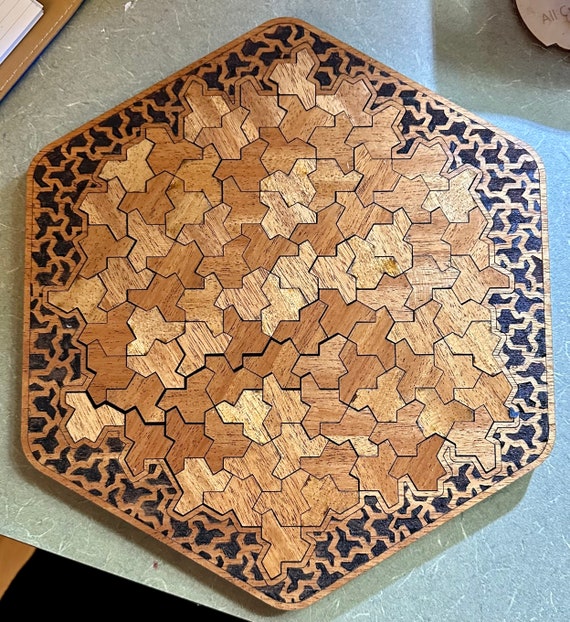
2.1 Refined Tactile and Visual Detection Methods
When you are deep into a complex hexagonal tile jigsaw, standard observation is often not enough. Because these puzzles rely on non-standard connection points, you need to sharpen your observational skills. One of the most effective tricks is utilizing directional lighting. By angling a desk lamp or flashlight across the surface of the puzzle, you create subtle shadows. These shadows highlight the indentation depth and the precise angle of the cut, allowing you to see if the edges of two pieces truly meet flush. If a connection looks “off,” the light will reveal a slight gap or a ridge that shouldn’t be there.
Beyond lighting, you must develop a tactile sensitivity to the “click” of a successful join. Unlike standard puzzles, rotating piece jigsaw puzzles require you to find the exact orientation among six potential sides. Instead of forcing a piece, gently rotate it against its neighbor. If you feel resistance or a “wobble,” it is likely a false fit. A perfect-fit connection will feel seamless and stable to the touch, often locking into place with a subtle shift in elevation that lets you know the geometric alignment is finally correct.
2.2 Resolving Common Hexagonal Tile Jigsaw Pitfalls
False positives are the most common frustration in geometric pattern jigsaw projects. Because of the repeating nature of these shapes, two pieces might look like they connect perfectly based on color, even if the cut is slightly different. If you find yourself unable to complete a surrounding area, stop and audit the pieces already in place. Often, a single incorrectly oriented tile at the base of a section creates a chain reaction of misalignment that only becomes obvious several rows later.
When you realize an error has occurred, do not be afraid to backtrack. It is tempting to try and force the remaining pieces into the gaps, but this rarely works with hexagonal geometry. Instead, clear a small radius around the suspect area. Re-evaluate the angle of the surrounding tiles and confirm the connection points. If the grid seems to “drift” or skew, it is a clear sign that a piece was forced into an incorrect orientation earlier in the process.
2.3 Mental Frameworks and Long-Term Project Management
Puzzles of this nature require intense focus, which can easily lead to “puzzle fatigue.” To maintain your efficiency, adopt a system of micro-sessions. Work in 30-to-45-minute bursts, then step away. Returning to the puzzle with fresh eyes often makes the next placement obvious, whereas staring for hours can blind you to simple patterns. For those interested in timed jigsaw completion, these breaks are essential to keep your brain agile and your pattern recognition sharp.
Finally, if you intend to preserve your work, consider the structural integrity of your assembly before applying any adhesive. Because hexagonal tiles have more connection points than square ones, they are prone to shifting. Gently slide a stiff sheet of cardboard or a specialized puzzle mat beneath the completed section before sealing. You can learn more about managing complex piece orientations in our guide to rotating block puzzles, which offers additional strategies for handling difficult piece rotations and spatial challenges.
Mastering the hexagonal tile jigsaw requires more than just patience; it demands a shift in perspective. By moving away from the traditional logic of rectangular pieces and embracing the unique rotational symmetry of six-sided tiles, you transform a potentially frustrating task into a deeply rewarding mental exercise. Whether you are tackling a complex geometric pattern jigsaw or simply looking for a way to unwind, the systematic approach of sorting by gradient, establishing a firm perimeter, and utilizing anchor clusters will significantly elevate your puzzle-solving efficiency. Remember that these challenges are meant to be an engaging hobby, so don’t hesitate to break your progress into manageable micro-sessions to keep your mind sharp and your motivation high.
As you continue to refine your skills, you will find that the tactile sensation of a perfect, satisfying fit becomes second nature. If you enjoy the challenge of spatial logic, you may want to explore other physics puzzle games to further sharpen your problem-solving abilities. Every completed puzzle is a testament to your focus and strategic thinking. Embrace the process, take pride in your progress, and enjoy the calming, meditative rhythm of turning a chaotic pile of tiles into a perfectly aligned masterpiece.