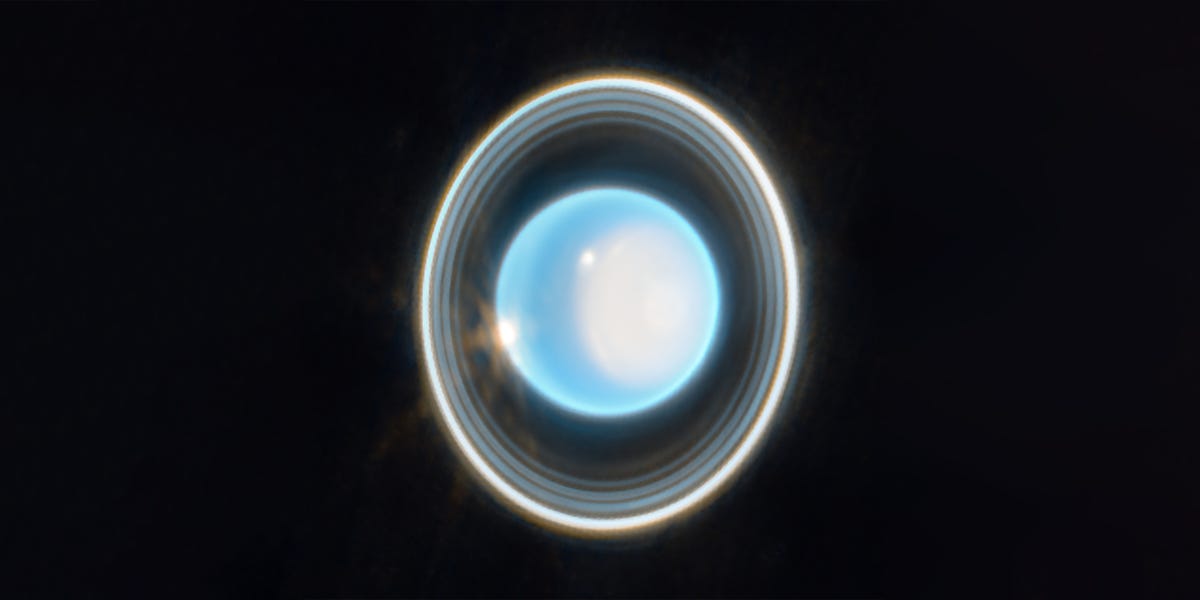

Uranus has spent decades fighting an unfair reputation. Voyager 2 photographed the distant planet in 1986, and the visible-light images made it look like a smooth blue-green marble with excellent posture problems. Then the James Webb Space Telescope looked at Uranus in infrared light and revealed what the ice giant had been hiding: delicate rings, bright storms, a glowing polar cap, numerous moons, and an atmosphere that is far more active than it first appears.
NASA released Webb’s enhanced Uranus images on December 18, 2023. The observations were made on September 4, 2023, using the telescope’s Near-Infrared Camera, better known as NIRCam. They expanded on an earlier two-filter image released in April 2023, giving astronomers a richer and more detailed portrait of the seventh planet from the Sun.
What the New James Webb Images of Uranus Reveal
The new James Webb Telescope images of Uranus include a dramatic close-up and a wider view of the surrounding planetary system. In the close-up, Uranus appears as a luminous blue world wrapped in a set of thin, nearly vertical-looking rings. A brilliant white region covers much of the pole facing the Sun, while bright cloud features appear near its edge.
The wide-field image pulls back to show moons, background stars, and distant galaxies. Uranus may be the celebrity in the foreground, but several galaxies quietly photobomb the scene from millions or billions of light-years away.
Among the most important details visible in the images are:
- The planet’s seasonal north polar cap
- A bright inner region within the polar cap
- A darker atmospheric lane at lower latitudes
- Several bright clouds associated with storm activity
- Faint inner and outer rings, including the elusive Zeta ring
- Small moons located close to or within the ring system
- Major moons and distant galaxies in the wide-field view
Photo 1: A Close-Up of Uranus and Its Rings
The close-up image is the showstopper. Uranus sits against the blackness of space while its rings form a graceful oval around the planet. Because Uranus rotates with an axial tilt of nearly 98 degrees, the ring system appears almost upright from our perspective rather than flat and horizontal like the familiar rings of Saturn.
Webb’s sensitivity makes the faintest structures particularly interesting. Uranus has 13 named rings, many of which are dark, narrow, dusty, and difficult to observe. The telescope captured both inner and outer parts of the system, including the Zeta ring, a faint and diffuse band located closest to the planet.
The bright ring near the outside of the system is much easier to spot. Some neighboring rings are so close together and so bright in the processed image that they appear to blend. It is less “one ring to rule them all” and more “several rings standing too close together for the group photo.”
Why the Zeta Ring Matters
The Zeta ring is scientifically valuable because it occupies the region closest to Uranus. Its structure can help researchers study how dust moves near the planet, how small moons influence ring material, and what hazards a future spacecraft might encounter while approaching the ice giant.
Detailed maps of faint rings are therefore more than beautiful wallpaper. They may eventually help engineers plan safer trajectories for a Uranus orbiter or atmospheric probe.
Photo 2: Uranus, Its Moons, and Background Galaxies
The wide-field Webb image places Uranus in a much larger cosmic setting. Fourteen of the 27 moons recognized at the time of the 2023 release can be identified in the expanded view. These include Oberon, Titania, Umbriel, Ariel, Miranda, Puck, Portia, Cressida, Bianca, Juliet, Desdemona, Belinda, Rosalind, and Perdita.
Some appear as tiny blue-white points close to the planet, while others sit farther away. The five major moonsMiranda, Ariel, Umbriel, Titania, and Oberonare especially important targets because they preserve clues about the formation and evolution of the Uranian system.
Farther in the background are fuzzy orange or pale shapes. These are not additional moons, lens smudges, or crumbs left by an astronomer eating near the controls. They are distant galaxies captured by Webb’s highly sensitive infrared instruments.
How Webb Created the Detailed Uranus Portrait
The enhanced image was assembled from observations taken through four NIRCam filters. These filters collected infrared light centered around wavelengths of approximately 1.4, 2.1, 3.0, and 4.6 microns. Image processors assigned visible colorsblue, cyan, yellow, and orangeto those invisible infrared measurements.
This means the portrait is a representative-color image rather than a literal view of what a nearby astronaut would see with human eyes. The color choices help scientists and the public distinguish structures recorded at different wavelengths.
| Webb Uranus Release | Observation Details | Key Improvements |
|---|---|---|
| April 2023 image | Observed February 6, 2023, with two NIRCam filters | Revealed bright clouds, the polar cap, six visible moons, and 11 prominent rings |
| December 2023 image | Observed September 4, 2023, with four NIRCam filters | Added wavelength coverage, clearer polar details, faint rings, storms, and more moons |
Why Infrared Light Changes the View
Uranus looks relatively smooth in visible light because atmospheric haze conceals many features. Methane in the atmosphere also absorbs red wavelengths, contributing to the planet’s familiar blue-green appearance.
Infrared observations tell a different story. Webb can detect differences in cloud altitude, haze, temperature, and atmospheric composition that visible-light cameras may miss. High-altitude clouds can reflect infrared sunlight before methane absorbs it, causing them to appear as bright spots.
The result is a planet that suddenly looks active rather than bland. Webb did not give Uranus new weather; it simply arrived with better glasses.
The Bright White Polar Cap Is Not Solid Ice
One of the most eye-catching features in the James Webb Uranus image is the bright white area covering the north pole. Unlike the icy polar caps of Earth or Mars, this feature is not a solid surface deposit. Uranus has no conventional solid surface on which an astronaut could stand.
Instead, the polar cap consists of atmospheric haze and clouds. The enhanced Webb data show a bright inner cap surrounded by a darker lane toward lower latitudes. Scientists believe sunlight and seasonal atmospheric circulation contribute to the development of this unusual feature.
Uranus takes approximately 84 Earth years to complete one orbit around the Sun. Each season therefore lasts about 21 years. For nearly a quarter of that long year, one pole receives continuous sunlight while the opposite hemisphere experiences an extraordinarily long winter night.
The northern pole is moving toward its summer solstice in 2028. As the pole receives increasing sunlight, astronomers expect its polar atmosphere to continue changing. Webb allows researchers to monitor how the brightness, clouds, aerosols, and storms evolve as solstice approaches.
Bright Storms Show That Uranus Is Surprisingly Active
Several bright features are visible near and below the southern boundary of the north polar cap. These are associated with clouds and storm systems in the planet’s atmosphere.
Researchers are studying whether the number and location of these storms are controlled mainly by changing seasons, short-term weather, or a combination of both. That distinction is difficult to make on Uranus because its seasons unfold over decades rather than months.
The atmosphere is composed primarily of hydrogen and helium, with smaller amounts of methane and traces of water and ammonia. Winds can reach hundreds of miles per hour. Beneath the upper atmosphere lies a hot, dense mixture of water, methane, and ammonia-rich fluids surrounding a comparatively small rocky core.
The term “ice giant” can therefore be misleading. Uranus is not a giant frozen snowball. In planetary science, the “ices” are volatile compounds that may exist as extremely hot, compressed fluids deep inside the planet. Space has a talent for making ordinary words complicated.
Webb Versus Voyager 2: Two Very Different Views
Voyager 2 remains the only spacecraft to have visited Uranus. It passed the planet in January 1986 and collected close-range measurements of the atmosphere, magnetic field, rings, and moons. Its cameras showed Uranus mainly in visible wavelengths, producing the famous image of a quiet blue-green globe.
The difference between Voyager’s portrait and Webb’s image does not mean one telescope was wrong. The instruments observed different wavelengths under different seasonal conditions. Voyager arrived when the southern pole was facing the Sun. Webb observed decades later as the northern pole moved toward summer.
Voyager provided the irreplaceable advantage of proximity. Webb provides exceptional infrared sensitivity, stable observations, and the ability to revisit Uranus repeatedly. Together with Hubble and large ground-based telescopes, the observatories create a long-term record of a planet whose weather changes more slowly than a television series that releases one season every 21 years.
Why Scientists Care About the New Uranus Images
The James Webb Telescope images are not merely attractive portraits. They provide data for several major areas of planetary research.
Understanding Extreme Seasons
Uranus has the most extreme axial tilt of any planet in the solar system. By tracking its clouds and polar haze, researchers can test models of how sunlight drives atmospheric circulation on a sideways world.
Studying Rings and Small Moons
The planet’s narrow rings interact gravitationally with nearby moons. Observing their shapes, brightness, and distribution can reveal how ring particles move and whether unseen moons may be shaping parts of the system.
Preparing for a Future Uranus Mission
Planetary scientists have strongly supported sending a dedicated orbiter and atmospheric probe to Uranus. Webb observations can help identify important targets, characterize environmental hazards, and refine the scientific questions such a mission should investigate.
Learning About Ice-Giant Exoplanets
Planets similar in size to Uranus and Neptune are common around other stars. Yet our own two ice giants remain poorly explored. Uranus acts as a nearby laboratory for understanding the atmosphere, weather, chemistry, and formation of distant worlds that appear as little more than points of light.
What the Images Still Cannot Tell Us
Even Webb cannot answer every question from photographs alone. Scientists still debate how Uranus acquired its extreme tilt, how its interior is layered, where it formed, how much heat escapes from inside, and how its rings and moons have changed over time.
Images reveal cloud patterns and ring structures, while spectroscopy measures how matter absorbs and emits light. Researchers must combine these observations with computer models, laboratory experiments, Hubble monitoring, ground-based data, and eventually measurements from another spacecraft.
That is the wonderful frustration of planetary science: every improved image solves a few mysteries and quietly places several new ones on the desk.
Conclusion: Uranus Is Finally Getting Its Close-Up
The new James Webb Telescope images transform Uranus from a nearly featureless blue dot into a complex planetary system. Faint rings encircle the planet, small moons travel through the system, storms brighten its atmosphere, and a seasonal polar cap reflects the dramatic effects of its sideways rotation.
Webb’s infrared vision has not replaced Voyager 2, Hubble, or ground-based observatories. It has added a powerful new layer to their work. As Uranus approaches its 2028 northern solstice, repeated observations could reveal how the polar cap and surrounding storms respond to increasing sunlight.
Saturn may still own the solar system’s most famous jewelry collection, but Uranus has officially stopped being shy about its rings.
A 500-Word Viewing Experience: How to Explore the Uranus Photos
The best way to experience the Webb images is to resist the urge to glance at them for three seconds and continue scrolling. Open the highest-resolution version available from an official space-agency gallery, enlarge it, and begin with the close-up. At first, Uranus may look like a bright blue ornament surrounded by white hoops. After a minute, smaller details begin to emerge.
Start with the planet’s orientation. The rings appear almost vertical, which immediately makes Uranus feel different from Saturn. Mentally rotate the image until the rings resemble Saturn’s familiar horizontal system. That simple exercise helps demonstrate just how dramatically Uranus is tilted.
Next, examine the white polar region. It is tempting to interpret it as a frozen surface, especially because “white pole” usually means snow or ice on Earth. Remember that you are looking at atmospheric haze and clouds above a world with no accessible solid ground. Search for the brighter center of the cap and the darker lane along its lower boundary. The contrast is subtle, but once recognized, it becomes difficult to ignore.
Move outward to the rings. The brighter rings are obvious, while the innermost bands require more patience. Lower your screen brightness if the central planet overwhelms the surrounding structures. On a well-calibrated display, the delicate Zeta ring may appear as a soft, ghostlike band close to the globe. Its faintness makes Webb’s achievement feel more impressive than the bold outer rings do.
Then switch to the wide-field image. Do not assume every point of light is a moon. The annotated version is useful because it separates members of the Uranian system from foreground stars and background galaxies. Compare the labeled and unlabeled versions. Try to locate Titania, Oberon, Ariel, Umbriel, and Miranda without assistance, then check your results. This turns the image into a small astronomy exercise rather than passive decoration.
The background galaxies provide perhaps the most humbling part of the experience. Uranus is approximately 1.8 billion miles from the Sun on average, yet the fuzzy galaxies behind it are vastly farther away. One image therefore contains several layers of distance: the telescope near the Sun-Earth L2 region, a planet in the outer solar system, moons orbiting that planet, stars within our galaxy, and galaxies far beyond the Milky Way.
Finally, compare Webb’s portrait with Voyager 2’s visible-light image from 1986. The comparison demonstrates why astronomers use multiple wavelengths. Voyager’s pale globe is not an inferior photograph, and Webb’s colorful image is not a conventional snapshot. Each observation records different physical information. Placed side by side, they show that a planet can appear calm in one part of the spectrum and wonderfully unruly in another.
This slower viewing process changes the image from “pretty space photo” into a record of seasons, chemistry, weather, orbital motion, and planetary history. It also makes Uranus seem less like a remote blue ball and more like an active destination waiting for its next robotic visitor.
Research verification: NASA Science and mission releases, Webb Telescope/STScI materials, ESA/Webb, JPL Night Sky Network, Smithsonian Magazine, Smithsonian National Air and Space Museum, Scientific American, Space.com, Sky & Telescope, Astronomy Magazine, and The Planetary Society.