
Spoiler warning: This article discusses important scenes from the 1973 film.
More than half a century after its release, The Exorcist still has an impressive ability to make viewers reconsider every creak in the hallway. William Friedkin’s adaptation of William Peter Blatty’s novel was more than a successful horror movie. It became a cultural event, a box-office phenomenon, an awards-season landmark, and possibly the worst advertisement for pea soup ever created.
Behind the film’s unsettling images is an equally fascinating production history involving real priests, freezing sets, mechanical puppets, an Iraqi location shoot, disputed credits, and enough accidents to inspire rumors of a curse. These 25 fascinating facts about The Exorcist explain how an unusual Hollywood production became one of the most influential classic horror films ever made.
The Story, Casting, and Creative Vision
1. The story was inspired by a reported 1949 exorcism
Blatty’s novel drew inspiration from newspaper reports about a 14-year-old Maryland boy who underwent Catholic exorcism rituals in 1949. The historical case remains disputed, and later investigators proposed psychological and behavioral explanations. Therefore, describing The Exorcist as inspired by reports of a real case is more accurate than calling every supernatural event “true.”
2. Blatty discovered the case while attending Georgetown
William Peter Blatty was studying at Georgetown University when he read coverage of the alleged possession. The setting stayed with him, eventually becoming the sophisticated Washington, D.C., neighborhood where Regan MacNeil’s ordinary home life collides with something distinctly unordinary. Blatty also changed the subject from a boy to a girl when fictionalizing the story.
3. The novel became a major bestseller
Published in 1971, Blatty’s novel rose to the top of bestseller lists and remained a national sensation. Its popularity gave Warner Bros. a valuable property, but adapting it presented an obvious challenge: How do you make demonic possession believable without producing two hours of theatrical fog, thunder, and actors shouting at the furniture?
4. Blatty wrote and produced the movie
Blatty did not simply sell his book and wave goodbye from the parking lot. He adapted the screenplay and served as a producer, helping protect the story’s religious and emotional foundations. His screenplay later won the Academy Award for Best Adapted Screenplay, one of the movie’s two Oscar victories.
5. Friedkin did not approach it as a conventional horror film
William Friedkin repeatedly said that he had not set out to make a horror movie. He treated the material as a serious story about faith, doubt, family, and unexplained suffering. His preference for documentary-style realism made the hospital tests, domestic conversations, and quiet Georgetown streets nearly as important as the supernatural fireworks.
6. The Exorcist was Linda Blair’s film debut
Linda Blair was 13 when production began, and Regan became her first motion-picture role. Her agents had not initially put her forward, but her mother helped bring her to the filmmakers’ attention. Blair’s mother, Elinore, also appears briefly in the finished movie as a nurse, creating a tiny family cameo amid the chaos.
7. Max von Sydow was much younger than Father Merrin
Max von Sydow was only in his early 40s when he played the elderly Father Lankester Merrin. Makeup artist Dick Smith aged him by several decades using subtle prosthetics, stippling, shading, and detailed hand makeup. The transformation was so convincing that many viewers assumed von Sydow was already an older actor.
8. Jason Miller made his movie debut as Father Karras
Jason Miller was an accomplished stage actor and the Pulitzer Prize-winning playwright behind That Championship Season, but The Exorcist was his first film. His restrained performance as a priest struggling with grief and lost faith earned him an Academy Award nomination for Best Supporting Actor.
9. A real Jesuit priest played Father Dyer
Father William O’Malley, a Jesuit priest, teacher, and author, portrayed Father Joseph Dyer and also advised the production. Other clergy members, including Fathers John Nicola and Thomas Bermingham, provided technical guidance. Their involvement helped the movie present Catholic language, clothing, rituals, and institutional procedures with unusual specificity.
Behind-the-Scenes Facts About The Exorcist
10. Production lasted far longer than expected
Principal photography was originally planned as a comparatively short shoot, but technical difficulties, injuries, location work, and Friedkin’s demanding methods pushed production far beyond its schedule. Filming stretched across much of a year, while the budget climbed to roughly $12 milliona substantial amount for an early-1970s supernatural drama.
11. Hundreds of Georgetown community members became extras
Approximately 300 Georgetown students, faculty members, staff, and seminarians participated as extras. Familiar campus locationsincluding Healy Hall, Dahlgren Chapel, the Quadrangle, Old North, and the university’s athletic groundsgave the film a lived-in quality that would have been difficult to reproduce on a studio backlot.
12. The famous Exorcist Steps required cinematic trickery
The steep Georgetown staircase contains roughly 75 steps and has become a tourist attraction. Because the real house was set back from the stairs, the production built a false extension to make Regan’s bedroom appear directly above them. Rubber padding was added for the stunt fall, although the descent still looks like gravity filed a personal complaint.
13. The opening sequence was filmed in Iraq
Friedkin shot Father Merrin’s archaeological scenes in Iraq, including areas around Mosul and ancient Hatra. Because the United States lacked normal diplomatic relations with Iraq, the filmmakers negotiated directly with the ruling government. The agreement reportedly required the production to employ and train Iraqi crew members, including lessons in creating theatrical blood.
14. Regan’s bedroom was refrigerated below freezing
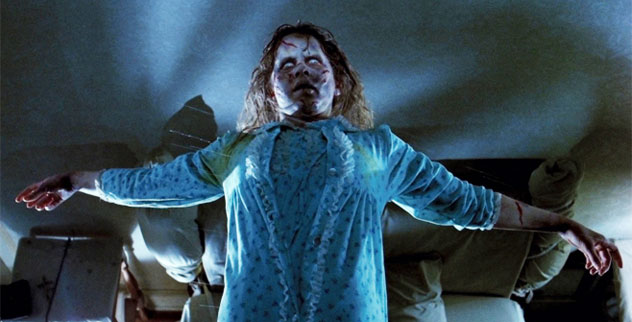
Visible breath during the exorcism was not painted onto the screen later. A powerful air-conditioning system chilled the bedroom set to below-freezing temperatures. When the lights warmed the room and the actors’ breath disappeared, filming stopped until the temperature dropped again. Those clouds are real breathand probably real annoyance.
15. A major set fire delayed filming
A fire damaged the New York soundstage containing the MacNeil house interiors, forcing parts of the set to be rebuilt and delaying production. Other setbacks included illnesses, family emergencies, and injuries. Ellen Burstyn hurt her back while being pulled by a harness during one violent bedroom scene and later said the injury had lasting effects.
16. Regan’s green vomit was pea soup
The movie’s most notorious culinary contribution was made with pea soup. Special-effects tubes ran along the performer’s face and beneath a wig, allowing the mixture to shoot outward on cue. Temperature and consistency had to be carefully controlled. It was a complicated mechanism devoted entirely to ruining Father Karras’s shirtand countless future lunches.
17. Mercedes McCambridge created the demon’s voice
Academy Award-winning actress Mercedes McCambridge supplied the demon’s guttural voice. She used physically intense vocal techniques and reportedly experimented with cigarettes, alcohol, raw eggs, and chewed apple to achieve certain sounds. McCambridge was absent from the original onscreen credits, protested publicly, and was subsequently acknowledged in advertising and later versions.
18. The sound design used animals and ordinary objects
The supernatural noises were frequently built from natural recordings instead of electronic effects. Sound artists incorporated dogs, pigs, a trapped bee, scratching sounds, and human vocalizations. Layered together, these familiar noises became difficult to identify, proving that a pig can be terrifying when removed from the reassuring context of a county fair.
19. The rotating head was a mechanical duplicate
Regan’s infamous head turn relied on a detailed mechanical figure created from Linda Blair’s likeness. Makeup artist Dick Smith and the effects team constructed a controllable head and body capable of movements no human neck should attempt. The physical presence of the puppet helped the scene retain its weight and unsettling texture decades before digital effects.
20. Friedkin inserted extremely brief demonic images
The pale “demon face” that flashes through the movie came from makeup tests performed on Blair’s double, Eileen Dietz. Friedkin later explained that certain appearances lasted only two or three frames. Viewers could register the interruption without fully processing it, creating the uncomfortable sensation that their own eyes had become unreliable employees.
21. The spider-walk scene was removed and later restored
A contortionist performed the sequence in which Regan descends the stairs in a backbend. Friedkin omitted it from the original theatrical cut partly because the supporting wires were visible and because the moment arrived too early in the narrative. Digital wire removal allowed a revised version to appear in the extended 2000 release.
22. “Tubular Bells” was not written for the film
Composer Lalo Schifrin initially worked on music for The Exorcist, but Friedkin rejected the proposed score and assembled the soundtrack from existing compositions. A brief passage from Mike Oldfield’s “Tubular Bells” became permanently associated with the movie, even though it occupies far less screen time than many people remember.
Release, Reception, and Cultural Legacy
23. Its R rating generated controversy
The Motion Picture Association gave The Exorcist an R rather than an X rating, technically allowing minors to attend with an adult. Critics argued that the disturbing subject matter made the classification too permissive. Washington authorities went further, warning at least one theater against admitting anyone younger than 17.
24. Audience reactions became part of the marketing legend
Reports described moviegoers fainting, becoming nauseated, leaving screenings, and seeking medical attention. Some theaters distributed souvenir vomit bags or kept staff prepared for distressed patrons. Individual stories were undoubtedly amplified by publicity, but contemporary reporting confirms that intense reactions occurred. The audience supplied a second show, apparently without receiving billing.
25. It shattered both box-office and awards expectations
Released on December 26, 1973, The Exorcist grew into a worldwide commercial phenomenon and remained the top-grossing horror movie for decades. It became the first horror film nominated for the Academy Award for Best Picture, earning 10 nominations and winning two. In 2010, the Library of Congress added it to the National Film Registry.
Experiencing The Exorcist Today
Choose the right version for a first viewing
Watching The Exorcist for the first time can feel strangely different from encountering a modern horror movie. Viewers accustomed to immediate jump scares may initially wonder when the supernatural chaos is going to arrive. The original theatrical cut is generally the best starting point because its careful pacing and selective use of effects preserve the film’s ambiguity. The extended version is worth exploring afterward for restored material such as the spider walk and additional character moments.
This is also a film that benefits from focused viewing. Put the phone away, lower the lights, and use a sound system or good headphones if possible. The soundtrack contains subtle movements, distant noises, changes in room tone, and stretches of near-silence. Watching while scrolling through messages turns its carefully engineered dread into background decorationwhich is a little like visiting a haunted house while completing a spreadsheet.
Notice how long the movie resists a supernatural explanation
One of the most memorable parts of the experience is how seriously the story examines medical and psychological possibilities. Regan undergoes invasive diagnostic procedures before anyone accepts exorcism as an option. The hospital sequences can be more upsetting than the supernatural scenes because their equipment, clinical lighting, and physical discomfort feel completely real.
On a second viewing, watch Ellen Burstyn’s performance rather than concentrating exclusively on Regan. Chris MacNeil begins as a confident, successful parent and gradually becomes exhausted, isolated, and desperate. The emotional center of the story is not simply a battle between priests and a demon; it is a mother trying every available method to help her child. That human foundation is a major reason the horror remains effective.
Watch with friends, but avoid turning it into a contest
A group screening can produce an excellent discussion because people interpret the film through different beliefs. One viewer may see a religious drama, another may see a story about parental helplessness, and another may focus on Father Karras’s grief and crisis of faith. Nervous laughter is normal. Pretending not to be frightened while gripping a couch cushion like emergency equipment is also normal.
The movie contains intense medical imagery, disturbing language, violence, and sexualized behavior involving a possessed child. New viewers should check appropriate content guidance before arranging a family movie night. “It won two Oscars” is not, by itself, a complete parental advisory.
Visit the Georgetown locations respectfully
For fans traveling to Washington, D.C., the Exorcist Steps at 36th and Prospect Streets offer a tangible connection to the production. The staircase is open to the public and is used by tourists, residents, and determined exercisers. Nearby streets and Georgetown University architecture still evoke the film’s cold, autumnal atmosphere.
Remember that the famous house is a private residence and Georgetown is an active neighborhood and university community. Admire locations from public areas, avoid blocking entrances, and resist reenacting Father Karras’s fall. The original stunt involved padding, professional coordination, and editing; your vacation insurance probably involves considerably less enthusiasm.
Let the film settle before judging whether it was scary
The Exorcist does not always produce an immediate, roller-coaster reaction. Its power may emerge later, when a bedroom suddenly seems colder or an ordinary attic noise becomes suspicious. The movie’s most lasting question is not whether a particular special effect looks frightening. It is what a person would do when medicine, reason, authority, and faith all appear inadequate.
That uncomfortable uncertainty explains why the film remains a rewarding experience even for viewers who do not believe in possession. Its practical effects are ingenious, but its deepest horror comes from watching reasonable people confront something they cannot classify. Few movies have made doubt feel so frighteningor made a quiet Georgetown bedroom feel so far from safety.
Conclusion
These fascinating facts about The Exorcist reveal a production shaped by serious artistic ambition, difficult working conditions, innovative practical effects, and occasional behind-the-scenes turmoil. William Friedkin and William Peter Blatty made the supernatural feel plausible by surrounding it with recognizable family problems, medical procedures, institutional rules, and genuine human grief.
The result did more than frighten 1973 audiences. It changed the commercial possibilities of horror, earned unprecedented Academy recognition, influenced generations of possession movies, and turned an ordinary staircase into a cinematic landmark. Its head may spin, but its legacy has remained remarkably steady.