
Summer is easy to recognize and surprisingly hard to photograph well. Point a camera at a beach, add a sun flare, and you may have a pleasant vacation snapshot. Creating an image that feels like summereven to someone sitting beneath fluorescent office lights in Februaryis a much taller order.
This selection of 20 award-winning photographs from the 2024 Tokyo International Foto Awards, or TIFA, succeeds because it treats summer as more than a season. Here, summer is saturated blue, a child’s shadow inside a burst of water, a surfer facing a moving wall, a crowded seaside economy, and a cat quietly guarding a Moroccan doorway. TIFA recognizes photographers from around the world across professional, amateur, student, fine-art, editorial, nature, people, architecture, and special categories. This is a themed cross-section of recognized work rather than a ranking of the competition’s overall winners.
Why These TIFA 2024 Photos Feel Like Summer
The strongest summer photography does not merely record warm weather. It translates sensory memory. Hard light draws sharp shadows. Water becomes both setting and character. Crowds form colorful patterns from the air. Festivals turn streets into stages. Even waiting feels different beside a lake when the day appears to have nowhere urgent to go.
These photographs also show why visual storytelling depends on more than technical perfection. Light sets mood, composition directs attention, and color creates emotional temperature. Bright tones suggest energy; cool blues can create calm, distance, or mystery. A memorable photograph gives viewers enough information to enter the scene while leaving enough unsaid for imagination to finish the trip.
20 Award-Winning Summer Photos From the 2024 Tokyo International Foto Awards
1. “Cat at the Door” by Glenn Goldman
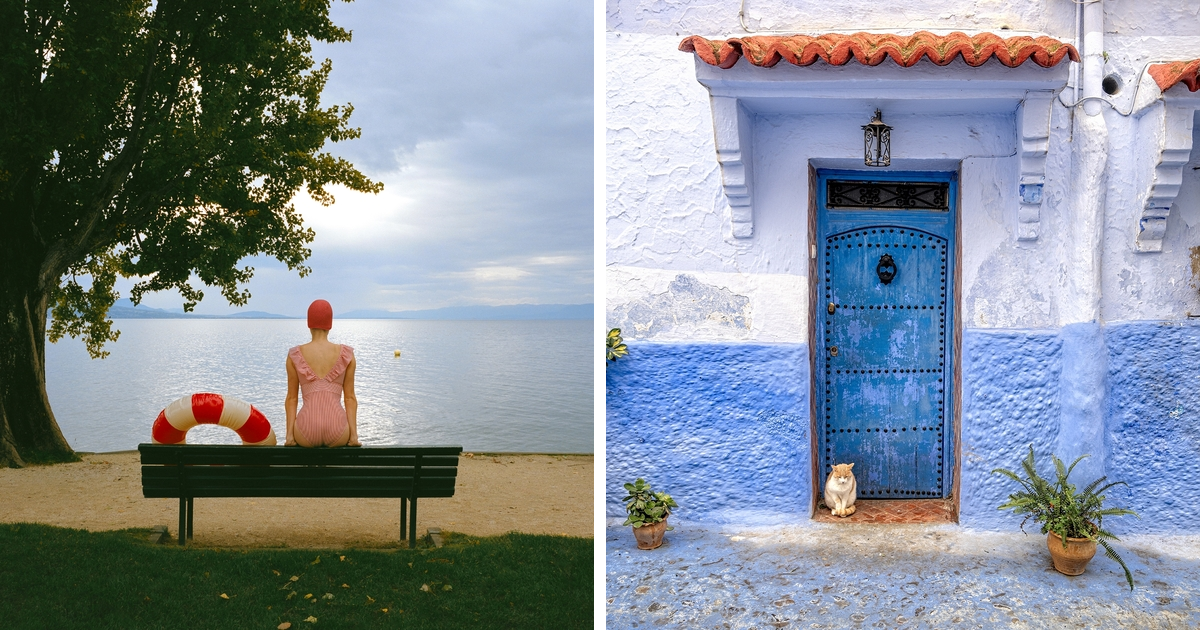
Bronze winner in Advertising/Travel/Tourism, “Cat at the Door” finds its charm in Chefchaouen, Morocco. A cat, a doorway, and a quiet street become the kind of travel memory no itinerary can schedule. The scene feels intimate rather than grand, proving that a small neighborhood encounter can outlast the monument you walked miles to see. The cat, naturally, appears to be in charge of visitor permits.
2. “Threads of Tradition” by Chris Ha
Chris Ha’s Silver-winning aerial image transforms a Vietnamese fishing net into a field of emerald texture. A worker in a conical hat anchors the composition, bringing labor and craftsmanship into the abstract pattern. From above, an ordinary repair becomes landscape, cultural record, and visual rhythm at once.
3. “In the Stillness of Waiting” by Renzo Cicillini
Photographed at Lake Geneva in Switzerland, this Gold-winning analog fine-art image makes waiting feel less like delay and more like permission to breathe. Summer is not always surfboards and cannonballs. Sometimes it is a quiet pause beside water, when the horizon slows the clock and the journey’s in-between moment becomes the destination.
4. “A Kind of Blue Series 2” by Roland Blum
Blum’s Silver-winning abstract series looks down on Indian Ocean archipelagos, revealing reefs, sandbanks, and currents in turquoise, cyan, indigo, and sapphire. The ocean resembles a monumental painting made by geology. Its beauty also carries a warning: warming seas can stress and bleach coral ecosystems, making these luminous environments increasingly fragile.
5. “Ocean Companions” by Fiona Basile
A person and a dog share the sea in Basile’s Silver-winning Nature/Pets photograph. The rising light and their shared pause turn a vast ocean into an intimate story about trust and companionship. Anyone who has taken a dog near water will also appreciate the rare calm before the inevitable full-body shake beside the clean towels.
6. “Venetian Dawn” by Giovanna Arnaud Fleming
From Venice’s Accademia Bridge, “Venetian Dawn” watches the Grand Canal wake beneath soft morning color, with Santa Maria della Salute in the distance. The Bronze-winning architectural photograph chooses transition over spectacle. Dawn smooths the water and gives the city a brief sense of privacysummer travel without elbows, rolling suitcases, or a gelato emergency.
7. “Titans” by Brigitte Bourger
Gold winner and first place in Events, “Titans” focuses on surfing at Teahupo’o in French Polynesia, the site of the July 2024 Olympic surfing competition. The wave is not decorative scenery; it is opponent, arena, and moving architecture. Bourger makes elite surfing look like both athletic performance and negotiation with a liquid mountain.
8. “Kayak Patterns” by Ngar Shun Victor Wong
Before training begins in Sai Kung, Hong Kong, stacked kayaks form a bright aerial mosaic. Wong’s Gold-winning drone image finds excitement in preparation. Everything is still, yet the frame feels ready to launch. The boats resemble a box of crayons organized by someone far more disciplined than the average beachgoer.
9. “Beach Life” by Simon Heather
“Beach Life,” a Gold winner and first-place image in the Special category, turns shorelines in Italy, Britain, Hawaii, and Portugal into aerial tapestries. Umbrellas, swimmers, towels, and paths become design elements from above; closer inspection reveals hundreds of tiny human stories. The series shows that a beach is never one experience but many vacations happening side by side.
10. “Water Frenzy” by Oded Perry
In this Bronze-winning children’s photograph, sunlight sharpens silhouettes as water erupts around playing kids. The frame practically supplies its own soundtrack: squeals, splashes, running feet, and one adult saying, “Please stop spraying me,” while standing beside the spray. Perry preserves the unselfconscious joy adults spend years trying to recover.
11. “Temple Fairs” by Yu Ling Ho
Yu Ling Ho’s Gold-winning culture photograph presents Taiwan’s temple fairs as expressions of faith, regional identity, community, and local economic life. Color, motion, costume, ritual, and crowds turn public space into a stage. The deeper story is that celebration is not just entertainment; it is a social structure that keeps shared traditions visible and alive.
12. “Grockles” by Paul Carruthers
“Grockles” complicates the sunny postcard. The Gold-winning street-photography project examines tourism in seaside towns on England’s south coast, where visitors bring income but also intensify housing, water, displacement, and seasonal-work pressures. Carruthers keeps the beach fun in view while asking who carries the cost after vacationers leave.
13. “Presence/Absence” by Francesco Pace Rizzi
Rizzi’s Bronze-winning fine-art work uses shadows to make an off-frame subject feel present. Strong summer light writes temporary geometry across walls and pavement, turning absence into evidence. The result is playful and mysterious, reminding us that the most interesting character in a photograph may be the one the camera refuses to show directly.
14. “Children’s Happiness” by Olessya Mikhailova
This Silver-winning photograph was not staged. Mikhailova captured her young son enjoying a warm pool, sunshine, and his mother’s nearby presence. Its simplicity is the point. Childhood summer happiness rarely needs luxury: warm water, safety, and permission to play can be enoughbefore adulthood adds notifications and opinions about pool maintenance.
15. “Searching for Light” by Andre Magarao
Magarao’s Gold-winning editorial sports project treats action photography as collaboration among athlete, setting, timing, and illumination. Golden-hour light may be ideal, but athletes do not always consult the sun, so carefully placed flashes help shape the scene. The images reveal how much preparation can hide behind a moment that appears spontaneous.
16. “Flying Through Childhood” by Lena Sokolova
Sokolova’s Silver-winning image uses flight as a metaphor for how quickly childhood passes. School vacations once felt endless; in memory, they compress into bright fragmentsbare feet, late sunsets, scraped knees, a bicycle in the grass. Childhood seems to soar precisely because nobody can persuade it to hover.
17. “Curved Line” by Jose Antoine Costa
“Curved Line,” a Silver winner in Fine Art/Minimalism, fragments architecture until the familiar becomes abstract. Costa lets angle, harmony, and atmosphere do the work. The lesson is useful: when everyone else photographs the whole building, the more memorable image may be the single curve they walked past.
18. “Surf Life Saving” by Andrea Francolini
Francolini’s Bronze-winning sports photograph shifts attention from recreation to responsibility. Australian surf lifesaving competitions test rescue skills, strength, judgment, and teamwork while reinforcing the role of clubs that protect coastal communities. Ocean fun depends on knowledge, vigilance, and people trained to react when a carefree afternoon suddenly is not.
19. “Woman Is Like the Sea” by Monika Maroziene
Gold winner and first place in Fine Art, Maroziene’s portrait connects a woman with the sea: powerful, calm, dangerous, fragile, giving, and impossible to reduce to one mood. The image rejects the idea that summer must be lighthearted. Water can symbolize freedom, but also uncertainty, depth, and emotional force.
20. “Cup Island” by Devin Depamphilis
“Cup Island” ends the collection with a wink. The Gold-winning macro photograph combines food, miniature figures, and a beach scene built from candy. A familiar treat becomes a tiny vacation world. No ocean or airfare was requiredonly close observation, careful staging, and the question of what miniature tourists might do with chocolate and peanut butter.
What These Award-Winning Summer Images Teach Us
Summer Is a Behavior, Not a Filter
Several images contain expected ingredientswater, beaches, sunlightbut their real subject is behavior. People wait, work, worship, rescue, compete, travel, and play. A blue sky may establish the season; human intention gives the photograph a story.
Perspective Can Turn Familiar Scenes Into New Worlds
The aerial works reorganize reality. Nets become waves of fabric, kayaks become pattern, and crowded beaches become social maps. Macro photography performs the reverse trick in “Cup Island,” enlarging a tiny construction until it feels geographical. Change the camera’s position and the ordinary may stop behaving ordinarily.
Great Summer Photography Allows Complexity
The best images do not insist that summer is perfect. “Grockles” introduces housing and labor tensions. “A Kind of Blue Series 2” pairs beauty with ecological vulnerability. “Surf Life Saving” places duty behind leisure. Strong visual storytelling can hold delight and concern in the same frame without flattening either one.
An Experiential Guide: Learning to See Summer Like an Award-Winning Photographer
A rewarding way to experience this collection is to stop asking, “Which picture is prettiest?” and ask, “What makes this image feel alive?” Spend a minute with each photograph before reading its title or award category. Notice where your eye lands first, what pulls it next, and whether the frame feels loud, quiet, playful, tense, or reflective. That exercise separates subject matter from visual construction. A wave is not automatically dramatic, a child is not automatically joyful, and a sunset is not automatically meaningful. The photographer still has to organize the evidence.
Then take the same approach outside. Choose one summer day and photograph it in three chapters. In the morning, look for softness: empty streets, early swimmers, reflections, workers setting up, or sunlight entering a room. At midday, do not hide from harsh light. Use it for graphic shadows, bright walls, silhouettes, sparkling water, and saturated color. Late in the day, focus on interactionfamilies packing up, athletes taking one more run, friends sharing food, vendors closing stalls, or pets refusing to leave the shore.
Limit yourself to one lens or a phone camera. The restriction prevents gear from becoming an excuse and encourages movement. Step higher, crouch lower, move closer, and turn around after taking the obvious shot. The winning images repeatedly prove that perspective matters as much as destination. A beach at ground level is a crowd; from above, it becomes pattern. A piece of candy is a snack; through a macro lens, it becomes an island with excellent dessert-based real estate.
Look for transitions rather than only peak action. The second before a child enters the water may contain more anticipation than the splash. Stacked kayaks can suggest a day of movement before anyone launches. A lifeguard preparing equipment may tell a richer story than a generic action frame. Waiting, setting up, resting, and leaving are visually fertile because people are less likely to perform for the camera.
Photograph respectfully. At festivals, workplaces, and culturally significant sites, a compelling composition does not erase responsibility. Avoid manufacturing behavior, misrepresenting context, or treating tradition as decorative novelty. Ethical visual storytelling requires accuracy, dignity, and enough context to prevent a beautiful image from becoming a misleading one.
At day’s end, select five frames: one for light, one for color, one for motion, one for human connection, and one surprise. The surprise may be strongest because it escaped the plan. That is the most useful lesson in this TIFA selection: prepare carefully, observe patiently, and leave room for the world to improvise.
Conclusion
These 20 photographs capture summer without reducing it to sunshine and leisure. They show the season as color, labor, danger, ritual, memory, community, environmental fragility, and imaginative play. From a monumental wave in French Polynesia to a miniature candy island, scale changes constantly, but the principle remains steady: a memorable image does more than show where the camera was. It reveals why the moment mattered.
The 2024 Tokyo International Foto Awards selection also proves that summer has no single visual language. It can whisper at Lake Geneva, roar at Teahupo’o, shimmer over Venice, crowd an English resort town, or fit inside a macro frame. The season is not merely in the temperature. It is in the light, the behavior, and the fleeting feeling that the day might last forevereven though every photographer knows it will not.
Editorial note: Award titles, photographers, locations, categories, and project context are based on published 2024 TIFA records and the themed 20-image selection. All critical interpretation and explanatory commentary are original.