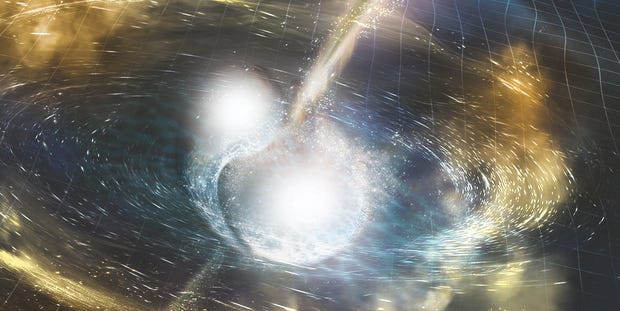

Black holes are famous for being terrible at customer service. They do not glow, they do not wave, and they definitely do not send postcards. For a long time, that made them frustrating cosmic neighbors: dramatic in theory, invisible in practice. Then gravitational-wave astronomy showed up like the universe’s most sensitive eavesdropping device and changed the whole mood. Suddenly, scientists were no longer stuck guessing what black holes were doing in the dark. They could listen.
That is what makes the discovery behind Found: Four New Gravitational Wave Events From Colliding Black Holes such a big deal. Researchers working with LIGO and Virgo announced four additional signals from black hole mergersnamed GW170729, GW170809, GW170818, and GW170823expanding the young catalog of gravitational-wave detections and giving astronomers a much richer sample of cosmic collisions to study. In plain English: the universe coughed up four more receipts proving that black holes collide, merge, and shake spacetime hard enough for us to notice from Earth.
This was not just another round of “science confirms space is weird.” These new events helped shift gravitational-wave research from the age of firsts into the age of patterns. Instead of marveling at one extraordinary signal, astronomers could begin asking deeper questions: How massive are these black holes? How often do they merge? Are there limits on how big stellar black holes can be? And what can all of this tell us about how massive stars live, die, and leave behind some of the most extreme objects in the universe?
Why These Four Discoveries Mattered So Much
The four newly reported events came from data collected during LIGO and Virgo’s early observing runs, when the field of gravitational-wave astronomy was still moving from historic breakthrough to serious census-taking. The first direct detection of gravitational waves in 2015 had already confirmed Einstein’s prediction that violent cosmic motion can send ripples through spacetime. But once the novelty wore off, scientists needed more than one spectacular success story. They needed a population.
That is where these four black hole mergers became invaluable. Together, they pushed the confirmed total at the time to 11 gravitational-wave detections: 10 from binary black hole mergers and one from a neutron star merger. That growing sample gave researchers enough information to move beyond isolated headlines and start doing astrophysics with statistics. Space, in other words, stopped being a one-hit wonder.
Each event added something useful. One helped establish how massive black hole pairs can get. Another showed how well a global detector network can locate a source on the sky. Together, the full set helped researchers refine estimates of merger rates, source masses, and the broader black hole population. The signal was clear: black hole collisions were not rare curiosities. They were becoming a regular feature of the observable universe.
Meet the Four New Events
GW170729: The Heavyweight Champion
If gravitational-wave discoveries had a trophy shelf, GW170729 would have been flexing in front of it. At the time of its announcement, it stood out as the most massive and most distant gravitational-wave source yet observed. This event involved two hefty black holes spiraling together and merging into a remnant black hole more massive than 80 suns.
What made GW170729 especially dramatic was the amount of energy involved. Nearly five solar masses’ worth of mass was converted into gravitational radiation during the merger. That sentence deserves a second look. Imagine turning several Suns entirely into pure spacetime ripples and then detecting the aftermath from billions of light-years away. If that sounds rude, loud, and deeply unbothered by the limits of human imagination, that is because it was.
GW170729 also mattered because extreme systems force theorists to sharpen their models. Large masses and powerful signals provide better leverage for testing whether our understanding of black hole formation is complete. Events like this raise questions about whether some black holes are born directly from collapsing stars or whether some might themselves be the products of earlier mergers.
GW170809 and GW170823: Quietly Important
Not every discovery arrives wearing a crown. GW170809 and GW170823 did not grab quite as much attention as GW170729, but they were still essential additions to the catalog. In science, “another good data point” can be more valuable than “one flashy outlier,” especially in a field trying to figure out how common certain kinds of systems really are.
These events reinforced the emerging view that binary black hole mergers are a genuine population, not a handful of cosmic oddballs. They helped fill in the mass range of detected systems and made the catalog more robust. When astronomers estimate how often black holes merge or what masses are most common, they do not do it by staring lovingly at one famous event. They do it by building a sample. GW170809 and GW170823 helped build that sample.
That kind of contribution may sound modest, but it is actually the backbone of good astrophysics. A field matures when discoveries stop being isolated miracles and start becoming comparable data. These two events helped gravitational-wave astronomy grow up.
GW170818: The Sky Map Star
GW170818 earned its fame in a different way: localization. Because it was detected by the global network formed by the two LIGO detectors and Virgo, scientists could pinpoint its location on the sky far more precisely than usual for a black hole merger. That matters because localization is the difference between saying, “Something happened somewhere out there,” and saying, “It happened over there, in that patch.”
At the time, GW170818 became the second-best localized gravitational-wave source after the famous neutron star merger GW170817. Its source region was narrowed down to just 39 square degrees, and the system was estimated to be about 2.5 billion light-years away. For black hole mergerswhich typically do not produce visible lightbetter localization still improves confidence, calibration, and follow-up strategies. It is also proof that a multi-detector network is not just helpful; it is transformative.
How LIGO and Virgo Actually Pull This Off
The technology behind these discoveries is so precise it almost sounds fake. LIGO operates twin observatories in Livingston, Louisiana, and Hanford, Washington, while Virgo adds a third major detector in Europe. These facilities use giant L-shaped interferometers, where laser beams travel down long perpendicular arms, bounce off mirrors, and return for comparison.
When a gravitational wave passes through Earth, it slightly stretches space in one direction and squeezes it in another. The change is tinyridiculously tinybut not zero. By measuring tiny differences in laser travel time, researchers can infer that spacetime itself has wobbled. It is essentially the world’s fanciest way of noticing that the ruler changed length while you were using it.
This setup is powerful for two reasons. First, it makes direct gravitational-wave detection possible. Second, using multiple detectors allows scientists to compare arrival times and signal patterns, which improves confidence and source localization. One detector can whisper, “I heard something.” A network can say, “Yes, and here is roughly where it came from.”
What These Mergers Taught Us About Black Holes
The four additional events did more than boost the scoreboard. They helped reveal that LIGO and Virgo were uncovering a population of black holes larger than those commonly known from earlier X-ray observations. That alone was important. Black holes detected through gravitational waves were not merely repeating the story astronomers already knew. They were expanding it.
Researchers also began inferring broader population properties. One striking conclusion at the time was that almost all stellar black holes in these merger samples appeared to weigh less than about 45 times the mass of the Sun. That hinted at a possible upper boundary tied to stellar evolution, especially the physics of pair-instability supernovae, which may prevent certain stars from leaving behind black holes in a specific mass range.
In other words, gravitational-wave astronomy was not just spotting black holes. It was exposing the fingerprints of how stars explode, collapse, and fail. Every merger became both an event and a clue.
From Singular Discovery to Catalog Science
One of the most important shifts triggered by these four events was psychological as much as scientific. The first gravitational-wave detection felt like a moon landing moment. The next phase felt more like the opening of a new observatory era. With GWTC-1, the first catalog of compact binary mergers from the first two observing runs, gravitational-wave research started looking less like a lucky breakthrough and more like a working branch of astronomy.
That matters because astronomy advances through accumulation. The more events scientists detect, the better they can estimate merger rates, test general relativity in extreme conditions, identify unusual systems, and compare theory with reality. The early catalog suggested roughly one gravitational-wave detection every 15 days of searched data in those runs. That was already fast enough to tell the field that the future would be busy.
And busy it became. Later observing campaigns, detector upgrades, and the broader LIGO-Virgo-KAGRA network pushed the field from dozens of detections into the hundreds. Recent catalog updates show an increasingly diverse zoo of systems, including heavier binaries, more asymmetric pairs, and unusually spinning black holes. So while these four events were once “new,” their deeper significance is that they helped launch the era in which gravitational-wave discoveries became a sustained stream rather than a rare surprise.
Why This Discovery Still Feels Fresh
Some science stories age into trivia. This one aged into infrastructure. The announcement of four new black hole mergers marked an early turning point in how astronomers think about the invisible universe. Before, black holes were mostly studied by their effects on nearby matter or light. After gravitational-wave catalogs began to grow, black holes could be studied through motion itselfthrough the way they warp spacetime during their final dance.
That shift changes the tone of the whole field. We are no longer just looking for black holes that happen to light up their surroundings. We are listening for black holes that would otherwise remain completely hidden. That gives astrophysics a new sensory organ, one tuned to violence, gravity, and deep cosmic history.
And there is something wonderfully humbling about that. These signals were created when black holes spiraled together far away, long before anyone on Earth had lasers capable of measuring distortions smaller than an atomic nucleus. Yet the ripples arrived anyway, like a message sent across the universe on a medium older than language: motion itself.
What Comes Next for Gravitational-Wave Astronomy
The big picture is clear. Better detector sensitivity means more detections, richer catalogs, and sharper tests of physics. Scientists now expect gravitational-wave observations to keep improving our understanding of black hole populations, stellar death, neutron star matter, and perhaps even the expansion history of the universe. The more events we observe, the less the universe gets to keep its secrets.
Future instruments and upgrades should improve reach, frequency, and precision. That means more chances to catch rare mergers, more accurate source measurements, and more opportunities for multimessenger astronomy when light-based telescopes can join the party. Black hole mergers will remain central because they are common, powerful, and detectable across enormous distances.
So yes, four new gravitational-wave events from colliding black holes is an excellent headline. But it is also something more enduring: a chapter in the story of how humanity learned to hear the dark.
Experiences Related to “Found: Four New Gravitational Wave Events From Colliding Black Holes”
One reason this topic connects with readers so strongly is that it creates a rare kind of science experience: the feeling of being both tiny and newly capable. You read about two black holes colliding billions of light-years away, and your first response is often laughter mixed with awe. Not because it is funny in a joke-book way, but because the scale is so absurd it almost becomes comedic. Two invisible monsters crash together in total darkness, shake the fabric of reality, and a group of humans on one small planet says, “Hold on, our lasers noticed.” That emotional whiplash is part of the magic.
For students, this story often becomes a gateway experience. A person may not remember every detail of orbital decay or interferometry, but they remember the feeling of learning that space can be “heard” as well as seen. It changes science from a stack of facts into a live process of discovery. Suddenly, Einstein is not just a chapter heading, black holes are not just a movie poster, and physics is not just equations doing push-ups on a whiteboard. It becomes a living investigation with suspense, teamwork, instrumentation, software, and triumph.
For casual readers, the experience is slightly different but just as powerful. The discovery scratches a very human itch: we want proof that the universe is still capable of surprising us. In a world where many headlines feel recycled, gravitational-wave astronomy still delivers a healthy sense of cosmic plot twist. The idea that black holes can collide without producing light, yet still announce themselves through ripples in spacetime, feels like a reminder that reality is under no obligation to be boring or intuitive. Frankly, that is refreshing.
There is also an emotional experience tied to the patience of the science itself. These signals traveled for billions of years before reaching Earth. The collisions happened long before human civilization built observatories, wrote textbooks, or learned how to spell “interferometer” without checking twice. And yet the information survived. That creates a strange, beautiful sense of continuity. The universe has been sending messages the whole time. We simply grew into the ability to receive them.
Even for people far outside astrophysics, stories like this can inspire a more personal reflection. You do not need to understand every statistical model to appreciate what the discovery represents: careful work, long collaboration, and the payoff of curiosity. It is a reminder that some truths arrive quietly. They do not explode onto the screen in bright colors. Sometimes they appear as tiny distortions in a laser beam, extracted from noise by people who believed the signal was there before anyone else could hear it. That is a deeply human experiencepart stubbornness, part imagination, part wonder.
And maybe that is the lasting experience of this topic: not just that four black hole mergers were found, but that we live in an era when such findings are possible. The universe is still wild, still dark, still full of collisions we will never witness with our eyes. But we have learned enough, built enough, and listened carefully enough to catch the tremor. That is not just good science. That is one of the coolest things our species has ever done.
Conclusion
The discovery of four new gravitational wave events from colliding black holes was more than a satisfying addition to a growing list. It helped move gravitational-wave astronomy from breakthrough to discipline, from isolated marvel to catalog-driven science. With GW170729, GW170809, GW170818, and GW170823, researchers gained sharper insight into black hole masses, merger rates, detector performance, and the structure of the hidden universe.
Today, with gravitational-wave catalogs growing rapidly, those four events look even more important in hindsight. They were early evidence that black hole mergers were not rare cosmic drama but a rich and ongoing population waiting to be measured. The universe was making noise all along. We finally learned how to listen.