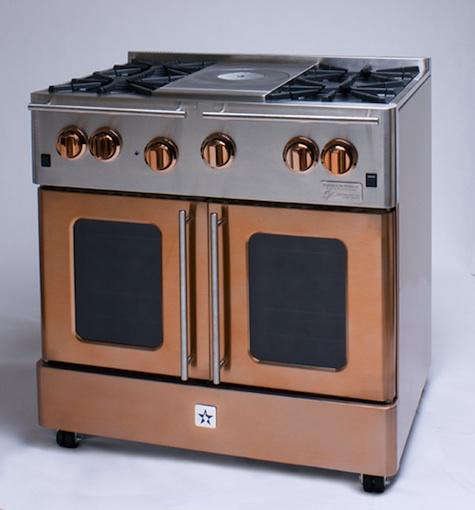

Some celebrity collaborations amount to a famous name printed on an ordinary product and a price tag that suddenly needs its own financial adviseg> were different. Created through a collaboration between American appliance manufacturer BlueStar and award-winning chef Marcus Samuelsson, the limited-edition collection combined serious restaurant-style cooking power with finishes bold enough to make stainless steel look slightly underdressed.
Introduced in 2010, the collection was designed for ambitious home cooks who wanted professional-range performance without turning their kitchens into joyless stainless-steel laboratories. It offered high-output burners, configurable cooking surfaces, oversized ovens, distinctive French doors, chef-selected colors, and even personalized nameplates. Production was limited to 200 ranges during the launch year, making the line as much a piece of culinary design history as an appliance collection.
A Celebrity-Chef Range With a Genuine Point of View
Marcus Samuelsson was an especially logical partner for a range built around power, flexibility, and personality. Born in Ethiopia, raised in Sweden, and established professionally in New York, Samuelsson developed a cooking style shaped by several culinary traditions rather than a single rigid rulebook. His career has included acclaimed restaurants, television work, cookbooks, community projects, and numerous James Beard Foundation honors.
That multicultural background matters because the Inspired by Marcus range was not merely designed for baking casseroles and boiling spaghetti. Its configurations supported searing, simmering, griddling, wok cooking, slow cooking, and direct grilling. In other words, it was intended for cooks whose weekly menu might travel from Swedish meatballs to Ethiopian stews, American fried chicken, seafood, vegetables, and late-night pancakes without asking permission.
Samuelsson described the range as a tool for helping home cooks create their own culinary experiences. That phrase captures the project well. The appliance was not meant to automate cooking or protect users from every possible decision. It provided heat, space, control, and configuration choices, then expected the cook to take it from there.
How the Inspired by Marcus Collection Began
BlueStar announced the collaboration in April 2010. The company already had a long manufacturing history in Pennsylvania, tracing its roots to Prizer-Painter Stove Works, which began producing residential and commercial cooking and heating equipment in Reading in 1880. BlueStar later applied that commercial-appliance experience to professional-style residential ranges.
The Marcus Samuelsson collaboration took those established principles and gave them a more contemporary identity. BlueStar’s archival announcement emphasized additional burner power, custom cooktop arrangements, an extra-large oven, rounded body panels, comfortable handles, French doors, matching knobs and trim, and six previously unavailable finishes selected by Samuelsson. Each unit also carried an Inspired by Marcus signature plate engraved with the customer’s name. It was a serious cooking machine wearing a tailored suit.
The line was offered in 30-inch and 36-inch widths. Those sizes made it possible to install a chef-oriented range in kitchens that could not accommodate the enormous 48- and 60-inch appliances seen in restaurant-inspired showrooms. The 30-inch version offered concentrated performance in a familiar footprint, while the 36-inch model created room for specialized cooking surfaces.
The Performance Features That Made It Special
High-Output Open Burners
The standard 30-inch Inspired by Marcus range included two 22,000-BTU burners, one 18,000-BTU burner, and a dedicated simmer burner. The standard 36-inch version used two 22,000-BTU burners, one 18,000-BTU burner, a simmer burner, and a 12-inch specialty cooking surface. Buyers choosing the all-burner 36-inch configuration could receive three 22,000-BTU burners, two 18,000-BTU burners, and one simmer burner.
Those figures were impressive for a residential appliance in 2010. More importantly, the different outputs gave cooks options. A powerful burner can bring a stockpot to a boil quickly, heat a wok, or create the intense pan temperature needed for a deeply browned steak. A gentler burner is better for melted chocolate, delicate sauces, rice, and soups that should bubble politely instead of staging a kitchen coup.
Bon Appétit highlighted the BlueStar range’s 22,000-BTU burners when discussing kitchen equipment worth investing in. The publication also pointed to the full-size sheet-pan capacity, convection cooking, and high-temperature infrared broiler as features that brought restaurant-oriented capabilities into a home kitchen.
A Choice of French Top, Griddle, or Charbroiler
On the 36-inch model, buyers could select a French top, griddle, or charbroiler. This was not a decorative choice like deciding between brushed nickel and slightly more expensive brushed nickel. Each option changed how the range functioned.
A griddle suits pancakes, eggs, burgers, grilled sandwiches, tortillas, and vegetables. A charbroiler brings direct grilling indoors, although it also makes proper ventilation and frequent cleaning especially important. The French top provides graduated heat zones across a broad metal surface, allowing cooks to move pans between hotter and cooler areas without constantly adjusting individual burners.
Samuelsson specifically praised the French top because it supported the slow cooking, sautéing, and wok work familiar from professional kitchens. For cooks who prepare several components at once, that broad variable-temperature surface can operate almost like a heat-management workstation.
An Oven Made for Large-Scale Cooking
Both sizes were promoted with extra-large oven capacity. BlueStar’s professional-style ranges became known for accommodating full-size commercial sheet pans, giving serious bakers and frequent entertainers more usable space than many conventional residential ovens. Convection circulation helped distribute heat, while an infrared broiler supplied the concentrated top heat needed for browning, broiling, and finishing dishes.
That capacity changes the rhythm of cooking. Vegetables can be spread out instead of crowded into a pan where they steam sadly in their own moisture. Large batches of cookies require fewer rotations. A holiday roast can share the oven with side dishes. The appliance does not cook dinner by itself, unfortunately, but it gives dinner considerably more elbow room.
French Doors With Practical Benefits
The collection’s French oven doors were among its most recognizable details. Rather than using one large door that folded downward, the range used two doors opening outward from the center. Remodelista noted that this arrangement made loading and unloading easier. It also reduced the distance a cook needed to reach across an open oven door when handling heavy roasting pans.
French doors also gave the appliance a furniture-like appearance. Combined with rounded sides and slim handles, they softened the industrial personality normally associated with high-powered gas ranges. The result looked professional but not anonymous.
Six Finishes That Refused to Whisper
The Inspired by Marcus collection was released in six finishes: Infused Copper, Statuary Bronze, Ginger Spice, Enchanted Silver, Enchanted Sand, and Matte Black. Knobs and trim were coordinated with the selected finish rather than automatically defaulting to chrome or stainless steel.
The finishes reflected a broader idea that BlueStar helped popularize: a range could be the visual anchor of a kitchen rather than an appliance designers tried to hide. Copper and bronze could warm a room filled with wood, stone, and aged brass. Matte black could provide contrast against pale cabinets. Ginger Spice could add energy without making the kitchen look like it had lost a bet involving fluorescent paint.
BlueStar has continued expanding appliance personalization well beyond this historical collection. Its current customization program advertises more than 1,000 colors, textured finishes, colored knobs, multiple trim choices, and custom color matching. The modern program is not the same as the limited Marcus collection, but it demonstrates how the collaboration anticipated the movement toward highly personalized kitchens.
Why the Collaboration Still Feels Relevant
The Inspired by Marcus ranges appeared before richly colored professional appliances became common features in design magazines and luxury renovation projects. Today, designers often treat the range as a focal point, coordinating it with cabinetry, metalwork, tile, and lighting. Architectural Digest has described contemporary kitchens as increasingly personalized around the owner’s habits and aesthetic priorities rather than designed according to a single universal formula.
The Samuelsson collaboration followed that philosophy early. It connected appliance configuration to cooking behavior and exterior color to personal identity. Buyers were not simply choosing a stove; they were specifying which cooking surface they would use, how much burner power they wanted, what finish belonged in the room, and what name should appear on the signature plate.
It also represented a productive kind of chef endorsement. Samuelsson’s contribution was connected to actual kitchen functions: high heat, multiple temperature zones, flexible configurations, usable oven capacity, and an appearance that celebrated creativity. His name was not merely attached to a standard appliance after the engineering department had gone home.
Who Was the Inspired by Marcus Range Designed For?
This was a range for frequent, confident cooks. Its most valuable features would have been wasted on someone whose signature recipe involved pressing the “add 30 seconds” button on a microwave. The ideal owner prepared several dishes at once, entertained regularly, cooked with large pans, valued intense burner output, and enjoyed maintaining professional-style equipment.
It was also designed for homeowners willing to make the range a central part of the kitchen plan. A high-output gas appliance requires appropriate fuel service, clearances, installation, ventilation, and professional maintenance. The hood should not be selected as a decorative afterthought. The EPA, CPSC, and ENERGY STAR all recommend effective kitchen exhaust, preferably through a hood vented outdoors, to reduce moisture, grease particles, combustion products, and other pollutants generated during cooking.
Owners must also accept that open burners, griddles, and charbroilers reward regular cleaning. Grease and food debris are not charming evidence of culinary authenticity. CPSC guidance recommends keeping cooking surfaces clean, watching food while it cooks, and avoiding grease accumulation that can contribute to kitchen fires.
Buying or Restoring an Inspired by Marcus Range Today
Because the original run was limited, an authentic Inspired by Marcus range appearing today would most likely be a used, installed, restored, or collector-owned appliance. Anyone considering one should verify the model and serial information, inspect the burner system and ignition, test the oven, confirm the fuel type, examine the door mechanisms, and determine whether replacement parts and qualified service are available.
Measurements deserve equal attention. A nominal 30- or 36-inch width does not answer every installation question. Depth, backguard dimensions, ventilation placement, gas connections, surrounding materials, and clearance requirements all matter. A professional appliance technician and an experienced installer should evaluate the unit before it becomes the extremely heavy centerpiece of an extremely expensive misunderstanding.
Buyers primarily attracted to the concept rather than the collectible model may find similar ideas in current BlueStar ranges. The company still offers professional-style burners, large convection ovens, infrared broilers, specialty cooktop configurations, and extensive color customization. Current specifications, prices, series, and warranties differ from those of the archival 2010 collaboration, so comparisons should be made feature by feature.
An Experience-Based Walkthrough: Cooking on a Range Like This
The following section is a realistic, experience-based scenario rather than a claim of personal ownership.
The first thing a cook would probably notice is not the burner power. It would be the color. An Infused Copper or Ginger Spice range does not disappear between the cabinets. It announces itself before breakfast, standing in the kitchen like it has reservations for dinner and expects everyone else to dress appropriately.
Then comes the weight of the controls. Professional-style knobs tend to feel more deliberate than the lightweight controls found on basic appliances. Turning on a high-output burner produces an immediate ring of flame. A heavy skillet begins heating quickly, which is wonderful until the cook remembers that onions do not care how much the range cost; they will still burn when ignored.
The learning curve is mostly about restraint. With abundant burner power, full output is not the default setting. It is a specialized tool. The cook soon learns to preheat a pan briefly, reduce the flame earlier, and match burner size to cookware. High heat becomes useful for boiling water, stir-frying vegetables, and building a fast crust on meat. Medium and low settings handle most of the ordinary work.
The simmer burner becomes the quiet hero. While a large burner handles a stockpot or skillet, the smaller flame keeps a sauce warm without turning it into edible wallpaper paste. This contrast between force and delicacy is what makes a multi-output cooktop more valuable than one where every burner behaves identically.
On a French top, the experience changes again. Instead of assigning every pan to a separate flame, the cook moves cookware across different temperature zones. A stew can remain in a gentler area while a saucepan reduces closer to the center. It encourages a more physical style of cooking: slide, stir, taste, move, and adjust. The kitchen begins to feel less like a row of independent burners and more like one continuous workspace.
The large oven becomes most noticeable during entertaining. Two sheet pans of vegetables can roast without ingredients being piled into damp little mountains. A tray of rolls can bake while a main dish rests on another rack. Opening the French doors from the center feels convenient when lifting a heavy pan, especially because the cook does not have to lean as far over a large lowered door.
Cleanup, however, is part of the bargain. Open burners and specialty surfaces expose more components to splashes and crumbs. After a lively dinner, there will be grates to lift, drip areas to wipe, and possibly a griddle or charbroiler demanding attention. The range rewards the owner who cleans in small installments rather than waiting until the cooktop resembles an archaeological site.
Ventilation quickly becomes part of the cooking routine. The hood goes on before the steak hits the pan, not after smoke has formed its own weather system near the ceiling. When the exhaust is properly sized, ducted, and maintained, strong searing and broiling feel more manageable. Without it, the experience would be considerably less glamorous and considerably more fragrant.
Over time, the most memorable quality would likely be the range’s sense of occasion. Even a familiar meal feels more intentional when prepared on a machine designed around active cooking. The appliance does not provide skill, but it responds clearly to skill. It gives the cook room to improve, make mistakes, develop timing, and attempt dishes that would be awkward on a smaller or less flexible setup.
That is the real appeal of the Inspired by Marcus concept. It was not only about producing more heat. It was about giving the home cook a more expressive workspaceone capable of looking beautiful, working hard, and occasionally reminding everyone that dinner may be fifteen minutes late because somebody became overly confident with the charbroiler.
Conclusion
The Inspired by Marcus BlueStar ranges represented an unusually thoughtful meeting of culinary performance and personal design. Their high-output burners, configurable cooktops, large ovens, French doors, coordinated hardware, personalized plates, and chef-selected colors made them distinctive even within the professional-style appliance category.
The limited 2010 collection also anticipated several ideas that now shape luxury kitchen design: appliances tailored to individual cooking habits, color used as an architectural element, restaurant-derived features adapted for home use, and collaborations in which a chef influences function rather than simply appearing in the advertisement.
For collectors, the original ranges remain fascinating examples of appliance history. For modern renovators, their larger lesson is still useful: the best range is not automatically the one with the biggest burner or the longest specification sheet. It is the one whose layout, power, oven capacity, ventilation requirements, maintenance needs, and visual character genuinely match the way its owner cooks.
Note: The Inspired by Marcus range was an archival, limited-production collection announced in 2010. It should not be confused with BlueStar’s current product series. Features, availability, pricing, colors, safety requirements, parts support, and warranties should be confirmed directly with the manufacturer or a qualified appliance professional before purchasing or installing any used model. This article was synthesized from historical BlueStar materials and reporting from established culinary, design, appliance, government-safety, and industry sources.
