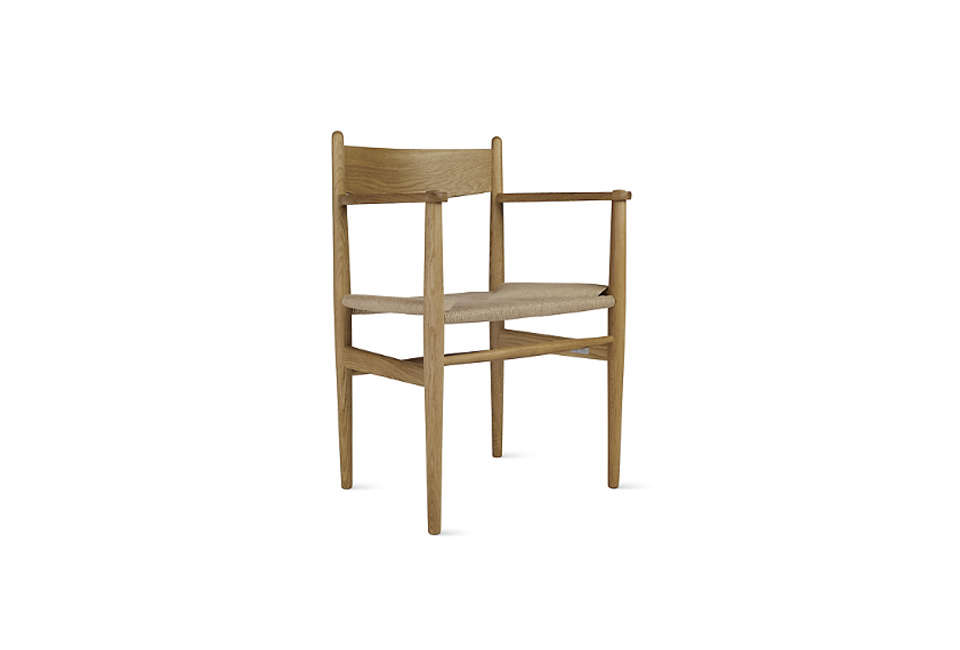

The Hans Wegner CH37 Armchair is the furniture equivalent of someone who arrives at dinner in a perfectly tailored jacket but never feels overdressed. It is elegant without being theatrical, comfortable without looking bulky, and historically important without demanding that everyone in the room discuss Scandinavian modernism before dessert.
Designed in 1962 for Carl Hansen & Søn, the CH37 combines Danish craftsmanship with principles associated with American Shaker furniture: simplicity, usefulness, honest construction, and a refreshing absence of decorative nonsense. Its solid wood frame, gently curved backrest, supportive arms, and hand-woven paper cord seat create a dining chair that feels visually light yet reassuringly substantial.
Although it is often categorized as a dining armchair, the CH37 is versatile enough for a reading corner, home office, bedroom, library, or carefully styled living room. It is not a giant lounge chair that swallows the sitter like an upholstered marshmallow. Instead, it offers upright comfort, architectural clarity, and the quiet confidence of an object whose designer knew exactly when to put the pencil down.
Who Was Hans J. Wegner?
Hans Jørgensen Wegner was born in Denmark in 1914 and trained as a cabinetmaker before studying furniture design. That practical beginning mattered. Wegner did not approach a chair as an abstract shape that happened to need legs. He understood wood, joints, tools, structural loads, and the small physical details that determine whether a beautiful chair remains beautiful after people actually sit in it.
Throughout his career, Wegner became one of the central figures of Danish modern design. Museums and manufacturers recognize him for combining traditional craftsmanship with modern simplicity, producing furniture that is sculptural but still useful. His designs are represented in major American institutions, including the Museum of Modern Art, the Metropolitan Museum of Art, and Cooper Hewitt, Smithsonian Design Museum.
Wegner designed hundreds of chairs, including the Wishbone Chair, Round Chair, Shell Chair, Valet Chair, and Flag Halyard Chair. While these pieces vary dramatically in appearance, they share several family traits: respect for natural materials, careful attention to the human body, visible craftsmanship, and a dislike of unnecessary decoration.
Knoll describes Wegner’s signature approach as a union of Danish craft traditions and the reduced, honest principles of modernism. That description applies especially well to the CH37. Nothing appears to be hiding, pretending, or wearing a decorative mustache. The construction is part of the visual experience.
The History of the CH37 Armchair
Wegner created the CH37 in 1962 as the armchair companion to the CH36 side chair. Both models reveal the influence of American Shaker furniture, particularly its emphasis on disciplined proportions, practical construction, lightness, and durability. The CH37 adds armrests for greater support while preserving the airy character of the original family.
Shaker furniture was never intended to impress through excessive carving, gilding, or ornamental flourishes. Its beauty came from proportion, usefulness, workmanship, and material honesty. Wegner adopted those principles without producing a historical reproduction. The CH37 is clearly a twentieth-century Danish design, but its visual restraint reflects the same belief that a chair should earn its place through performance rather than decoration.
The model number also tells part of the story. “CH” identifies Carl Hansen & Søn, while the number distinguishes the design within the manufacturer’s collection. The relationship between Wegner and Carl Hansen & Søn became one of the most significant collaborations in modern furniture history. Their earlier work included the CH24 Wishbone Chair, which helped bring Danish craftsmanship and woven paper cord seating to an international audience.
What Makes the Hans Wegner CH37 Armchair Special?
A Frame That Looks Light but Feels Dependable
The CH37 uses slender vertical legs, horizontal stretchers, a shaped backrest, and compact arm supports to create an open silhouette. The legs are subtly tapered, reducing visual weight without making the chair appear fragile.
This balance is one of the chair’s greatest achievements. From across the room, it looks graceful and almost delicate. Up close, the solid wood construction and carefully resolved joints communicate strength. It is the furniture version of a ballet dancer who could probably also help you move a refrigerator.
A Backrest Designed Around the Body
The curved wooden backrest is not shaped merely for dramatic effect. It arches backward, with a slightly different curve near the upper section, to improve support. This provides a comfortable resting point across the back while preserving the chair’s upright dining posture.
Unlike a rigid ladder-back chair, the CH37 does not make the sitter feel as though good posture is being enforced by a strict nineteenth-century schoolteacher. The curve allows the body to relax while remaining properly positioned at a table or desk.
Distinctive Armrest Connections
The gently rounded armrests meet the front legs through visible capped connections. Rather than disguising these structural points, Wegner made them part of the design. The result demonstrates a recurring characteristic of his work: construction details are allowed to become decoration.
The arms are broad enough to provide useful support but slim enough to slide comfortably beneath many dining tables. Because table aprons and heights vary, measurements should always be checked before ordering multiple chairs. Furniture compatibility is much easier to solve with a tape measure than with an emotional argument on delivery day.
The Hand-Woven Paper Cord Seat
Paper cord may sound like something borrowed from the shipping department, but furniture-grade paper cord is a remarkably strong material. The cord is twisted into durable lengths and woven across the seat frame to create a supportive, slightly flexible surface.
The material gives the CH37 warmth and texture while keeping it lighter in appearance than an upholstered seat. It also connects the chair to a broader tradition within Danish modern furniture. Paper cord became closely associated with several Wegner designs, most famously the Wishbone Chair, whose combination of hardwood and woven seating remains a defining example of human-centered Scandinavian design.
CH37 Dimensions and Proportions
The CH37 is approximately 22.8 inches wide and 31.9 inches high, with a seat height of about 17.7 inches. Published depth measurements can vary slightly among retailers depending on measuring methods, but the chair generally occupies a compact dining-chair footprint.
These proportions make it suitable for standard dining tables while offering more personal space than an armless side chair. The seat height works well for many tables in the typical 28-to-30-inch range, although the thickness of the tabletop and position of any apron must also be considered.
The arms increase the chair’s total width, so homeowners planning to place several CH37 chairs together should measure the usable perimeter of the table rather than relying only on its advertised length. A six-foot table does not automatically welcome six armchairs. Tables, like elevators, have theoretical capacity and comfortable capacity.
Materials, Woods, and Finishes
Oak
Oak emphasizes the chair’s natural grain and gives it a grounded, architectural character. Oiled oak tends to feel warm and tactile, while soap-treated or white-oiled versions can produce a lighter Scandinavian appearance. Oak works beautifully with stone, linen, wool, leather, plaster walls, and other natural materials.
Beech
Beech generally has a smoother and more uniform grain. It is particularly suitable for painted or lacquered versions, including black finishes that make the CH37 appear sharper and more graphic. A black frame paired with black paper cord can look formal and contemporary, while natural beech creates a softer, casual mood.
Natural and Black Paper Cord
Natural cord provides visible texture and gradually develops character with use. Black cord creates stronger contrast with pale wood and a seamless monochromatic effect with a black frame. Current authentic configurations may vary by market and dealer, but the established material formula remains a solid hardwood frame paired with a woven paper cord seat.
Is the CH37 Armchair Comfortable?
Comfort is subjective, but the CH37 offers several features that make it more accommodating than many minimalist dining chairs. Its paper cord seat distributes weight while providing a small degree of flexibility. The backward-curving backrest supports the torso, and the flat, rounded arms offer a natural resting place for the forearms.
The chair is best understood as an upright armchair rather than a lounge chair. It encourages attentive sitting suitable for meals, conversation, reading, and desk work. Someone seeking a deeply reclined seat for a three-hour movie marathon may prefer a dedicated lounge chair. Someone seeking a dining chair that remains comfortable through appetizers, dinner, dessert, coffee, and an unnecessarily competitive board game will find the CH37 much more relevant.
Body proportions matter. Taller users may appreciate its open back and supportive arms, while smaller users may find the seat relatively generous. Whenever possible, sitting in a showroom model remains the best way to evaluate personal comfort.
CH37 Versus CH36
The CH36 and CH37 share the same design language, including tapered legs, a shaped backrest, exposed construction, and a woven paper cord seat. The major difference is that the CH37 includes armrests, while the CH36 does not. Carl Hansen & Søn identifies the CH36 as the arm-free version of the same design family.
The CH36 is easier to position closely around a table and may be preferable where floor space is limited. The CH37 provides additional support and a stronger visual presence. A popular arrangement is to place CH37 armchairs at the heads of a rectangular table and CH36 side chairs along its length. This creates variety without making the room look like a furniture showroom experienced a clerical error.
How to Style the CH37 Armchair
In a Scandinavian Dining Room
Pair natural oak CH37 chairs with a simple wood table, warm white walls, linen curtains, and a pendant light. Avoid filling every surface with decorative objects. The chair looks best when its silhouette has room to breathe.
In a Contemporary Interior
Black CH37 chairs can add definition around a glass, stone, or dark wood table. Their traditional joinery prevents the composition from feeling cold, while the dark finish brings a clean architectural outline.
In a Mixed Vintage Setting
The CH37 works well beside older furniture because it draws from historical craft traditions without imitating a specific period. Try one as a desk chair near a vintage writing table, or pair several with an antique farmhouse table for a contrast between rustic mass and Danish precision.
As a Stand-Alone Accent Chair
A single CH37 can occupy a bedroom corner, entryway, or reading area. Add a small side table and focused lamp rather than burying it beneath multiple cushions. The paper cord and curved frame already provide visual interest. The chair does not need to be dressed like it is attending a pillow convention.
Care and Maintenance
Dust the wooden frame regularly with a soft, dry cloth. For minor marks, use a slightly damp cloth and wipe in the direction of the grain. Avoid strong household cleaners, silicone polishes, and abrasive pads, which may damage the finish.
Different wood treatments require different care. Oiled surfaces may eventually need re-oiling, while lacquered finishes generally require only gentle cleaning. Always follow the manufacturer’s instructions for the exact finish rather than applying a generic furniture treatment.
Vacuum the paper cord carefully with a soft brush attachment. Blot spills quickly instead of rubbing them deeper into the weave. Authentic versions may use paper cord treated with a thin protective wax layer, but the seat should still be protected from heavy moisture, oily food, and the creative decisions of unsupervised toddlers.
Avoid placing the chair next to strong heat sources or in prolonged direct sunlight. Wood naturally responds to temperature, humidity, and ultraviolet exposure. Consistent indoor conditions help protect both the frame and woven seat.
Authenticity and Buying Considerations
The CH37 is an investment-grade piece of furniture, so buyers should purchase through Carl Hansen & Søn or an authorized dealer. Verify the specified wood, finish, cord color, warranty, lead time, return policy, and delivery method before ordering.
Authentic production matters because the design depends on proportion, joinery, shaping, and weaving quality. A reproduction may imitate the outline while missing the details that make the original comfortable and visually balanced. A backrest curved a little incorrectly or an arm positioned slightly too high can change the entire sitting experience.
Buyers should also distinguish between genuine vintage examples, current authorized production, and vaguely described “Wegner-style” chairs. The last category can range from respectful inspiration to a chair that merely has four wooden legs and a confident product description.
Advantages and Possible Drawbacks
Advantages
- Timeless Danish modern design with strong historical significance
- Supportive backrest and useful armrests
- Natural hardwood and hand-woven paper cord construction
- Visually light enough for compact dining spaces
- Compatible with modern, traditional, rustic, and minimalist interiors
- Produced by the manufacturer closely associated with Wegner’s original design
Possible Drawbacks
- Premium pricing compared with mass-market dining chairs
- Armrests require more clearance around and beneath a table
- Paper cord needs protection from moisture and staining
- Its upright posture may not suit buyers seeking lounge-level softness
- Natural wood and cord will develop visual character rather than remaining factory-perfect forever
Everyday Experience with the Hans Wegner CH37 Armchair
The most revealing way to understand the CH37 is not to stare at a product photograph but to imagine living with it through an ordinary week. On the first day, the chair’s visual details command attention. You notice the capped arm connections, the smooth transition between components, the tension of the woven seat, and the subtle curve of the backrest. Nothing is loud, yet nearly every line rewards inspection.
After several days, the chair begins to recede into daily life, which is arguably the greater compliment. It becomes the seat used for morning coffee, a laptop session, lunch, homework, or a long conversation that began as “just five minutes.” The arms provide a welcome sense of enclosure without trapping the sitter. They are especially useful during extended meals because the forearms can rest naturally instead of wandering around the tabletop looking for employment.
The paper cord seat feels firmer than upholstery, but it is not harsh. Its woven structure provides subtle give and distributes pressure more effectively than a completely flat wooden seat. It also stays visually neat. There are no cushions to rotate, covers to straighten, or mysterious crumbs disappearing into upholstered seams.
The open construction makes the room feel less crowded. Even when several CH37 chairs surround a table, light passes through the frames and beneath the woven seats. This can be particularly valuable in small dining rooms, apartments, and combined kitchen-living spaces where heavy furniture quickly dominates the view.
Daily use also reveals the practical difference between an armchair and a side chair. The CH37 is comfortable for lingering, but it cannot always be pulled as close to a table if the arms meet a low apron. Careful measuring before purchase makes the experience far more satisfying. When paired with a compatible table, the arms slide beneath the top or stop at a comfortable distance without forcing the sitter to lean forward.
Over time, the natural materials begin to tell a quiet story. An oiled wood frame may deepen slightly in tone. The paper cord can soften through regular use while retaining its supportive character. These changes are not necessarily defects. They are part of the appeal of furniture made from materials that age rather than pretending time does not exist.
Cleaning is pleasantly straightforward as long as spills are handled quickly. Routine dusting and gentle vacuuming keep the chair looking composed. The greatest maintenance challenge is usually behavioral: persuading guests not to balance a plate of oily food on the paper cord seat while reaching for something across the table.
As a desk chair, the CH37 works best for focused periods rather than eight uninterrupted hours of corporate captivity. Its upright geometry encourages an engaged posture and looks far more refined than a conventional task chair. However, it lacks adjustable lumbar support, casters, and other ergonomic features required for intensive computer work. It is excellent for a writing desk, occasional home office, or study space where beauty and flexibility matter as much as technical adjustment.
The emotional experience is perhaps the most distinctive. Many modern products are purchased for novelty and replaced when the novelty fades. The CH37 operates differently. Its restrained design becomes more familiar rather than more tiresome. Owners may initially admire it as a design object, but the chair gradually becomes part of family meals, celebrations, workdays, and quiet routines.
That is where Wegner’s approach succeeds. The CH37 does not ask to be protected behind a velvet rope. It asks to be used thoughtfully. It is refined enough for a carefully designed home, durable enough for everyday dining, and modest enough to coexist with objects from many periods. The experience is less like owning a fashionable accessory and more like living with a well-made toolexcept this tool happens to look exceptionally handsome beside a dining table.
Final Verdict
The Hans Wegner CH37 Armchair is a compelling choice for buyers who value natural materials, visible craftsmanship, supportive comfort, and furniture that can outlast short-lived decorating trends. Its Shaker-inspired restraint, Danish construction, sculpted backrest, paper cord seat, and distinctive arm connections transform a simple dining chair into a remarkably complete design.
It is not inexpensive, excessively cushioned, or designed to disappear into the anonymous background of a room. Instead, it offers a quieter form of luxury: excellent proportions, carefully shaped wood, durable materials, and details that remain interesting long after the purchase receipt has stopped being interesting.
More than six decades after its creation, the CH37 still feels relevant because it was never dependent on fashionable tricks. It demonstrates that simplicity is not the absence of design. Simplicity is what remains after every unnecessary decision has been removedand, in this case, after a master chair designer has made the necessary decisions exceptionally well.
SEO Information
Note: Product configurations, finishes, availability, and specifications may vary by market. Confirm current details with Carl Hansen & Søn or an authorized retailer before purchasing.