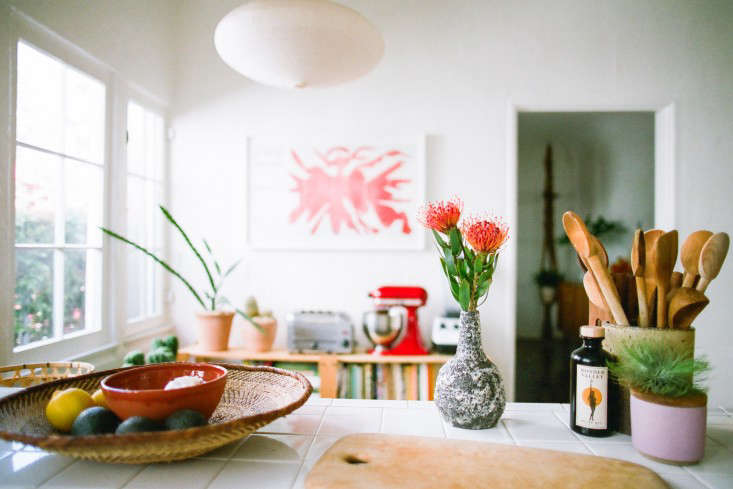

Lauren Soloff’s Hancock Park home demonstrates that bohemian interior design does not require a jungle of houseplants, seventeen tasseled pillows, and a crystal collection large enough to affect local weather patterns. Her approach is calmer and more personal: begin with light, leave room to breathe, and introduce color through objects that have earned their place.
When the Los Angeles interior designer’s rental was photographed in 2015, it offered a memorable lesson in California bohemian style. The rooms combined white walls, vintage furniture, natural fibers, handcrafted ceramics, family keepsakes, and one spectacular rug. Instead of looking staged, the home felt collectedan important difference in an era when “boho” can become a shopping category rather than a way of living.
A New Yorker Finds Her California Rhythm
Soloff grew up in New York and earned an undergraduate degree in art history from Columbia University. After moving west, she studied architecture at UCLA. Her professional path soon shifted toward interiors as client work accumulated, eventually leading her to establish an independent residential design practice.
That background helps explain the balance visible in her Los Angeles home. Art history encouraged an appreciation for objects, periods, and visual relationships. Architectural study supplied an understanding of proportion and structure. California contributed sunlight, informality, indoor-outdoor living, and permission to loosen the collar a little.
At the time of the original tour, Soloff shared the ground floor of a 1920s Spanish-style stucco house in Hancock Park with her young son, Roman. The two-bedroom rental had been passed along by friends and was already in livable condition. Rather than launching the sort of renovation she regularly managed for clients, she concentrated on paint, furniture, textiles, and meaningful possessions.
That restraint matters. The home’s personality did not come from changing every surface. It emerged from observing the existing rooms and adding only what supported daily life.
Cloud White Creates a Quiet Foundation
Soloff painted the rooms in Benjamin Moore Cloud White, a soft white that avoids looking either icy or aggressively yellow. Against that adaptable backdrop, daylight could move naturally through the house while art, ceramics, wood, and textiles retained their individual character.
White paint is sometimes treated as the absence of a decorating decision. Here, it is an active part of the composition. It connects rooms, reflects Los Angeles light, and prevents colorful pieces from fighting for attention. The result feels airy without becoming sterile.
Why the Rooms Do Not Feel Cold
The warmth comes from texture. Belgian linen, sheepskin, rattan, wicker, worn wood, handmade pottery, and woven fibers soften the white shell. These materials absorb and scatter light differently, producing subtle variations that a perfectly matched furniture set cannot provide.
Soloff’s broader design philosophy reinforces this approach. She has recommended layering cotton and linen in neighboring shades of white and ivory, especially in smaller rooms. The colors remain quiet, but differences in weave, weight, and finish create depth. It is minimalism with a pulse.
The Living Room Begins with a Fearless Rug
The living room’s defining piece was a contemporary silk ikat rug made in India and sourced through Lawrence of La Brea. Its vivid pattern established the room’s visual direction from the floor upward. Soloff kept much of the surrounding furniture and wall space subdued so the rug could lead without having to shout over an equally dramatic sofa, gallery wall, and chandelier.
This reveals one of the home’s most useful ideas: decide where the energy belongs. In Soloff’s living room, it belongs underfoot. Natural materials and neutral upholstery then moderate the color rather than duplicating it.
A Belgian-linen-covered George Smith sofa supplied an enduring anchor. A wicker hoop chair found at the Rose Bowl Flea Market introduced an eccentric silhouette, while wood floors, linen pillows, a paisley throw, and an oatmeal-toned sheepskin added gentler layers. The combination was expressive but not chaotic.
Even the television remained visible above the mantel. It was a practical admission that this was a real living room, not a museum gallery pretending nobody had ever watched a movie. That decision may be the most refreshingly bohemian gesture of all: comfort and honesty outrank decorative theater.
Vintage Objects Give the Home Its Memory
Soloff’s rooms held objects gathered through family, friendship, travel, flea markets, clients, and years of looking. A farmhouse dining table came from people who no longer needed it. Vintage Thonet chairs arrived as hand-me-downs. A midcentury sideboard supported a toy sailboat, an Italian ceramic pitcher, and pottery by Los Angeles artist Adam Silverman.
In the dining area, a steer skull introduced a deliberate Georgia O’Keeffe note above an Indonesian chest. The chest stored formal pieces that were rarely used, while a weathered boat propeller functioned as sculpture. Nearby, a mosaic table from Lawson-Fenning recalled the cacti and African baskets that surrounded Soloff during childhood.
Collection Beats Decoration
These pieces work because they are not merely “bohemian accessories.” They carry associations. Some connect to family, some to places, and others to makers whose work Soloff admires. Their irregularity is the point.
A convincing collected interior develops slowly. A room assembled in one weekend may look polished, but it rarely contains much biography. Soloff’s home suggests a better filter: bring something in because it is useful, beautiful, memorable, or ideally all three. If an object is only present because an online checklist declared that every bohemian home needs one, it may be time to release the emergency macramé.
Lighting as Sculpture and Atmosphere
Lighting throughout the home contributed shape as well as illumination. Paper lantern-style fixtures and woven pendants floated overhead with less visual weight than conventional chandeliers. In the dining space, a wicker globe light brought warmth and referenced the relaxed atmosphere of Southern California gathering places.
Isamu Noguchi’s Akari light sculptures are especially compatible with this kind of interior because their paper surfaces diffuse light while their simple forms remain sculptural. Their combination of modern design and handcraft mirrors the broader conversation taking place throughout Soloff’s rooms.
Her bedroom used adjustable Tolomeo lamps in an intentionally informal way, setting them on unconventional bedside surfaces rather than matching nightstands. The arrangement offered practical reading light without forcing symmetry. In a house full of individual objects, identical bedside tables might have looked suspiciously well behaved.
A Vintage Kitchen That Earns Its Charm
The kitchen retained its original cabinets and white-tiled countertops. Fresh paint refreshed the cabinetry, but the room was not stripped of its age. A freestanding white Viking range, glass-front cupboards, vintage art, and colorful ceramics turned the modest kitchen into one of the home’s most engaging spaces.
Soloff favored glass-front storage over open shelves because doors protect dishes from kitchen dust while still allowing collections to be seen. Heath Ceramics pieces, an Adam Silverman bowl, a vintage Jens Quistgaard pepper mill, and a handmade salt bowl became part of the room’s color story.
A damaged vintage David Smith exhibition poster was salvaged and displayed in a red frame, introducing a sharp graphic note. A copy of a Flemish still life sat near a black La Chamba cooking pot. The contrast between modernist graphics, old-world painting, California ceramics, and Colombian cookware made the kitchen feel cultural rather than coordinated.
Why the Imperfect Layout Still Works
The kitchen was somewhat makeshift, and Soloff acknowledged that its freestanding stove arrangement was not the last word in efficiency. Yet the room was bright, clean, pleasant to cook in, and honest about its limitations.
That is a valuable counterpoint to renovation culture. Not every dated feature represents an emergency. Sometimes original cabinets need paint rather than demolition. Sometimes a good range transforms the experience of cooking more than an expensive backsplash does. And sometimes the best kitchen table is the one you have not found yet.
A Child’s Room with Freedom and Boundaries
Roman’s bedroom was a brighter, more playful variation on the rest of the home. A large dream catcher brought back from a mother-son trip to Tulum hung above the bed. A vintage drafting table inherited from Soloff’s grandparents became a drawing station, paired with a task light and a modern molded chair.
The room welcomed toys, art, and color without surrendering to clutter. Soloff and her son regularly edited his belongings so he could recognize what he owned and find it easily. A large bulletin board provided a designated place for drawings and discoveries. Rather than mounting it conventionally, they leaned it against a chaira casual solution Soloff jokingly described as a “California lean.”
This balance is instructive for family-friendly interior design. Children need spaces that can change, but they also benefit from visible order. Open floor area supports play, accessible storage encourages independence, and display zones allow personality to flourish without every wall becoming an archaeological record of tape.
The Bedroom Turns Down the Volume
Soloff’s bedroom shifted toward an almost entirely white palette. A custom linen-covered bed, a fluffy sheepskin, a pale Flokati rug, and layered bedding created softness without requiring strong color. The look fulfilled a long-held desire for a serene white room.
A ceramic wall hanging added quiet relief, while an unusual wooden bowl on a tripod served as a clothes catchall. Travel keepsakes were gathered beneath a glass cloche, converting small objects that might otherwise create visual noise into a single composed display.
The room illustrates how bohemian design can become restful. Personal objects remain present, but they are edited and contained. Texture supplies interest, and unconventional furniture adds character. Nothing needs to sparkle, blink, or announce that it was found during a “boho bedroom essentials” search at 1:14 a.m.
What Makes Lauren Soloff’s Bohemian Style Endure?
The Hancock Park home remains compelling because its style is based on principles rather than trends. Its white background, honest materials, old furniture, handmade pieces, and travel mementos can evolve as life changes. The design is not locked to a particular catalog season.
Later glimpses of Soloff’s work and family homes continued to show her preference for interpreting what a building can become, often using white paint to clarify its architecture before adding grounded, layered furnishings. Her projects may vary in scale and setting, but the recurring priorities are recognizable: natural light, tactile materials, collected objects, comfortable seating, and rooms that support actual people.
Five Lessons to Borrow
- Establish a calm base. Use a warm white or restrained neutral to connect rooms and make natural light work harder.
- Choose one strong visual anchor. A distinctive rug can establish color and pattern without crowding every surface.
- Mix periods with intention. Vintage seating, contemporary ceramics, inherited furniture, and modern lighting can coexist when their materials relate.
- Edit collections. Display fewer meaningful pieces and give them enough space to be noticed.
- Protect real life. Keep the television, make room for toys, use practical storage, and accept that a chair may occasionally hold clothes. Civilization will survive.
Living with the Look: A 500-Word Experience Guide
Re-creating the spirit of Lauren Soloff’s Los Angeles home is less about buying identical objects than experiencing a room differently. Start by spending an ordinary day in the space before changing anything. Notice where morning light lands, which chair everyone chooses, where bags accumulate, and which surfaces are performing jobs they were never designed to do. A successful bohemian home begins with observation, not a shopping cart.
Experience One: Let the Floor Set the Mood
Try placing a patterned rug in an otherwise quiet living room and live with it for a week before adding more color. During daylight, watch how the tones respond to sun and shadow. At night, test them under lamps rather than relying on overhead lighting. You may discover that the rug already supplies enough drama. This pause prevents the common mistake of repeating every color in curtains, pillows, vases, and possibly the dog’s bandana.
Experience Two: Build Texture in a Neutral Room
In a bedroom or small sitting area, gather materials in closely related colors: washed linen, cotton canvas, wool, unfinished wood, woven grass, and matte ceramic. The experience should be tactile as well as visual. A linen pillow feels cool and relaxed; wool introduces warmth; handmade pottery adds weight and irregularity. When texture does the work, a neutral palette feels layered rather than empty.
Experience Three: Shop Your Own History
Before visiting a store, open the cabinets, closets, and boxes where family objects tend to hibernate. Look for an old drawing, a small bowl, a travel souvenir, a faded textile, or a piece of furniture that could be repaired. Select only items that trigger a clear memory or serve a useful purpose.
Then display them with breathing room. A single inherited vase on a sideboard can be more affecting than fifteen newly purchased accessories. Group tiny keepsakes in a tray, shadow box, or glass cloche so they read as one collection. The process turns storage into storytelling while avoiding countertop confetti.
Experience Four: Make the Kitchen More Personal, Not More Precious
Place the tools you use every day within reach and store occasional pieces behind glass. A tray beside the stove can hold salt, oil, and a pepper mill. Frequently used ceramics can introduce color without becoming purely decorative. Hang one unexpected artworka vintage poster, small still life, or child’s drawingin a protected area away from heat and splashes.
Cook a real meal afterward. If the arrangement slows you down, revise it. Beauty in a working kitchen should improve the ritual of cooking, not require a twelve-step evacuation whenever tomato sauce enters the building.
Experience Five: Allow the House to Stay Unfinished
The most important exercise is learning to tolerate an open space. Leave one wall unfilled. Wait for the right table. Keep a gifted chair even if its finish does not perfectly match the others. A home assembled over time will contain small tensions, and those tensions often produce its character.
Soloff’s Hancock Park interior felt relaxed because it left evidence of growth, travel, parenting, cooking, friendship, and changing taste. Follow that example by treating your rooms as living compositions. Edit when they become noisy, add when something meaningful arrives, and remember that “finished” is not the same as “alive.”
Conclusion: Bohemian Design with a Backbone
Lauren Soloff’s Los Angeles home presented bohemian living as a disciplined form of freedom. White walls gave the rooms clarity, a powerful rug supplied color, natural materials created warmth, and collected objects carried the story. Vintage pieces were not trophies, and handmade ceramics were not props; they belonged to the rhythms of family life.
The enduring lesson is simple: an expressive home does not need more things. It needs better relationships among the things that matter. Begin with light, choose objects slowly, respect the building, and leave enough space for life to interrupt the decorating. Life always doesand usually brings snacks.