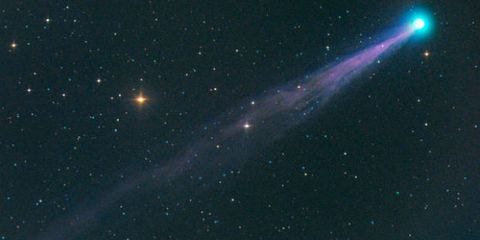

Some discoveries arrive with fireworks. Others show up as a tiny wobble in a graph, quietly waving from 800 light-years away like a cosmic sticky note. That is exactly how scientists found evidence of comet-like objects orbiting another star: not by seeing a glittering tail through a backyard telescope, but by noticing odd dips in starlight collected by NASA’s Kepler Space Telescope.
The discovery centered on a distant star called KIC 3542116, an F-type star in the constellation Lyra. In Kepler’s massive archive of brightness measurements, researchers found strange, one-time dimming events that did not behave like ordinary planet transits. Instead of producing the clean, repeatable “U-shaped” dip astronomers expect from a planet, these signals dropped quickly and then faded back slowly. In plain English: something with a tail seemed to be crossing the star.
That “something” was best explained as an exocomet, a comet outside our solar system. The finding was a big deal because comets are tiny compared with planets, and detecting one around another star is a little like spotting a snowflake in front of a lighthouse from another county. Yet the signal was there, hiding in old data and waiting for someone patient enough to look.
What Exactly Did Scientists Find?
The team identified several comet-like transits around KIC 3542116. A citizen scientist, Thomas Jacobs, first noticed three unusual dips while visually inspecting Kepler light curves. After he flagged the events, professional astronomers including Saul Rappaport and Andrew Vanderburg examined the data more deeply and found additional candidates.
The dips were not random noise. They had a distinctive shape: a sharp beginning followed by a long, gradual recovery. That pattern is important. A planet crossing a star blocks light with a fairly symmetrical profile. A comet, however, can drag a cloud of dust behind it. When the dense head of the comet moves across the star, brightness falls quickly. As the trailing dust tail passes, the light slowly returns to normal.
Think of a planet transit as someone briefly holding a dinner plate in front of a lamp. Think of an exocomet transit as someone walking by with a smoky barbecue grill. The lamp still dims, but the smoke lingers. Astronomy: occasionally poetic, occasionally barbecue-adjacent.
Why Kepler Was the Perfect Accidental Comet Hunter
NASA’s Kepler Space Telescope was built to find exoplanets, not comets. Its job was to stare at a crowded patch of sky and measure the brightness of stars with remarkable precision. If a planet crossed in front of its star from our point of view, Kepler recorded a small dip in brightness. Repeat that dip on a regular schedule, and astronomers could infer the planet’s orbit.
That method revolutionized exoplanet science. Kepler helped reveal that planets are common in the galaxy, including worlds smaller than Neptune and rocky planets orbiting in temperate zones. But Kepler’s archive also contains plenty of oddities that do not fit the planet template. Those weird cases are scientific gold, provided someone has the patience to sift through them.
The exocomet signals around KIC 3542116 were exactly that kind of oddity. They did not repeat like planets. They did not have the tidy shape of a solid sphere crossing a star. They looked messy, asymmetric, and suspiciously tail-like. For comet hunters, that messiness was the clue.
Are These Really the First Comets Around Another Star?
The phrase “first comet around another star” needs a small but important footnote. Astronomers had earlier found strong evidence for exocomets around other stars, especially the famous young star Beta Pictoris. In that system, scientists detected gas absorption signatures that suggested evaporating comet-like bodies falling toward the star.
What made the KIC 3542116 discovery special was that it provided the first strong evidence for transiting exocomets in ordinary visible-light Kepler data. Instead of seeing chemical fingerprints in a spectrum, scientists saw the actual dimming pattern caused by dusty comet tails crossing a star. That is a different kind of detection, and a very exciting one.
In other words, the headline is catchy, but the scientific nuance is even better: researchers found compelling photometric evidence of exocomets, using a planet-hunting telescope, in data that had already been sitting around like a treasure chest nobody had fully opened.
Meet KIC 3542116: The Star With a Comet Problem
KIC 3542116 is located roughly 800 light-years from Earth. It is not visible to casual skywatchers, and it does not have the household-name status of Sirius or Betelgeuse. Yet for a brief moment, this faint star became one of the most interesting places in exocomet research.
The comet-like objects detected around it appeared to be moving extremely fast, likely tens of kilometers per second. Some estimates placed their speeds near the range expected for bodies passing close to a star. Their dusty tails produced small but measurable dips in brightness, with the deeper events lasting about a day.
The researchers modeled the transits and found that the amount of dust needed to explain the deeper events was enormous by human standards, though perfectly reasonable by comet standards. The inferred cometary bodies may have been comparable in mass to famous solar system comets such as Halley’s Comet. That does not mean anyone saw a tiny iceball directly. Instead, scientists reconstructed the likely culprit from its dusty shadow.
How a Comet Creates a Signature in Starlight
A comet is often described as a “dirty snowball,” though “icy rubble pile with dramatic flair” may be more accurate. Its nucleus contains frozen gases, dust, and rocky material. When it approaches a star, heat causes some ices to turn into gas. That process releases dust, forming a coma and tail.
Inside our solar system, the Sun lights up comet tails and makes them visible from Earth when conditions are right. Around another star, we usually cannot see the comet directly. It is too small, too far away, and much too faint. But if the comet passes in front of its star, its dust can block a tiny fraction of starlight.
The trick is recognizing the shape of the dimming. A planet blocks light like a neat, solid object. A comet’s dusty tail produces an uneven profile. The brightness often drops steeply and recovers slowly because the tail continues to obscure the star after the head has moved on. That asymmetry is the comet’s calling card.
Why Exocomets Matter More Than Their Size Suggests
Comets may be small, but they are not minor characters in the story of planetary systems. In our own solar system, comets preserve ancient material from the era when planets were forming. They are leftovers from the construction zone, frozen time capsules from more than 4.5 billion years ago.
Studying exocomets helps scientists understand whether other planetary systems went through similar messy beginnings. Planet formation is not a calm process. It involves collisions, migrations, gravitational kicks, icy debris, and occasional chaos that would make a bowling alley look organized.
If comets exist around other stars, they may reveal the presence of belts of icy bodies similar to the Kuiper Belt or Oort Cloud. They may also hint at unseen planets. In our solar system, giant planets can disturb comet orbits and send icy bodies inward. If exocomets are diving close to a distant star, something massive may be stirring the pot.
The Beta Pictoris Connection
No discussion of exocomets is complete without Beta Pictoris. This young star, located about 64 light-years from Earth, is one of astronomy’s favorite laboratories for studying planet formation. It has a debris disk, giant planets, gas, dust, and a long history of exocomet evidence.
Later studies using NASA’s TESS mission identified dozens of comet-like transits around Beta Pictoris. Scientists measured the size distribution of those exocomets and found that their nuclei ranged from a few kilometers to more than a dozen kilometers across. Even more intriguing, their size distribution looked similar to comet populations in our own solar system.
That similarity matters. It suggests that the grinding, colliding, fragmenting process that shaped small bodies around the Sun may also happen elsewhere. Planetary systems may have their own versions of icy leftovers, comet showers, and cosmic demolition derbies. Apparently, the universe also forgets to clean up after building planets.
Citizen Science Had a Starring Role
One of the best parts of this discovery is that it involved a citizen scientist. Thomas Jacobs was not operating a billion-dollar space telescope from a secret mountain lair. He was carefully examining light curves, looking for patterns that automated searches might miss.
That matters because modern astronomy produces more data than professional researchers can inspect by eye. Space telescopes, sky surveys, and automated observatories generate mountains of measurements. Algorithms are powerful, but they are often trained to find expected patterns. Human eyes can still be excellent at noticing the weird stuff.
The exocomet discovery is a reminder that science is not only about giant instruments and advanced equations. It is also about curiosity, persistence, and the willingness to say, “That looks strange,” instead of scrolling past. Many breakthroughs begin as suspicious little bumps in a graph.
What This Discovery Teaches Us About Other Solar Systems
The discovery of exocomets supports a broader idea: planetary systems are not just stars and planets. They are ecosystems of debris, dust, gas, asteroids, comets, moons, rings, and gravitational interactions. A solar system is less like a tidy clock and more like a family garage after a weekend project.
When scientists find comet-like bodies around another star, they gain clues about the system’s architecture. Are there distant reservoirs of icy material? Are unseen planets disturbing those reservoirs? Are collisions producing fresh fragments? Are volatile-rich bodies delivering water or organic molecules to inner rocky planets?
These questions connect exocomet research to astrobiology. Comets are not proof of life, of course. A comet is not going to show up carrying a tiny flag that says “microbes inside.” But comets can transport water, carbon-bearing compounds, and other ingredients relevant to habitable environments. Understanding their role elsewhere helps scientists compare our solar system with the wider galaxy.
How This Fits With Interstellar Comets
There is another related category: interstellar comets that pass through our own solar system. Comet 2I/Borisov, discovered in 2019, was the first confirmed interstellar comet observed visiting the Sun’s neighborhood. In 2025, 3I/ATLAS became another confirmed interstellar object, giving scientists a rare chance to study material that formed around a different star and then wandered into our cosmic backyard.
Exocomets and interstellar comets are connected by a simple idea. Many star systems likely form icy bodies. Some remain bound to their stars, where we may detect them as exocomets. Others get ejected by planets or stellar encounters and travel through interstellar space. Occasionally, one enters our solar system, and astronomers scramble to observe it before it leaves forever.
That makes every comet-like discovery part of a larger puzzle. We are not just studying icy rocks. We are tracing how planetary systems form, evolve, exchange material, and sometimes fling their leftovers into the galaxy like confetti from a very dramatic parade.
Why the Discovery Was So Difficult
Finding exocomets is hard because they are small, short-lived in transit, and often non-repeating. Planet hunters love repetition. If a dip happens every ten days, it becomes easier to confirm an orbiting planet. A comet may pass once, shed dust, change dramatically, or even vaporize. It does not politely return on schedule for a second appointment.
That is why the KIC 3542116 signals were so impressive. The team had to rule out instrumental artifacts, background stars, and other false alarms. They needed to show that the asymmetric dips were consistent with dusty tails rather than random glitches. In astronomy, “weird” is not enough. Weird must survive cross-examination.
The researchers used models of comet tails to explain the observed light curves. These models considered how dust spreads behind the comet, how it blocks starlight, and how quickly the signal should fade. The result was not a photograph of an alien comet, but it was a strong fingerprint.
What Comes Next for Exocomet Research?
Future surveys will likely find more exocomets. NASA’s TESS mission has already expanded the field by detecting comet-like transits around Beta Pictoris. The Vera C. Rubin Observatory, space telescopes, and next-generation data analysis tools may uncover many more unusual dimming events.
The challenge will be separating true exocomets from other causes of stellar variability. Stars can flicker. Dust clouds can orbit. Instrumental effects can imitate signals. Binary stars can create confusing patterns. The universe is generous with mysteries and stingy with labels.
Still, the payoff is enormous. Every confirmed exocomet gives researchers another data point in the study of planetary systems. Over time, scientists may learn which types of stars host the most comet activity, how comet populations change with age, and whether systems like ours are ordinary or delightfully strange.
Experience Section: What This Discovery Feels Like From Earth
There is something wonderfully humbling about this discovery. Imagine sitting at a desk, looking at a graph of starlight from a star so far away that its light began traveling toward us centuries ago. The line dips. Not much. Just enough to make a careful observer pause. That tiny dent may be the shadow of a dusty comet tail in another solar system. Suddenly, a spreadsheet becomes a postcard from deep space.
For anyone who has watched a comet from Earth, the connection feels personal. A bright comet in the night sky can make people stop mid-conversation, point upward, and briefly forget their grocery lists. Comets have always had that effect on humans. Ancient observers feared them, poets praised them, and modern skywatchers chase them with cameras, binoculars, and an alarming amount of coffee.
The exocomet discovery stretches that familiar experience across the galaxy. We are used to thinking of comets as members of our own solar neighborhood. Halley’s Comet, Hale-Bopp, NEOWISE, and others feel like local celebrities. But KIC 3542116 tells us the comet story is not local at all. Other stars may have their own icy wanderers, their own dusty tails, their own leftover building blocks from planetary birth.
That realization changes the way you look at the night sky. The stars stop being simple points of light. They become places. Around some of them, planets orbit. Around others, debris disks glow faintly. Around many, comets may be diving inward, breaking apart, releasing dust, and leaving signals too subtle for human eyes but not too subtle for our instruments.
There is also a quiet lesson in patience. The Kepler data did not shout, “Comet found!” It waited. A citizen scientist looked carefully. Researchers tested the idea. Models were built. False explanations were considered. Science moved not like a lightning bolt, but like a detective with a very large notebook.
That makes the discovery feel even more satisfying. It was not just technology doing magic. It was technology plus human attention. The telescope gathered the light. The archive preserved it. A curious person noticed the odd shape. Scientists turned that odd shape into evidence. The result is a beautiful example of how modern discovery often works: machines collect more information than we can immediately understand, and then humans return to the data with better questions.
For readers, the experience is a reminder that the universe is busy at every scale. While we worry about emails, traffic, and whether the refrigerator is making a weird noise, comets are circling other stars. Dust tails are crossing alien suns. Planetary systems are aging, colliding, and rearranging themselves. Somewhere, an icy body may be making its final bright plunge toward a star, leaving behind only a faint dip in light and a clue for astronomers on Earth.
That is the charm of this discovery. It makes the distant universe feel active, textured, and strangely familiar. A comet around another star is not just an object. It is evidence that the processes that shaped our home may be common elsewhere. The same cosmic ingredientsice, dust, gravity, heat, chaos, and timemay be mixing around countless stars. The recipe varies, but the kitchen is galactic.
Conclusion: A Tiny Shadow With a Huge Message
The discovery of comet-like bodies around KIC 3542116 showed that astronomers can detect more than planets around distant stars. They can also find the faint signatures of small, dusty, fragile objects that reveal how planetary systems are built and disturbed.
Scientists found these exocomets not by snapping a direct picture, but by reading the shape of starlight itself. The asymmetric dips in Kepler data suggested dusty tails passing in front of a distant star, opening a new window into the small-body populations of other systems.
That is why this discovery matters. Comets are leftovers, messengers, and clues. They help scientists compare our solar system with others and explore whether the galaxy builds planetary systems in similar ways. A tiny dimming event around a faint star may not sound dramatic at first, but in astronomy, even a small shadow can illuminate a very big story.