
Some buildings whisper history. Szombierki Power Plant does not whisper. It clears its throat like an old coal furnace, adjusts its brick shoulders, and practically shouts across Bytom, Poland: “Yes, I used to power a region. Please admire the clock tower.”
Located in Upper Silesia, the former Szombierki Power Plant is one of Poland’s most fascinating abandoned industrial landmarks. It is massive, moody, and strangely elegant, like a castle that decided to get an engineering degree. Built in the early twentieth century, this coal-fired giant once helped define the industrial identity of the region. Today, its tall chimneys, dark red brick facades, empty halls, and weathered machinery make it a dream subject for photographers, architecture lovers, urban explorers, and anyone who thinks “beautiful decay” is a perfectly normal weekend interest.
This is not just another abandoned power plant in Poland. Szombierki is a symbol of Silesian industry, modernist design, coal-era ambition, and the complicated question of what we should do with buildings that are too important to forget but too expensive to leave alone.
The First Impression: A Cathedral Built For Electricity
The phrase “cathedral of industry” gets used often for historic factories and power stations, but Szombierki earns it. The building does not merely sit in the landscape; it dominates it. From a distance, the chimneys rise like industrial spires. Up close, the brickwork feels almost ceremonial, as if every wall was designed to remind workers that electricity was not just a utility. It was modernity itself.
When I first approached the site, the scale was the first shock. Many abandoned places feel hidden, tucked behind fences or swallowed by weeds. Szombierki feels different. It has presence. The long facades, tall window openings, tower forms, and monumental mass make the whole complex look less like a ruin and more like a sleeping machine.
The second shock was the silence. Power plants are built for noise: turbines, boilers, pumps, steam, footsteps, commands, alarms, metal on metal. Standing near the empty structure, the quiet felt almost unnatural. It was the kind of silence that makes your camera shutter sound rude.
A Short History Of Szombierki Power Plant
Szombierki Power Plant, known in Polish as Elektrociepłownia Szombierki, was established in Bytom and opened in 1920. Its first owner was connected with the Schaffgotsch industrial family, and the design is associated with Georg and Emil Zillmann, architects whose work helped shape important industrial and residential landscapes in Upper Silesia.
The plant was built during a time when coal, steel, rail, and electricity were transforming Silesia into one of Europe’s major industrial regions. This was not a modest local boiler room. It was a serious power-generating complex, tied to mines, railway systems, workers, and the hard rhythm of industrial life.
The Clock Tower That Refused To Be Ordinary
One of the most memorable features of the building is its four-sided clock, installed in 1925. The clock was reportedly connected with dozens of clocks operating throughout the facility, which makes perfect sense in a power plant where time was not decorative. Time meant shift changes, output targets, maintenance schedules, and the synchronized heartbeat of work.
It also makes the place wonderfully dramatic. A huge abandoned power plant with a clock tower is already halfway to becoming the main character in a gothic novel. Add coal dust, red brick, and a few pigeons with suspicious confidence, and you have atmosphere for days.
One Of Europe’s Great Coal-Era Power Stations
During its strongest period, especially around the World War II era, Szombierki was considered one of the largest coal-powered power plants in the region and among the notable industrial facilities in Europe. Reports describe hundreds of employees working there and output reaching roughly 92 to 100 megawatts during peak years.
Those numbers matter because they help explain the size of the place. Szombierki was not built to look impressive in photographs a century later. It was built to perform. Its huge halls, chimneys, service areas, and infrastructure were practical responses to the demands of coal-fired electricity generation. The beauty came partly from architecture and partly from the confidence of a machine age that believed bigger was often better.
Architecture: Why This Abandoned Power Plant Looks So Good
Many industrial buildings are functional boxes. Szombierki is not. Its architecture has rhythm, proportion, and intention. The long brick facades are broken by vertical elements, tall window bays, pilasters, and strong geometric lines. The result is stern but graceful, like a factory wearing a tailored coat.
The Zillmann brothers were known for designing industrial and workers’ housing projects with a strong sense of place. At Szombierki, that approach shows. The building is practical, but it is also civic. It tells the city: this work matters. The people who labored here were part of something large.
This is why abandoned industrial architecture attracts so many people. A modern office building may become outdated in twenty years and look embarrassed about it. A power plant like Szombierki ages differently. Its scars become texture. Its empty spaces become memory. Its broken windows somehow make the brick look even prouder.
Inside The Abandoned Giant
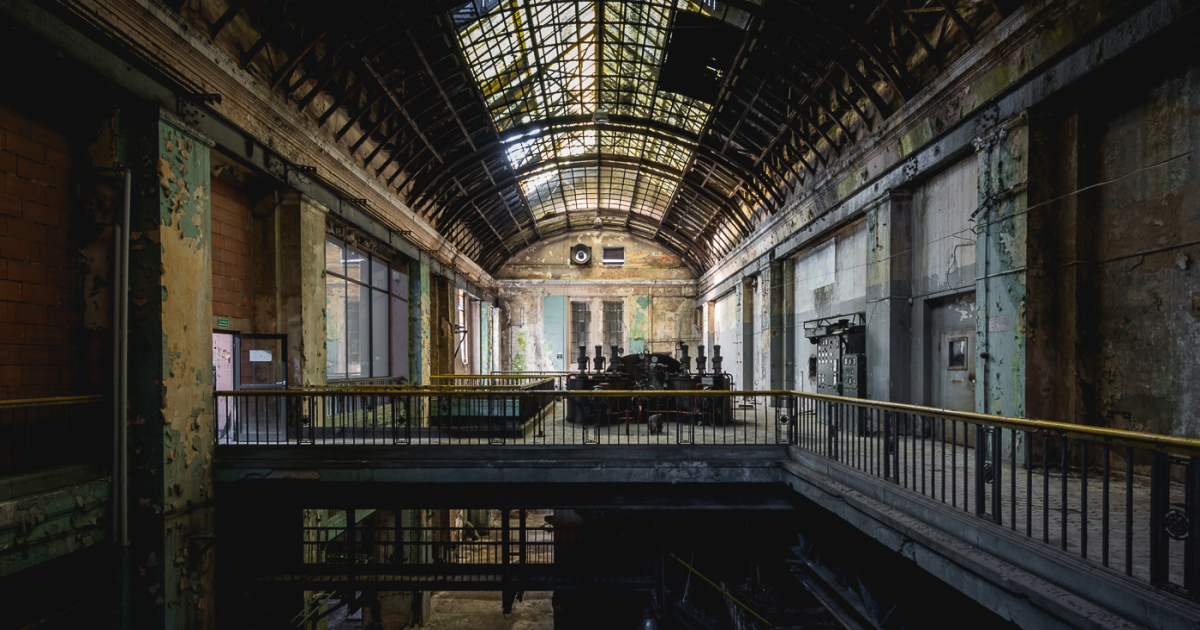
The interior of Szombierki is where the experience shifts from impressive to unforgettable. Large industrial halls create a sense of scale that ordinary buildings cannot fake. You do not simply walk through a place like this; you are swallowed by it.
The former turbine areas and machinery spaces show why power plants are so visually powerful. Pipes, platforms, steel frames, worn surfaces, and high ceilings create layers of detail. Even when machinery has been removed or damaged, the building still reveals its purpose. You can read the old workflow in the bones of the structure.
There is also an emotional contrast. The plant was built for energy, heat, electricity, and production. Now, in its abandoned state, it feels cold and still. That contrast gives the site its haunting charm. It is not “spooky” in a cheap haunted-house way. It is haunting because it once mattered so much.
Why Szombierki Became Abandoned
Like many old coal-fired power stations in Europe, Szombierki gradually lost its original role as technology, energy systems, environmental standards, and economic needs changed. The plant was converted over time from a power station into a heat and power facility, and its electricity generation eventually ended. By the twenty-first century, much of the complex had fallen into disuse.
Abandonment is rarely a single dramatic moment. It is usually a slow fade: fewer functions, fewer workers, less maintenance, more empty rooms, more leaks, more weeds, more people saying, “Someone should really do something about this,” while everyone checks the budget and coughs politely.
Szombierki’s deterioration became a serious concern. Heritage organizations warned that the building, despite its architectural and historical value, faced risks from neglect, vandalism, theft, weather damage, and possible demolition. In 2020, it was included among Europe’s endangered heritage sites, a public reminder that even giants can be fragile.
Industrial Heritage: Why Places Like This Matter
It is easy to romanticize abandoned places, especially when they photograph beautifully. But Szombierki matters for more than mood. Industrial heritage tells the story of labor, technology, urban growth, environmental change, and community identity.
Coal power is complicated. It helped build cities, industries, jobs, and modern comforts, but it also left pollution, health impacts, and environmental costs. A site like Szombierki forces visitors to hold both truths at once. It is beautiful and heavy. Impressive and outdated. Worth preserving and worth rethinking.
That complexity is exactly why preservation matters. If we erase every industrial building because it belonged to a dirty era, we lose the ability to understand how that era shaped the present. If we preserve everything without adaptation, we risk freezing cities into museums. The better answer is often adaptive reuse: keep the strongest architectural and historical features, clean up hazards, and give the building a new public life.
Could Szombierki Become Poland’s Tate Modern Moment?
When people talk about saving giant power stations, two famous examples often appear: Bankside Power Station in London, now Tate Modern, and Battersea Power Station, now redeveloped into a major mixed-use destination. Szombierki is not identical to either, but the comparison is useful.
Power plants are difficult buildings to reuse. They are huge. They can contain contamination. They need serious structural work, modern safety systems, accessibility upgrades, insulation, heating, lighting, and a financial plan stronger than “people on Instagram will love it.” But when reuse succeeds, the reward can be enormous.
Large turbine halls can become exhibition spaces, concert venues, markets, museums, sports areas, or event halls. Former administrative buildings can become offices, hotels, studios, or educational spaces. Outdoor industrial areas can become public parks, festival grounds, or cultural districts. The key is to respect the building’s character rather than sanding it into blandness.
In recent years, redevelopment plans connected with Arche Group have pointed toward a mixed-use future for Szombierki, including hospitality, events, culture, recreation, exhibitions, and museum functions. If done carefully, that could turn the abandoned power plant from a threatened monument into one of Poland’s most exciting industrial revitalization projects.
The Urbex Appeal: Beauty, Risk, And Responsibility
Urban exploration, or urbex, has helped bring attention to abandoned industrial places around the world. Photographers have documented Szombierki’s grand spaces, peeling textures, and monumental forms, allowing people who may never visit Bytom to understand why the building matters.
But there is an important line between appreciation and recklessness. Abandoned power plants can contain unstable floors, falling materials, sharp metal, hidden holes, electrical hazards, contaminated dust, and restricted areas. In other words, they are not playgrounds. They are historic structures with real risks.
The responsible way to experience places like Szombierki is through legal access, guided visits, official events, or authorized photography opportunities. That approach protects visitors, respects owners and preservation teams, and helps keep the site from suffering more damage. The goal is not to “conquer” a ruin. The goal is to understand it without making the next preservation problem worse.
What It Felt Like To Stand There
Standing near Szombierki, I kept thinking about the people who had once worked there. It is easy to focus on brick and steel, but buildings like this are really about human routines. Someone checked gauges. Someone maintained turbines. Someone walked under that clock at the beginning of a shift. Someone went home smelling faintly of coal and machinery.
That human layer makes the abandonment more powerful. Without it, the plant would be just a big empty shell. With it, every corridor feels like a sentence interrupted halfway through.
The building also has a strange kind of dignity. Even in decay, it does not feel defeated. It feels patient. Perhaps that is because the architecture was built with such confidence. Perhaps it is because the redevelopment story is not finished yet. Or perhaps I had been staring at brick walls too long and started assigning them personality. Travel writing is dangerous like that.
Why Photographers Love Szombierki
For photographers, Szombierki offers nearly everything: symmetry, scale, texture, shadows, historic machinery, architectural detail, and dramatic vertical lines. The site can look different depending on weather and light. On a gray day, it becomes severe and cinematic. In warmer light, the red brick glows, and the ruin suddenly feels less abandoned and more asleep.
The best photographs of places like this do more than say, “Look, decay!” They show proportion. They show how industry shaped space. They capture the tension between engineering and art. Szombierki is photogenic not because it is broken, but because it was built with purpose.
There is also a lesson here for modern architecture. Utility does not have to be ugly. Infrastructure can have character. A power plant can be a landmark. A building designed for work can still stir the imagination a hundred years later.
The Future Of The Abandoned Power Plant
The future of Szombierki depends on preservation, financing, public interest, and careful redevelopment. A successful project would need to balance commercial uses with respect for heritage. Too little investment could leave the building vulnerable. Too much insensitive development could erase the very qualities that make it special.
The most promising vision is not a polished theme park version of industry. It is a living complex where old brick, steel, machinery, halls, and towers remain readable while new functions bring people back. Imagine concerts in a former turbine hall, exhibitions explaining Silesia’s coal history, hotel rooms inside restored industrial walls, public events under the gaze of the clock tower, and educational spaces that do not hide the building’s past.
That kind of reuse would not simply save a building. It would help Bytom tell a wider story about industrial change, environmental transition, and cultural memory.
Extra Field Notes: My Experience Visiting One Of Poland’s Biggest Abandoned Power Plants
The longer I stayed near Szombierki, the more I understood why abandoned industrial sites create such strong reactions. At first, the visit feels visual. You notice the height, the brick, the chimneys, the broken surfaces, the enormous spaces. Your brain begins sorting everything into photographs before your feet have even stopped moving. But after a while, the experience becomes slower and more thoughtful.
I remember looking up at the clock tower and thinking about how strange it is that a building can outlive its original purpose so completely. A clock once used to organize work now watches over emptiness. Chimneys built to release smoke now frame the sky. Walls designed to contain heat and machinery now hold echoes. It is dramatic, yes, but not in a fake way. The drama comes from usefulness fading into memory.
The most powerful part of the visit was the feeling of scale. Modern buildings often hide their systems. Air-conditioning, electricity, heating, water, and data all disappear behind smooth panels. Szombierki belongs to an older world where infrastructure was visible, heavy, and unapologetic. It made energy feel physical. You could sense that power did not magically arrive at a switch. It came from coal, labor, engineering, maintenance, and a whole network of human effort.
That realization changed the way I saw the ruin. The abandoned power plant was not just an aesthetic object. It was a reminder of how much modern life depends on systems most people never see. We enjoy warm rooms, lit streets, charged phones, and running factories, but the places that made those comforts possible are often ignored until they become obsolete.
There was also a surprising amount of tenderness in the experience. That may sound odd when talking about a coal-fired industrial complex, but old buildings can hold public memory in a way that new developments often struggle to match. Szombierki is part of the identity of Bytom and Upper Silesia. For former workers, residents, photographers, historians, and preservationists, it is not simply real estate. It is a landmark with emotional weight.
At the same time, visiting a site like this makes one thing clear: nostalgia alone is not enough. A giant abandoned power plant cannot survive on admiration, hashtags, and people saying “they don’t build them like this anymore” while doing absolutely nothing. Preservation needs plans, money, engineering, safety work, environmental assessment, and a realistic future use. Romantic decay may look beautiful online, but rain does not care how many likes a turbine hall gets.
That is why Szombierki’s possible redevelopment is so important. If the project succeeds, the plant could become a model for how post-industrial cities reuse their most difficult landmarks. It could welcome visitors legally and safely. It could support culture, tourism, education, and local pride. It could show that industrial heritage is not a burden from the past, but a foundation for reinvention.
When I left, I did not feel like I had visited a dead place. I felt like I had visited a building waiting for its next assignment. Szombierki has already been a power plant, a heat plant, a workplace, a symbol, a ruin, and a warning. Maybe its next life will be as a public destination where people come not only to photograph decay, but to understand the energy, labor, architecture, and memory built into every brick.
Conclusion: Why Szombierki Deserves A Second Life
Visiting one of the biggest abandoned power plants in Poland is not just an adventure into a dramatic old building. It is a walk through the industrial history of Europe, the rise and decline of coal power, and the difficult beauty of places left behind by progress.
Szombierki Power Plant is magnificent because it is more than a ruin. It is architecture, infrastructure, memory, and warning all at once. It shows how industrial buildings can become civic landmarks, how abandonment can threaten cultural heritage, and how adaptive reuse can transform a difficult site into something valuable again.
If saved with care, Szombierki could become a landmark not only of Poland’s industrial past, but also of its creative future. And honestly, any building that can make a clock tower, coal history, and empty turbine halls feel this cinematic deserves another chapter.