
Space documentaries usually arrive with a familiar collection of ingredients: roaring rockets, inspirational music, magnificent views of Earth, and at least one scientist trying to explain dark matter without frightening the audience. Among the Stars includes all of those things, but its real subject is considerably more human. This six-part documentary series reveals what happens when a complicated space mission encounters changing assignments, failing equipment, personal disappointment, and a global crisis nobody placed on the schedule.
Originally released on Disney+ on October 6, 2021, the series follows veteran NASA astronaut Chris Cassidy as he prepares for what may be his final spaceflight. Yet Cassidy is only the doorway into a much larger story. Director Ben Turner gradually expands the documentary’s focus to include astronauts, engineers, scientists, tool designers, flight controllers, and family members whose work supports life aboard the International Space Station.
The result is an unusually intimate NASA documentary. Instead of presenting space exploration as a smooth parade of historic achievements, Among the Stars shows the uncertainty behind those achievementsand the enormous number of people required to make “one small step” possible.
What Is the "Among the Stars" Documentary About?
Among the Stars is a six-episode documentary series directed by Ben Turner and produced by Fulwell 73 Productions. Filmed over approximately two years, it combines professional documentary footage, astronaut video diaries, NASA recordings, mission-control communications, computer animation, and extraordinary images captured aboard the International Space Station.
The opening episodes introduce Chris Cassidy, a former Navy SEAL and experienced astronaut determined to return to space. He begins training for an exceptionally difficult assignment: repairing the Alpha Magnetic Spectrometer, or AMS-02, attached to the outside of the space station.
That mission would be demanding even by NASA standards. The AMS was never designed for orbital maintenance, which is roughly equivalent to building a car without a hood and later asking a mechanic to replace the engine while wearing boxing gloves. Cassidy and European Space Agency astronaut Luca Parmitano prepare for the work, rehearsing complex procedures inside NASA’s enormous Neutral Buoyancy Laboratory.
Mission assignments change, however, and Cassidy does not perform the actual AMS repair. Parmitano and NASA astronaut Andrew Morgan ultimately carry out the spacewalks while Cassidy continues preparing for a different journey. Rather than treating this change as an inconvenient disruption, the series makes it central to the story. It demonstrates that space exploration depends as much on flexibility and humility as it does on courage.
The Alpha Magnetic Spectrometer: The Series’ Other Star
Chris Cassidy may be the recognizable human lead, but the documentary’s most unusual character is a roughly seven-ton particle detector bolted to the International Space Station.
What Does the AMS Actually Do?
Installed during the space shuttle Endeavour’s final mission in 2011, the Alpha Magnetic Spectrometer is a sophisticated particle-physics experiment. It records charged cosmic rays passing through space and helps scientists investigate antimatter, dark matter, and the origins of the universe.
Dark matter cannot be observed directly with ordinary telescopes, yet scientists infer its existence from the gravitational behavior of galaxies and other large structures. AMS researchers study cosmic particles for patterns that might reveal where high-energy positrons and other unusual signals originate. The answers could alter our understanding of the cosmosor produce even more questions, which is science’s favorite method of job security.
The project is led by Nobel Prize-winning physicist Samuel Ting, whose quiet intensity gives the documentary some of its most memorable scenes. Ting views the AMS as a tool for following evidence rather than confirming comfortable assumptions. His presence connects the dangerous repair mission to a much bigger purpose: extending humanity’s ability to study fundamental physics from orbit.
Why Did the AMS Need a Repair?
The instrument’s silicon tracking system required cooling pumps to function properly. After years in orbit, those pumps began failing. Shutting down the detector would have ended a tremendously valuable stream of scientific data, so teams devised a replacement cooling system.
There was one small complication: AMS had not been built for astronaut servicing. Engineers had to invent tools and procedures for tasks that had never been expected, including cutting tiny stainless-steel cooling lines and connecting them to new hardware. Everything needed to work in microgravity, outside the station, while the astronauts wore pressurized gloves with limited dexterity.
The documentary follows tool manager Heather Bergman and other specialists as they test equipment, investigate problems, and translate delicate engineering into actions an astronaut can safely complete. These sequences are among the series’ strongest because they turn an abstract NASA mission into a collection of practical puzzles. Even a wrench becomes dramatic when dropping it means donating it permanently to low Earth orbit.
Four Spacewalks and One Very Nervous Planet
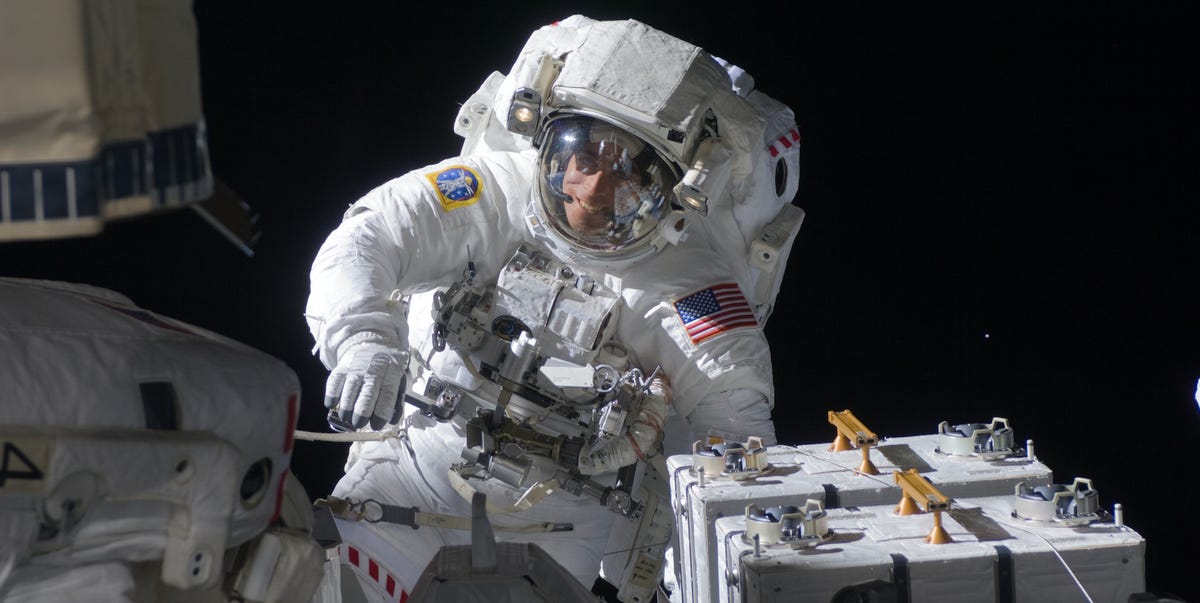
Luca Parmitano and Andrew Morgan conducted four spacewalks between November 2019 and January 2020 to repair the AMS. Their work included removing protective material, installing access equipment, cutting and joining cooling lines, fitting the new pump system, checking for leaks, and restoring the experiment to operation.
These were described as some of the most complicated spacewalks attempted since the servicing missions to the Hubble Space Telescope. The comparison makes sense: both projects required astronauts to perform intricate repairs on scientific instruments that were difficultor never intendedto service.
Among the Stars makes those spacewalks understandable without draining them of tension. Viewers see Parmitano and Morgan working against time while flight controllers and engineers monitor every motion from Earth. A suspicious connection or unexpected leak is not treated as a manufactured cliffhanger. It is a genuine engineering problem occurring hundreds of miles above the nearest hardware store.
The series also brings additional emotional weight to Parmitano’s role. During a 2013 spacewalk with Cassidy, water accumulated inside Parmitano’s helmet, creating a potentially deadly emergency. Cassidy helped him return safely to the airlock. Seeing Parmitano later lead the ambitious AMS repair campaign turns his participation into a story of resilience rather than reckless fearlessness.
Chris Cassidy’s Final Mission Takes a Historic Turn
Although Cassidy misses the opportunity to repair the AMS himself, his story does not remain on Earth. He launches aboard Soyuz MS-16 on April 9, 2020, with Russian cosmonauts Anatoly Ivanishin and Ivan Vagner. Cassidy later commands Expedition 63 aboard the International Space Station.
The timing transforms his mission. COVID-19 is spreading around the world as the crew prepares to leave Earth. The final weeks before launch become unusually isolated, and the astronauts depart for a station that suddenly seems less cut off than the quarantined planet below.
Cassidy’s 196-day flight also overlaps with a landmark moment in commercial spaceflight. In May 2020, NASA astronauts Doug Hurley and Bob Behnken arrive aboard SpaceX’s Crew Dragon during the Demo-2 mission. It is the first crewed orbital launch from the United States since the end of the space shuttle program in 2011.
Cassidy and Behnken subsequently perform four spacewalks to continue upgrading the station’s power system. By the time Cassidy returns to Earth in October 2020, he has accumulated 378 days in space across three missions and completed ten career spacewalks. The documentary therefore begins with a mission opportunity he loses and ends with achievements nobody could have predicted when filming started.
The People Behind the Space Suits
The title Among the Stars sounds as though the series will focus almost entirely on astronauts. Its smartest decision is showing why that assumption is incomplete.
Flight directors, engineers, scientists, trainers, and technical specialists receive meaningful screen time. Emily Nelson, one of NASA’s female flight directors, helps illustrate how mission control combines calm leadership with detailed technical knowledge. AMS project manager Ken Bollweg represents the persistence required to keep a major international science program moving through years of planning and setbacks.
These participants are not presented as anonymous people wearing headsets behind Cassidy. They possess their own responsibilities, ambitions, anxieties, and professional pride. The documentary repeatedly demonstrates that an astronaut performing a task in orbit is executing the accumulated work of hundreds of people on Earth.
The international nature of the project is equally important. NASA, the European Space Agency, Roscosmos, CERN-linked researchers, and specialists from many countries contribute to the missions depicted. The collaboration is not perfect or effortless, but it makes space exploration look less like a national victory lap and more like a giant group project in which nobody can pretend the presentation file was mysteriously deleted.
Why the Documentary Feels Different
It Allows the Mission to Change Direction
Many documentaries construct a clean narrative in which the central character identifies a goal, overcomes obstacles, and completes the original plan. Reality rarely behaves that politely. Among the Stars permits Cassidy’s role to change and follows the actual repair team instead of forcing every development into a predetermined hero story.
That choice makes the series more credible. Cassidy’s disappointment is real, but so is his ability to support another crew and move toward a new assignment. The documentary defines professionalism as contributing to the mission even when someone else receives the glamorous task.
It Balances Science With Emotion
The series explains the AMS, spacewalk preparation, mission control, and astronaut training in accessible language. It does not require viewers to know particle physics or orbital mechanics before pressing play. At the same time, it avoids turning the science into decorative background material.
Personal video diaries and family scenes provide an emotional counterweight. Cassidy is shown at home, during training, in quarantine, aboard the station, and preparing to return. These moments make the risks understandable without resorting to constant speeches about destiny. Sometimes a quiet conversation communicates more than another slow-motion rocket launch accompanied by a choir.
The Space Footage Is Genuinely Spectacular
The visual material is a major attraction. Exterior station cameras capture astronauts suspended above Earth while interior footage reveals the crowded, practical environment of the ISS. Tools float, bodies rotate, and familiar actions acquire strange new choreography.
Yet the beautiful imagery is rarely disconnected from the work. The planet is breathtaking, but there is usually a repair deadline, a checklist, or a cooling line waiting just outside the frame. Space remains wondrous without becoming an expensive screensaver.
Is "Among the Stars" Worth Watching?
For space enthusiasts, the answer is an enthusiastic yes. The documentary provides rare access to NASA training facilities, mission planning, engineering discussions, spacewalks, and daily life aboard the ISS. Viewers interested in leadership or complex organizations may find it just as rewarding because its best lessons apply well beyond aerospace.
The six episodes generally run around three-quarters of an hour, giving the story room to develop. The pace can feel deliberate, particularly when the series shifts between the AMS repair and Cassidy’s later flight. Some viewers may also want deeper explanations of the particle physics or more attention devoted to members of the international team.
Those are modest limitations. The documentary remains approachable enough for families and younger viewers while offering technical and emotional substance for adults. Spacewalk danger is real, and tense moments are not hidden, but the program avoids graphic content and emphasizes problem-solving, cooperation, and responsibility.
Experiencing "Among the Stars" Beyond the Screen
The most rewarding way to experience Among the Stars is to watch it as a workplace documentary disguised as a space adventure. The astronauts naturally command attention, but try following the chain behind each successful action. A tool designer develops an object, trainers reproduce orbital conditions, astronauts practice the procedure underwater, flight controllers prepare contingencies, and specialists monitor the real operation. By the time a bolt turns in space, an entire community has already touched that moment.
Watching one or two episodes at a time also works better than racing through all six. The AMS repair involves enough people, hardware, and changing assignments that a little breathing room helps. After an episode, viewers can look up NASA footage of the actual spacewalks or explore interactive views of the International Space Station. Seeing the unedited operation makes the documentary’s careful storytelling easier to appreciate.
Families can turn the series into an informal STEM experience. Younger viewers might design a simple tool that could be used while wearing thick gloves, then test it with oven mitts. The activity quickly reveals why apparently basic repairs become difficult during a spacewalk. Adults should participate too; confidence tends to evaporate the moment someone tries to pick up a washer with padded fingers.
The series also offers a useful leadership exercise. Consider Cassidy’s reaction when the AMS assignment changes. His preparation is not wasted simply because he does not perform the repair. Knowledge transfers to the flight team, and he redirects his attention toward another mission. That experience can prompt valuable conversations about responding to a lost opportunity without treating another person’s success as a personal defeat.
Another striking experience comes from comparing life aboard the station with events on Earth during 2020. Cassidy leaves the planet as the pandemic is transforming ordinary routines. From orbit, national borders are invisible, but the consequences of human decisions remain very real. The contrast gives familiar views of Earth an unexpected emotional force.
Finally, the documentary encourages viewers to reconsider what counts as exploration. Discovery is not limited to the person outside the spacecraft. It includes the engineer who tests a connector for the hundredth time, the controller who notices an unusual reading, and the scientist who spends decades examining data that may contradict a favorite theory. Among the Stars makes that collective effort feel adventurous.
After finishing the series, a rocket launch may still be the loudest and most photogenic part of a mission. It will no longer look like the beginning, however. It will look like the visible tip of years of preparation, argument, testing, patience, and very serious people making sure a tiny cooling tube behaves itself in space.
Conclusion
Among the Stars succeeds because it understands that space exploration is both extraordinary and deeply ordinary. Astronauts float above Earth and repair a particle detector that could reshape fundamental physics, but they also face reassignment, frustration, family separation, equipment trouble, and plans that refuse to cooperate.
Chris Cassidy provides the series with an engaging emotional center, while Luca Parmitano, Andrew Morgan, Samuel Ting, and the teams supporting them broaden its perspective. Together, their stories transform a NASA documentary into a thoughtful examination of teamwork, scientific curiosity, adaptability, and risk.
The stars may inspire the mission, but people make it possibleand most of them never leave the ground.
Note: This article discusses major mission outcomes from the documentary. Streaming availability can change by country and platform, so viewers should check current local listings.