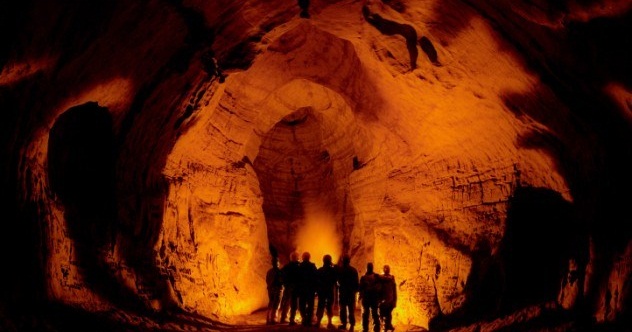

Humanity has always had a complicated relationship with the ground beneath its feet. We build houses on it, bury treasure in it, mine it for resources, and occasionally decide that an advanced civilization must be hiding inside it with glowing crystals, flying machines, and suspiciously excellent municipal planning.
Stories of subterranean civilization appear in archaeology, religion, folklore, speculative fiction, newspaper hoaxes, and modern conspiracy culture. Some began with genuine underground settlements. Others grew from spiritual traditions that were never intended as geography lessons. A few were simply imaginative novels that readers later promoted to “classified historical documents” without asking the authors.
The following strange tales range from real cities carved into volcanic rock to kingdoms that exist only in mythology. The key is knowing which is whichbecause an ancient ventilation shaft is evidence, while a man announcing that his homemade radio scanner has detected reptilian gold vaults under Los Angeles is, shall we say, a different category of information.
1. Derinkuyu: The Underground City That Actually Existed
A civilization hidden beneath Cappadocia
Derinkuyu is the perfect place to begin because it proves that people really did construct enormous underground communities. Located in Turkey’s Cappadocia region, the complex descends through numerous levels cut into relatively soft volcanic rock. Its chambers include storage rooms, food-preparation areas, wells, livestock spaces, ventilation shafts, and communal rooms.
Researchers generally believe that different populations expanded the site over many centuries. During periods of invasion or religious persecution, residents could retreat underground, seal passages with heavy circular stone doors, and survive with supplies stored below. Estimates of its capacity vary, but the city may have sheltered thousands of people and possibly as many as 20,000 at its busiest.
Derinkuyu was not a fantasy metropolis glowing around a miniature sun. It was something more impressive: a carefully engineered refuge created with hand tools, practical mathematics, and an obvious desire not to be found by unfriendly armies. Its existence also explains why later travelers were willing to believe even wilder tales of subterranean civilization. Once one underground city is real, the imagination quickly adds elevators and psychic energy weapons.
2. The Chincana Labyrinth Beneath Cusco
When an Inca tunnel legend met modern investigation
For centuries, stories in Peru described secret passages beneath Cusco, the former capital of the Inca Empire. The supposed network, called the chincana, was said to connect important locations such as the fortress of Sacsayhuamán and Coricancha, the great temple dedicated to the sun.
The legend became increasingly dramatic over time. Treasure hunters imagined chambers filled with Inca gold. Adventurers supposedly entered the tunnels and never returned. Some versions claimed that hidden descendants of the Inca still guarded sacred objects below the modern city.
Recent archaeological and geophysical investigations have given the basic tunnel tradition more credibility, although not the treasure-room embellishments. Researchers have reported underground structures and historical clues consistent with at least part of a constructed passage system. Such routes may have served ceremonial, defensive, drainage, or transportation purposes.
The fascinating point is that folklore preserved a possible memory of real architecture. However, evidence of tunnels does not automatically prove every later claim about lost emperors, vanishing explorers, or warehouses of untouched gold. Archaeology tends to move one careful measurement at a time; legends prefer to arrive riding a golden llama at full speed.
3. Agartha: The Kingdom at the Center of the World
An occult empire connected by global tunnels
Agartha, also spelled Agharta or Agharti, became one of the most influential legendary underground kingdoms of the modern era. Occult writers described it as a vast interior civilization populated by spiritually advanced masters. Depending on the storyteller, its capital was connected by tunnels to Tibet, Egypt, South America, and other ancient centers.
The tale developed through a mixture of Asian religious imagery, European occultism, adventure literature, and Hollow Earth speculation. In some versions, Agartha’s inhabitants quietly guided surface history. In others, they guarded scientific knowledge inherited from lost continents such as Atlantis or Lemuria.
No archaeological or geological evidence supports a worldwide tunnel empire. More importantly, Agartha should not be treated as an authentic summary of one Asian tradition. Western writers frequently blended unrelated Buddhist, Hindu, Mongolian, and Theosophical ideas into a convenient mystical package.
The legend remains popular because it offers a comforting reversal of ordinary geography. Instead of becoming hotter and more hostile as one descends, Earth supposedly becomes wiser, calmer, and better organized. Apparently enlightenment includes excellent tunneling infrastructure and no arguments about subway funding.
4. Shambhala and Its Underground Reinvention
A spiritual kingdom turned into a physical hideout
Shambhala occupies an important place in Tibetan Buddhist tradition, especially in teachings associated with the Kalachakra. It is generally described as a hidden or semi-mythical kingdom whose enlightened rulers preserve wisdom during an age of moral decline.
That religious concept was later transformed by Western occult writers. Instead of a sacred kingdom with symbolic and spiritual meanings, Shambhala became a physical headquarters beneath the Himalayas. Some authors merged it with Agartha, while others imagined technologically superior masters monitoring world events from underground temples.
This transformation shows how easily sacred geography can become conspiracy geography. A hidden spiritual realm becomes a cavern. A teaching about inner development becomes a map. An enlightened ruler becomes the administrator of a secret global government.
Traditional descriptions of Shambhala are far more complex than the simplified claim that monks know the entrance to an underground supercity. Scholars of Buddhism have repeatedly noted that foreign occult movements mixed the Shambhala tradition with unrelated beliefs. The subterranean interpretation therefore tells us more about modern fascination with secret societies than it does about Tibetan Buddhism.
5. The Vril-Ya and Their Terrifying Energy Source
How an 1871 novel escaped into conspiracy culture
In Edward Bulwer-Lytton’s 1871 novel The Coming Race, an explorer discovers an advanced subterranean people called the Vril-ya. They control a mysterious force known as Vril, which can heal, power machinery, influence minds, destroy enemies, and generally perform every task electricity was not yet fashionable enough to handle.
The underground society appears peaceful and highly developed, but it is hardly harmless. The narrator fears that the Vril-ya may eventually emerge and replace surface humanity. This mixture of utopia, technological anxiety, and possible extinction made the book an influential work of early science fiction.
The strange part came afterward. Some occultists began treating Vril as a real cosmic energy rather than a fictional device. Later conspiracy literature connected it with secret societies, psychic powers, flying craft, and supposed underground bases.
There is no credible evidence that Bulwer-Lytton was leaking classified information from a cavern civilization. The text is clearly presented as imaginative literature. Still, its afterlife demonstrates a recurring pattern: write an exciting fictional world, wait several decades, and someone will eventually insist it was a documentary.
6. John Cleves Symmes and the Polar Entrances
The American campaign to explore a hollow planet
In the early 19th century, American army officer John Cleves Symmes Jr. promoted the idea that Earth was hollow and accessible through enormous openings near the poles. He argued that the planet contained concentric interior spheres and potentially habitable regions.
Symmes did more than tell entertaining stories at dinner. He publicly circulated his theory and attracted supporters who hoped the United States would sponsor a polar expedition. One advocate, Jeremiah Reynolds, lobbied politicians and helped keep interest in polar exploration alive, although no expedition discovered a doorway into an inner world.
Modern geophysics leaves no room for Symmes’ giant polar holes. Seismic waves, gravity measurements, magnetic-field studies, heat flow, laboratory experiments, and planetary science reveal a layered Earth consisting of crust, mantle, liquid outer core, and solid inner core.
Symmes was wrong, but his theory had remarkable cultural endurance. It helped create a framework later used by novelists, occultists, and conspiracy theorists. His imagined openings became the express lanes through which nearly every later underground civilization could conveniently enter the story.
7. The Smoky God and the Inner-Earth Giants
A sailor’s alleged voyage beyond the North Pole
Published in 1908, Willis George Emerson’s The Smoky God presents the supposed testimony of a Norwegian sailor named Olaf Jansen. According to the narrative, Jansen and his father sailed through a polar opening and entered Earth’s interior.
There they encountered giant human beings, enormous plants, advanced transportation, and a luminous central object called the Smoky God. Rivers and oceans stretched across the inner surface of the planet, creating a habitable world concealed beneath ordinary civilization.
The book borrowed from earlier Hollow Earth theories while adding the personal tone of an explorer’s memoir. That format gave the fantasy an appearance of authenticity. Readers could imagine that the text was not a novel but a suppressed eyewitness report.
No navigational records, physical artifacts, independent testimony, or geological observations support Jansen’s voyage. The tale belongs to the tradition of fantastic travel literature. Nevertheless, it became a favorite reference for later Hollow Earth believers, particularly those who preferred their secret civilizations tall, peaceful, and equipped with indoor sunlight.
8. The Lemurian City Beneath Mount Shasta
White-robed survivors inside a California volcano
Mount Shasta in Northern California has accumulated an extraordinary collection of supernatural stories. The best-known subterranean tale claims that survivors of Lemuria, a lost Pacific continent, established an advanced city inside the mountain.
The modern legend developed partly from late-19th- and early-20th-century occult literature. Frederick Spencer Oliver’s A Dweller on Two Planets helped connect Lemurian survivors with Mount Shasta, while later mystical writers expanded the hidden settlement into a city sometimes called Telos.
Residents of the underground city are often described as tall, spiritually developed beings wearing white robes. They supposedly possess crystals, unusual technology, interdimensional travel, and a strong preference for appearing only when cameras are unavailable.
Mount Shasta is a real and geologically active volcano, but there is no evidence of a technologically advanced population living inside it. The Lemurian legend should also be distinguished from the sacred traditions of Indigenous peoples associated with the mountain. Modern occult stories borrowed the landscape while constructing an entirely different mythology around it.
9. The Lizard People’s City Under Los Angeles
A radio scanner, a treasure map, and one ambitious excavation
In 1934, newspapers reported that mining engineer G. Warren Shufelt was searching for a lost city beneath Los Angeles. Shufelt claimed to have mapped tunnels and chambers using a device described as a radio X-ray machine.
According to the story given to him by a Hopi informant named Chief Green Leaf, an ancient reptilian people had constructed an underground complex shaped like a giant lizard. The chambers supposedly contained golden tablets recording human history and valuable treasures preserved after an ancient catastrophe.
Shufelt obtained permission to dig near Fort Moore Hill and drilled a shaft, but the excavation produced no lizard-shaped metropolis, golden library, or reptilian city council. Work eventually stopped.
The episode blended speculative technology, misunderstood Indigenous material, Depression-era treasure fever, and the irresistible idea that downtown Los Angeles was sitting above something stranger than downtown Los Angeles. Original newspaper archives confirm that the search occurred, but they do not confirm the underground civilization itself.
10. The Egyptian Citadel Inside the Grand Canyon
A newspaper story that refused to stay buried
On April 5, 1909, the Arizona Gazette published a sensational report claiming that explorer G. E. Kinkaid had discovered an enormous cavern in the Grand Canyon. The article described rooms, statues, weapons, mummies, hieroglyphic writing, and objects supposedly showing an Egyptian or Asian connection.
The newspaper also claimed that the Smithsonian Institution was involved in the excavation. That detail gave the report an institutional shine, and the story became a foundation for later theories about Old World civilizations reaching ancient North America.
There is one major problem: the Smithsonian has no record of the expedition, Kinkaid, or the alleged archaeologist connected with it. No verified artifacts, field notes, photographs, maps, or excavation reports have surfaced. The Smithsonian has publicly classified the account as a hoax.
Grand Canyon contains numerous genuine caves and important archaeological sites, but none supports the newspaper’s Egyptian citadel. The tale survives because it combines lost treasure, institutional secrecy, ancient migration, and an inaccessible locationthe four essential food groups of a durable historical conspiracy.
Could a Vast Subterranean Civilization Really Exist?
Large underground spaces unquestionably exist. Natural caves can extend for hundreds of miles, while humans have created mines, shelters, temples, military installations, transportation systems, and settlements below ground. Derinkuyu demonstrates that an underground community can support thousands of people for limited periods.
A continent-sized civilization deep inside Earth is another matter. Such a society would require stable cavities, breathable air, water, food production, waste management, energy, and protection from extreme heat and pressure. It would also produce measurable effects through seismic activity, excavation waste, heat, chemical exchange, and surface connections.
Seismologists examine waves from earthquakes as they travel through the planet. Changes in their direction and speed reveal boundaries between Earth’s layers. These measurements consistently support a dense, layered interior rather than an enormous habitable shell. The scientific answer may sound less adventurous than a crystal palace beneath the North Pole, but it has the small advantage of being supported by observations.
Why Subterranean Civilization Tales Refuse to Disappear
Underground kingdoms survive in popular culture because they solve several storytelling problems at once. They explain missing peoples, mysterious ruins, unusual lights, hidden knowledge, and lost treasure. They also place the unknown directly beneath familiar landscapes.
The stories often reflect contemporary anxieties. Victorian authors imagined superior races controlling revolutionary energy. Depression-era treasure hunters searched beneath cities. Cold War audiences dreamed of hidden bases. Modern internet communities add extraterrestrials, portals, secret governments, and videos recorded vertically from very far away.
These tales are most interesting when treated as cultural artifacts rather than literal maps. They reveal what societies fear, admire, misunderstand, and hope to discover. Beneath every legendary civilization is another hidden world: the imagination of the people telling the story.
A 500-Word Subterranean Experience: Entering the World Beneath
Imagine beginning your exploration not with a forbidden tunnel or an internet map marked “government entrance,” but at a legally accessible archaeological site. The guide leads your group toward a narrow stone passage. Sunlight follows for several steps, weakens to a gray ribbon, and finally disappears behind a bend.
The temperature changes first. Even on a hot day, underground air can feel unexpectedly cool. Sound behaves differently as well. Footsteps become sharper, whispers travel farther, and the ordinary rustle of clothing suddenly seems important. Your brain, deprived of a distant horizon, begins measuring the world one wall at a time.
Inside a place such as Derinkuyu, the greatest surprise is not mystery but practicality. Openings in the ceiling supplied ventilation. Rooms were arranged for storage, cooking, livestock, worship, and communal activity. Narrow passages limited the movement of intruders. Rolling stone barriers could close critical entrances. Every feature answers a human problem.
That practical engineering makes the experience more powerful than fantasy. You can picture families carrying grain below, children learning the safest routes, guards listening near sealed doors, and residents waiting for danger to pass. The city was not designed for tourists seeking dramatic photographs. It was built because survival sometimes required an entire community to vanish.
Claustrophobia can appear even in visitors who have never experienced it before. A low ceiling may feel heavier after several minutes. A crowded corridor can make the air seem thinner, even when ventilation is adequate. Responsible guides therefore control group size, maintain lighting, identify exits, and prevent visitors from entering unstable or protected areas.
The same caution applies to caves and tunnels associated with legends. Never enter abandoned mines, sealed shafts, restricted archaeological areas, drainage tunnels, or unmarked cave systems. Such places may contain unstable rock, toxic gases, sudden flooding, vertical drops, wildlife, or confusing branches. A mysterious opening is not automatically an invitation. Sometimes it is simply geology holding a very effective “keep out” sign.
After returning to the surface, sunlight can feel almost theatrical. Colors appear brighter, the sky seems larger, and even ordinary traffic sounds oddly reassuring. This physical contrast helps explain why underground journeys have inspired spiritual stories. Descending resembles leaving the known world; emerging resembles rebirth.
A museum or visitor center can deepen the experience by showing maps, tools, pottery, construction methods, and timelines. Pay special attention to what archaeologists can demonstrate and what remains uncertain. A responsible interpretation should distinguish physical evidence from local folklore without mocking either. Folklore may preserve cultural memory, but it can also change as stories pass between languages, generations, and commercial storytellers.
Finally, record the experience with notes rather than conclusions. Describe the air, stone, layout, and emotions before deciding what the site “means.” Real underground history is extraordinary enough. It does not require invented giants, missing gold libraries, or reptilian engineers to become memorable. The deepest lesson of a subterranean journey is that human ingenuity already created wonders below our feetand reality, when given a flashlight, can be wonderfully strange.
Conclusion
The strangest tales of subterranean civilization occupy the shadowy territory between archaeology and imagination. Derinkuyu and the possible tunnels of Cusco show that real societies built remarkable worlds underground. Agartha, the Vril-ya, Mount Shasta’s Lemurians, and the Smoky God demonstrate how religion, fiction, and occult speculation can evolve into alleged history. The Los Angeles lizard city and Grand Canyon citadel reveal how a single newspaper story can outlive decades of correction.
There is no credible evidence of a planet-spanning civilization inside Earth. Yet the stories remain valuable when we ask why they were created, how they changed, and what they reveal about the cultures that repeated them. Humanity may not have found an inner-world empire, but it has built a very impressive underground archive of hopes, fears, rumors, and magnificent nonsense.