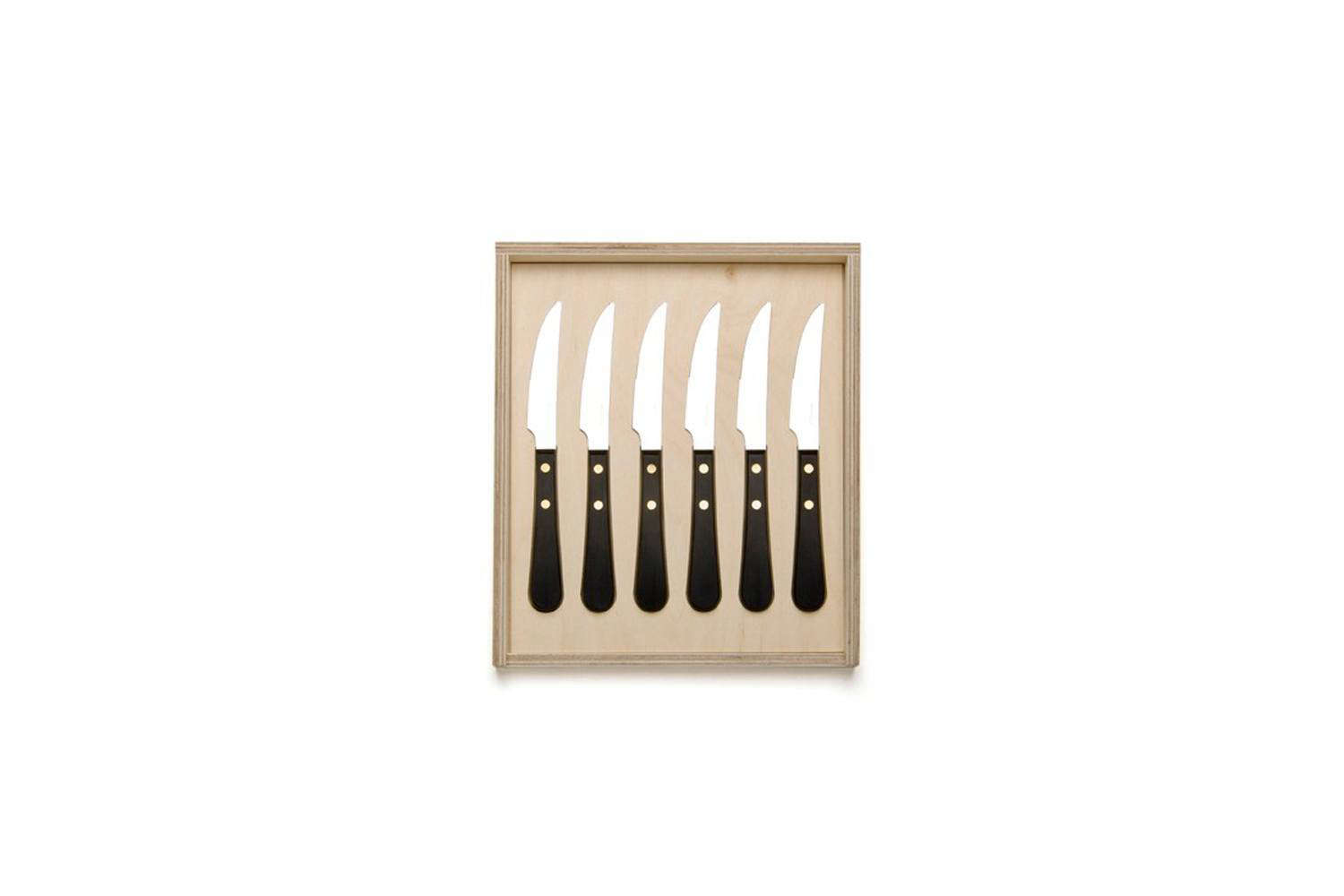

Some steak knives look as though they belong beside a backyard grill, wearing chunky handles and enough chrome to signal aircraft. The Provencal Black Steak Knife Set takes a quieter route. Designed by British metalworker and industrial designer David Mellor, the set combines clean stainless-steel blades, softly rounded black handles, brass rivets, and a wooden presentation box. It feels sophisticated without requiring the dining room to behave itself.
This is not merely a collection of sharp objects for attacking a ribeye. The Provençal design dates to the mid-1970s, yet its restrained shape still fits naturally beside modern stoneware, linen napkins, colorful ceramics, or everyday white plates. The set includes six serrated steak knives, each with a four-inch blade, stored in a purpose-made birch plywood box. The blades use high-carbon stainless steel, while the molded black handles are made from acetal resin and secured with brass rivets.
What Is the Provencal Black Steak Knife Set?
The Provencal Black Steak Knife Set is part of David Mellor’s long-running Provençal cutlery collection. Mellor introduced the collection in 1975, during a period when informal entertaining, seasonal cooking, and Mediterranean-inspired food were becoming increasingly influential. The design paired stainless steel with molded acetal resin, an unusual and forward-looking material combination at the time.
Rather than copying the slim, decorative silhouette of traditional French steak knives, the Provençal design uses a rounded, practical handle. Its curves give it a friendly café character, while the black finish and brass fasteners introduce just enough visual contrast. It is the sort of knife that can sit beside handmade pottery without looking too precious and beside formal china without arriving underdressed.
Key specifications
- Number of knives: Six
- Blade length: Approximately four inches
- Overall length: Approximately 8.375 inches
- Blade style: Serrated
- Blade material: High-carbon stainless steel
- Handle material: Molded black acetal resin
- Handle details: Brass rivets
- Storage: Birch plywood box with a sliding lid
The wooden box deserves more credit than storage boxes usually receive. It protects the serrations from knocking against other utensils, reduces the chance of someone discovering a sharp knife by surprise in a crowded drawer, and turns the set into a more complete gift. It also looks considerably better than a plastic tray that appears to have escaped from a hardware aisle.
Design Heritage: Why Provençal Still Looks Current
David Mellor was known for combining craftsmanship, industrial design, and practical manufacturing. His work extended beyond tableware to public objects and other functional products, but cutlery remained central to his reputation. The Provençal collection reflects his ability to make an everyday object distinctive without making it difficult to use.
The name “Provençal” suggests relaxed meals, fresh ingredients, shared dishes, and a table where nobody is urgently checking the time. The handles are gently rounded rather than sharply geometric. The exposed rivets give the knives a workshop-made honesty, while the black finish keeps them visually disciplined.
That combination helps explain the design’s longevity. Many products from the 1970s now require either nostalgia or an aggressively themed kitchen to feel at home. Provençal does not. Its materials and proportions remain relevant because the design was never dependent on decoration for its personality. Remodelista has previously included the set among notable steak-knife designs, while Heath Ceramics has carried David Mellor flatware alongside contemporary American tableware.
Blade Performance: What to Expect at the Table
High-carbon stainless-steel construction
The manufacturer describes the blades as top-grade stainless steel with a high carbon content. In practical terms, stainless steel is valued for corrosion resistance and relatively undemanding maintenance, while carbon contributes to hardness and edge performance. The exact steel alloy and hardness rating are not prominently specified in standard product listings, so shoppers should avoid assuming this is the same blade formula used in a forged professional chef’s knife.
That distinction does not make the blades unsuitable. A table knife has a different job. It needs to cut cooked meat reliably, feel comfortable during a meal, tolerate occasional contact with plates, and avoid demanding a whetstone ceremony every third Sunday.
Serrated edges: convenient but debated
The Provencal steak knives have serrated edges. Serrations can grip browned crust, connective tissue, poultry skin, sandwiches, firm vegetables, and other foods that resist a smooth initial cut. Because the pointed portions of a serrated blade do much of the work, these knives may continue to feel functional even after extended use.
However, culinary testers do not universally prefer serrated steak knives. Tests by Serious Eats, Epicurious, Food Network, and Bon Appétit have often favored sharp straight-edge models because they can create cleaner slices with less tearing. Serrated blades are also harder to sharpen at home because each scallop must be treated individually.
That does not mean every serrated knife mangles dinner like an enthusiastic garden tool. Serration patterns, blade thickness, sharpness, cutting angle, and the texture of the meat all affect performance. The Spruce Eats has found that well-designed serrated knives can cut effectively, while noting that straight edges are generally easier to restore. The real decision is whether you prefer low-maintenance grip or the cleanest possible slicing action.
Comfort and Handling
A steak knife may look beautiful in a photograph yet become irritating halfway through dinner. Handle comfort matters because the knife is used with a controlled pulling motion, often while the wrist is slightly elevated over a plate.
The Provençal handle has a broad, softly rounded profile instead of a narrow metal stem. The molded acetal resin should feel smooth and stable, while the rivets create subtle visual and tactile reference points. People who prefer substantial handles may find this shape easier to control than ultra-thin, all-metal steak knives.
The design is not especially ornate, but that is part of its charm. There are no decorative bees, imitation horn scales, oversized bolsters, or mysterious flourishes suggesting that the knife may have inherited a vineyard. Its personality comes from proportion and material contrast.
Who may enjoy the handle most?
- Diners who prefer rounded handles over narrow flatware
- Hosts who want black-handled knives that coordinate with modern table settings
- Buyers who like visible rivets and midcentury-influenced design
- People who value secure boxed storage
- Anyone assembling a full David Mellor Provençal flatware collection
How the Set Looks on a Dining Table
Black-handled flatware creates contrast without competing with the food. Against white plates, the knives form a crisp graphic line. Beside earthy stoneware, the brass rivets and rounded handles feel warmer and more relaxed. With dark plates, the stainless blades prevent the setting from becoming visually heavy.
The set works particularly well with:
- Natural linen napkins
- Handmade ceramic dinnerware
- Walnut, oak, or ash dining tables
- Matte black serving pieces
- Brass candlesticks or small brass accents
- Rustic French, Scandinavian, modern, or eclectic interiors
The knives are distinctive enough to be noticed, but they do not turn dinner into a cutlery exhibition. That balance is valuable. Guests should admire the table, not feel that touching it requires museum gloves.
What Can You Cut With These Knives?
Despite the category name, steak knives need not spend the year waiting for steak night. The short serrated blade can be useful whenever a standard dinner knife lacks enough bite.
Good everyday uses
- Ribeye, strip steak, sirloin, filet mignon, and flank steak
- Pork chops and lamb chops
- Roasted chicken and turkey
- Thick sandwiches and toasted panini
- Firm-skinned tomatoes
- Eggplant steaks and grilled portobello mushrooms
- Pizza crusts and flatbreads
- Roasted squash or other dense vegetables
A serrated table knife is especially convenient for foods with a firm exterior and softer interior. The teeth can establish the cut without requiring excessive downward pressure. Food Network similarly notes that serrated knives are useful when a blade must pass through a resistant surface without crushing what is underneath.
These are still dining knives, not miniature chef’s knives. They should not be used to chop bones, pry open packaging, loosen screws, or perform the many strange household jobs that innocent kitchen tools are forced to endure.
Cleaning and Caring for the Provencal Steak Knives
Although stainless steel and acetal resin are practical materials, hand washing is the safest routine for preserving the appearance and edge of premium knives. Knife manufacturers and consumer-care experts commonly recommend lukewarm water, mild dish soap, a nonabrasive sponge, and immediate drying. Dishwashers can expose blades and handles to high heat, aggressive detergent, water pressure, prolonged moisture, and collisions with other utensils.
Recommended cleaning routine
- Rinse the knife shortly after the meal so acidic sauces and salty residue do not remain on the blade.
- Wash it individually with mild dish soap and warm water.
- Wipe in the direction of the blade, keeping fingers away from the serrated edge.
- Dry the knife immediately with a soft towel.
- Return it to the birch plywood box only after it is completely dry.
Do not leave the knives soaking in a sink. Beyond possible finish damage, submerged knives are an unpleasant surprise for the next person reaching into the water. Dinner should produce leftovers, not an urgent-care anecdote.
Sharpening the serrations
Serrated blades usually need attention less frequently than straight blades, but sharpening them is more specialized. A tapered ceramic sharpening rod can be used carefully on individual scallops, although owners who are inexperienced with knife maintenance may prefer a professional sharpening service. Food & Wine and Epicurious both emphasize that serrated knives can be sharpened, but the process requires more precision than routine honing of a plain edge.
Storage: Why the Birch Box Matters
The included birch plywood box is not just packaging. Loose knives can collide with utensils, scrape against drawer interiors, and expose their edges to accidental contact. Dedicated storage helps maintain blade condition while keeping the set organized.
The sliding-lid box also solves a common steak-knife problem: these knives are used often enough to justify ownership but sometimes too infrequently to deserve permanent countertop space. The box can be stored in a drawer, cabinet, or sideboard and brought out when needed.
Proper storage is particularly useful for serrated knives because the teeth can catch on other objects. The box also makes it easier to confirm that all six knives have returned after dinner instead of allowing one to begin a new life beneath a stack of serving spoons.
Is the Provencal Black Steak Knife Set Worth It?
This set is best viewed as a combination of functional tableware and enduring industrial design. Less expensive steak knives can certainly cut meat. Some may even outperform premium serrated models in standardized sharpness tests. Price alone does not guarantee cleaner cuts, a point reinforced by comparative testing from Serious Eats and other culinary publications.
What the Provençal set adds is a coherent design language, recognizable heritage, durable materials, comfortable handles, six matching knives, and attractive storage. Buyers are paying partly for performance and partly for the pleasure of using a thoughtfully designed object.
The set makes sense for you if:
- You appreciate David Mellor or classic British industrial design.
- You want steak knives that coordinate with black-handled flatware.
- You prefer serrated blades that require infrequent maintenance.
- You regularly host meals for four to six people.
- You value a presentation box and gift-ready appearance.
Consider another set if:
- Your highest priority is a razor-clean, straight-edge cut.
- You want knives that are simple to sharpen at home.
- You need eight or twelve matching knives immediately.
- You prefer full-metal, wood, or natural-horn handles.
- You plan to place every utensil in the dishwasher without negotiation.
Serving Steak With the Set
A quality knife deserves meat that has been cooked and rested properly. For intact beef steaks, the USDA recommends a minimum internal temperature of 145°F followed by at least a three-minute rest. A food thermometer provides a more reliable safety check than judging doneness by color alone.
After cooking, allow the steak to rest before serving so its juices redistribute. Place the knife to the right of the plate with the blade facing inward. The Provençal knife works especially well with grilled ribeye, pepper-crusted strip steak, pork chops, roasted mushrooms, or any meal that needs more cutting authority than a standard table knife can provide.
For a visually balanced setting, repeat the handle’s black color elsewhere in small doses: a pepper mill, serving tray, candleholder, or napkin stripe. Avoid turning the entire table black unless the planned theme is “extremely elegant power outage.”
Extended Experience: Living With the Provencal Black Steak Knife Set
The most useful way to understand this set is to imagine how it behaves across several real meals rather than judging it only inside its wooden box. The following is a realistic ownership scenario based on the set’s documented dimensions, materials, blade style, and established steak-knife care practices; it is not presented as a personal laboratory test.
On the first evening, the knives make their strongest impression before anyone cuts anything. Opening the birch plywood box feels more intentional than pulling six loose knives from a drawer. The black handles sit neatly in formation, the brass rivets add warmth, and the stainless blades prevent the set from looking overly rustic. Guests may not know who David Mellor was, but they can tell that the knives were selected rather than accidentally accumulated.
With a medium-cooked New York strip, the serrated edge establishes a grip quickly. The knife does not need to be forced through the browned exterior. A short forward-and-back motion is more effective than pressing straight down. On a tender filet, the serrations may feel more aggressive than necessary because the meat offers little resistance. A sharp straight-edge knife would probably produce a smoother surface, but the Provençal still handles the task without requiring elaborate technique.
The rounded handle becomes more noticeable during a longer meal. It provides enough volume to hold comfortably, especially for diners who dislike thin, slippery utensils. The acetal resin does not have the organic texture of wood, but it also does not demand the same anxiety about moisture, swelling, or food stains. The handle feels practical rather than luxurious in the traditional sense. Its luxury comes from being well resolved.
At a second meal featuring pork chops, roasted potatoes, and grilled vegetables, the set’s versatility becomes clearer. The serrations move through browned pork edges and lightly charred vegetable skins with little hesitation. Cutting roasted eggplant or a portobello mushroom is easy because the blade can penetrate the exterior without flattening the softer center. The knives feel less like steak-only utensils and more like capable dinner knives for any substantial entrée.
Cleanup is where ownership habits matter. Placing the knives in a dishwasher would be convenient, but hand washing six small knives takes only a few minutes. Washing each one separately also avoids blade collisions and keeps the black handles looking polished. The knives should be dried before returning to the box; placing damp steel inside enclosed wooden storage is an unnecessary experiment in regret.
After several family meals, the box proves more valuable than it initially appears. It keeps the knives away from everyday forks and spoons and makes setting the table faster. There is no search for the sixth matching knife while dinner cools. The storage box also encourages owners to treat the set as a complete collection instead of gradually donating individual pieces to the mysterious dimension where missing utensils live.
For entertaining, six knives are a practical number. They cover a common dinner-party table without creating excessive storage requirements. The limitation appears when hosting eight people. Owners must either buy additional matching knives, mix in another pattern, or subtly hope that two guests order soup. Fortunately, the design is understated enough to coordinate with plain black-handled or stainless alternatives if perfect matching is not essential.
Over time, the main performance question will be how the serrations age. They should retain usable bite longer than many inexpensive smooth blades, but restoration is less straightforward when dullness finally appears. Professional sharpening may be the sensible choice. This tradeoff captures the entire ownership experience: the knives offer convenience, visual character, and durable everyday usefulness, but they are not designed for enthusiasts who enjoy regularly sharpening straight edges to surgical levels.
The lasting pleasure is surprisingly simple. These knives make an ordinary dinner feel considered. They do not need a white tablecloth, an expensive bottle of wine, or a steak with its own biography. Even a Tuesday pork chop looks better beside one. That is often the real value of good tableware: it does not merely perform a task; it makes people slightly happier to sit down and perform the ritual of eating together.
Conclusion
The Provencal Black Steak Knife Set succeeds because it offers more than sharp blades. Its six serrated high-carbon stainless-steel knives combine practical cutting performance with rounded black handles, brass rivets, a compact four-inch blade, and a protective birch plywood box. The design’s 1970s origins add genuine heritage, yet the set remains visually compatible with contemporary kitchens and relaxed American dining.
Straight-edge enthusiasts may prefer a knife that creates cleaner slices and can be sharpened easily. Buyers seeking low-maintenance serrations, comfortable handles, distinctive styling, and organized storage will find the Provençal set more compelling. It is elegant without being fragile, recognizable without being flashy, and useful for far more than steak. In other words, it is tableware for people who care about design but still plan to eat dinner.