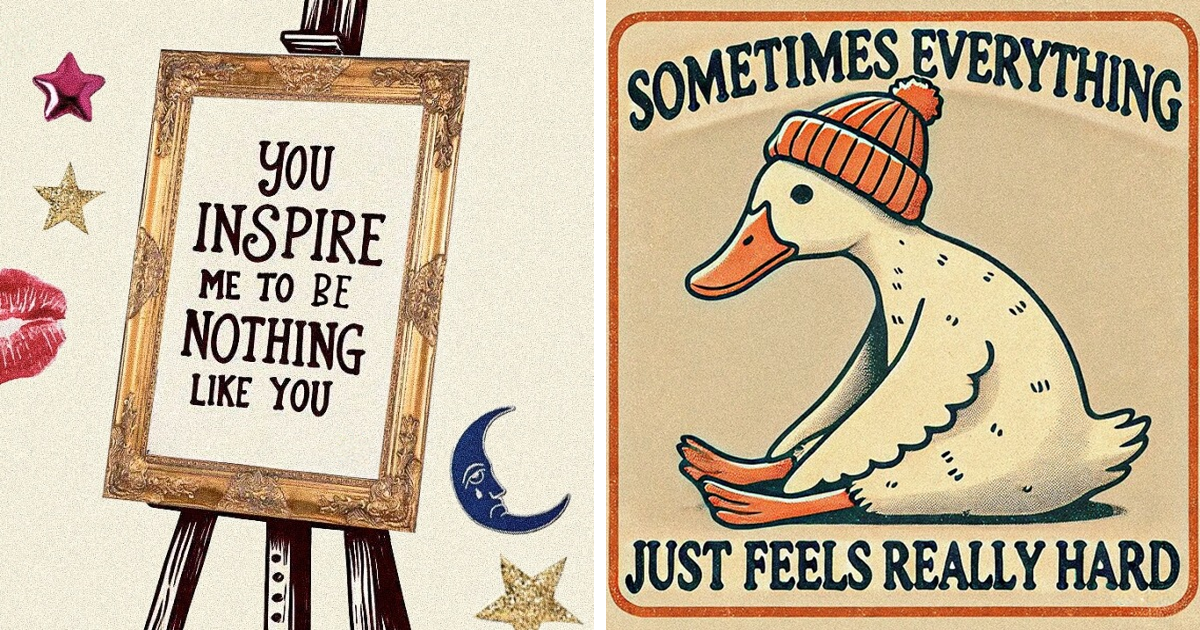

Some thoughts are too shy to walk into a room by themselves. They need a little costume: a heart-shaped cake, a sad duck, a turtle carrying an entire emotional ecosystem on its back. That is the magic behind “You Deserve Better”: 36 relatable inner thoughts illustrated by artist Adeline KM, known online as @addstronaut. Her work turns private feelings into colorful, tender, slightly weird, and deeply human images that make viewers think, “Oh no, it’s me,” followed immediately by, “Thank goodness, it’s not just me.”
Adeline is a Michigan-based graphic artist, corporate graphic designer, and small business owner whose visual world blends handwritten phrases, playful characters, lowbrow art energy, and the kind of emotional honesty usually found in 2 a.m. journal entries. Her illustrations often feel like sticky notes from the soul: vulnerable, funny, comforting, and occasionally rude to your inner critic in the nicest possible way.
The phrase “you deserve better” sits at the center of the collection because it is simple, direct, and strangely difficult to believe when you need it most. Many people can encourage a friend with Oscar-worthy sincerity but speak to themselves like a disappointed middle manager holding a clipboard. Adeline’s illustrations gently interrupt that habit. They do not shout, “Heal immediately!” Instead, they whisper, “Hey, maybe stop treating yourself like expired leftovers.” Progress, truly.
Who Is the Artist Behind @addstronaut?
Adeline KM, also called Addy, is the creator behind Addstronaut. Her online bio describes her as a graphic artist from Michigan and, wonderfully, a “highly emotional being.” That line is not just cute branding; it is practically a mission statement. Her art embraces the feelings many people try to edit out of themselves: neediness, softness, fear, grief, desire, confusion, and the very specific panic of wondering whether you are “too much.”
In interviews, Adeline has described art as her therapy. That does not mean her work should be confused with clinical art therapy, which is a regulated mental health profession involving trained art therapists and a psychotherapeutic relationship. But it does explain why her illustrations feel less like polished motivational posters and more like emotional field notes. She reportedly keeps a small notebook for ideas, then develops them through sketching and digital tools such as Procreate, Illustrator, and Photoshop. In other words: first the feeling attacks, then the notebook catches it, then the software makes it pretty enough to hurt responsibly.
Her shop and social presence show a wide range of prints, shirts, stickers, tote bags, and wearable pieces with titles that read like fragments of a private diary: “Don’t Be Afraid To Take Up Space,” “Not Mine To Carry,” “I Am Trying Not To Drown,” and “Thank You for Not Finding Me Too Much.” These are not vague inspirational slogans. They are tiny emotional doorways.
Why These Illustrated Inner Thoughts Feel So Relatable
The best relatable art does not tell us something brand-new. It tells us something we already knew but had not managed to say out loud. That is why a simple illustrated phrase can land harder than a five-paragraph inspirational speech from someone drinking celery juice at sunrise.
Adeline’s work resonates because it gives shape to invisible mental weather. Anxiety becomes a creature. Self-doubt becomes a poster. Hope becomes a flower. Exhaustion becomes an animal with eyes that clearly need a nap and possibly a snack. When feelings are turned into images, they become less abstract. You can look at them, name them, laugh with them, and sometimes put them on a wall instead of letting them run unsupervised through your nervous system.
Words Plus Images Create Emotional Shortcuts
Comics and illustrated text work because words and visuals do different jobs at the same time. A sentence delivers the thought; the image delivers the mood. A phrase like “you deserve better” might sound simple in plain text, but pair it with a tender, handmade-looking image and it becomes warmer. It feels less like a command and more like a friend sliding a cupcake across the table after a terrible day.
This is especially powerful online, where people scroll quickly and attention spans sometimes resemble a squirrel drinking espresso. A single image can pause the scroll because it communicates instantly. The viewer sees the colors, reads the phrase, recognizes the feeling, and suddenly the internet is not just noise; it is a mirror with doodles.
The Main Themes in “You Deserve Better”
The 36 illustrated thoughts in this collection circle around emotional honesty, self-worth, tenderness, loneliness, and the messy work of becoming kinder to yourself. The themes are not presented like a lecture. They arrive through animals, stars, cakes, mushrooms, moons, flowers, handwritten lines, and surreal little scenes that feel charming before they quietly punch you in the heart.
1. Self-Worth Without the Corporate Pep Talk
“You deserve better” is a phrase many people need but resist. Better treatment. Better boundaries. Better rest. Better love. Better self-talk. Better snacks, frankly, depending on the day.
Adeline’s art does not package self-worth as perfection. It does not say you deserve better because you are flawless, productive, photogenic, hydrated, and caught up on emails. It suggests you deserve better because you are human. That distinction matters. Self-worth should not require a résumé, a waist measurement, or the ability to answer texts within a socially acceptable time frame.
2. The Fear of Being “Too Much”
One of the recurring emotional currents in Addstronaut’s world is the fear of being overwhelming. Too emotional. Too needy. Too intense. Too honest. Too weird. Many sensitive people spend years trying to become “easy to love,” which often means becoming very quiet about their actual needs. This is exhausting and, as a long-term personality strategy, has the structural integrity of wet cardboard.
Art that says “thank you for not finding me too much” gives language to that fear. It also gives readers permission to imagine relationships where their full emotional volume is not treated like a technical problem.
3. Boundaries and Emotional Weight
Another powerful theme is learning what is “not mine to carry.” This idea has become popular for good reason. Many people move through life as unpaid emotional moving companies, hauling guilt, family expectations, other people’s moods, and old shame up six flights of stairs with no elevator.
Illustrations about release, heaviness, and carrying too much can help readers ask better questions: Is this responsibility actually mine? Am I helping, or am I disappearing? Am I being kind, or am I auditioning for the role of Human Doormat Number Three?
4. Vulnerability as a Strength, Not a Leak in the Roof
Adeline’s style makes vulnerability look alive. It is not presented as weakness or melodrama. It is shown as something strange, colorful, and sometimes beautiful. That matters because people often treat vulnerability like an embarrassing software bug. But sharing honest feelings, even indirectly through art, can create connection. It tells the viewer, “Someone else has been here too.”
Art as Therapy vs. Art Therapy
It is important to make a clear distinction: making art can be therapeutic, but it is not the same as professional art therapy. Clinical art therapy is practiced by trained professionals who use art-making, psychological theory, and therapeutic relationships to support mental health. That said, everyday creative expression can still be meaningful. Drawing, journaling, collage, digital illustration, music, crafts, and writing can help people process emotion, reduce stress, and organize thoughts that otherwise feel like a drawer full of tangled headphones.
Research and mental-health organizations have increasingly recognized the value of creative activities for well-being. Creative expression may help people feel more confident, less stressed, and more able to express difficult thoughts. The key is not artistic perfection. Nobody needs to produce a museum masterpiece to benefit from making something. Sometimes the most healing drawing is a lopsided frog labeled “I am doing my best.” If the frog speaks the truth, the frog has done its job.
Why “Relatable” Art Matters in the Social Media Era
Social media can be a carnival of comparison. Everyone is glowing, traveling, launching, healing, thriving, and somehow making overnight oats in matching glass jars. Against that backdrop, vulnerable illustration feels refreshing because it admits what many people experience behind the scenes: self-doubt, loneliness, emotional fatigue, awkward growth, and the recurring suspicion that everyone else received a life manual and you got a coupon for socks.
When an artist posts a tender inner thought, the comment section often becomes a little gathering place. People tag friends, say “this is me,” or confess that they needed to see those words today. That shared recognition can soften isolation. It does not solve every problem, but it can create a small bridge. In a digital world that often rewards performance, vulnerable art rewards recognition.
How Adeline’s Style Balances Sadness and Whimsy
A major reason Addstronaut’s illustrations work is the balance between emotional seriousness and visual play. Heavy themes are wrapped in bright colors, stars, animals, flowers, desserts, moons, and dreamy compositions. The result is not depressing. It is tender with a wink.
This balance makes the work approachable. A direct statement about emotional pain can feel intimidating. But place that feeling inside a whimsical image and the viewer can come closer. Humor and cuteness act like emotional oven mitts: they let us handle hot feelings without burning our fingers off.
The art also avoids the overly polished look that can make inspirational content feel mass-produced. The handwritten quality matters. It suggests a person behind the image, not a committee of beige wellness robots. Imperfection becomes part of the intimacy.
What Readers Can Learn From These 36 Inner Thoughts
The collection invites readers to practice a few quiet skills. First, naming emotions. A feeling becomes less mysterious when it has words. Second, questioning harsh self-talk. If the voice in your head says you are undeserving, unlovable, or too much, ask whether that voice is wise or just loud. Many terrible inner critics behave like they own the building because nobody has asked to see their lease.
Third, the artwork encourages self-compassion. That does not mean pretending everything is fine. It means responding to pain with care instead of punishment. It means replacing “What is wrong with me?” with “What do I need right now?” This is a small wording change with big emotional furniture-moving potential.
Finally, the collection reminds us that creativity is not reserved for “real artists.” If you have a thought, a pen, and a willingness to make something imperfect, congratulations: the emotional kitchen is open.
How to Use This Kind of Art for Reflection
Readers who connect with Adeline’s illustrations can turn that connection into a simple reflective practice. Choose one image or phrase that hits a nerve. Then ask yourself three questions: What feeling does this name for me? Where does this show up in my life? What would “better” look like in one small, realistic way?
For example, if “you deserve better” brings up a relationship, better might mean asking for clearer communication. If it brings up burnout, better might mean resting before your body files a formal complaint. If it brings up self-talk, better might mean replacing insults with neutral, factual statements. You do not have to leap from “I am a disaster” to “I am a radiant galaxy genius.” Start with “I am having a hard moment, and I can take one next step.” Neutrality is often the bridge to kindness.
Experience: Meeting Yourself in an Illustration
The first time a piece of relatable art really hits you, it can feel oddly dramatic. You are just scrolling. You did not sign up for an emotional appointment. You were looking for memes, recipes, or proof that someone else also hates folding fitted sheets. Then suddenly there it is: a little drawing with a sentence that describes a feeling you have been carrying quietly for months. Rude? Yes. Helpful? Also yes.
That is the experience many readers have with art like Addstronaut’s. The image does not need to know your entire history. It only needs to touch one true thing. Maybe you see “you deserve better” and think about the job that drains you, the friendship where you are always the emergency contact but never the celebrated guest, or the way you apologize before asking for basic respect. Maybe you laugh first because the illustration is cute. Then the second wave arrives: recognition.
There is something comforting about seeing difficult emotions drawn in a playful way. It makes the feeling less monstrous. A painful thought becomes an object on the table. You can examine it. You can move it around. You can say, “Ah, yes, that is my fear of being too much wearing a party hat.” The party hat does not fix everything, but it does make the fear less powerful. Sometimes that is enough to breathe.
Relatable inner-thought art can also become a conversation starter. Sending a friend an illustration may feel easier than writing, “Hello, I am emotionally underwater and trying not to become a decorative shipwreck.” The picture speaks first. The friend responds. Suddenly, there is connection where there might have been silence.
For creators, the experience works from the other side. Making art out of a private thought can feel scary because it asks, “What if nobody understands?” But when people do understand, the fear transforms. The thought is no longer trapped inside one person. It becomes shared language. That is why vulnerable art matters. It proves that softness can travel. It proves that one person’s messy notebook can become another person’s moment of relief.
And for anyone who wants to try it, the process does not need to be fancy. Write down one sentence you are afraid to admit. Draw a shape around it. Add stars, a frog, a moon, a suspiciously emotional sandwichwhatever feels right. The goal is not perfection. The goal is honesty with a little color on it. In a world that often asks people to be efficient before they are real, making something tender is a tiny rebellion. A glittery one, ideally.
Conclusion: You Deserve Better, and Maybe a Cute Drawing Too
“You Deserve Better”: 36 relatable inner thoughts illustrated by this artist is more than a gallery of pretty images. It is a reminder that the private voice inside your head deserves gentleness, not constant courtroom cross-examination. Adeline KM’s Addstronaut work succeeds because it understands a very human truth: people do not always need grand advice. Sometimes they need one clear sentence, one honest image, and one small reason to feel less alone.
Her illustrations turn emotional clutter into visual poetry. They make room for softness without making it cheesy, humor without making it dismissive, and vulnerability without making it feel like a public speaking assignment in front of your entire middle school. Whether you are drawn to the colors, the handwritten phrases, the strange little creatures, or the tender honesty, the message is the same: your inner world is worth noticing. Your feelings are not too big. Your needs are not ridiculous. And yes, in case nobody has told you lately, you probably do deserve better.