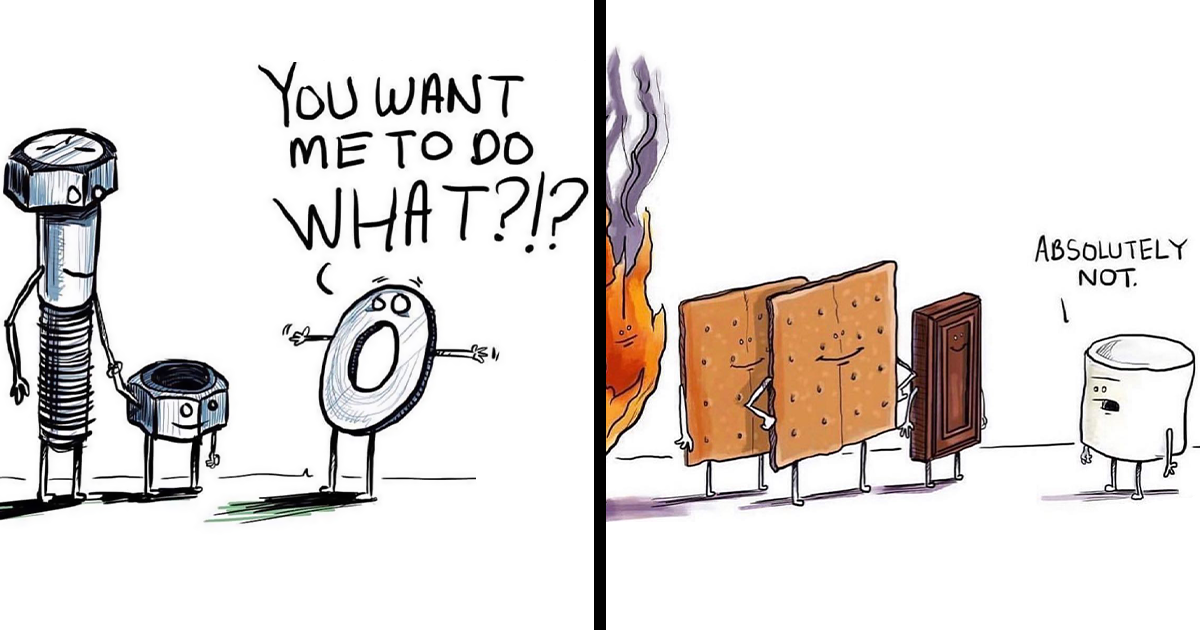

Some comics need a sprawling storyline, a dramatic villain, and enough lore to make your browser beg for mercy. Then there are one-panel comics: tiny, sharp, ridiculous little joy bombs that arrive, make a joke, and leave before you can overthink them. That is exactly the charm behind The Daily Dunc, the comic universe created by artist Dylan Duncan, where everyday objects suddenly have opinions, emotions, awkward social lives, and occasionally the confidence of a dad joke at a barbecue.
The collection titled “25 Funny One-Panel Comics By ‘The Daily Dunc’ That Might Make You Giggle” taps into a very specific kind of humor: simple drawings, clever setups, and punchlines that make you laugh because they are both silly and weirdly relatable. A mop can have drama. A snack can have boundaries. A vegetable can become the star of a tiny emotional crisis. In The Daily Dunc, the ordinary world is not ordinary at all; it is just waiting for someone to give it a speech bubble and a mild identity problem.
Who Is Behind The Daily Dunc?
The Daily Dunc is the comic project of Dylan Duncan, an illustrator, painter, comic artist, and designer based in the Boston area. His broader creative work includes digital illustration, painting, drawing, design, and comic art, but The Daily Dunc is especially known for giving inanimate objects a playful inner life.
What makes the series easy to enjoy is its low-pressure entry point. You do not need to know a backstory, memorize character names, or decode a complicated universe. You see the object, you notice the situation, and then the joke lands. Sometimes it is a pun. Sometimes it is an absurd twist. Sometimes it is the kind of joke that makes you groan first and laugh two seconds later, which is honestly one of comedy’s most underrated delivery systems.
Why One-Panel Comics Work So Well
One-panel comics are deceptively difficult. They look simple because the reader only sees one frame, but that frame has to do everything at once. It must introduce the characters, establish the situation, set the tone, and deliver the punchline without the luxury of multiple panels. That is like trying to host a dinner party inside an elevator.
The Library of Congress describes gag cartoons as a blend of punchlines and scenarios designed to make readers laugh, often using visual puns, social discomfort, family awkwardness, and language play. That definition fits The Daily Dunc beautifully. The series often takes a familiar object and gives it a surprisingly human reaction: embarrassment, confidence, confusion, jealousy, anxiety, or the quiet horror of being used for chores.
The Magic of the Instant Joke
A strong one-panel comic has to be understood quickly, but not so quickly that it feels empty. The best examples create a tiny delay in the reader’s brain. First you see the drawing. Then you read the caption or dialogue. Then your brain connects the two. That half-second of discovery is where the giggle lives.
The Daily Dunc often uses this rhythm with everyday objects. A food item may misunderstand its own name. A household tool may complain about its job. A plant, utensil, or appliance may behave like a person stuck in an awkward conversation. The humor is not loud or aggressive; it is compact, playful, and built for people who enjoy the little absurdities hiding in plain sight.
What Makes The Daily Dunc Comics So Funny?
The humor in The Daily Dunc comics comes from a few reliable ingredients: personification, puns, relatable frustration, clean visual design, and a willingness to be wonderfully ridiculous. The comics do not try to impress readers with complexity. Instead, they trust a simple idea: if a toothbrush, avocado, mop, or coffee mug had feelings, life would be much funnier and possibly much more dramatic.
1. Everyday Objects Become Tiny Comedians
Personification is the engine of the series. By giving ordinary things faces, voices, and emotions, The Daily Dunc turns the background of daily life into a cast of characters. A pencil is no longer just a pencil; it might be insecure. A snack is not just a snack; it might be flirting with danger. A cleaning product may have workplace complaints. Suddenly, your kitchen counter feels like it is hosting a sitcom.
2. The Puns Are Proudly Punny
Puns are risky. A bad pun can make people groan. A good bad pun can make people groan and laugh, which is basically a comedy two-for-one coupon. The Daily Dunc leans into wordplay with confidence. Many of the jokes depend on double meanings, object names, food phrases, and visual misunderstandings. The result is humor that feels light, fast, and easy to share.
3. The Art Style Keeps the Joke Clear
One strength of Dylan Duncan’s comic style is clarity. The drawings are simple enough to read instantly but expressive enough to sell the emotion. In one-panel humor, every detail matters. Too much clutter can bury the joke. Too little expression can flatten it. The Daily Dunc usually finds a sweet spot: clean scenes, readable characters, and just enough facial expression to make an object look deeply committed to its nonsense.
Why These 25 Comics Are Perfect for Quick Laughs
A collection of 25 funny one-panel comics is the ideal size for casual browsing. It is long enough to feel satisfying but short enough that you can enjoy it during a coffee break, between emails, or while pretending to check something extremely important on your phone. No judgment. We have all attended the sacred meeting of “just one more comic.”
The Daily Dunc works especially well in a list format because each comic is self-contained. You can jump in anywhere. There is no required order, no complicated continuity, and no emotional homework. Each panel is a little comedic postcard from a world where objects are alive and apparently have better timing than most humans.
The Role of Relatable Humor
Even though the characters are often objects, the feelings behind the jokes are very human. That is one reason the comics resonate. Readers recognize the mood even when the speaker is a banana, a lamp, or a piece of furniture. The jokes often echo familiar experiences: exhaustion, social awkwardness, insecurity, frustration, overconfidence, and the small indignities of daily routine.
This is where The Daily Dunc becomes more than just cute object humor. The comics remind us that comedy does not always need a huge setup. Sometimes it only needs a familiar feeling placed in the wrong body. A tired human is normal. A tired household object complaining like it just worked a double shift? That is comedy wearing tiny cartoon shoes.
How The Daily Dunc Fits Into the One-Panel Comic Tradition
Single-panel cartoons have a long history in American humor, from magazine gag cartoons to newspaper panels and modern webcomics. The format rewards economy. The artist has one image and maybe a few words to make the reader understand the entire joke. That makes the form perfect for sharp observations and visual wordplay.
The Daily Dunc carries that tradition into the social media age. Like many modern webcomics, it is built for quick reading and easy sharing. The jokes are compact, the visuals are clear, and the tone is friendly enough to appeal to readers who want a laugh without diving into heavy satire or long narratives.
Why Social Media Loves This Kind of Comic
Social media feeds move quickly, and one-panel comics are naturally suited to that environment. A reader can understand the joke in seconds, react, share, and keep scrolling. That does not mean the art is disposable. In fact, the best short-form comics often linger because they deliver a complete idea with impressive efficiency.
The Daily Dunc’s object-based humor is also highly accessible. People from different backgrounds can recognize a mug, a fork, a mop, or a snack. The situations may be absurd, but the visual language is universal. You do not need niche knowledge to understand why a household item having a mini meltdown is funny. You just need to have lived indoors at least once.
Specific Examples of The Daily Dunc’s Comic Appeal
Without needing to reproduce the comics themselves, we can describe the kind of scenarios that make this collection entertaining. Food items often become characters with surprisingly dramatic social lives. Cleaning tools may feel like reluctant employees. Office supplies can become insecure, competitive, or oddly philosophical. Nature, snacks, appliances, and furniture all become potential punchline machines.
The funniest examples usually work because the object’s real-world function collides with a human emotion. A mop exists to clean, but what if it felt insulted? A s’more is made of ingredients stacked together, but what if that arrangement became a joke about relationships? A nut, fruit, or vegetable can become funny simply because its name has another meaning. That is the heart of The Daily Dunc’s style: take the obvious thing, twist it slightly, and let the reader’s brain do the happy little somersault.
Why The Humor Feels Friendly Instead of Mean
A lot of online humor depends on sarcasm, outrage, or dunking on someone. The Daily Dunc usually feels gentler. It is more interested in goofy observations than cruelty. The jokes may be cheeky, and some punchlines may have a mischievous edge, but the overall tone is warm. It is the kind of humor that wants to make your day a bit lighter, not start a comment-section thunderstorm.
That friendly quality matters. In a digital world packed with bad news, arguments, and people typing in all caps like their keyboard owes them money, a simple comic about a talking object can feel weirdly refreshing. It is not trying to solve the world. It is trying to make you giggle. That is a noble mission, and frankly, the mop deserves a medal.
What Readers Can Learn From The Daily Dunc
Beyond the laughs, The Daily Dunc offers a useful creative lesson: humor often begins with noticing. The series asks a playful question again and again: what if this ordinary thing had a point of view? That question is powerful because it can turn almost anything into a story.
Writers, artists, bloggers, and social media creators can learn from that approach. Instead of chasing huge ideas, start with a small observation. Look at a pencil, a sink, a sandwich, or a pair of socks. Ask what it wants, what it fears, what it misunderstands, or what it would complain about after a long day. Congratulations, you are now dangerously close to making a comic.
Experience Section: Reading 25 Daily Dunc Comics in One Sitting
Reading a batch of 25 funny one-panel comics by The Daily Dunc feels a bit like opening a junk drawer and discovering that every item inside has been waiting years to perform stand-up comedy. At first, you think you are just looking at a quick cartoon. Then the pattern becomes clear: the ordinary world has been quietly ridiculous this entire time, and Dylan Duncan has simply been polite enough to point it out.
The experience is best when you let yourself slow down for each panel. One-panel comics are quick, but they are not always disposable. The drawing often sets up one expectation while the caption or dialogue flips it. That tiny mental flip is the fun part. You look at an object you have seen a thousand times, then suddenly it has a personality, a motive, and maybe a questionable social life. By the fifth or sixth comic, your brain starts helping. You begin imagining faces on things around you. The coffee mug looks tired. The desk lamp seems judgmental. The refrigerator is definitely hiding secrets.
What makes the experience especially enjoyable is how low-stress it is. There is no pressure to understand a complicated storyline or catch up on years of lore. You can read one comic, smile, and leave. Or you can read all 25 and let the jokes build into a mood: light, silly, and pleasantly offbeat. It is the kind of humor that works well at the end of a long day because it does not demand much from you. It simply taps you on the shoulder and says, “What if this avocado had timing?”
Another part of the fun is recognizing how much craft hides behind the simplicity. A one-panel comic cannot waste space. The expression, the object choice, the wording, and the composition all have to work together. When a joke lands, it feels effortless, but that effortlessness is usually the result of careful editing. The best Daily Dunc comics make you feel as though the punchline was inevitable. Of course that object would say that. Of course that pun was waiting there. Of course a household item has been emotionally processing its purpose while we were all busy paying bills.
The collection also leaves a surprisingly cheerful aftereffect. Once you have spent a few minutes in The Daily Dunc’s world, daily life becomes slightly more animated. A spoon is not just a spoon. A plant is not just a plant. A roll of tape may be going through something. That is the real charm of the series: it does not just make you laugh at the comic; it changes the way you look at the little things around you. And if a cartoon can make your kitchen feel like a comedy club, even for a minute, that is a pretty good return on your scrolling investment.
Conclusion
“25 Funny One-Panel Comics By ‘The Daily Dunc’ That Might Make You Giggle” is more than a collection of quick jokes. It is a reminder that humor can live in the smallest places: a snack, a tool, a plant, a piece of furniture, or a pun that absolutely refuses to apologize. Dylan Duncan’s comic style works because it is clear, playful, and rooted in the delightful idea that everyday objects might be just as confused by life as we are.
For fans of one-panel comics, visual puns, funny webcomics, and lighthearted cartoon humor, The Daily Dunc is easy to recommend. It is quick enough for a break, clever enough to reward attention, and silly enough to make you laugh even when you were fully prepared to remain a serious adult. Good luck with that.