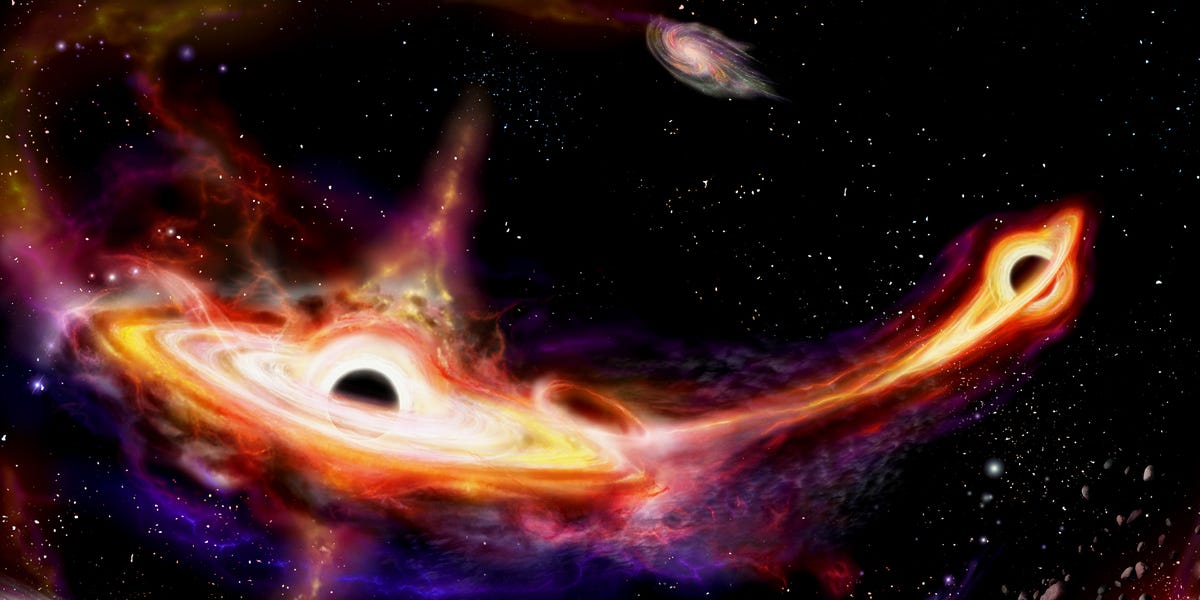

Somewhere in the constellation Aquarius, far beyond the reach of any spacecraft we have built and safely outside the “cancel your weekend plans” zone, two supermassive black holes are moving toward a dramatic cosmic union. Astronomers studying the galaxy NGC 7727 have confirmed that it contains the closest known pair of supermassive black holes to Earth, and these gravitational giants are expected to merge into one even larger black hole in the distant future.
Before anyone starts pricing underground bunkers, let’s be clear: “near Earth” is doing some heavy astronomical lifting here. The black hole pair sits about 89 million light-years away. That is nearby in cosmic terms, the way a grocery store on the other side of the country is “nearby” if your map is the size of the Milky Way. Earth is not in danger. The real story is not doom. It is discovery.
This system gives scientists a rare front-row seat to one of the most important processes in galaxy evolution: what happens when galaxies collide, their central black holes sink toward each other, and gravity begins preparing the universe’s slowest heavyweight title fight.
What Exactly Did Astronomers Find?
The action is happening in NGC 7727, a peculiar galaxy in Aquarius that looks slightly scrambled because it is the aftermath of an ancient galactic merger. When two galaxies combine, stars, gas, dust, and dark matter get rearranged into new structures. Their central black holes do not immediately crash together like billiard balls. Instead, they slowly drift inward over millions or billions of years, losing energy through gravitational interactions with nearby stars and gas.
In NGC 7727, astronomers confirmed two supermassive black holes separated by only about 1,600 light-years. That is still an enormous distance by human standards, but for supermassive black holes inside a merged galaxy, it is remarkably close. One black hole is estimated at roughly 154 million times the mass of the Sun, while the smaller companion weighs in at about 6.3 million solar masses. In other words, the “small” one is still a cosmic heavyweight that would make our solar system feel like a decorative snow globe.
The pair is expected to merge within roughly 250 million years. That sounds like forever, because it is. Dinosaurs appeared, ruled, and vanished in less time than that. But for galaxy evolution, 250 million years is not an eternity; it is more like a long afternoon with dramatic background music.
Why This Pair Matters So Much
Supermassive black holes are found at the centers of most large galaxies, including our Milky Way. Our home galaxy contains Sagittarius A*, a black hole about 4 million times the mass of the Sun. These objects are not just cosmic vacuum cleaners. They help shape galaxies by influencing gas flows, star formation, and the energetic activity of galactic cores.
The NGC 7727 discovery matters because it offers direct evidence of a dual supermassive black hole system at a relatively close distance. Many black hole pairs may be hiding in plain sight, especially if they are not actively feeding. When a black hole consumes nearby gas, the material heats up and shines brightly in X-rays, optical light, or radio waves. But if the black hole is quiet, it becomes extremely difficult to detect. It is still there, bending space and bossing stars around, but it does not announce itself with fireworks.
That is what makes NGC 7727 so valuable. The two black holes were confirmed not simply because they were glowing like cosmic neon signs, but because scientists studied the motion of stars around them. Stars near the centers of galaxies move under the influence of gravity. If they are orbiting faster than expected, something very massive is likely nearby. In this case, that “something” turned out to be two supermassive black holes.
How Do Black Holes Merge?
Black hole mergers are not quick collisions. They are long, complicated gravitational dances. First, two galaxies merge. Then their central black holes gradually sink toward the center of the newly combined galaxy through a process called dynamical friction. This happens when massive objects move through a background of stars and gas, creating gravitational disturbances that drain orbital energy.
Eventually, the two black holes may form a bound pair. As they orbit each other, interactions with stars and gas continue shrinking the orbit. In the final stage, gravitational waves carry away energy. These ripples in space-time were predicted by Albert Einstein and directly detected for the first time by LIGO in 2015 from the merger of stellar-mass black holes.
Supermassive black hole mergers are different from the smaller black hole collisions LIGO regularly detects. Because supermassive black holes are vastly larger, they generate gravitational waves at much lower frequencies. These waves are too slow for ground-based detectors like LIGO, but future space-based observatories such as LISA are designed to listen for them. Think of LIGO as hearing sharp cosmic chirps, while LISA will be built to hear the deep bass notes of galaxy-sized black hole mergers.
Is This “Monster” Dangerous to Earth?
No. Not even a little. The word “monster” is scientifically fair in terms of mass, but it can be misleading if readers imagine a black hole stomping toward Earth wearing a cape. NGC 7727 is about 89 million light-years away. That means the light we see from it today began traveling toward Earth when dinosaurs had already been gone for tens of millions of years, but humans were nowhere close to inventing coffee, telescopes, or comment sections.
Even when the two black holes finally merge, the event will not swallow Earth, disturb our orbit, or ruin anyone’s Wi-Fi. The main effect will be the release of gravitational waves traveling across the universe. By the time those ripples reach us, they will be incredibly faint. Their importance is scientific, not apocalyptic.
That said, the merger will be spectacular in the language of physics. The newly formed black hole will be larger than either of its parents, and the surrounding galaxy may bear the scars of the process through altered star motions, redistributed gas, and possible bursts of activity if material falls toward the black hole.
Why Are Supermassive Black Holes So Hard to Understand?
One of the biggest mysteries in astrophysics is how supermassive black holes became so massive in the first place. Some contain millions of solar masses. Others contain billions. A few known ultramassive black holes may reach tens of billions of solar masses. That is not “skipped breakfast and got a little hungry” growth. That is “ate the buffet, the building, and possibly the parking lot” growth.
Scientists think supermassive black holes grow through two main channels: accretion and mergers. Accretion happens when gas, dust, and stars fall toward a black hole. Mergers happen when black holes combine after their host galaxies collide. NGC 7727 supports the idea that mergers can help build the largest black holes in the universe.
But the process is not fully solved. Astronomers are still investigating how black holes get from being smaller seed objects in the early universe to becoming billion-solar-mass giants so quickly. Observations from the James Webb Space Telescope have made this puzzle even more interesting by revealing surprisingly massive black holes in very young galaxies. The universe, as usual, has looked at our neat theories and knocked over the filing cabinet.
NGC 7727 as a Preview of the Milky Way’s Future
NGC 7727 is also fascinating because it offers a preview of what may eventually happen to the Milky Way and Andromeda. Our galaxy and Andromeda are moving toward each other and are expected to merge billions of years from now. When that happens, the supermassive black holes at their centers may also begin a long inward spiral.
The NGC 7727 system is not identical to the future Milky Way-Andromeda merger, but it gives astronomers an observable example of a galaxy that has already gone through a major collision. Its distorted shape, tidal streams, and double nucleus are like forensic evidence at a cosmic crash scene. The universe does not leave chalk outlines, but it does leave star trails.
How Scientists Detect Hidden Black Holes
Detecting a black hole sounds impossible because black holes do not emit light from inside their event horizons. But astronomers are clever, patient, and apparently willing to spend years measuring tiny shifts in starlight that would make most of us politely pretend to understand and then go make a sandwich.
There are several ways to find black holes. One method is to look for radiation from hot gas spiraling into them. Another is to observe jets of energetic particles launched from regions near active black holes. A third method is gravitational: watch how nearby stars and gas move. If their motion suggests an unseen massive object, a black hole becomes a strong candidate.
For NGC 7727, the key was detailed stellar motion data gathered with advanced instruments. Astronomers used those measurements to infer the masses of the two black holes. This approach is powerful because it can reveal quiet black holes that are not actively feeding and therefore do not shine brightly.
What Happens When the Two Black Holes Finally Merge?
When the black holes in NGC 7727 eventually combine, they will form a larger black hole and release energy as gravitational waves. Some mass may be converted into these waves, carrying information about the system’s mass, spin, and orbital history. If future instruments are sensitive enough, they may detect similar mergers across the cosmos.
The final merger stage will happen much faster than the long approach. After millions of years of slow orbital tightening, the last moments can become a rapid plunge and ringdown, where the new black hole settles into a stable shape. It is like watching paint dry for geological ages and then suddenly getting a thunderclap.
Scientists are especially interested in whether black hole pairs can always complete this final step. In some models, binary supermassive black holes can stall if they run out of nearby stars or gas to drain energy from the orbit. Discoveries like NGC 7727 help researchers test how often these systems actually reach the merger stage.
Why This Discovery Is Good News for Astronomy
The NGC 7727 pair suggests that many more dual supermassive black holes may be waiting to be found. If this relatively quiet system was hidden until detailed observations revealed it, then surveys focused only on bright active galaxies may be missing a large population of black hole pairs.
Future telescopes will improve the search. Larger optical telescopes, advanced infrared observatories, radio arrays, X-ray missions, and gravitational-wave detectors will work together to create a fuller picture. Instead of relying on one clue, astronomers will combine many kinds of evidence: starlight, gas motion, X-ray emission, radio jets, infrared dust signatures, and space-time ripples.
That multi-messenger approach is the future of black hole science. Light tells us one part of the story. Gravitational waves tell us another. Together, they help reveal the hidden architecture of the universe.
The Human Experience of Thinking About a Cosmic Monster
There is something oddly refreshing about learning that two supermassive black holes are merging into a monster 89 million light-years away. It is terrifying in scale, yet calming in consequence. Nobody has to file an insurance claim. Nobody has to reschedule brunch. The event is so distant and slow that it forces us to think beyond the daily chaos of inboxes, traffic, bills, and mysterious refrigerator noises.
For many people, black holes trigger a mix of fear and fascination. They sound like cosmic villains: invisible, inescapable, and powerful enough to bend light itself. But the more you learn about them, the more they become less like monsters and more like extreme laboratories. They test our understanding of gravity, time, space, and matter. They are not evil; they are simply physics with the volume turned all the way up.
Reading about NGC 7727 can feel like standing at the edge of a mental cliff. On one side is ordinary life: coffee cups, phone chargers, laundry, grocery lists. On the other is a galaxy shaped by an ancient collision, hiding two black holes that together contain more mass than millions of suns. The contrast is almost comical. You can be annoyed that your laptop needs an update while, elsewhere in the universe, two gravitational titans are slowly preparing to rewrite the core of a galaxy.
This is why space news remains so powerful. It gives us perspective without making our lives feel meaningless. In fact, it often does the opposite. The universe is enormous, strange, and old, yet we are here with instruments precise enough to infer invisible objects by watching stars move. That is astonishing. A species that once told stories around fire can now measure the quiet influence of black holes in another galaxy. Not bad for clever primates with Wi-Fi.
There is also a lesson in patience. The NGC 7727 merger will not finish for about 250 million years. Human culture is built around speed: instant messages, same-day delivery, breaking news, trending topics. Black holes operate on a different clock. Their story is slow, majestic, and indifferent to our impatience. They remind us that not every important process happens quickly. Some transformations require deep time.
For students, amateur astronomers, and curious readers, this discovery can be a doorway into bigger questions. How do galaxies grow? What happens when gravity becomes extreme? Can we hear the universe through gravitational waves? Why do some black holes feed while others stay quiet? Each question leads to another, which is exactly how good science works. It does not close curiosity; it multiplies it.
And yes, the phrase “monster black hole” is irresistible. It gives the story drama. But the real monster here is not a threat. It is a monument to scale. It shows how galaxies build themselves through collision, disruption, and renewal. In a strange way, the future black hole of NGC 7727 is not just an ending. It is the result of cosmic assembly, a gravitational signature of two galaxies becoming one.
Conclusion: A Monster Worth Watching, Not Fearing
The supermassive black holes in NGC 7727 are among the most exciting nearby examples of a future black hole merger. They are close enough for detailed study, massive enough to matter, and quiet enough to remind scientists that many hidden black hole pairs may still be waiting in the dark.
The coming merger will not threaten Earth. Instead, it offers a priceless scientific opportunity: a glimpse into how galaxies evolve, how black holes grow, and how gravitational waves may reveal events that ordinary light cannot fully explain. The universe is not running out of surprises. It is simply making us build better telescopes.
So the next time you hear that supermassive black holes near Earth are merging into a monster, take a breath. The monster is real, but it is far away, slow-moving, and scientifically magnificent. In other words, it is the best kind of monster: one that teaches us something without eating the planet.