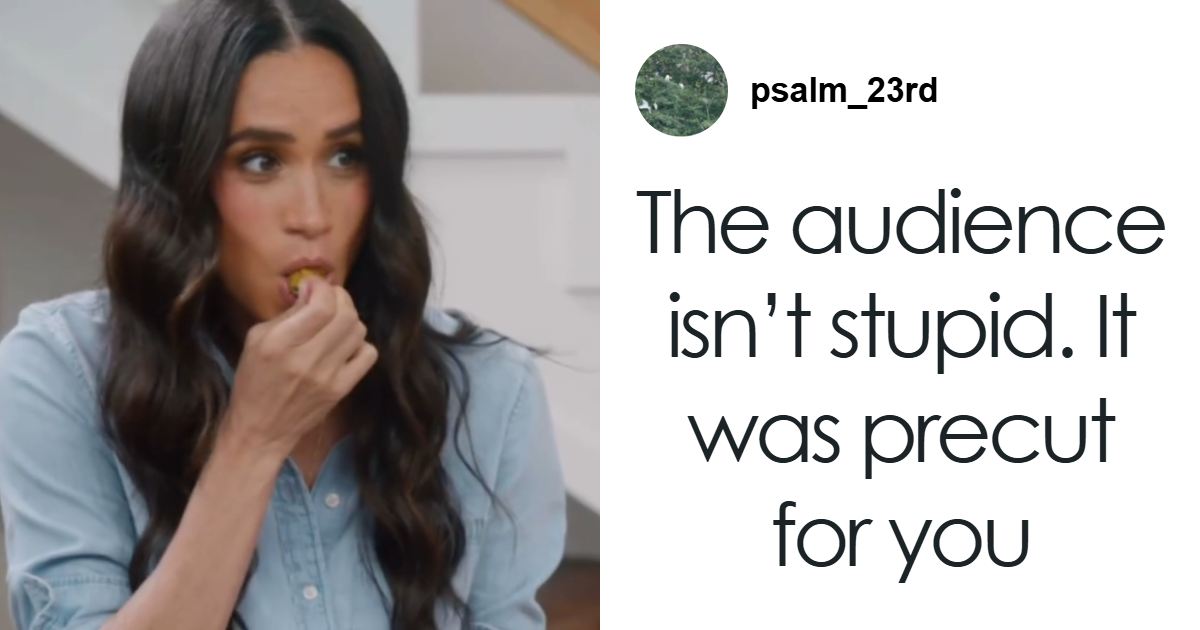

There are few things the internet loves more than a celebrity trying to be relatable. Actually, scratch that. There is one thing it loves even more: a celebrity trying to be relatable with a knife and a pineapple. That is how Meghan Markle found herself in yet another viral storm after sharing a simple food trick from a deleted scene connected to With Love, Meghan. What should have been a breezy lifestyle moment turned into a full-scale debate about privilege, presentation, and whether the world really needed a duchess to explain fruit geometry.
The reaction was fast, loud, and more than a little theatrical. Some viewers rolled their eyes so hard they probably saw last Tuesday. Others defended the trick as harmless, practical, and honestly kind of useful. And that split is exactly why this story took off. It was never just about pineapple. It was about Meghan Markle’s larger public image, the expectations placed on celebrity lifestyle content, and the increasingly weird internet habit of treating ordinary homemaking tips like either revolutionary philosophy or a felony.
So what actually happened? Why did such a tiny kitchen moment trigger such a giant online reaction? And was the hack itself really ridiculous, or did it simply arrive wrapped in the wrong messenger, the wrong mood, and the wrong cultural moment? Let’s peel this thing properly.
What Meghan Markle Actually Shared
The moment at the center of the backlash was not a grand culinary reveal. Meghan shared a clip showing a pineapple-cutting technique in which she followed the fruit’s diagonal pattern to create neat little bites. On paper, that sounds innocent enough. In practice, it landed like she had just announced the discovery of gravity, but with better lighting.
The trick itself is visually satisfying. Pineapples naturally have diagonal rows, and cutting along those lines creates small, tidy sections that look polished and easy to serve. It is the kind of tip lifestyle television loves: simple, demonstrative, camera-friendly, and just fancy enough to make a casual snack feel like it got invited to a garden party.
But context matters, and Meghan did not share this in a vacuum. The clip appeared as part of the wider orbit of her lifestyle brand and Netflix persona, a universe already built around handwritten labels, thoughtful hosting touches, carefully arranged breakfasts, pretty kitchen tools, and the idea that daily life can be elevated with a little extra attention. To supporters, that is charming. To detractors, it is exhausting with garnish.
Why the Internet Pounced So Hard
The Hack Looked Too Obvious
The loudest criticism came from people who felt the pineapple trick was painfully basic. Not wrong. Not dangerous. Not even especially bad. Just obvious. And that can be the kiss of death online. A tip that might be charming when passed between friends can sound patronizing when it arrives as polished content from a celebrity with a camera crew’s worth of ambiance trailing behind her.
That is why the comments took on such a mocking tone. The argument was less, “This doesn’t work,” and more, “Why are you presenting this like a revelation?” In the age of TikTok, YouTube shorts, and hyper-accelerated life hacks, audiences are brutally efficient. If a trick does not feel brand-new, they may treat it like an insult to their intelligence. The internet has many settings, but “graciously mild” is not usually one of them.
People Were Responding to the Whole Meghan Package
Another reason the clip got roasted is that viewers were not reacting to a pineapple in isolation. They were reacting to Meghan Markle’s entire lifestyle-show persona. By the time the fruit hack made rounds online, audiences had already seen other moments from her show become mini culture-war skirmishes. Repackaging store-bought pretzels into custom bags got mocked. Her one-pan pasta got debated. Her presentation style got parsed like it was a presidential address delivered from a cutting board.
Once a public figure becomes associated with “extra” touches, every new tip gets filtered through that lens. A garnish is not just a garnish anymore. A label is not just a label. A fruit trick is not just a fruit trick. It becomes proof, to critics, that the person is performative, out of touch, or trying too hard. Meghan’s problem is that she is no longer allowed an ordinary domestic moment. Everything becomes symbolism with side dishes.
The Show Itself Invited a Debate About Expertise
Celebrity lifestyle shows occupy a strange space in American culture. Viewers want warmth, aspiration, beauty, and personality. But they also want credibility. Martha Stewart built her empire on mastery. Ina Garten’s appeal rests on authority without panic. Even creators with softer brands still need to convince audiences that they know what they are doing.
Meghan’s show has often been judged against those standards, fairly or unfairly. Some critics have argued that her hosting style can feel over-curated or vague, more mood board than manual. Others have pointed out that the series still contains workable ideas, pleasant visuals, and genuinely useful touches for everyday entertaining. That split matters. It means the backlash is not simply “people hate the hack.” It is “people disagree on whether Meghan has earned the right to be the one giving the tip.”
Was the Pineapple Hack Actually Bad?
Not really. That is the funny part.
The technique is not magic, but it is not nonsense either. Pineapple eyes do run in diagonal rows, and cooks have been working with that pattern for a long time. In other words, Meghan did not invent a culinary hoax. She shared a real, workable method. The stronger criticism is that the trick was old news to experienced cooks, not that it was fake.
That distinction matters because online discourse tends to flatten everything into extremes. Either someone is a genius or a fraud. Either the hack changes your life or should be launched directly into the sun. Real life is less dramatic. Most kitchen tips live in the wide middle ground of “mildly helpful if you did not know it already.” That is where this pineapple trick belongs.
And frankly, that is where a lot of lifestyle content lives. You probably already know how to set a table, but you may still enjoy seeing a prettier way to do it. You probably know how to serve yogurt, but a layered parfait in a glass is still a nice touch. You probably understand that fruit can be cut into pieces, but following the wedge might make serving pineapple less annoying. None of this is Nobel Prize material. It does not have to be.
Why Simple Tips Can Feel So Annoying Online
The deeper issue is that “simple” and “condescending” can look dangerously similar on the internet.
When everyday advice comes from someone famous, wealthy, and heavily branded, people often hear it differently. A regular neighbor saying, “Hey, I learned an easy way to cut pineapple,” sounds friendly. A celebrity saying the same thing through glossy content can sound like a seminar titled How to Breathe With Intention. Same basic information. Very different emotional weather.
That tension is even stronger with Meghan because she occupies two public roles at once. She is both celebrity and symbol. Some people watch her because they like her style. Some watch because they dislike her. Some watch because they are curious how she will reinvent herself next. And some watch the way people slow down at a fender bender: not noble, not pretty, but undeniably common.
That means she is almost uniquely vulnerable to overreaction. A small idea becomes a referendum. A snack becomes a scandal. A pineapple becomes a personality test.
The Meghan Markle Paradox
Meghan Markle’s biggest challenge may be that she is trying to sell comfort in a culture that prefers conflict. Her lifestyle content is designed to communicate warmth, ease, hospitality, and care. But she exists inside a media ecosystem that rewards mockery, tribal loyalty, and instant judgment. It is very hard to whisper “thoughtful entertaining” while the internet is screaming “Who asked for this?”
And yet, the mockery alone does not explain the fascination. People keep watching. They keep talking. They keep clipping, reposting, dissecting, and arguing. That means the project is not invisible. Far from it. Whether audiences love her style or hate-watch it with Olympic-level commitment, they are paying attention.
In some ways, that is the most modern part of the whole story. Lifestyle content no longer has to be universally admired to succeed culturally. It just has to be sticky. It has to generate feelings. It has to make someone text a friend, “Did you see this?” Meghan’s pineapple moment did exactly that. It turned a tiny domestic action into public theater.
What This Says About Celebrity Lifestyle Culture
This controversy also exposes a bigger truth about the lifestyle genre in 2025 and beyond: audiences want authenticity, but they also want aspiration. They want polished content, but not too polished. They want helpful ideas, but not ideas that seem insultingly basic. They want charm without self-importance, authority without snobbery, and luxury without obvious wealth. Basically, they want a unicorn wearing an apron and carrying heirloom tomatoes.
That is a nearly impossible brief for anyone, let alone someone as polarizing as Meghan Markle. If she is too polished, she gets called fake. If she is too casual, she gets called amateur. If she offers simple tips, she gets mocked for stating the obvious. If she offered advanced techniques, she would likely be accused of being unrelatable. The line she has to walk is thinner than a garnish chive.
That does not mean all criticism is unfair. Some of it is legitimate. Viewers are allowed to want more substance, more originality, or more rigor from a lifestyle series. But the scale of the reaction often says as much about us as it does about her. We have become very comfortable turning small acts into giant verdicts. The pineapple was merely today’s prop.
Related Experiences: Why This Story Feels Familiar to So Many People
If this whole saga felt weirdly recognizable, that is because most people have lived some version of it, minus the title, the streaming deal, and the internet comment section from hell.
Almost everyone has had that moment in a kitchen where they excitedly share a “new” discovery, only to learn that half the room has known it since middle school. You finally realize a wooden spoon can stop pasta water from boiling over, and suddenly your aunt looks at you like you just announced that spoons exist. You proudly explain how to fold a tortilla without losing the filling, and your friend says, “Yes, that’s called wrapping a burrito.” Humbling? Absolutely. A human rights violation? Probably not.
That is part of why the Meghan Markle backlash hit such a nerve. It tapped into a universal embarrassment: the fear of sounding obvious when you are genuinely trying to be helpful. In real life, that moment usually ends with a laugh, maybe a little teasing, and somebody opening another bag of snacks. Online, it becomes a pile-on. The social media version of a raised eyebrow can multiply into thousands of people acting like your pineapple technique has personally offended their ancestors.
There is also another experience buried in this story, and it is one a lot of adults know well: learning basic things late. Plenty of people reach their thirties, forties, or fifties before discovering what others consider “common knowledge.” Some people never learned how to cut mango properly. Others discover surprisingly late that there is a correct way to dice an onion, store herbs, sharpen a knife, or keep brown sugar from turning into a brick. Life is long, kitchens are chaotic, and nobody emerges from childhood with an official fruit-prep diploma.
That is why simple lifestyle content still has an audience. Yes, some viewers roll their eyes. But plenty of others quietly think, “Huh, that’s actually useful.” A trick does not have to be revolutionary to help someone. Sometimes the most helpful advice is embarrassingly basic. The internet hates admitting that because it likes to perform expertise. Real households are less glamorous and more forgiving. In real kitchens, people forget things, improvise, Google obvious questions, and pretend they meant to burn the garlic just a little.
And then there is the hosting angle. Meghan’s style, for better or worse, leans heavily into making ordinary moments feel intentional. That can read as overdone, but it also connects to a familiar desire: wanting guests to feel cared for. Lots of people do that in their own way. One person ties a ribbon around a take-home cookie bag. Another labels leftovers so nobody grabs the spicy dip by accident. Someone else slices fruit neatly because it looks nice and makes people more likely to eat it. These are not earth-shattering acts. They are social gestures. Tiny signals that say, “I thought about you.”
So the reason this story keeps traveling is not just because Meghan Markle is famous. It is because the situation is weirdly ordinary underneath the celebrity gloss. A person shared a small kitchen tip. Some people found it sweet. Some found it silly. A lot of people projected bigger feelings onto it. Which, honestly, may be the most modern kitchen experience of all: trying to offer a snack and accidentally starting a cultural debate.
Conclusion
In the end, Meghan Markle was not slammed because she cut a pineapple incorrectly. She was slammed because the internet had already decided that every domestic gesture she makes must carry larger meaning. The hack worked. The reaction was the real spectacle.
That is what makes this story more interesting than its headline suggests. It is not really about fruit. It is about celebrity authority, audience resentment, lifestyle branding, and the hair-trigger speed of online mockery. Meghan shared a simple kitchen tip. Viewers saw either harmless hospitality or high-gloss condescension, depending on what they were already primed to believe.
And maybe that is the final lesson here. In the social media age, no hack is ever just a hack. Not when it comes from a celebrity. Not when lifestyle content doubles as identity. And definitely not when the internet is hungry, opinionated, and fully prepared to turn a pineapple into a referendum on class, taste, and whether anyone should ever say “perfect little bite” out loud.