
If you’ve ever finished an American Horror Story binge and thought, “Wow, that felt
a little… hellish,” congratulations: you might be onto something very literary.
For years, fans have theorized that the first nine seasons of American Horror Story (AHS)
secretly track the nine circles of Hell from Dante Alighieri’s
Inferno. The idea got a major boost when creator Ryan Murphy shared an Instagram
note linking specific seasons to specific circles, calling the theory “interesting”
and basically tossing gasoline onto the fandom’s conspiracy-board flames.
In this deep dive, we’ll walk through the basics of Dante’s underworld, then match
each of the first nine American Horror Story seasons to its
corresponding circle of Hell. We’ll look at what each season is really about
beneath the jump scares: lust, gluttony, greed, treachery, and more. And at the end,
we’ll talk about what it’s like to rewatch the whole series through this lens
because once you start seeing AHS as a guided tour through Hell, you can’t un-see it.
Where the “AHS = 9 Circles of Hell” Theory Comes From
The Dante theory didn’t come out of nowhere. TV critics and fan bloggers noticed
early on that each season of AHS is fairly self-contained: one major location,
a tight cast of sinners, and a specific type of moral decay. Articles in U.S. outlets
like TV Guide and entertainment magazines laid out the argument that each season
might represent a different circle of Hell, from Limbo all the way down to Treachery.
Then came the big nudge from above. In 2017, Ryan Murphy shared a screenshot-style
list pairing seasons with circlesMurder House with Limbo,
Freak Show with Greed, Hotel with Gluttony,
Asylum with Fraud, Coven with Treachery,
Roanoke with Anger, and Cult with Heresyleaving Lust
and Violence blank for future seasons. Fans promptly did what fans do best:
they took that skeleton and wrapped a whole flaming mythology around it, filling in
the remaining circles with seasons eight and nine, Apocalypse and
1984.
Even though Murphy hasn’t outright confirmed the theory as canon, he’s acknowledged
it enough that most people now treat it as a deliberate creative framework or,
at the very least, a clever way to read the show.
A Quick Tour of Dante’s 9 Circles of Hell
In Dante’s 14th-century epic Inferno, the poet travels through Hell with the
Roman poet Virgil as his guide. The underworld is organized into nine concentric
circles, each punishing a particular category of sin with poetic, often brutal
irony:
- 1. Limbo – The “softest” circle, home to virtuous pagans and the unbaptized; no physical torment, just eternal separation from salvation.
- 2. Lust – Souls driven forever by stormy winds, blown around by their desires.
- 3. Gluttony – Sinners lie in filthy, freezing slush, punished for overindulgence.
- 4. Greed – The miserly and the spendthrift crash enormous weights against each other for eternity.
- 5. Anger (Wrath) – The wrathful fight on the surface of a swamp; the sullen simmer beneath it.
- 6. Heresy – Heretics burn in flaming tombs for their rejection of spiritual truth.
- 7. Violence – Divided into three rings: violence against others, self, and God/nature.
- 8. Fraud – A complex circle of deceivers, hypocrites, flatterers, and con artists.
- 9. Treachery – The deepest pit, frozen in ice, reserved for traitors of all kinds.
Keep that lineup in mind as we descend through AHS, circle by circle.
Season-by-Season: Which Circle Each AHS Season Represents
Season 1 – Murder House: Limbo
On paper, Murder House might sound like Lustthere’s infidelity,
obsession, and more latex than a Halloween store in October. But according to the
version Murphy boosted, it sits in Limbo, and thematically that fits.
The Harmons and the many ghosts trapped in the Los Angeles mansion are literally
unable to move on. Once you die on the property, you’re stuck there forever, locked
into an eternal, half-alive existence. No Heaven, no Helljust this cursed, suburban
waiting room where your unresolved emotions replay on a loop.
Limbo in Dante’s work is tragic because it’s “almost” salvation: peaceful but cut off
from grace. Murder House operates the same way. The ghosts can build families,
relationships, even twisted versions of happinessbut they never escape. The real
horror isn’t just the bloodshed; it’s the realization that this house is your forever.
Season 2 – Asylum: Fraud
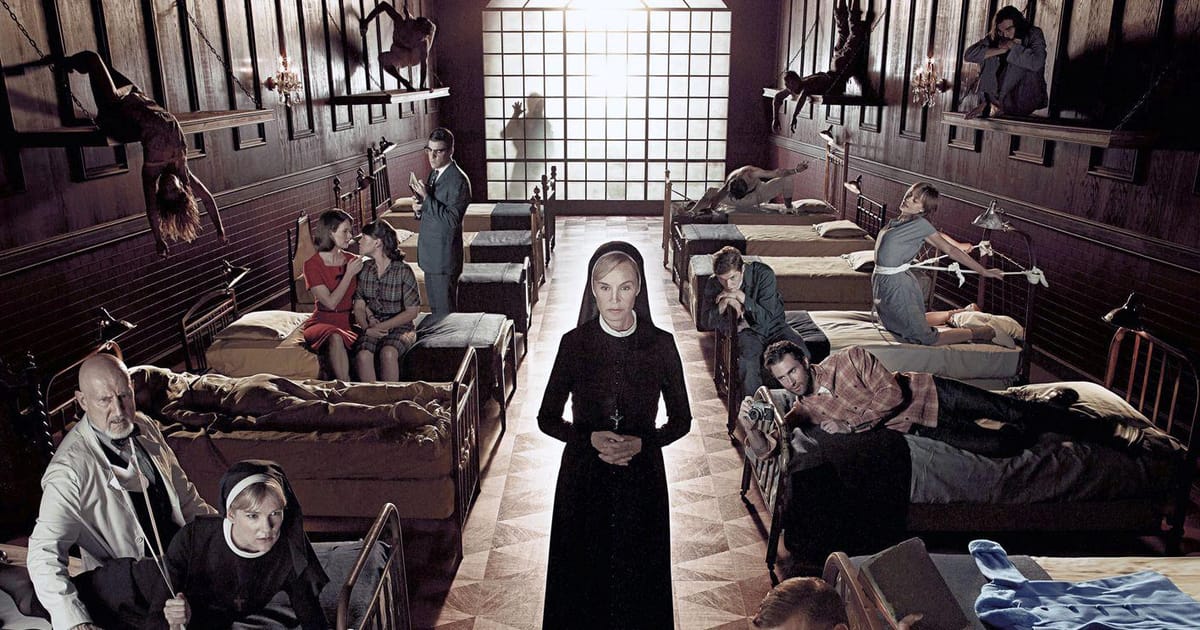
Asylum brings us to Briarcliff Manor, where nearly everyone is guilty
of some form of Fraud. On the surface, it’s a Catholic psychiatric
institution promising healing and redemption. In practice, it’s a maze of lies.
The church officials preach virtue while covering up abuse and experimentation.
Dr. Arden hides war-crime-level atrocities behind a respectable medical façade.
Oliver Thredson presents as a caring therapist but is secretly the serial killer
Bloody Face. Even Lana Winters, the season’s moral center, lies to get her story
and her lie traps her in the asylum.
Dante’s Fraud circle is packed with hypocrites, false prophets, and con artists.
Asylum reimagines that idea in a 1960s horror setting, where nearly every authority
figure is not who they claim to be. The jump scares are frightening, but the real
terror is discovering how thoroughly truth has been buried under layers of performance.
Season 3 – Coven: Treachery
Fans often describe Coven as the most glamorous season: chic witches,
New Orleans settings, and comedic one-liners. But underneath the camp is a steady
drumbeat of Treachery.
Everyone betrays someone. Cordelia’s husband is a witch hunter hiding in plain sight.
Mothers betray daughters; mentors betray protégés; supposed “sisterhood” turns into
cutthroat competition for the title of Supreme. We see characters poisoned, resurrected,
mutilated, and manipulated by the very people who claim to love them.
In Dante’s ninth circle, traitors are frozen in ice, locked forever in the consequences
of their own betrayal. Coven doesn’t do ice, but it does show us a community that
keeps sabotaging itself from within. For a group that preaches unity and survival,
the witches are impressively bad at basic loyaltywhich makes Treachery a painfully
accurate label.
Season 4 – Freak Show: Greed
Freak Show is a love letter to outcastsbut it’s also a brutal story
about Greed. Set in a 1950s Florida carnival, the season follows
Elsa Mars and her troupe of performers as they fight exploitation from all sides.
Elsa dreams of stardom and will sacrifice almost anyone to get it. Con artists
Stanley and Maggie literally carve up the freaks for profit, treating their bodies
as collectibles. Rich boy Dandy Mott’s greed is emotional and homicidal; he hoards
attention, people, and lives like they’re toys.
In the fourth circle of Hell, Dante’s greedy sinners push huge weights against each
other forever, their obsession with “more” turning into pointless, exhausting labor.
Freak Show mirrors that spiritual exhaustion: no matter how much fame, money, or
control its characters grasp at, it’s never enough. Their hunger for more destroys
the fragile community they’ve built.
Season 5 – Hotel: Gluttony
If any season screams Gluttony, it’s Hotel. The
Hotel Cortez is a monument to excess: blood, sex, drugs, murder, fashion, and
literally a vampiric countess who feeds on the beautiful.
The residents and guests of the Cortez are consumed by appetite. The Countess
collects lovers like accessories. Addicts spiral deeper into their habits, haunted
by the Addiction Demon. Detective John Lowe becomes obsessed with solving the Ten
Commandments Killer case and ultimately loses his grip on reality and morality.
Dante’s gluttons lie in filthy slush, symbolizing how their indulgence has turned
to waste. In Hotel, the glamour of the Cortez rots from the inside. The season
shows how pleasure, when detached from empathy or limits, becomes a prison. The
characters aren’t just enjoying themselves; they’re devouring themselves.
Season 6 – Roanoke: Anger (Wrath)
Roanoke is chaotic by design, blending found footage and reality TV
formats into one of the show’s most violent seasons. Beneath the screaming and
gore, though, the primary energy is Anger.
The lost Roanoke colony is powered by rageat betrayal, displacement, and perceived
injustice. The Butcher leads vengeful spirits in brutal blood-moon massacres.
The living characters, from the traumatized Millers to the fame-hungry actors and
producers, lash out at one another in fear and resentment.
Dante’s fifth circle pictures the wrathful attacking each other on the surface of
a swamp while the sullen drown beneath it, stewing in silent rage. Roanoke captures
both versions: explosive violence and simmering resentment. The haunted house is
less a setting and more a pressure cooker where everyone’s anger eventually boils
over.
Season 7 – Cult: Heresy
Released in the aftermath of the 2016 U.S. election, Cult is about
political terror, but at its core it’s a season about Heresynot
just religious heresy, but ideological.
Kai Anderson builds a personality cult that functions like its own religion. He
preaches salvation through fear, loyalty through manipulation, and community through
violent exclusion. Followers abandon long-held beliefs and relationships to worship
his vision of power.
In Dante’s Hell, heretics are sealed in flaming tombs for rejecting spiritual truth.
In Cult, characters are metaphorically “buried” in their chosen echo chambers.
Families and neighborhoods burn downnot literally, but morallyas fanatical belief
replaces empathy and reality. The show asks a very modern question:
what happens when politics becomes the new religion, and dissent is treated as sin?
Season 8 – Apocalypse: Violence
Apocalypse feels like the obvious candidate for Violence.
The season opens with nuclear annihilation and centers on Michael Langdon, the
Antichrist, whose entire existence is a walking act of violence against humanity,
nature, and cosmic order.
Dante’s seventh circle is subdivided: violence against others, violence against
self, and violence against God and nature. Apocalypse checks every box. We see
mass murder, occult sacrifices, self-destruction, and a battle between witchcraft
and literal biblical-level evil. Time itself gets broken and reset in a last-ditch
attempt to undo the devastation.
Where earlier seasons focus on more personal sins, Apocalypse blows the doors off
and asks what happens when violence stops being a personal failure and becomes a
structural, world-ending force. It’s Hell, but at a global scale.
Season 9 – 1984: Lust
That leaves 1984 to embody Lust, and in many ways
it’s the perfect fit. As a love letter to ’80s slasher films, the season leans
into the genre’s classic formula: horny counselors, morally panicked adults, and
killers who seem to appear whenever someone sneaks off to hook up.
Lust here isn’t just about sex, though there’s plenty of that. It’s about obsession:
with image, with revenge, with the high of survival. Characters chase thrills,
fame, and romantic fantasies through waves of violence. The summer-camp setting,
aerobics studios, and neon aesthetics all highlight how desire and danger blur
together.
In the second circle of Hell, lustful souls are blown forever by violent winds,
symbolizing how they’re tossed around by their passions. 1984 updates that metaphor:
the characters are yanked from place to place by their impulsesromantic, murderous,
or bothuntil the line between victim and predator gets as messy as a VHS horror
tape.
Do Later Seasons Break the Hell Map?
After season 9, AHS keeps going with Double Feature, NYC, and
Delicate, so the clean nine-circle pairing obviously gets less tidy.
Many fans treat the Dante framework as primarily applying to the first nine seasons,
with later installments acting as epilogues, variations, or entirely new “rings”
built on top of the original Hell.
Still, even the newer seasons echo Inferno-style ideas: moral decay, existential
punishment, and societies that feel like they’re collapsing under the weight of
their own sins. Once you start watching AHS through Dante’s eyes, you’ll find
circles of Hell everywhere.
Why the 9 Circles of Hell Theory Makes AHS More Fun
So what’s the point of mapping all this outbesides giving English majors a fun
party trick? Viewing AHS as a descent through Dante’s nine circles adds structure
to a show that can otherwise feel deliberately chaotic.
First, it turns each season into a case study in a particular kind of sin. Instead
of just “the spooky asylum season,” Asylum becomes “the fraud season,” revealing how
every subplotreligious hypocrisy, medical abuse, false identitiesis another riff
on deception. Coven isn’t only witch drama; it’s a story about betrayal. Freak Show
is greed. Hotel is gluttony. You start to see how tightly each season’s imagery,
character arcs, and even soundtrack choices orbit its central sin.
Second, the theory reframes recurring actors as recurring souls. If the same
performers keep popping up in different eras and settings, perhaps they’re different
incarnations of the same damned spirits, working through new layers of punishment.
It’s very Dante: one long journey, multiple encounters with the same essential
failures.
Finally, the theory invites us to see ourselves as Dante, with Ryan Murphy as our
very chaotic Virgil. We’re guided, season by season, through a modern Hell built
from American anxietiesabout family, religion, politics, fame, and survival.
It’s horror, but with a strangely literary backbone.
Experiencing AHS as a Trip Through the 9 Circles of Hell
Watching AHS in release order is already a wild ride. Watching it as a deliberate
descent through Hell is something else entirely. Many fans who rewatch the series
with the Dante framework in mind say it changes not just what they notice, but
how they emotionally respond to each season.
On a rewatch, Murder House becomes less about jump scares and more
about the tragedy of being stuck. You start paying attention to the little moments
when a ghost realizes there is no “moving on,” only endless holidays in the same
cursed house. The Halloween episodes hit harder because you know those brief
glimpses of the outside world are the closest these souls get to freedom.
In Asylum, the fraud theme changes how you view characters like
Sister Jude or Dr. Arden. Instead of simple villains, they become portraits of what
happens when people lie to themselves long enough to believe their own masks.
Suddenly every confession or breakdown feels like a crack in the illusion of
righteousness, not just a plot twist.
Coven becomes strangely heartbreaking. When you watch it as the
Treachery circle, all the camp and sass are still there, but your brain keeps
tallying betrayals: who sells out whom, who resurrects whom for selfish reasons,
who turns friendship into a power grab. The finale doesn’t just crown a new Supreme;
it quietly asks whether this coven is doomed to repeat its icy betrayals forever.
For Hotel and Freak Show, the Dante lens makes the
seasons feel more like parables about excess. Every time someone in the Hotel Cortez
gives in to temptationanother fix, another lover, another murderyou can almost
feel the metaphorical slush rising around them. In Freak Show, the greed theme
sharpens the horror of exploitation: these aren’t just murders, they’re business
decisions made with chilling indifference.
When you get to Roanoke and Cult, the anger and
heresy circles, the theory helps tie together what can feel like very different
kinds of horror. Roanoke’s reality show framing becomes less gimmick and more
statement: every participant is angry about somethingfame, trauma, betrayaland
the cameras trap that rage in an endless loop. Cult, meanwhile, feels even more
disturbing when you think of it as a story about ideological heresy, where people
abandon their own moral compasses to worship a political false prophet.
By the time you reach Apocalypse and 1984, the
Violence and Lust circles, the descent feels complete. Apocalypse plays like the
violent culmination of every sin the series has exploredfraudulent leaders,
greedy cults, gluttonous monsters, treacherous alliesfinally tearing the world
apart. 1984, conversely, almost feels like Hell’s epilogue: a stylized slasher
purgatory where desire and death are stuck in an endless loop of sequels and
reboots.
If you want to test the theory yourself, try this experiment: during your next
rewatch, pick one season and write its circle of Hell on a sticky note. As you
watch, jot down every moment that fits that sinevery lie in Asylum, every betrayal
in Coven, every act of greed in Freak Show. You’ll probably end the season with a
full page of evidence and a newfound appreciation for how carefully AHS leans into
its chosen flavor of damnation.
Of course, part of the fun is that the theory is never 100% neat. Real people, like
real characters, rarely fit into just one category of sin. But that’s exactly what
keeps the Dante lens compelling: you’re not just watching monsters and ghosts;
you’re watching a messy, modern morality play about what damns usand whether
we ever truly escape the things we can’t stop wanting.
Final Thoughts: AHS, Dante, and Our Favorite Nightmares
Whether Ryan Murphy designed American Horror Story as a precise map of the
nine circles of Hell or simply enjoyed a clever fan theory, the connections are
hard to ignore. Each of the first nine seasons has a dominant sin, a signature
moral failure, and a setting that functions like a customized prison for the people
trapped there.
Thinking of AHS this way doesn’t erase the camp, the shocks, or the meme-worthy
moments. It just adds another layer: beneath the jump scares, the show is quietly
asking old questions in new costumes. What do we desire most? What are we willing
to sacrifice to get it? And if there really is a Hell, would it look like fire and
brimstoneor like a gorgeous Los Angeles hotel with no checkout, a haunted murder
house you can never leave, or a coven where the people who love you the most are
also the ones holding the knife?
In the end, that might be the most unsettling part of the whole theory: if each
season of American Horror Story is a circle of Hell, then every time we
hit “Play Next Episode,” we’re choosing to walk back in. Luckily, unlike Dante,
we can always back out to the home screen. Probably.