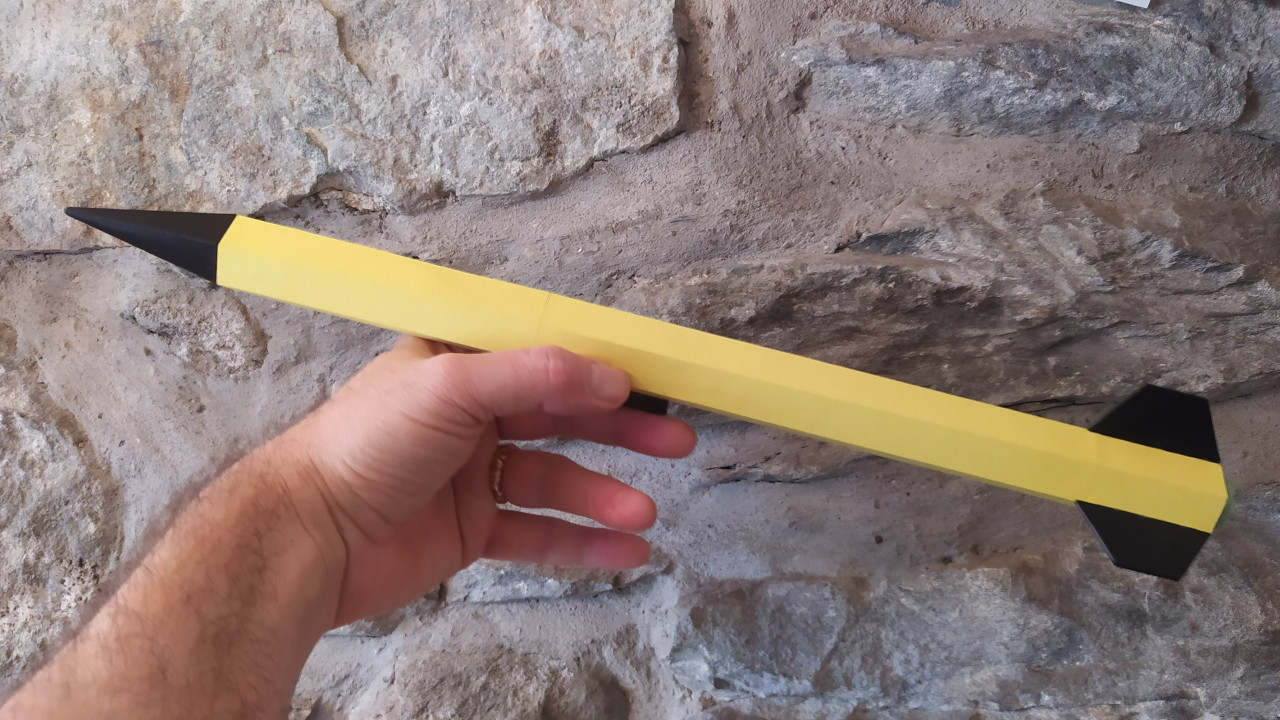

What happens when open-source hardware, paper engineering, 3D printing, and model rocketry walk into a makerspace? Apparently, they fold themselves into a hexagon and launch skyward.
A Rocket Kit With Six Sides and One Very Clever Idea
Most model rockets follow a familiar recipe: a round cardboard body tube, a nose cone, fins, a motor mount, a recovery system, and just enough glue to make your fingers temporarily part of the aerospace industry. The HEXA rocket kit takes that classic formula and gives it a sharp geometric twist. Instead of relying on a traditional cylindrical tube, it uses pre-cut and pre-scored cardstock that folds into a hexagonal airframe.
That may sound like a cosmetic decision at first. After all, a six-sided rocket looks undeniably cool, especially if your design taste leans toward honeycombs, sci-fi corridors, and objects that appear slightly more engineered than they need to be. But the hexagonal form is not just visual flair. It solves a real shipping and manufacturing problem: lightweight cardboard tubes can be awkward to mail because they are bulky, fragile, and easy to crush. Flat cardstock sheets, on the other hand, travel more politely through the postal system.
The result is a model rocket kit that feels both old-school and refreshingly modern. It still belongs to the friendly world of hobby rocketry, but its flat-pack design, open documentation, and 3D printed components give it the spirit of contemporary maker culture. It is the kind of project that makes you say, “Of course rockets can arrive flat. Why didn’t we always do this?”
What Is HEXA?
HEXA is an open-source hexagonal model rocket designed by Jo Hinchliffe, better known in maker circles as Concretedog. The project uses a combination of folded cardstock and 3D printed parts to create a functional, flyable model rocket. The kit is designed around 18 mm Estes-style model rocket motors, and the creator has reported successful flights using B6-4 motors.
The core idea is wonderfully simple: replace the standard round body tube with folded polygonal tubes. The rocket’s body sections begin as flat sheets that are cut and scored so builders can fold them into shape. Once assembled, the airframe becomes a rigid hexagonal structure. The nose cone, fins, launch lug, and other functional pieces are made with 3D printed parts, while the recovery system includes a parachute setup.
In practical terms, HEXA is not trying to reinvent physics. Gravity is still rude, thrust is still required, and the sky remains stubbornly upward. What it does reinvent is the kit format. By making the body flat-packable, the design reduces shipping vulnerability and opens up a fun new way to think about small rocket construction.
Why the Hexagon Works
Flat-Pack Shipping Makes Sense
Traditional model rocket body tubes are light, but they occupy space and can be damaged if squeezed. Anyone who has received a bent tube knows the heartbreak: one minute you are planning a majestic launch, the next you are holding a cardboard banana. HEXA avoids much of that risk by shipping the main airframe material as flat sheets.
This gives the kit a design advantage similar to flat-pack furniture, only with more thrust and fewer arguments about missing Allen keys. Flat materials are easier to store, easier to ship, and often easier for small makers to produce in batches. For an independent designer selling kits online, that matters.
A Hexagonal Body Is Easy to Align
The flat faces of a hexagonal tube can also make certain building steps more approachable. Round tubes are elegant, but attaching fins and lugs to curved surfaces can be a small alignment adventure. A polygonal body provides defined faces, which can help builders position components consistently.
This does not mean the hexagon is magically superior to the cylinder in every aerodynamic situation. Cylinders remain the standard for good reasons: they are smooth, strong for their weight, and aerodynamically efficient. But for a small model rocket, especially one designed for education, maker experimentation, and kit-building fun, the hexagonal body offers a smart balance of practicality and personality.
The Shape Invites Customization
One unexpected strength of the hexagonal form is how much it invites visual creativity. Each face can become a panel for decals, color blocks, handwritten payload labels, or even classroom team names. The rocket can look like a pencil, a sci-fi probe, a tiny weather satellite, or a geometry lesson that got tired of staying on the worksheet.
Open-Source Hardware: The Real Booster Stage
The most important part of HEXA may not be the folded body or the 3D printed nose cone. It is the fact that the design is open-source hardware. Open-source hardware means the design files and documentation are publicly available so people can study, modify, make, distribute, and improve the project.
HEXA has been certified by the Open Source Hardware Association, commonly known as OSHWA. Its certification entry identifies it as a small hexagonal model rocket made with 3D printed components and card. The project is released under the CERN Open Hardware Licence, specifically the strongly reciprocal CERN-OHL-S-2.0 license for hardware and documentation.
That licensing choice matters. In plain English, it means the project is not merely “look at this cool thing I made.” It is closer to “here is the cool thing, here is how it works, and here is permission to build on it under open terms.” For educators, makerspaces, hobbyists, and curious students, that is a big deal.
Open-source hardware turns a product into a learning platform. Builders are not limited to following instructions. They can inspect the design, change dimensions, adapt components, experiment with materials, and share improvements. In a field like model rocketry, where understanding stability, weight, drag, recovery, and motor selection is part of the fun, that openness is especially valuable.
Model Rocket Basics Behind the Design
The Main Parts Still Matter
Even with its unusual body shape, HEXA still follows the basic architecture of a model rocket. A typical rocket includes an airframe, nose cone, fins, motor mount, launch guide, and recovery system. The airframe provides structure, the nose cone helps airflow separate cleanly, the fins help maintain stable flight, and the motor supplies thrust.
The recovery system is not optional if you enjoy seeing your rocket more than once. Parachutes, streamers, or tumble recovery methods help slow the rocket after the motor’s ejection charge deploys the recovery device. HEXA includes a parachute kit, which makes sense for a reusable model rocket intended for repeated flights.
Stability Is Not a Vibe
A rocket must be stable in flight. That means the center of pressure should be behind the center of gravity, allowing the rocket to point into the airflow rather than perform an embarrassing sky dance. Fins help by moving the aerodynamic center rearward. Nose weight can also shift the center of gravity forward when needed.
For any builder modifying HEXA, this is where open-source freedom meets responsible engineering. Want to stretch the payload bay? Add a camera? Swap materials? Great. But every modification can affect mass, balance, drag, and recovery timing. A fun-looking change should still be checked before launch.
Simulation Can Save Your Saturday
Tools such as OpenRocket are useful because they let hobbyists design and simulate model rockets before committing to a build. Simulation cannot replace careful construction and safe launch practices, but it can help estimate stability, altitude, velocity, and recovery behavior. For an open project like HEXA, simulation files or community-created variants could become part of the project’s long-term value.
3D Printing Meets Paper Engineering
HEXA’s construction approach is interesting because it does not treat 3D printing as the answer to everything. That restraint is refreshing. Many maker projects start with “let’s 3D print the whole thing,” then end with a heavy object, a long print time, and a faint smell of regret. HEXA uses 3D printing where it makes sense and folded card where it shines.
The 3D printed components provide shape and durability for parts such as the nose cone, fins, rail or launch lug, and pieces exposed to heat or wear. The folded card provides lightweight structure for the body. According to the creator’s kit description, PETG is used for parts that may encounter hot ejection gases, while PLA is used for parts such as fins, the nose cone, and the rail lug.
This mixed-material approach is one of the project’s best lessons. Good design is not about using the fanciest material everywhere. It is about putting each material where its strengths matter. Cardstock is light, foldable, inexpensive, and easy to cut. PLA prints cleanly and works well for many low-heat structural parts. PETG offers better heat resistance and toughness in areas that need it. Together, they create a practical kit that can be built without industrial equipment.
Why HEXA Is Great for Education
For teachers, STEM clubs, scout groups, and makerspaces, HEXA has a lot going for it. The design naturally connects geometry, materials science, aerodynamics, manufacturing, and open licensing. That is a lot of learning packed into one little rocket.
The hexagonal body makes geometry visible. Students can see how a flat net becomes a three-dimensional structure. They can compare polygonal and cylindrical shapes, discuss stiffness, test folding accuracy, and explore how small build errors affect alignment. The 3D printed parts introduce digital fabrication. The motor and recovery system introduce physics. The open-source documentation introduces responsible sharing and collaborative engineering.
It also has the secret educational ingredient: excitement. A worksheet about center of gravity may earn polite silence. A rocket that students fold, glue, decorate, and launch tends to earn actual attention. The launch is the reward, but the learning happens in every step before the countdown.
Safety: The Part That Keeps Rocketry Fun
Model rocketry has a strong safety culture, and HEXA should be treated with the same respect as any other flying model. Builders should use certified commercially made motors, follow the motor manufacturer’s recommendations, and launch only in suitable open areas. Lightweight, non-metal construction is standard for model rockets, and safe electrical launch systems with countdowns are part of responsible practice.
Weather matters too. A light rocket can drift surprisingly far under parachute, especially if the wind decides to audition for the role of villain. Dry grass, nearby trees, power lines, buildings, roads, and spectators all deserve attention before launch. The best launch day is boring from a safety standpoint: clear field, proper pad, correct motor, stable rocket, good recovery, and no dramatic sprinting after a parachute headed toward a parking lot.
Because HEXA is open and modifiable, safety becomes even more important. A stock kit may be tested by its designer, but a modified version becomes a new design. Builders who change the body length, payload mass, fin shape, motor class, or recovery system should re-check stability and flight behavior before pressing the button.
The Maker-Culture Appeal
HEXA succeeds because it feels approachable. It is not a luxury aerospace object hiding behind proprietary files and mysterious manufacturing choices. It is a kit that says, “Here are the parts, here are the files, here is the license, now go learn something.” That attitude fits perfectly with the open hardware movement.
It also shows how small projects can be genuinely innovative. HEXA is not trying to land on Mars or deliver satellites. It is solving a modest problem in a clever way: how to make a model rocket kit that is easy to ship, fun to build, and open enough for others to improve. That kind of innovation is easy to underestimate because it does not arrive with a billion-dollar launch tower. But in maker education, small clever ideas can travel far.
The hexagon also gives the project identity. Many beginner rockets blur together visually because the classic form is so familiar. HEXA looks different immediately. Its shape tells a story before the first launch: this is a rocket made by someone thinking about construction, shipping, openness, and fun at the same time.
Specific Examples of Possible HEXA Experiments
Payload Bay Experiments
HEXA’s payload-friendly design invites small experiments. Builders might add a tiny altimeter, a lightweight data logger, or a paper “mission card” for classroom launches. Any added payload should be weighed carefully and secured so it does not shift during flight.
Fin Shape Comparisons
Because the design is open, students can compare fin shapes while keeping other variables as consistent as possible. Larger fins may improve stability but add drag. Smaller fins may reduce drag but reduce stability. That tradeoff is rocketry in miniature.
Material Testing
Builders could compare different card weights, adhesives, or finishing methods. A sealed or painted airframe may resist moisture better, while heavier finishes can affect mass and performance. The lesson is simple: rockets keep receipts. Every gram and every surface change matters.
Decorative Geometry
The six flat faces make it easy to assign design themes. One side can show motor data, another can display a team name, and another can show a mission number. In classrooms, this turns the rocket into both a flying object and a communication exercise.
Experiences Related to “OSHW Model Rocket Kit Embraces The Hexagon”
The most memorable part of a project like HEXA is not only the launch. It is the sequence of small discoveries that happen before the rocket ever reaches the pad. The first experience is usually surprise: a rocket body can begin as a flat sheet. For builders used to round tubes, folding a hexagonal airframe feels like turning a cereal box into a spacecraft. The transformation is satisfying because the structure appears through your hands, crease by crease.
The second experience is respect for precision. Folded designs are forgiving in some ways and brutally honest in others. If a crease is slightly off, the body may still assemble, but the seam might complain. If glue is applied too generously, the card may warp. If a fin is attached casually, the rocket may look fine on the table but reveal its attitude problem in flight. HEXA teaches that aerospace thinking begins long before advanced math. It begins with clean folds, square alignment, careful bonding, and patience.
Another experience is the joy of mixed fabrication. There is something charming about seeing cardstock and 3D printed plastic cooperate. The card brings lightness and foldability. The printed parts bring repeatable shapes and durable interfaces. This combination feels very “maker” because it rejects the idea that one tool must dominate the entire project. A vinyl cutter, a 3D printer, a bottle of glue, and a launch pad each get their moment.
For educators, HEXA can create a classroom rhythm that works beautifully. First, students inspect the flat parts and predict how the shape will form. Then they assemble the body and discuss why a hexagon might be useful. Next, they attach fins and talk about stability. Then they prepare recovery systems, check mass, and discuss motor selection. Finally, they launch. Each stage creates a natural question, and the rocket answers in the most dramatic way possible: by flying.
For hobbyists, the open-source nature adds another layer of enjoyment. Building the stock kit is only the beginning. Once the first flight succeeds, ideas start arriving. Could the payload bay be longer? Could the fins be redesigned? Could the nose cone be shaped like a pencil tip? Could the body panels carry printed graphics? Could a club create a fleet of themed HEXA rockets? The files make these questions practical rather than purely imaginary.
There is also a social experience baked into open hardware. A closed kit ends at the instruction sheet. An open kit continues through forks, remixes, build logs, print settings, classroom adaptations, and community feedback. Someone might improve the cutting layout. Someone else might design a different fin can. Another builder might create an OpenRocket simulation. A teacher might publish a lesson plan. That is how a small rocket kit becomes a shared platform.
The hexagon itself becomes a teaching metaphor. Strong structures often come from simple patterns repeated well. Honeycombs, trusses, folded panels, and modular designs all point toward the same idea: geometry is useful. HEXA makes that idea visible, touchable, and launchable. It reminds builders that engineering does not have to be hidden behind polished products. Sometimes it can sit on your desk as six folded faces, waiting for glue to dry.
Finally, launching a rocket you folded yourself feels different from launching a pre-made tube. You remember the seams. You remember the alignment marks. You remember wondering whether the parachute was packed too tightly. When the motor lights and the rocket leaves the pad, the flight carries all those decisions with it. If it rises straight, deploys cleanly, and drifts back within walking distance, the feeling is pure maker happiness. If something goes wrong, the open design invites investigation rather than defeat. Either way, HEXA turns a simple model rocket into an experience of building, testing, learning, and improving.
Conclusion: A Small Rocket With a Big Open-Source Lesson
HEXA proves that innovation in model rocketry does not always require exotic motors, carbon fiber airframes, or a launch controller that looks like it belongs in a submarine movie. Sometimes innovation is a smart fold, a better shipping idea, and the decision to share the design files openly.
The OSHW model rocket kit embraces the hexagon because the shape solves practical problems while making the build more distinctive. It ships flat, assembles into a memorable airframe, supports 3D printed components, and invites experimentation. More importantly, its open-source hardware certification gives builders permission to learn from the design instead of simply consuming it.
For hobbyists, HEXA is a fun rocket. For educators, it is a compact STEM lesson. For makers, it is a reminder that open documentation can turn one person’s clever idea into a launchpad for many more. Six sides, one parachute, and a whole lot of possibility: that is a pretty good flight plan.