
Some houses are pretty. Some houses are historic. And some houses make you want to cancel your plans, put on boots, and drive until the pavement gives up and the good stories begin. Mysterious Objekts belongs to that last category. Set in an 1840s farmhouse in Breslau, Ontario, this home-and-shop hybrid feels less like a retail concept and more like a beautifully haunted conversation between architecture, memory, and the irresistible pull of old things.
That is the magic of the place. It does not scream for attention with polished trendiness or influencer-level perfection. Instead, it leans into the romance of wear: dark rooms, storied surfaces, old portraits, time-softened textures, and antiques that look as though they have already survived several lifetimes and could handle a few more. In a world that keeps trying to sand every corner smooth, Mysterious Objekts makes a strong case for the opposite. Leave the edges. Keep the mystery. Let the house be a house.
A Farmhouse That Sells More Than Antiques
Mysterious Objekts is not simply an antiques store parked inside an old building. It is a full atmosphere. The 1840s farmhouse and its outbuildings were turned into both a home and a place to display a rotating collection of antiques and curiosities. That matters because the objects are not arranged like they are waiting for fluorescent lights and a barcode scanner. They are placed the way objects want to live: a weathered chair where someone might actually sit, a platter that looks ready for bread, a portrait that quietly judges the room from a shadowy wall. Frankly, every modern showroom should be a little more nervous.
This blending of domestic life and retail creates something far more memorable than a standard shopping experience. You are not just browsing products. You are walking through a philosophy. The message is simple: old things do not have to be precious in the stiff, museum-gloves sense. They can be useful, funny, moody, soulful, and a little weird. In fact, the weird part may be the best part.
Why an 1840s Farmhouse Still Has Such Pull
Old houses have rhythm
An 1840s farmhouse carries the kind of physical presence that newer homes often spend a fortune trying to fake. There is usually a sense of accumulated craftsmanship in the bones: thick walls, hardworking windows, porch life, practical room arrangements, and materials that were meant to age instead of being replaced every time they get a scratch. Historic preservation experts often emphasize that the real value of an old building lies in its character-defining features, not in making it look freshly unwrapped. That idea explains a lot about why this farmhouse feels so compelling. It has not been stripped of its past in pursuit of generic perfection.
Patina beats polish
The farmhouse aesthetic works best when it resists becoming too cute. The strongest country homes are grounded in utility first and charm second. That is why aged wood, timeworn hardware, softened paint, and handmade details feel so convincing here. They are not decorative gimmicks pasted onto a blank shell. They read as evidence. And evidence is far more interesting than styling. A chip in the paint says more than a thousand brand-new “distressed” accessories ever could.
The Mood Is the Main Character
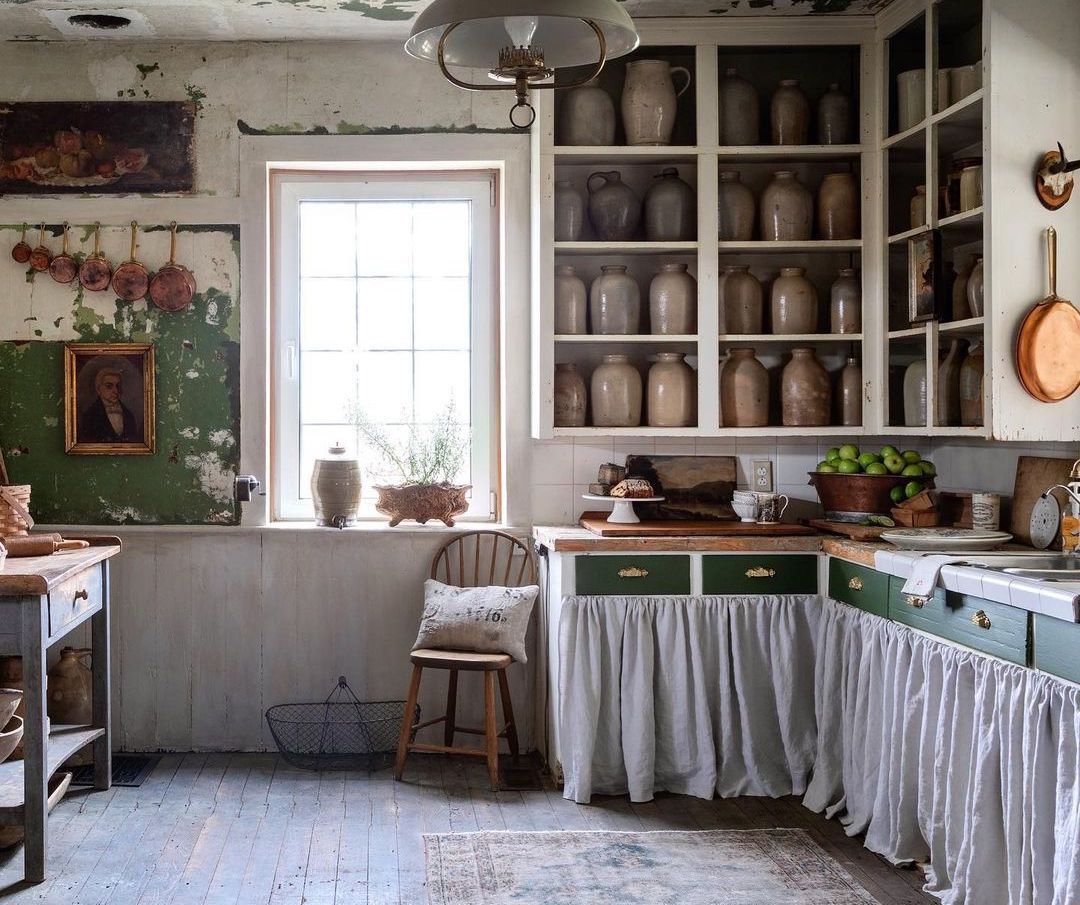
One of the most striking things about Mysterious Objekts is its refusal to play farmhouse by the usual rules. This is not the blindingly white, aggressively cheerful version of country living that looks like it was assembled by a committee of ceramic pitchers. The interiors are darker, richer, and more cinematic. Think bottle green walls with peeling charm, old portraits, shelves of objects with unclear former jobs, and rooms that invite curiosity rather than instant comprehension.
That mood matters because it transforms antiques from background decor into active participants. A brass candlestick in a bright, overstyled room can read as “nice vintage accent.” Put that same candlestick in a moody farmhouse interior with worn floors, dark paint, and a table full of ironstone and earthenware, and suddenly it becomes part of a story. The room gains depth. The objects feel earned. The whole place starts to look collected rather than purchased in one efficient Saturday.
This layered, collected atmosphere also reflects a broader shift in design. Many American design publications have noted the move away from stark, high-gloss interiors toward homes with depth, texture, vintage pieces, and a sense of having evolved over time. Mysterious Objekts lands squarely in that sweet spot. It feels curated, yes, but never over-managed. It has confidence. It knows not every corner needs to explain itself.
Authenticity Is the Real Luxury
The phrase that best captures the spirit of Mysterious Objekts is probably this: authentic condition. That way of seeing antiques is refreshingly different from the urge to refinish, repaint, repair, and sanitize every old object until it loses the very thing that made it special. Here, age is not a defect. It is the point.
A leather chair with softened arms, a rug faded by decades of light, a frame with foxing on the glass, a chest with uneven wear on its knobs and corners, a stack of ironstone that has outlived several kitchens: these are not flaws to disguise. They are signs of a useful, human life. The best antique spaces understand that patina is a visual record. It is what happens when material meets time, sunlight, weather, touch, and repetition. In other words, it is history you can see without reading a plaque.
That outlook also helps explain why Mysterious Objekts feels so emotionally persuasive. The farmhouse is not trying to impress you with flawless restoration or sterile “heritage” vibes. It is allowing the old house and the old objects to keep some of their rough edges. And those rough edges create trust. You believe what you are seeing.
Design Lessons to Steal From Mysterious Objekts
Let one room go dark and dramatic
Farmhouse interiors do not have to live on a strict diet of white paint and natural oak. A darker palette can make old architecture feel warmer, more intimate, and more grounded. Deep greens, browns, blacks, and oxblood-adjacent tones give antiques a stronger silhouette and make candlelight, lamplight, and natural light work harder in the best possible way.
Mix humble and elegant pieces
The most memorable rooms often pair ordinary rural utility with flashes of refinement: a rough table under a formal portrait, simple pottery beside silver, a plain chair next to an ornate mirror. That tension keeps a farmhouse from feeling either too rustic or too precious. It also makes the space feel realistic. Most lived-in homes accumulate in layers, not categories.
Show objects in use, not on parade
Mysterious Objekts succeeds because it does not stage antiques like nervous artifacts. Bowls stack where bowls belong. Chairs sit near tables. Lamps look ready to be switched on. This is a subtle but powerful lesson for anyone decorating with vintage pieces: use them. Let them participate in daily life. Otherwise, your living room starts looking like a mildly uptight estate sale.
Respect the original bones
One reason old farmhouses endure is that their essential features still work. Historic windows, porches, trim, and room proportions do a lot of visual heavy lifting. Preservation guidance in the U.S. consistently argues for repairing and understanding old buildings before replacing their defining features, and that wisdom applies here too. The best old-home design starts with paying attention to what the building already knows how to do.
Do not over-edit the odd stuff
Antique dealers with a great eye know that not everything should be conventionally pretty. The strange object, the unsettling portrait, the chipped vessel, the item whose original function has become a bit fuzzy: these are often the pieces that give a home its pulse. Mysterious Objekts understands that beautifully. A little mystery keeps a room awake.
Why This Farmhouse-and-Shop Idea Works So Well
There is something deeply satisfying about a house that is also a place of discovery. Homes and shops usually operate under different emotional rules. Homes are private, layered, and personal. Shops are edited, navigable, and transactional. When the two overlap successfully, as they do here, you get the best of both. The house lends soul to the inventory, and the inventory keeps the house alive with movement and change.
It also fits the spirit of antique culture better than a blank retail box ever could. Antiques are about context. A pine chest makes more sense in a room with old floors than under track lighting next to acrylic shelving. A worn portrait becomes more powerful when hung in a hallway that already carries a little shadow. In spaces like this, architecture acts like a translator. It tells you how to look at the objects.
More Than Pretty Pictures: Why People Connect With Places Like This
Mysterious Objekts is visually striking, but its real appeal goes beyond the photos. People are hungry for spaces that feel specific. Not optimized. Not endlessly replicated. Specific. A farmhouse from the 1840s in Ontario, filled with antique finds and moody interiors, offers something rare: a point of view. It does not try to be everything to everyone. It simply knows what it is.
That kind of clarity is powerful online and in real life. It is why the title lingers. It is why readers stop scrolling. It is why design lovers, antique hunters, and old-house obsessives all perk up at once. The place speaks to a broader craving for homes with memory, shops with personality, and interiors that feel collected rather than computed.
Final Thoughts
Mysterious Objekts: An 1840s Farmhouse (and Antiques Shop) in Ontario works because it embraces exactly what makes it unusual. It is old, moody, curious, and gloriously uninterested in looking brand-new. The farmhouse honors the best qualities of historic homes: material honesty, architectural character, useful imperfection, and the quiet drama of things that have lasted. The shop adds another layer, turning those qualities into an immersive experience instead of a static backdrop.
In the end, the place reminds us that good interiors are not built from trends alone. They come from judgment, restraint, atmosphere, and a willingness to let age show. That is true whether you are restoring an 1840s farmhouse, decorating a suburban bungalow, or just trying to keep yourself from buying another suspiciously cheerful mass-produced lantern. A home gets more interesting when it carries evidence of life. Mysterious Objekts understands that, and that is exactly why it feels so unforgettable.
Experience: What It Feels Like to Spend Time in a Place Like Mysterious Objekts
Visiting a farmhouse antiques shop like Mysterious Objekts is less like shopping and more like slipping into an alternate tempo. You pull up expecting a store, but what you get is a setting with its own heartbeat. The first thing that usually lands is not one object, but the whole composition: the old exterior, the suggestion of outbuildings, the porch, the windows, the sense that this place had a life before you arrived and will continue just fine after you leave. That alone changes your posture. You stop rushing. Your phone suddenly feels less important. Miracles happen.
Inside, the experience becomes wonderfully tactile. Floors creak in a way that feels reassuring rather than alarming. Light falls unevenly, which is good because old objects look better when they are discovered instead of announced. You begin to notice textures before labels: worn wood, cool metal, glazed ceramics, linen with a little slouch, leather with a history written into the surface. Even the air seems different in an old farmhouse. It carries wood, age, dust, and the faint feeling that every room has seen a hundred versions of itself.
Then there is the psychology of browsing. In a big-box store, your brain goes into task mode. Lamp. Table. Checkout. Done. In a place like this, your mind wanders in a much more enjoyable way. You start making little narratives. Who used this bowl? Why does that portrait look like he knows all my bad decisions? How did this chair survive long enough to look better than half the chairs made yesterday? The joy comes from surprise. The next corner might hold ironstone, religious art, old textiles, a stack of books, a cabinet full of oddities, or a tiny object you cannot identify but now irrationally believe you need.
There is also a strong emotional pull in seeing antiques used in rooms that still feel domestic. That is what makes a farmhouse setting so effective. A pitcher on a rough table looks different in a house than it does in a glass case. A mirror above a mantle feels more convincing when the mantle belongs to a room with shadow, depth, and maybe a slightly uneven wall. The house gives the objects context, and the objects return the favor by making the house feel inhabited rather than preserved in amber.
By the time you leave, you are usually carrying more than a purchase, even if you buy nothing. You leave with sharpened eyes. You start noticing the value of wear, the beauty of darker rooms, the charm of things that do not match too perfectly, and the emotional charge of a house that keeps its history visible. You may also leave mildly annoyed at your own furniture for lacking mystery, which is fair. Once you have experienced a place like Mysterious Objekts, it becomes harder to settle for rooms that feel assembled in one afternoon. You want homes with layers, shops with character, and objects with enough backstory to raise at least one excellent question.
That is the real experience at the heart of Mysterious Objekts. It is not just about antiques in Ontario or a beautiful 1840s farmhouse. It is about rediscovering how satisfying it is to be in spaces that do not explain themselves immediately. They ask you to look longer. They reward attention. And in an age of instant everything, that may be the most luxurious feeling of all.