
Note: This article is written as an original SEO-friendly feature inspired by publicly available information about the fineliner artwork Recalibration, the artist’s process, and real pen-and-ink drawing techniques.
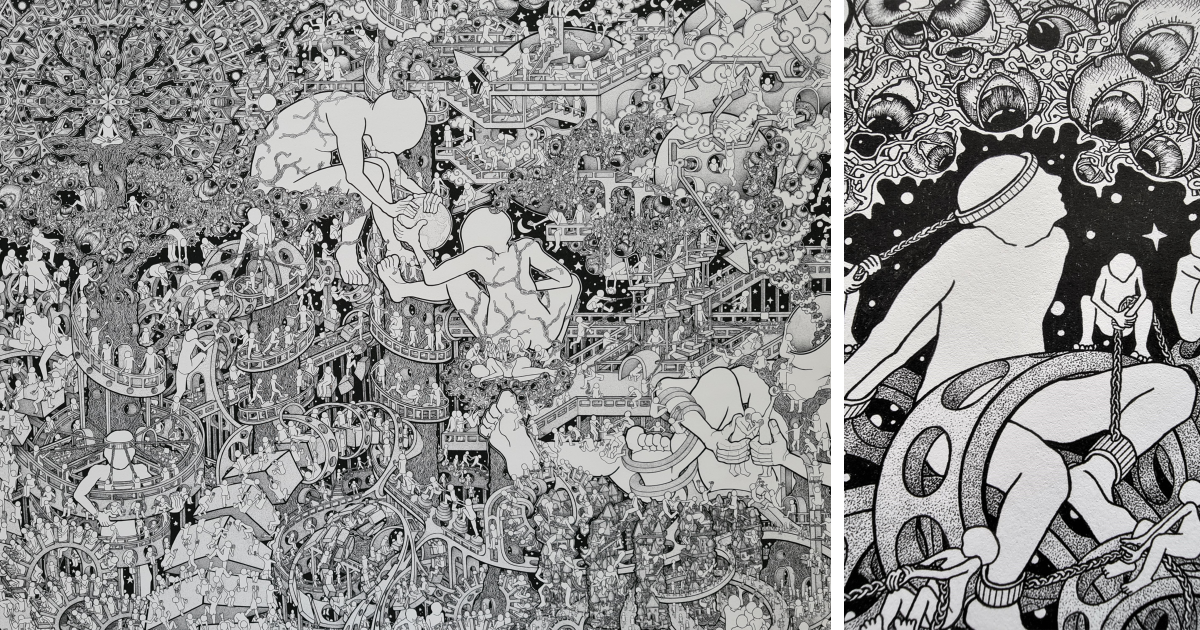
Some artworks politely ask for your attention. Others grab your eyeballs, hand them a magnifying glass, and say, “Good luck, friend.” Recalibration, a massive black fineliner drawing by visual artist and beatboxer Niek Dingemans, better known as Studiomonkie, belongs firmly in the second category. Created over more than 1,000 hours, this intricate drawing is not just a piece of paper covered in lines. It is a marathon, a maze, a meditation, and possibly a quiet warning that one tiny pen can absolutely take over your life.
The artwork was made using black fineliner pens, with the original drawing measuring approximately 1110 x 765 mm. That is not a casual doodle made during a long phone call. That is a full-scale expedition into detail, patience, and controlled chaos. Over roughly a year, Dingemans returned to the drawing day after day, allowing it to grow naturally instead of forcing every element into a rigid plan. The result is a dense, surreal, highly detailed composition that rewards slow looking. Zoom in, and the drawing keeps unfolding. Zoom out, and it becomes a strange world that seems to breathe on its own.
In an age where digital images are often swiped past in half a second, Recalibration feels almost rebellious. It says: slow down. Look closer. Stay a while. Also, maybe buy more pens.
What Is ‘Recalibration’?
Recalibration is a large-scale fineliner drawing made with countless lines, dots, textures, and imaginative forms. The title itself is meaningful. To recalibrate means to adjust, reset, or realign something so it works more accurately. In a technical sense, a machine can be recalibrated. In a personal sense, a mind can be recalibrated too. That makes the title feel surprisingly fitting for a year-long drawing process built around repetition, discipline, intuition, and change.
Rather than beginning with a fully mapped-out blueprint, the artist approached the piece with a looser rule: draw regularly, keep planning minimal, and let the image develop. This gives Recalibration its organic feeling. It does not look like a drawing that was simply executed. It looks like a drawing that was discovered slowly, one decision at a time.
The artwork sits somewhere between detailed illustration, surreal world-building, abstract line art, and what some viewers might associate with “wimmelbilder,” a style of densely packed imagery filled with tiny discoveries. It invites the same kind of visual treasure hunt as a hidden-object book, except here the reward is not finding a striped-shirt character in a crowd. The reward is noticing how much life can be packed into black ink.
The Power of Fineliner Drawing
Fineliner pens are beloved by illustrators, architects, comic artists, journal keepers, and anyone who has ever said, “I only need one pen,” before buying twelve. Their appeal comes from precision. A fineliner can create crisp outlines, tiny textures, delicate patterns, and controlled shading. Unlike charcoal or paint, it does not smudge dramatically across the page unless you provoke it. Unlike pencil, it usually does not forgive mistakes. Fineliner drawing is a commitment. Once the line is down, it lives there now. Congratulations, you have a roommate.
That permanence changes the way an artist works. Every mark matters, but not in a stiff or fearful way. In large detailed drawings, small imperfections often become part of the personality of the piece. A slightly irregular line can make an object feel handmade. A cluster of dots can become shadow. A repeated pattern can turn into rhythm. The pen does not offer shortcuts, so the artist learns to build complexity through patience.
Why Black Ink Feels So Strong
Black fineliner ink has a special authority. It strips away the distraction of color and leaves the viewer with structure, contrast, movement, and texture. In Recalibration, the absence of color does not make the artwork feel simple. It makes the details sharper. The eye starts to read light and shadow through line density, dot patterns, gaps, curves, and repeated marks.
This is one reason pen-and-ink art remains so powerful. It can feel both ancient and modern. The tools are simple, but the results can be wildly complex. With only black marks on a white surface, an artist can suggest depth, atmosphere, tension, humor, architecture, nature, motion, and emotion. It is visual cooking with two ingredients and somehow ending up with a ten-course meal.
How 1,000+ Hours Changes an Artwork
Spending more than 1,000 hours on a single drawing is not just a matter of time. It changes the relationship between artist and artwork. At hour ten, the drawing is still an idea. At hour one hundred, it has a personality. At hour five hundred, it may start making demands. By hour one thousand, the artwork is no longer a project you are finishing. It is a place you have lived.
This kind of long process allows for a special kind of depth. Details accumulate gradually. Patterns echo each other. Mistakes can be absorbed into new forms. Empty areas become opportunities. A corner that once looked unimportant can suddenly become a focal point. The drawing grows like a city: one street, one window, one strange little creature at a time.
There is also a mental side to this. A year-long drawing requires consistency without boredom, discipline without rigidity, and focus without becoming so precious that every mark feels terrifying. Dingemans’ approachdrawing a little every day and allowing the image to evolvekeeps the process alive. Instead of treating the artwork like a factory task, he treated it like an ongoing conversation.
Minimal Planning, Maximum Discovery
One of the most interesting things about Recalibration is the artist’s decision to keep sketching and planning to a minimum. For many people, that sounds risky. Starting a large drawing without a detailed plan can feel like entering a forest with a sandwich, a flashlight, and a suspicious amount of confidence. But for this style of work, that risk becomes part of the energy.
Minimal planning leaves room for surprise. The artist can respond to what is already on the page. A curve can suggest a new structure. A shadow can become a pathway. A tiny shape can grow into a larger motif. This process gives the drawing a natural flow that might be harder to achieve if every inch had been pre-approved in advance by the committee of overthinking.
Of course, “minimal planning” does not mean “no skill.” It requires strong visual instincts. The artist must balance density and breathing space, detail and readability, repetition and variation. Too much detail everywhere, and the viewer gets lost in visual static. Too little, and the magic disappears. Recalibration works because the chaos feels controlled. It is busy, but not careless. It is spontaneous, but not random.
The Techniques Behind the Detail
Fineliner drawings like Recalibration often rely on classic ink techniques, even when the final image feels contemporary and surreal. These techniques are simple in concept but demanding in practice.
Hatching and Cross-Hatching
Hatching uses parallel lines to create tone, movement, and form. Cross-hatching adds another layer of lines at an angle, deepening the shadow. In a large fineliner drawing, these methods can create dramatic contrast without using gray ink. The closer the lines, the darker the area appears. The wider the spacing, the lighter it feels.
Stippling and Dot Work
Stippling uses tiny dots to build value and texture. It is beautiful, slow, and slightly dangerous to your sense of time. You begin with one dot, and suddenly it is midnight. Dot work can create soft gradients, rough surfaces, atmospheric effects, and organic textures. In a piece requiring hundreds of hours, stippling becomes both a technique and a test of patience.
Line Weight and Texture
Line weight refers to the thickness or darkness of a line. Even with fineliners, artists can vary line weight by switching pen sizes, layering marks, or controlling pressure. Thicker outlines can bring forms forward, while thinner lines can suggest distance or delicate detail. Texture comes from repeated decisions: short strokes, long curves, dots, scratches, spirals, grids, and tiny marks that build into a visual language.
Why Viewers Love Ultra-Detailed Art
There is something deeply satisfying about art that keeps revealing new details. It gives viewers permission to linger. Instead of consuming the image instantly, they explore it. The experience becomes active, almost like reading a map or solving a puzzle.
Ultra-detailed drawings also create a sense of wonder because the labor is visible. When people hear that an artist spent more than 1,000 hours on a drawing, they immediately understand that this is not a casual piece. The time becomes part of the artwork’s meaning. Each line represents a decision. Each section represents a return. The viewer is not only looking at an image; they are looking at evidence of devotion.
That devotion is especially compelling today because so much visual culture is optimized for speed. Quick posts, quick edits, quick reactions, quick trends. Recalibration goes in the opposite direction. It is slow art for fast times. It reminds us that attention can still be stretched, trained, and rewarded.
The Role of Repetition in Creative Work
Repetition is often misunderstood as boring. In reality, repetition can be where creativity gets interesting. When an artist repeats lines, dots, and patterns for months, the hand becomes more confident. The mind starts noticing variations. Small changes become meaningful. The process becomes less about forcing originality and more about staying present long enough for originality to appear.
This is why detailed drawing can feel meditative. The artist enters a rhythm: mark, pause, adjust, continue. There is no dramatic explosion of genius every five minutes. There is just the steady accumulation of tiny acts. The funny thing is that those tiny acts eventually become something enormous.
Anyone who has ever tried a detailed ink drawing knows the emotional cycle. First comes excitement. Then comes doubt. Then comes the stage where your hand hurts and your brain whispers, “What if we simply moved to another country and abandoned this paper?” But if you keep going, something changes. The drawing begins to carry you forward.
What Artists Can Learn from ‘Recalibration’
Recalibration offers useful lessons for artists, illustrators, designers, and creative people in general. The first lesson is that a huge project does not need to be conquered all at once. It can be built in daily sessions. One or two hours a day may not sound dramatic, but over a year, it becomes a mountain.
The second lesson is that not every artwork needs a perfect plan. Some projects benefit from structure, but others grow best when the artist leaves space for discovery. This does not mean abandoning standards. It means trusting the process enough to let the artwork participate in its own creation.
The third lesson is that limitation can be powerful. By using only black fineliners, the artist narrowed the visual language. That limitation created focus. Instead of asking, “Which color should I use?” the drawing asks, “What can this line do?” Sometimes fewer tools lead to deeper invention.
Experience Section: What Spending 1,000+ Hours on a Drawing Really Feels Like
Spending more than 1,000 hours on a fineliner drawing is a strange experience because the progress is both obvious and invisible. At the end of a session, you can point to the area you completed. Maybe you filled a corner with tiny buildings, added shadow to a surreal shape, or spent two hours making a texture that looks like it could have taken ten minutes to someone who has never tried it. But when you step back, the whole artwork may still look unfinished. That can be humbling. It can also be addictive.
The first major challenge is learning how to return. Starting is easy when the idea is fresh. Returning on day 47 is harder. Returning after a bad session is harder still. A large drawing teaches you that motivation is not the whole engine. Routine matters more. You sit down, pick up the pen, and make the next mark. Some days feel inspired. Some days feel like you are negotiating with a very demanding rectangle of paper.
Another experience is the relationship with mistakes. In pencil, you can erase. In digital art, you can undo. With fineliner, the line stays. At first, that can feel terrifying. Later, it becomes freeing. You stop expecting perfection and start practicing adaptation. A line that goes slightly wrong can become a shadow. A crowded area can become texture. An accidental mark can turn into a new object. The drawing becomes less about avoiding mistakes and more about responding intelligently.
Physical comfort becomes surprisingly important too. A 1,000-hour drawing is not only a creative challenge; it is an ergonomic event. Your wrist, shoulders, neck, and back all become part of the production team, and some of them complain loudly. Good lighting matters. Breaks matter. Rotating the paper matters. Stretching matters. The romantic image of the artist suffering for art is charming until your hand feels like it has filed a formal complaint with management.
There is also a deep emotional satisfaction in watching tiny marks become a world. A detailed fineliner drawing grows slowly, but that slowness creates intimacy. You remember sections by how they felt to draw. One area may remind you of a rainy week. Another may belong to late-night sessions. Another might carry the energy of a breakthrough after days of uncertainty. By the time the artwork is finished, it contains more than imagery. It contains time.
The best part is the final viewing experience. When people look closely and discover small details, the long hours feel shared. Someone notices a texture you nearly gave up on. Someone zooms into a corner you spent an entire afternoon building. Someone says, “How did you even think of this?” and the honest answer is: slowly. Very, very slowly. That is the quiet magic of a drawing like Recalibration. It proves that imagination does not always arrive as a lightning bolt. Sometimes it arrives as one black line, repeated with patience until a whole universe appears.
Conclusion
Recalibration is more than a 1,000+ hour fineliner drawing. It is a celebration of patience, instinct, detail, and the creative value of showing up again and again. Niek Dingemans’ large-scale black ink artwork reminds us that not every masterpiece needs speed, color, or digital polish. Sometimes all it needs is paper, pens, time, and a willingness to follow the next line without knowing exactly where it will lead.
For artists, the lesson is encouraging: ambitious work can be built gradually. For viewers, the lesson is equally simple: look longer. The good stuff is often hiding in the details.