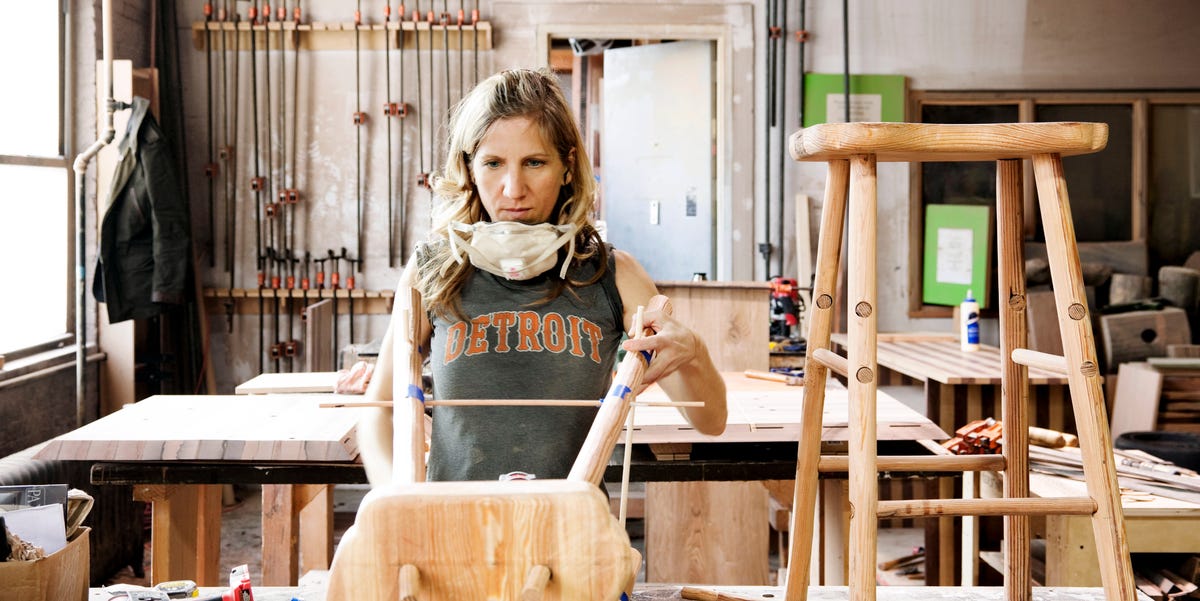

Building your own furniture can seem like a hobby reserved for people with enormous workshops, heroic beards, and an emotional attachment to hand planes. Fortunately, none of those things is required. You can begin furniture building in a garage, basement, spare room, covered patio, or carefully organized corner of a shared workspace.
The real starting point is not buying a truckload of expensive tools. It is learning how furniture works: how parts are measured, cut, joined, supported, sanded, and finished. A simple side table built square and sturdy will teach you more than an ambitious dining set that spends three years becoming an unusually expensive lumber pile.
This beginner furniture-building guide explains how to choose a first project, assemble a practical toolkit, select suitable wood, learn basic joinery, work safely, and turn early mistakes into useful skills.
Start With the Right Expectations
Furniture making combines design, woodworking, problem-solving, and patience. Your first project probably will not look as though it rolled out of a luxury showroom. It may have a visible screw, a slightly enthusiastic sanding mark, or one leg that needed a discreet felt pad. That is normal.
A beginner succeeds by completing manageable projects and understanding what happened during the build. The goal is not immediate perfection. The goal is to make each project safer, stronger, straighter, and cleaner than the last one.
“`
Choose usefulness over complexity
Good beginner furniture projects include a small bookshelf, plant stand, storage bench, basic coffee table, wall shelf, or square side table. These projects use mostly straight cuts and introduce essential skills without requiring complicated curves, drawers, doors, or traditional hand-cut joints.
Avoid beginning with a rocking chair, large dresser, expandable dining table, or anything described as “heirloom quality” in a plan containing 94 parts. Your confidence deserves a gentler opening act.
Pick a Plan Before Buying Lumber
A clear furniture plan is the beginner’s best defense against expensive improvisation. A useful plan should provide finished dimensions, a cut list, material thicknesses, hardware requirements, joinery details, assembly order, and diagrams that show how the pieces fit together.
Read the entire plan before visiting the lumber aisle. Highlight unfamiliar techniques and check whether the project requires tools you do not own. A “simple weekend table” becomes less simple when Step 4 casually requests a commercial mortising machine.
Check the finished size
Measure the room where the furniture will live. Then measure doors, stairways, elevators, and tight corners along the delivery route. A beautifully built cabinet that cannot leave the basement is no longer furniture. It is architecture.
Create your own working cut list
Rewrite the project parts in a checklist with columns for quantity, thickness, width, length, and status. Mark parts as they are cut. Give similar pieces clear names such as “front rail,” “rear rail,” and “left side” instead of relying on your memory after three hours of sanding.
Build a Basic Furniture-Making Toolkit
You do not need a warehouse of machinery to get started in furniture building. A compact selection of reliable tools can produce surprisingly refined work. Buy tools according to the needs of your projects rather than collecting equipment because someone online called it essential.
Measuring and marking tools
- A readable tape measure
- A 6-inch or 12-inch combination square
- A sharp pencil or marking knife
- A straightedge
- A small level
Accuracy begins with consistent reference points. Choose one straight edge and one flat face on each board, mark them, and take related measurements from those references. Measuring repeatedly from different ends is an excellent way to create four table legs that are almost the same length.
Cutting and shaping tools
A circular saw with a straightedge guide can make long, accurate cuts in boards and plywood. A miter saw is convenient for repeated crosscuts, while a jigsaw handles curves and interior cutouts. A quality handsaw remains useful for small cuts, trimming, and jobs where setting up a power tool would take longer than making the cut.
Add a small chisel set, a block plane, and a rasp or file as your skills grow. These tools help refine joints, soften edges, and correct small fitting problems without removing half the project in one dramatic pass.
Drilling, assembly, and sanding tools
- A cordless drill and driver
- Drill bits and countersink bits
- A random-orbit sander
- Several bar clamps or F-style clamps
- Wood glue and suitable screws
- A sturdy work surface
Clamps deserve special attention. Beginners often buy one clamp and discover that woodworking treats clamps the way kitchens treat clean towels: however many you have, the project wants two more.
Set Up a Safe, Functional Workspace
Your workshop does not need to be large, but it must be stable, bright, and free of tripping hazards. Provide enough room to support the full length of your workpiece before, during, and after a cut. Never balance sheet goods on a folding chair while hoping physics is in a generous mood.
Wear eye protection whenever cutting, drilling, routing, or sanding. Use hearing protection with loud equipment. Keep guards installed and follow the tool manufacturer’s instructions. Disconnect power before changing blades, bits, or making adjustments near cutting components.
Control wood dust
Cutting and sanding produce airborne wood particles that should not become part of your respiratory system. Connect tools to effective dust collection or a suitable shop vacuum when possible. Work with ventilation, clean using a vacuum rather than blowing dust around, and wear properly fitted respiratory protection appropriate to the task.
Finishes, adhesives, and solvents also require careful handling. Read product labels, provide fresh air, keep flammable materials away from ignition sources, and store oily rags according to the finish manufacturer’s safety directions.
Learn How Wood Behaves
Wood is not a perfectly uniform building material. Grain direction, knots, moisture, density, and natural defects affect how a board cuts, sands, accepts finish, and moves over time. Solid wood gains and loses moisture as surrounding conditions change, causing most dimensional movement across the grain rather than along the board’s length.
This matters when attaching a wide solid-wood tabletop. Locking it rigidly to a base in every direction can encourage cracks, splits, or distortion as humidity changes. Furniture makers use methods such as elongated screw holes, figure-eight fasteners, tabletop clips, and properly designed joinery to hold the top securely while allowing controlled movement.
Beginner-friendly materials
Common softwoods such as pine and poplar are widely available and easy to machine, although softer surfaces dent more readily. Poplar is especially useful for painted furniture. Oak, maple, cherry, and walnut offer greater durability and distinctive grain but generally cost more and can require sharper tools or more careful finishing.
Plywood is valuable for cabinets, shelves, and large panels because its layered construction provides stability. Furniture-grade plywood usually offers cleaner faces and fewer internal voids than basic construction panels. Medium-density fiberboard creates smooth painted surfaces but is heavy, produces very fine dust, and does not hold every type of fastener equally well.
When purchasing plywood, MDF, or particleboard for indoor furniture, look for products labeled as compliant with applicable U.S. composite-wood emission standards.
Inspect every board
Look down the length of lumber to check for bowing, twisting, cupping, or crook. Examine both faces and edges for cracks, loose knots, stains, and milling damage. A mildly imperfect board may still yield shorter parts, but starting with twisted lumber makes square furniture unnecessarily difficult.
Master a Few Basic Furniture Joints
Joinery determines how furniture parts connect and transfer weight. Traditional joints such as mortise-and-tenon and dovetails are valuable skills, but beginners can build strong, attractive pieces using simpler methods.
Butt joints with screws
A butt joint places the end or edge of one board against another. Alone, it offers limited strength, but glue, screws, blocks, or brackets can reinforce it. Butt joints work well for utility furniture, simple shelving, and workshop projects.
Pocket-hole joinery
A pocket-hole jig guides an angled drill bit so a specialized screw can pull two parts together. This technique is approachable, quick, and useful for face frames, table aprons, cabinet components, and many beginner furniture plans. Measure the material thickness carefully, use the correct screw length, and clamp parts before driving the screws to prevent shifting.
Dowels, dados, and half-laps
Dowels align and strengthen joints while keeping fasteners hidden. A dado is a flat-bottomed channel that receives another board, making it useful for shelves and cabinet dividers. A half-lap removes part of the thickness from two crossing pieces so they overlap with a flush face. Each method teaches more precise layout and fitting without immediately requiring advanced equipment.
Practice joints on scrap
Before cutting joinery into an important project part, reproduce the setup on scrap material of the same thickness. Test the fit, screw depth, glue behavior, and tool settings. Ten minutes of practice can save a board that costs more than lunch.
Cut Accurately and Assemble in Stages
Furniture quality depends less on making every measurement mathematically perfect than on making matching parts consistently. Cut table legs together using a stop block. Rip shelves in one setup. Use the same reference edge for repeated layouts. Small inconsistencies become very visible when related pieces meet.
Use a dry assembly
Put the project together without glue before final assembly. Confirm that joints close, panels fit, hardware has clearance, and the structure sits square. A dry fit reveals reversed parts and missing holes while the problem can still be corrected without a mallet and emotional bargaining.
Check for square
Measure the diagonals of rectangular frames or cabinet boxes. When both diagonal measurements match, the assembly is square. Adjust clamp pressure before the glue cures. Also place a square against accessible corners rather than trusting your eyes, which are optimistic and easily impressed by fresh lumber.
Control glue
Apply a thin, even film to mating surfaces. More glue does not automatically create a stronger joint; it mostly creates a more memorable cleanup session. Remove squeeze-out before it hardens, but avoid smearing diluted glue into surrounding grain where it may interfere with stain.
Sand and Finish Without Rushing
Sanding removes machining marks and prepares a uniform surface. Begin with a grit coarse enough to eliminate visible defects, then move through progressively finer grits without making enormous jumps. Sand with the grain during final hand sanding and remove dust between stages.
Ease sharp edges with sandpaper or a small round-over treatment. This improves comfort, reduces splintering, and helps finishes adhere more evenly along corners.
Test the finish first
Wood species, sanding methods, and stains interact unpredictably. Apply your complete finishing schedule to an offcut from the project. A stain that looked warm and sophisticated on a sample card may turn your pine tabletop the color of an overcooked pumpkin.
Wipe-on oils and varnish blends are approachable because they are easy to apply in thin coats. Water-based clear finishes dry quickly and usually preserve a lighter wood color. Film finishes such as polyurethane provide greater surface protection for tables and other hard-use furniture. Follow label instructions for ventilation, drying time, recoating, and disposal.
Design Furniture for Real-World Safety
A piece of furniture must do more than survive a workshop beauty shot. It must remain stable during everyday use. Test chairs, stools, benches, and tables gradually before trusting them with a full load. Check that legs contact the floor evenly and that fasteners are properly seated.
Tall bookcases, dressers, cabinets, and entertainment units can tip forward, particularly when drawers or doors are opened or children climb on them. Design for a stable base and include appropriate anti-tip anchoring. Secure tall furniture to suitable wall structure using hardware intended for that purpose.
Avoid sharp projections, exposed fastener tips, pinch points, and unsupported shelves. Furniture intended for children requires especially careful attention to stability, spacing, finishes, hardware, and foreseeable misuse.
A Practical First Furniture-Building Roadmap
- Select a small project made mostly from straight parts.
- Read the full plan and identify every required operation.
- Buy straight, dry material appropriate for your tools.
- Label the parts and establish reference faces and edges.
- Practice unfamiliar cuts and joints on scrap wood.
- Cut matching parts with the same setup whenever possible.
- Dry-fit the complete project and check for square.
- Glue and clamp in manageable subassemblies.
- Sand carefully and test the finish on an offcut.
- Install hardware, level the piece, and add anchoring where needed.
This process may feel slower than cutting immediately, but planning reduces rework. Furniture building follows an unusual law of time: the five minutes skipped during layout frequently return later wearing a two-hour disguise.
Common Beginner Mistakes to Avoid
- Buying every tool at once: Start with tools required by your current project and expand gradually.
- Using warped lumber: Straight joinery cannot fully rescue badly distorted stock.
- Ignoring blade width: Cut on the waste side of the line and account for the material removed by the blade.
- Skipping the dry fit: Glue should not be the first moment you discover that a panel is upside down.
- Overtightening screws: Excessive torque can strip holes, crush fibers, or split narrow parts.
- Sanding unevenly: Remaining too long in one area can create dips and rounded edges.
- Finishing too soon: Give glue, stain, and each finish coat the recommended curing or drying time.
- Ignoring wood movement: Wide solid-wood components need attachment methods that permit seasonal change.
Conclusion
Learning how to get started in furniture building is mainly about choosing a realistic project and practicing a repeatable process. Measure from consistent references, make controlled cuts, use joinery suited to your skill level, dry-fit before gluing, and treat safety as part of the design.
Your early furniture does not need to be flawless to be worthwhile. A sturdy table with one small imperfection is still a table you designed, built, finished, and learned from. That accomplishment is far more useful than a pristine collection of unused tools.
Experience Notes: What the First Few Furniture Builds Really Teach You
The first lesson most new furniture builders learn is that cutting wood is only a small part of the job. A first side table may require less than an hour of actual cutting, yet the project can occupy an entire weekend. The remaining time disappears into layout, tool setup, checking dimensions, organizing parts, waiting for glue, sanding, finishing, and searching for the pencil that is usually behind one ear.
One of the most useful early habits is writing directly on rough project parts. Mark the visible face, grain direction, orientation, and part name in an area that will later be sanded away. During a dry fit, these marks prevent similar rails or panels from trading places. On simple furniture, nearly identical pieces often differ by only one hole, one edge treatment, or a fraction of an inch. Labels save time and reduce the thrilling experience of disassembling an almost-finished table.
Another important realization is that workshop accuracy is cumulative. A cut that is slightly out of square may not look serious by itself. Repeat that error across four frame parts, however, and the final assembly begins leaning like it has developed an opinion. Experienced builders do not necessarily measure faster; they create setups that make repeated errors less likely. Stop blocks, spacers, templates, and reference edges turn consistency into a physical feature of the process rather than a test of memory.
Beginners also discover that clamps do more than squeeze glue joints. They hold guides, stabilize workpieces, prevent drilling movement, and serve as temporary assembly assistants. The practical lesson is to plan clamping before applying glue. Perform a rehearsal with every clamp positioned nearby and adjusted close to the required opening. Glue-ups become much calmer when you are not spinning a clamp handle for 40 seconds while adhesive begins setting and a table apron slowly slides toward freedom.
The first finishing experience often teaches restraint. New builders may keep brushing a surface because one area looks slightly uneven. Each extra pass disturbs material that was already leveling correctly. Thin coats, good lighting, clean applicators, and patience usually create better results than aggressive correction. Dust is another surprise. A project can be perfectly sanded and still develop bumps because the workspace was not cleaned before finishing. Vacuuming the piece, bench, floor, and nearby surfaces is worth the effort.
Mistakes become less frustrating once they are treated as information. A split board may reveal that a pilot hole was too small or too close to an edge. A visible glue patch may show that squeeze-out was smeared instead of removed cleanly. A wobbly stool may expose inconsistent leg length or a twisted assembly. Record the cause and the correction in a notebook or project file. That record becomes a personalized woodworking manual based on problems you are unlikely to forget.
Finally, early furniture projects teach that completion matters. It is tempting to delay finishing a piece until every detail matches the picture in your head. Complete the project anyway, provided it is safe and functional. Install it, use it, and observe how it performs. Daily use will tell you whether the height is comfortable, the shelf spacing is practical, the finish is durable, and the joints remain tight. Those lessons will shape your next design more effectively than endless workshop perfectionism.
“`