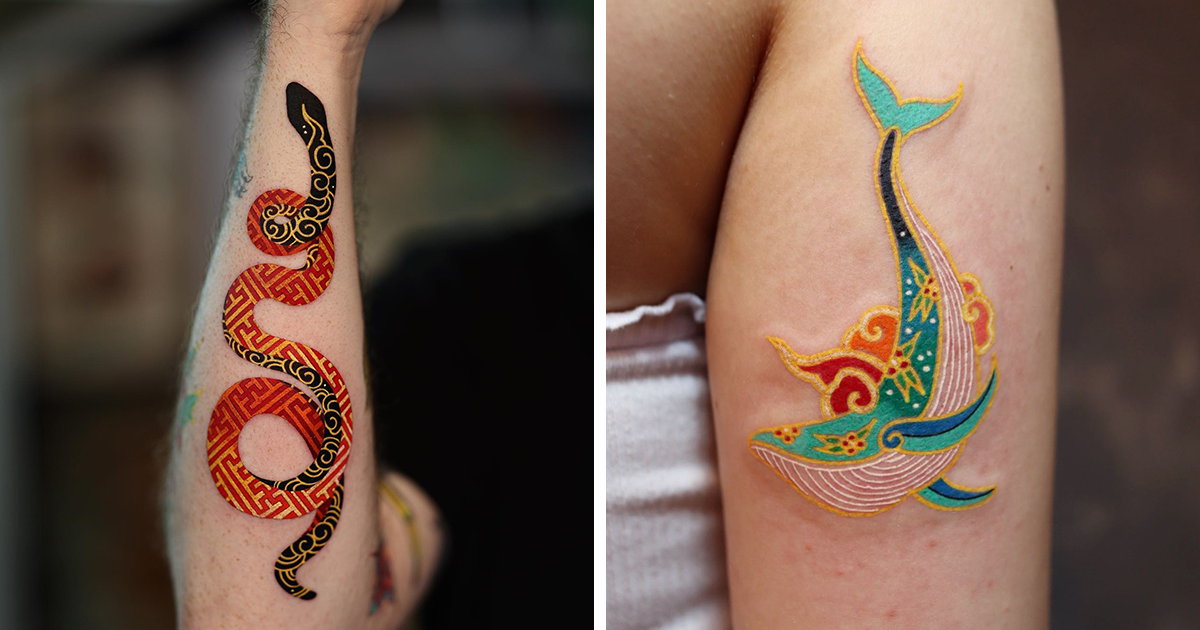

Some tattoos whisper. Some tattoos shout. And then there are the tattoos of Korean artist PittaKKM, which seem to open a tiny painted temple gate on the skin and invite the viewer inside. His work is bold, ornamental, deeply cultural, and somehow still modern enough to feel right at home on Instagram, in a gallery, or peeking out from under a denim jacket at a coffee shop.
Known for transforming traditional Korean aesthetics into vivid contemporary body art, PittaKKM has built a recognizable visual language: crisp outlines, jewel-like colors, dancheong-inspired patterns, Buddhist motifs, Korean folklore, dramatic negative space, and surprising references to Western fine art and pop culture. In short, his tattoos do not simply decorate the body. They tell stories with the confidence of a palace roof and the precision of a painter who definitely does not believe in “good enough.”
This article explores why his mesmerizing tattoos have captured global attention, what makes his style so distinctive, and how 30 of his best tattoo concepts reveal a rare balance between heritage and reinvention.
Who Is PittaKKM?
PittaKKM is a South Korean tattoo artist based in Seoul whose work is widely recognized for reinterpreting traditional Korean art through tattooing. His designs often draw from Buddhist temple decoration, Korean color symbolism, mythical animals, flowers, clouds, architectural frames, and ornamental patterns. Instead of copying old art onto skin, he reimagines it, making ancient motifs feel alive, wearable, and unmistakably contemporary.
That is the magic trick. A PittaKKM tattoo may include a tiger, lotus, crane, dragon, hanbok silhouette, moonlit pavilion, or even a famous Western painting, but the final result always looks filtered through Korean visual culture. The colors do much of the talking: reds, blues, greens, yellows, blacks, and whites arranged in compositions that feel energetic without becoming chaotic. It is like watching a stained-glass window learn martial arts.
Why His Korean Tattoos Stand Out
A Modern Take on Dancheong
One of the biggest influences in PittaKKM’s work is dancheong, the traditional decorative coloring found on Korean wooden buildings, especially temples and palaces. Dancheong is famous for its bright, rhythmic use of color and its complex geometric, floral, and symbolic patterns. On architecture, it adds beauty, spiritual meaning, and protection. On skin, in PittaKKM’s hands, it becomes a moving canvas of Korean heritage.
Many of his tattoos echo the look of painted temple beams: swirling clouds, framed panels, layered borders, lotus ornaments, mythical creatures, and balanced color fields. The result feels both historic and futuristic. You can sense the temple, but you can also sense the tattoo machine humming in the present.
The Power of Obangsaek Colors
Another key element is obangsaek, the traditional Korean five-color spectrum. These colors are commonly associated with directions and natural elements: blue or green, red, yellow, white, and black. In Korean visual culture, they are not random pretty shades. They carry ideas of balance, harmony, protection, nature, and cosmic order.
PittaKKM uses this palette with serious confidence. His reds glow. His greens curl around forms like vines. His yellows add warmth and ceremony. His black fields create depth, while white details give the eye room to breathe. The result is colorful tattoo art that never feels like someone emptied a marker box on the client and hoped for the best.
30 Of PittaKKM’s Best Tattoo Works And Signature Ideas
Because his body of work is broad, the “best” pieces are not only individual tattoos but recurring design ideas that show his strongest artistic instincts. Here are 30 standout types of works that define his mesmerizing style.
1. The Dancheong Crane Tattoo
A crane framed by red, green, and gold temple-inspired ornamentation is one of the clearest examples of PittaKKM’s gift for movement. The bird appears delicate, but the surrounding color structure gives it ceremonial power.
2. The Korean Tiger Tattoo
The tiger is a beloved figure in Korean folk art, and PittaKKM turns it into a fierce yet playful symbol. His tigers often feel less like predators and more like guardian spirits with excellent graphic design taste.
3. The Dragon Wrapped in Clouds
Dragons are common in Asian art, but his versions often lean into swirling clouds, patterned frames, and bold color contrast. They look ancient, energetic, and ready to supervise your life choices.
4. The Lotus Elbow Piece
Lotus tattoos can easily become generic. PittaKKM avoids that by building the flower with layered shapes, temple colors, and a sense of sacred geometry.
5. The Moonlit Pavilion Tattoo
Some of his most poetic work features Korean architectural elements beneath moons, stars, or cloud forms. These tattoos feel like small landscapes with a secret.
6. The Hanbok Silhouette
His hanbok-inspired pieces are especially memorable because they combine fashion, identity, and ornament. Instead of rendering every fabric detail realistically, he fills the silhouette with cultural patterns and color.
7. The Skating Hanbok Design
This is where tradition gets a skateboard and refuses to apologize. Designs that blend Korean clothing with modern movement show how PittaKKM keeps heritage from feeling frozen in a museum case.
8. The Buddhist Temple Pattern Sleeve
His larger sleeve compositions often use panels, bands, and repeating motifs that recall temple eaves. The effect is immersive, almost architectural.
9. The Phoenix Tattoo
A phoenix gives him room to show off color gradients, wing movement, and ornamental framing. These pieces often feel fiery but controlled.
10. The Magritte-Inspired Korean Fusion Tattoo
PittaKKM has been noted for mixing famous Western art references with Korean aesthetics. A surreal figure can become completely new when surrounded by obangsaek clouds and traditional motifs.
11. The Klimt-Inspired Ornament Tattoo
Decorative Western art and Korean pattern work make surprisingly good neighbors. His fusion pieces prove that visual cultures can meet without one swallowing the other.
12. The Michelangelo-Inspired Piece
Classical art references become less marble museum and more living folklore when filtered through PittaKKM’s color language.
13. The Black Negative Space Tattoo
One of his strongest techniques is negative space. Black areas are not empty; they frame the design and make the colors appear brighter.
14. The Cloud Band Tattoo
Clouds in his work often act like visual music. They guide the eye around the arm, shoulder, or leg while giving motion to otherwise static images.
15. The Floral Mandala Tattoo
His floral mandalas borrow from Korean ornament rather than standard mandala clichés. They are symmetrical, bright, and highly polished.
16. The Korean Mask Motif
Mask-inspired tattoos bring drama and character. They can feel theatrical, protective, and slightly mischievous.
17. The Temple Door Frame Tattoo
Some works use frame-like structures that resemble doors, windows, or architectural borders. This gives the tattoo the feeling of a portal.
18. The Red-and-Green Contrast Piece
Red and green are common in dancheong, and PittaKKM uses their contrast to create instant visual impact.
19. The Small Ornamental Wrist Tattoo
Not every design has to be a sleeve. His smaller works can carry the same cultural richness in a compact format.
20. The Forearm Story Panel
Forearm tattoos give him a long vertical canvas. He often uses this space to stack symbols, borders, and central figures like an illustrated scroll.
21. The Korean Roofline Tattoo
Architectural rooflines bring structure and nostalgia. They also remind viewers that Korean traditional design is not limited to clothing or painting.
22. The Guardian Animal Tattoo
Tigers, dragons, birds, and other creatures often appear as protectors. They add mythology without turning the tattoo into a costume party.
23. The Fine-Art Remix
One of his most shareable strengths is remixing recognizable art history through Korean pattern work. The viewer recognizes the reference, then realizes it has been transformed.
24. The Pop-Culture Fusion Tattoo
When contemporary characters or pop references appear in Korean ornamental style, the result is playful but still technically serious.
25. The Shoulder Cap Design
The shoulder is a tricky rounded surface, but PittaKKM’s pattern logic works beautifully there. Circular motifs and framed figures can wrap naturally around the body.
26. The Full Color Half Sleeve
His half sleeves are among the best examples of his discipline. Color, line, pattern, and spacing all need to cooperate, and in his stronger works they do so like a very stylish choir.
27. The Cosmic Korean Landscape
Moons, stars, mountains, clouds, and pavilions create dreamy landscapes that feel both personal and mythic.
28. The Lotus-And-Cloud Combination
This pairing appears often for good reason. The lotus gives symbolism and symmetry; the clouds add motion and atmosphere.
29. The Cultural Heritage Tattoo
Some of his most meaningful pieces are those that help clients connect with Korean identity, ancestry, travel memories, or admiration for Korean art.
30. The Fully Integrated PittaKKM Composition
The best PittaKKM tattoos combine everything: traditional color, strong linework, spiritual motifs, architectural framing, pop-cultural confidence, and a modern sense of composition. These are the works that make people stop scrolling.
The Art Behind The Mesmerizing Effect
Color That Feels Alive
Color tattoos can go wrong quickly. Too many shades can make a design look muddy, while too few can make it feel flat. PittaKKM’s work succeeds because his palette has cultural logic. The colors are bold, but they are not random. They behave like a family at a reunion: loud, lively, occasionally dramatic, but clearly related.
Linework With Discipline
His tattoos also rely on clean outlines. This matters because ornamental tattooing can become visually noisy if the lines are weak. In his best pieces, every curve, border, petal, feather, and cloud has a clear role.
Negative Space That Lets The Skin Breathe
One reason his tattoos remain readable is his use of negative space. Skin becomes part of the composition. Rather than covering every inch, he lets blank areas support the design, creating contrast and elegance.
Korean Tattoo Culture Is Changing
For years, tattoo artists in South Korea worked in a difficult legal environment. Tattooing was widely practiced and increasingly popular, yet artists faced restrictions because the procedure was treated as something only medical professionals could legally perform. This made the growth of Korean tattoo artistry even more remarkable. Many artists built international reputations while navigating social stigma, hidden studios, and legal uncertainty.
In 2025, South Korea’s parliament passed a landmark Tattooist Act that moves the profession toward legal recognition through licensing and regulation. This matters because artists like PittaKKM are not just creating beautiful tattoos; they are part of a broader cultural shift. Tattooing in Korea is moving from the shadows toward formal legitimacy, and the world is watching.
What Clients Can Learn From PittaKKM’s Work
Choose Meaning Before Trend
A tattoo does not need a 900-page backstory, but it should mean enough that you will still respect it later. PittaKKM’s best works feel lasting because they are connected to culture, symbolism, form, and identity.
Respect The Artist’s Specialty
If you choose an artist known for Korean ornamental color work, let that artist do what they do best. Asking PittaKKM for a tiny gray barcode tattoo would be like hiring a chef famous for royal banquets and requesting plain toast. Technically possible, emotionally confusing.
Think About Placement
His designs often interact with the body’s shape. Forearms, shoulders, calves, backs, and upper arms allow patterns to wrap and flow. Good placement turns a tattoo into part of the body rather than a sticker placed on top of it.
Do Not Ignore Safety
Beautiful tattoo art still involves needles, ink, healing skin, and aftercare. Clients should choose trained professionals, ask about sterile equipment, follow aftercare instructions, avoid sun exposure during healing, and seek medical help for unusual reactions. Art is exciting; infections are not the kind of plot twist anyone ordered.
Why These Tattoos Work So Well Online
PittaKKM’s tattoos are highly shareable because they are instantly recognizable. In a feed full of black line tattoos, tiny symbols, and minimalist script, his work explodes with color and cultural specificity. Viewers do not need to understand every motif to feel the impact. The tattoos are visually generous: bright enough to stop the thumb, detailed enough to reward close inspection, and meaningful enough to invite conversation.
They also arrive at the perfect cultural moment. Global audiences are more familiar with Korean music, film, food, fashion, skincare, and design than ever before. Korean tattoo art naturally enters that larger wave of curiosity, but PittaKKM’s work avoids feeling like a trend-chasing product. It feels rooted. That rootedness is why the tattoos continue to resonate.
Experiences Related To This Korean Artist’s Mesmerizing Tattoos
Looking at PittaKKM’s tattoos can feel surprisingly personal, even for someone who has never stepped into a tattoo studio. The first experience many viewers have is simple visual shock: the colors are brighter than expected, the patterns are denser than ordinary tattoo flash, and the compositions look more like portable murals than standard body art. You pause because the work asks for attention. Then you keep looking because the details keep unfolding.
For tattoo lovers, his pieces may inspire a different kind of experience: the realization that cultural tattoos do not have to be stiff, outdated, or overly literal. A person interested in Korean heritage might expect a traditional symbol, perhaps a flag element, calligraphy, or a small icon. PittaKKM shows another path. Heritage can be abstract, ornamental, colorful, and experimental. A tattoo can honor the past without dressing like it lives entirely in the past.
For travelers, especially those who have visited Korean palaces or temples, his tattoos may trigger memory. The colors recall painted beams under palace roofs. The cloud shapes may bring back a quiet temple courtyard. The lotus patterns may feel like a souvenir, but not the refrigerator-magnet kind that falls off at 2 a.m. and scares the dog. These tattoos suggest that a travel memory can become art when treated with care.
For artists and designers, PittaKKM’s work is a lesson in translation. He translates architecture into skin, spiritual symbolism into contemporary design, and traditional palette rules into modern tattoo composition. That is not easy. Skin curves, stretches, ages, and moves. A pattern that looks perfect on paper may fail on a forearm. His success comes from understanding both visual culture and tattoo craft.
For someone considering a first tattoo, his work also offers a useful reminder: do not rush. Mesmerizing tattoos often come from thoughtful collaboration, strong references, and trust in the artist’s process. A tattoo inspired by Korean traditional art deserves more planning than a late-night “sure, put it there” decision. The best experience begins before the needle touches skin, with research, consultation, placement discussion, and realistic expectations about pain, healing, and long-term care.
Finally, there is the emotional experience. PittaKKM’s tattoos are beautiful, yes, but they also feel protective. Tigers guard. Cranes rise. Lotuses bloom. Clouds move. Temple colors balance the world in miniature. For many people, that is the real appeal. These tattoos are not only images; they feel like wearable blessings, visual anchors, and personal myths. And if a tattoo can make your arm look like a sacred Korean painting while also making strangers say, “Wait, can I see that?” then it has probably done its job.
Conclusion
PittaKKM’s tattoo art stands out because it refuses to choose between old and new. His work celebrates Korean tradition while pushing it into fresh territory. Dancheong patterns become sleeves. Obangsaek colors become living compositions. Buddhist and folk motifs become personal symbols. Western art references become Korean-inspired reinterpretations. The result is tattooing that feels rich, respectful, playful, and visually unforgettable.
His 30 best works and recurring design ideas show why Korean tattoo art has gained such international attention. These tattoos are not just “cool designs.” They are cultural conversations written in color, line, skin, and story. In a world where trends fade faster than a cheap temporary tattoo at the beach, PittaKKM’s work has something stronger: identity, craft, and a point of view.
Note: This article is original, publication-ready content based on public information about PittaKKM, Korean tattoo artistry, dancheong, obangsaek, tattoo culture in South Korea, and responsible tattoo-care guidance. No source links or unnecessary reference tags are included in the article body.