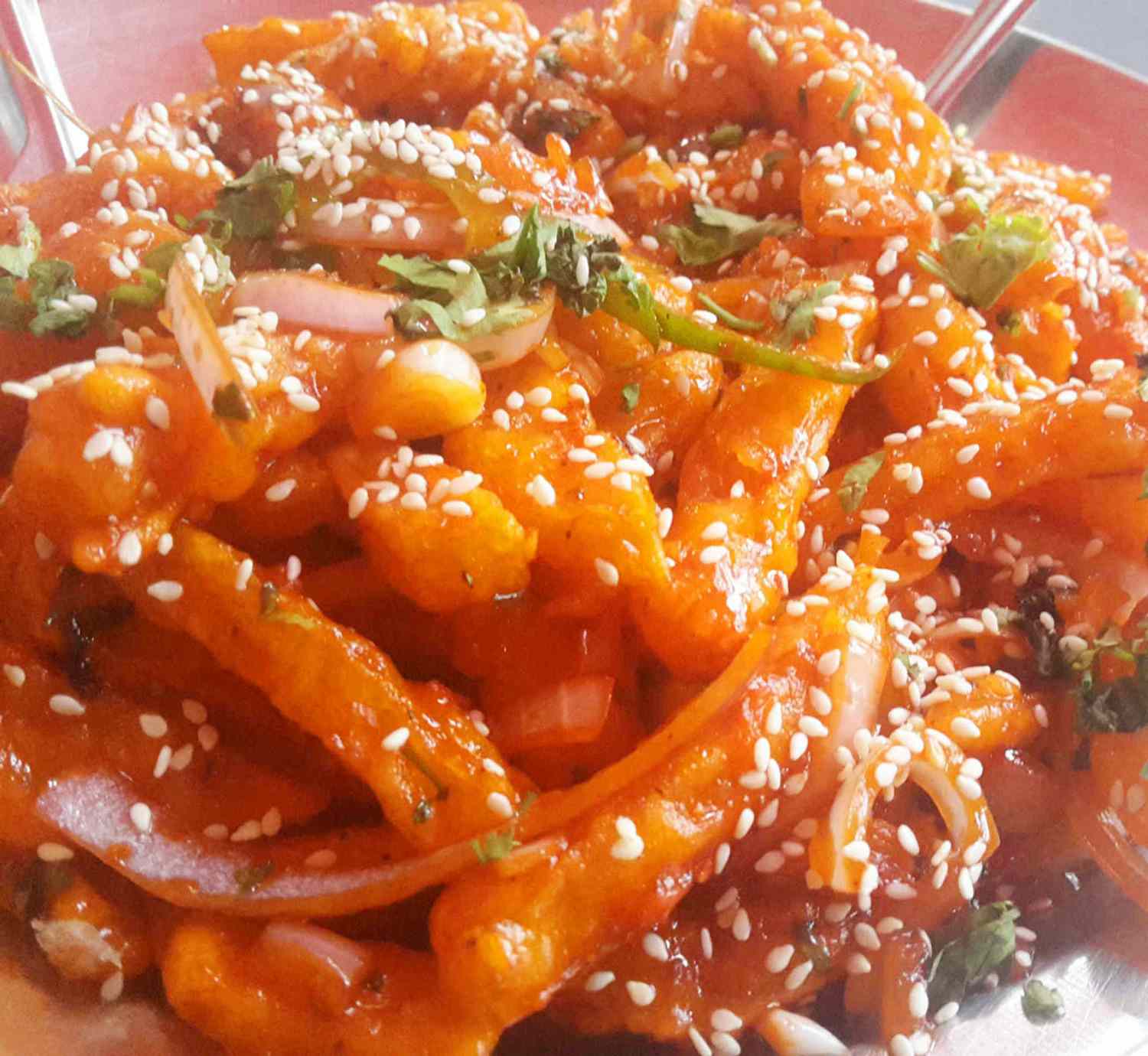

Order “Chinese” food at a busy Indian street stall and you’ll spot a celebrity on almost every menu:
chilli potatoes. Golden, crispy batons of potato tossed in a glossy, sweet–spicy, garlicky sauce,
piled high with scallions and sesame seeds. They sound Chinese. They look Chinese. But ask someone
from Shanghai or Beijing about chilli potatoes and you’ll mostly get confused stares.
That’s because chilli potatoes are not traditional Chinese food at all. They belong to
Indo-Chinese cuisine (often called Indian Chinese food): a bold, fiery fusion that
blends Chinese cooking techniques with Indian flavors, ingredients, and eating habits. Chilli potatoes
are a perfect poster child for this mash-up: familiar Chinese-style stir-fry sauce, very Indian levels
of chili heat, and one of India’s favorite ingredients of all timepotatoes.
In this article, we’ll unpack how this dish evolved, why it captured India’s imagination, and how it
became a global comfort food for anyone craving something crispy, saucy, and just a little bit dangerous
for their white shirt.
From Hakka Kitchens to Desi Street Food: The Indo-Chinese Backstory
How Chinese Food Landed in India
To understand chilli potatoes, you have to zoom out to Indo-Chinese cuisine in general. Beginning in
the late 18th and 19th centuries, Chinese migrantsespecially from the Hakka communitysettled in
eastern India, particularly around Kolkata’s old Chinatown neighborhoods like Tiretta Bazaar and later
Tangra. They opened tanneries, workshops, and eventually small eateries serving food from back home.
Over time, these cooks realized that if they wanted repeat customers, they had to adjust to local tastes.
Classic Chinese techniques like stir-frying in a wok stayed, but flavor profiles shifted: more chili heat,
more garlic and ginger, and the introduction of spices and condiments familiar to Indian palates.
Soy sauce, vinegar, and cornflour met green chilies, cilantro, and sometimes even garam masala. The result
was an entirely new style of cookingstill recognizably Chinese in technique, but unmistakably Indian in flavor.
The Birth of “Chilli” Everything
As this fusion took shape, certain “formats” emerged: dishes labeled chilli,
Manchurian, and Schezwan (or “Schezwan” in Indian spelling) became the backbone of
Indian Chinese menus. “Chilli” dishes generally meant something batter-fried and then tossed with onion,
bell pepper, and a hot, tangy sauce. Chilli chicken, chilli paneer, and eventually chilli potato all follow
the same logic: fry something until it’s crispy, then bathe it in a sauce that tastes like a love child
of Chinese takeout and Indian street food.
Chilli potatoes are part of this wave. They apply the same “chilli” template to a deeply beloved Indian staple
potatoescreating a dish that feels both adventurous and oddly safe at the same time.
What Exactly Are Chilli Potatoes?
Let’s break down the anatomy of this dish, because “chilli potatoes” is simple in theory and strangely
complex in practice.
The Building Blocks
- Potatoes: Usually cut into batons, wedges, or thick fries. They’re often parboiled first, then battered and deep-fried or air-fried until shatteringly crisp.
- Base aromatics: Garlic, ginger, and spring onions (scallions) form the flavor backbone.
- Classic Indo-Chinese sauces: Soy sauce, chili sauce, tomato ketchup, and vinegar create the signature sweet–sour–spicy balance.
- Heat and texture: Fresh green chilies, crushed red chili flakes, and sometimes a Schezwan-style chili paste add fire. Cornstarch makes the sauce clingy and glossy.
- Garnishes: Sesame seeds and loads of green onion tops give a finishing crunch and fresh bite.
In some versions, honey is added for extra sweetness, turning the dish into
honey chilli potatoesa sticky, addictive snack that’s part appetizer, part emotional
support system.
Dry vs. Gravy Chilli Potatoes
Like many Indo-Chinese dishes, chilli potatoes come in two personalities:
- Dry chilli potatoes: The sauce is reduced until it clings to each fry in a shiny, sticky coat. This version is served as a starter or bar snack.
- Gravy chilli potatoes: Extra stock and cornflour are added for a thicker, spoonable sauce. This is usually eaten with fried rice or noodles as a main course.
Both versions share the same core idea: potatoes as the vehicle, Indo-Chinese sauce as the thrill ride.
Why Potatoes Instead of Meat?
One of the clever adaptations in Indian Chinese food is how often it swaps traditional
meat-based Chinese dishes with vegetarian or carb-rich alternatives. India has a large vegetarian population,
and even non-vegetarians enjoy meat-free options for religious or health reasons. Enter the potato.
Potatoes are neutral in flavor, comforting in texture, and widely available across the country. They absorb
sauce beautifully and get irresistibly crisp when friedexactly what you want in a “chilli” dish.
Where a Chinese menu might lean heavily on chicken, pork, or seafood, the Indian adaptation adds
potato, paneer, baby corn, mushrooms, and cauliflower (hello, gobi Manchurian) as stand-ins.
Chilli potatoes, in that sense, are a smart compromise: the structure of a Chinese-style appetizer,
with an ingredient that feels like home to Indian diners.
The Flavor Mash-Up: Indian Masala Meets Chinese Technique
Chilli potatoes are a great case study in how fusion food actually works when it’s done well.
Rather than randomly throwing ingredients together, Indo-Chinese dishes follow a consistent pattern:
- Chinese-style prep: Wok cooking, high heat, stir-frying, and sauce thickened with cornflour.
- Indian-level intensity: More chilies, more garlic, sometimes extra spices, and a higher tolerance for oily, sticky, “chatpata” (sharp and tangy) flavors.
- Textural drama: Deep-frying isn’t just for crunch; it lets the potatoes stay crisp on the outside while soaking in sauce without falling apart.
The result is a dish that would confuse a traditional Chinese chef but absolutely delights an Indian diner.
It’s louder, hotter, and sweeter than classic Chinese food, yet still anchored in recognizable techniques like
stir-frying and balancing sweet, salty, and acidic notes.
Street Stalls, Restaurants, and the Global Journey
Today, chilli potatoes are everywhere in India: from college canteens and roadside carts to high-end “Pan Asian”
menus. They’re a staple of the “Chinese” section that isn’t really Chinese, but no one’s complaining.
As the Indian diaspora grew, Indo-Chinese dishes traveled with them. Indian restaurants in the United States,
Canada, and the UK often serve chilli potatoes alongside dishes like chilli paneer, Hakka noodles, and gobi
Manchurian. For many second-generation diners abroad, chilli potatoes are less about being “authentically Chinese”
and more about tasting like homea nostalgic flavor from family dinners and late-night takeout.
Interestingly, this puts chilli potatoes in the same global club as other “not really Chinese” dishes like
General Tso’s chicken in the US or Ireland’s spice bag. These recipes use Chinese flavors as a starting point but
clearly belong to the country that adopted them.
How to Make Chilli Potatoes at Home (Without Losing Your Sanity)
You don’t need a commercial kitchen or a giant wok to make good chilli potatoes at home, but you do need a game plan.
Here’s a practical breakdown:
1. Get the Potatoes Right
The biggest mistake beginners make is soggy potatoes. For restaurant-style crispness:
- Use firm, starchy or all-purpose potatoes and cut them into even batons or wedges.
- Parboil them briefly in salted water, then drain well.
- Toss the potatoes in a light coating of flour and cornstarch with a pinch of salt and chili powder.
- Deep-fry or air-fry them twiceonce to cook through, then again at higher heat for serious crunch.
2. Build the Sauce Like a Pro
The sauce is where the “Chinese” in this Indian adaptation lives. A basic Indo-Chinese chilli sauce usually includes:
- Oil plus lots of chopped garlic and ginger
- Sliced green chilies and spring onion whites
- Soy sauce for saltiness and umami
- Chili sauce or chili paste for heat
- Tomato ketchup for sweetness and body
- Vinegar for sharp acidity
- A splash of water plus a cornstarch slurry to thicken
For honey chilli potatoes, a generous spoonful of honey is added at the end to create a shiny, sticky glaze that
clings to every fry.
3. Toss Fast, Eat Faster
Once your potatoes are crisp and your sauce is ready, the final step is fast:
- Reheat the sauce until it’s bubbling and just thick enough to coat a spoon.
- Add the hot, fried potatoes and toss vigorously so every piece gets evenly coated.
- Finish with sesame seeds and lots of chopped spring onion greens.
Then serve immediately. Chilli potatoes do not age gracefully. The longer they sit, the softer they get,
and the closer they move from “crunchy snack” to “soft, nostalgic regret.”
Why Chilli Potatoes Feel So Comforting
Beyond flavor, chilli potatoes hit an emotional sweet spot. They’re:
- Familiar yet exciting: Potatoes are comfort food; the sauce brings drama.
- Shareable: Perfect for passing around a table, whether at a street stall or a party.
- Customizable: You can adjust spice levels, swap honey in or out, and even bake or air-fry to cut down on oil.
And like all great fusion dishes, they tell a story: of migration, adaptation, and creativity. What started
as Chinese cooking in a new land evolved into Indian Chinese cuisine, and from there into specific dishes like
chilli potatoes that don’t belong to any one country so much as they belong to the people who love eating them.
Experiences and Stories Around Chilli Potatoes
Talk to people who grew up in India (or in Indian communities abroad), and chilli potatoes often come with a
side of stories. This dish has quietly woven itself into everyday life in ways that don’t show up on a recipe card.
For many students, chilli potatoes are pure college nostalgia. Picture this: it’s exam season, everyone’s broke,
and there’s that one campus café or street cart that sells a giant plate of extra-saucy chilli potatoes big
enough for four friends to share. Nobody remembers the lecture that day, but everybody remembers how crisp those
potatoes were and how someone invariably dropped a piece on their notes.
In family settings, chilli potatoes often mark a gentle compromise in taste. Kids who aren’t ready for the full
blast of traditional Indian curries will happily demolish a plate of chilli potatoes, especially the honeyed
version where sweetness tempers the heat. Parents get to enjoy something spicy and “restaurant-style,” while the
kids feel like they’re eating cool street food at home. It’s fusion cuisine doubling as family peace treaty.
Among the Indian diaspora in places like the United States, chilli potatoes also show up at potlucks and holiday
gatherings as a kind of edible identity statement. They’re not just an appetizer; they’re a conversation starter.
Somebody will inevitably ask, “So… is this Chinese or Indian?” and the answer“Both, sort of”opens the door to
stories about Kolkata’s Chinatown, late-night Indo-Chinese takeout, or that one restaurant “back home” everyone
still dreams about.
Home cooks experimenting with healthier versions talk about discovering air-fried chilli potatoes and feeling
like they’ve unlocked a cheat code. You still get crisp edges and a glossy sauce, but with much less oil and a
tiny bit less guilt. It’s a good example of how this dish keeps evolving: first it adapted Chinese recipes to
Indian tastes, and now it’s adapting again to modern concerns around wellness, home cooking, and convenience.
Professional chefs, especially in modern Indian or Asian-fusion restaurants, sometimes use chilli potatoes as a
playful element on tasting menus. You might see a deconstructed version with confit potatoes and smoky chili
glaze, or a small, artful stack of fries balanced with microgreens and sesame shards. It’s the same flavor memory,
just dressed up in fine-dining clothes. The fact that a once-humble street snack can show up in such polished
settings says a lot about how deeply it resonates.
At the end of the day, chilli potatoes are more than “an Indian adaptation of a Chinese recipe.” They’re proof
that cuisine is never static. One community brings its techniques; another lends its pantry and personality; the
street vendors and home cooks do the rest. Somewhere in the middle, under a pile of scallions and sesame seeds,
a new classic is bornand if it happens to be crispy, sticky, and a little bit messy to eat, that just makes it
even easier to love.