
Note: This article is written for web publication and synthesizes verified scientific research on Hawaiian lava-cave microbes, Mars analog environments, astrobiology, lava tubes, microbial dark matter, biosignatures, and the search for life beyond Earth.
Introduction: When Hawaiʻi Starts Looking a Little Like Mars
At first glance, Hawaiʻi and Mars seem like they belong in completely different vacation brochures. Hawaiʻi has ocean breezes, green cliffs, rainbows, and shave ice. Mars has dust storms, radiation, freezing temperatures, and no beachfront resort service. Yet beneath Hawaiʻi’s volcanic landscapes, inside dark lava caves and tubes, scientists have found microscopic communities that may help answer one of humanity’s biggest questions: could life have existed on Mars?
The stars of this story are not palm trees or astronauts in shiny helmets. They are microbestiny bacteria living in Hawaiian lava caves, geothermal vents, and volcanic tubes where sunlight is scarce, nutrients are limited, and the environment can be harsh enough to make most organisms politely decline the invitation. These microbes are fascinating because they do something life is very good at doing: they adapt. Some appear to survive by interacting with minerals and chemicals in volcanic rock, rather than relying on sunlight-based food chains. That matters because if life ever took hold on ancient Mars, it may have needed similar survival tricks.
Researchers study Hawaiian lava tubes because Mars also has volcanic terrain and possible cave entrances. Lava tubes can protect their interiors from radiation, temperature swings, and surface weathering. On Earth, those protected spaces can preserve mineral deposits, microbial mats, and chemical clues. On Mars, similar environments could preserve ancient biosignaturesthe subtle fingerprints of lifeeven if the surface has become too hostile for organisms today.
So yes, Hawaiʻi may be tropical paradise on the surface. But underground, parts of it double as a natural astrobiology laboratory. Mars, meet your Hawaiian cousin. Please wipe your dusty boots before entering.
Why Scientists Are So Interested in Hawaiian Lava Tubes
Lava tubes form when molten lava flows downhill and the outer surface cools into a hard crust while the hot lava inside continues moving. Once the flow drains away, it can leave behind a tunnel-like cave. Hawaiʻi, built by volcanic activity over millions of years, contains many such formations. Some are young in geological terms; others have had centuries to develop complex microbial communities.
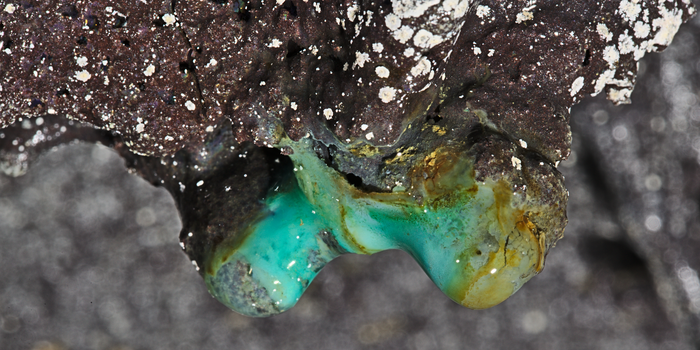
For astrobiologists, these lava tubes are not just caves. They are time capsules, survival chambers, mineral libraries, and field classrooms all rolled into one. Their walls and ceilings can host colorful microbial matswhite, yellow, orange, pink, green, tan, and other shades that look as if someone gave a microbiology lab a paint palette and too much enthusiasm.
Inside these caves, conditions are often dark, nutrient-poor, and isolated from the lush surface world above. That makes them especially useful for studying how microbes live without obvious access to sunlight or abundant organic matter. In some places, microbial communities may depend heavily on chemical energy from minerals, moisture, gases, or rock surfaces. This style of life is important because Mars today does not offer friendly surface conditions for photosynthetic organisms. If Martian microbes ever existedor still exist in protected nichesthey would likely need to survive in the subsurface or in shielded environments.
The “Microbial Dark Matter” Beneath Hawaiʻi
One of the most exciting findings from Hawaiian volcanic environments is that many of the bacteria discovered there are poorly known or not confidently assigned to familiar groups. Scientists sometimes call this kind of unseen biodiversity “microbial dark matter.” The phrase sounds dramatic, but it is accurate: much of microbial life on Earth remains unidentified, uncultured, and mysterious.
Studies of lava caves, lava tubes, fumaroles, and geothermal caves on Hawaiʻi Island have revealed unexpectedly high bacterial diversity. Researchers found that different caves and geothermal sites can host distinct microbial communities with surprisingly little overlap. In other words, two caves on the same island may have microbial neighborhoods as different as New York and a quiet desert townexcept everyone is microscopic and nobody complains about rent.
Older lava tubes can also differ from younger or geothermally active sites. Some research suggests that lava tubes several hundred years old may host greater phylogenetic diversity than younger, hotter, or more unstable volcanic settings. This gives scientists a way to think about ecological succession: how life colonizes fresh volcanic rock, changes over time, and builds more complex communities in extreme environments.
How Hawaiian Microbes Could Resemble Possible Martian Life
The key word is not “identical.” No serious scientist is saying that Hawaiian cave bacteria are Martians wearing tiny aloha shirts. The point is that these microbes may offer analogsEarth-based examples of how life can function in environments that share important features with ancient or subsurface Mars.
1. Life Without Sunlight
Many Earth ecosystems depend on photosynthesis. Plants, algae, and photosynthetic microbes capture sunlight and turn it into chemical energy. But in deep caves, sunlight may not reach the walls or floor. Microbes living there must use other strategies. Some can feed on organic material carried in by water, roots, insects, or air. Others may use chemical reactions involving minerals, gases, metals, or rock surfaces.
This is where the Mars connection becomes exciting. Ancient Mars likely had water, volcanic activity, and a thicker atmosphere than it has today. As the planet lost much of its atmosphere and surface water, any life would have faced brutal new conditions. A move underground, into caves or porous rock, could have offered protection and a possible chemical buffetadmittedly not a five-star buffet, but for microbes, a little iron, sulfur, hydrogen, or carbon chemistry can be a party.
2. Survival in Volcanic Rock
Hawaiian lava is basaltic, meaning it is rich in minerals also relevant to Martian geology. Mars has large basaltic regions shaped by ancient volcanism. Microbes that live on or within basaltic materials on Earth can help scientists understand what chemical traces life might leave in similar rock types elsewhere.
These traces could include organic molecules, mineral textures, isotopic patterns, biofilms, or microscopic structures associated with microbial activity. The challenge is that nonliving geological processes can sometimes create similar signals. That is why scientists are careful with words like “potential biosignature.” A potential biosignature is not proof of life; it is a clue that deserves deeper investigation.
3. Communities Built on Cooperation and Competition
Hawaiian lava-cave microbes do not live as isolated heroes in a science-fiction movie. They form communities. Some organisms may play “hub” roles, interacting with many others and influencing how the ecosystem functions. Research has identified groups such as Chloroflexi and Acidobacteria as potentially important in these networks, even when they are not the most abundant organisms present.
This matters because life rarely survives extreme conditions alone. Microbial communities can share resources, recycle waste, create protective films, alter local chemistry, and help stabilize tiny habitats. If life ever existed in Martian caves, it may have formed similarly cooperative communities, especially where nutrients were scarce and environmental stress was high.
Why Lava Tubes on Mars Are Prime Astrobiology Targets
Mars is not exactly a cozy place today. The surface is cold, dry, exposed to radiation, and chemically reactive. Its thin atmosphere provides little protection compared with Earth’s. Organic molecules and delicate biological traces can be damaged over time by radiation and oxidizing chemistry.
Lava tubes and caves could change the odds. A cave roof can act like a natural shield, protecting the interior from ultraviolet radiation, cosmic rays, dust storms, micrometeorites, and extreme day-night temperature swings. Caves may also preserve minerals deposited by past water. If those minerals formed alongside microbial life, they could trap biosignatures for long periods.
Orbital imagery has revealed many candidate cave entrances, skylights, pits, and void-like features on Mars. Scientists cannot simply stroll inside them yetMars remains inconveniently far away and rude about breathable airbut robotic missions may eventually explore these spaces. Future cave robots could use imaging, drilling, spectroscopy, DNA-free life-detection chemistry, and environmental sensors to search for signs of past or present habitability.
What Hawaiian Caves Teach Us About Biosignatures
A biosignature is evidence that may indicate life. It can be chemical, physical, mineralogical, or biological. On Earth, microbial life can change minerals, produce organic molecules, form biofilms, and leave textures behind. In lava caves, microbes may interact with secondary mineral deposits such as gypsum, calcite, or other cave formations. These deposits can become archives of microbial activity.
However, finding life is not as simple as spotting something weird and shouting, “Aliens!” Science is more disciplined than that, even when everyone secretly wants the dramatic movie moment. Researchers must ask whether a signal could have formed without biology. Could water, heat, pressure, volcanic gases, or ordinary chemistry explain it? Could contamination from Earth be involved? Could the instrument be misreading the sample?
This careful approach is exactly why Hawaiian lava tubes are valuable. They allow researchers to test methods on Earth before sending instruments to Mars. Scientists can compare microbial communities with minerals, map where biofilms grow, examine chemical patterns, and learn which signals are most reliable. Hawaiian caves help build the rulebook for recognizing life in places where life may be rare, ancient, or deeply hidden.
Recent Mars Discoveries Make the Question Even More Interesting
Recent Mars rover research has increased scientific interest in organic preservation and possible biosignatures. NASA’s Curiosity rover has detected a diverse set of organic molecules in ancient Martian rocks. Organic molecules are carbon-containing compounds associated with life on Earth, but they can also form through nonbiological processes. That distinction is crucial. Organic chemistry is exciting; it is not a victory parade.
NASA’s Perseverance rover has also studied rocks in Jezero Crater with mineral textures and chemical features that scientists describe as potential biosignatures. These findings do not prove life existed on Mars, but they show that Mars had environments where water, minerals, and organic chemistry interacted in ways that deserve serious attention.
Put those discoveries beside Hawaiian lava-cave studies, and the broader picture becomes clearer. Scientists are not searching randomly. They are comparing Earth environments where microbes survive in difficult conditions with Martian environments that may once have offered similar opportunities. Hawaiʻi helps researchers ask better questions: What minerals preserve microbial traces? How do cave microbes use basalt? Which communities thrive in low-nutrient volcanic settings? What clues would remain after thousands, millions, or billions of years?
Why “Extreme” Life on Earth Keeps Expanding Our Imagination
For a long time, people assumed life needed comfortable conditions: sunlight, moderate temperatures, plenty of water, and a nice snack. Then science kept finding organisms in places that looked completely unreasonableboiling springs, acidic pools, deep-sea vents, frozen deserts, salty lakes, radioactive sites, and caves where sunlight never appears.
These organisms are called extremophiles, though from their perspective they are probably just “organisms” and we are the delicate ones. Extremophiles have reshaped astrobiology because they show that life is more flexible than once believed. The question is no longer only “Is Mars like modern Earth?” A better question is “Did Mars ever provide enough energy, water, chemistry, and protection for microbial life to begin or persist?”
Hawaiian lava-cave microbes fit beautifully into that question. They show that volcanic environments can host complex, novel, and highly adapted microbial communities. They also remind us that Earth still contains biological mysteries. Before we can confidently recognize life on Mars, we need to better understand strange life here at home.
Specific Examples: What Researchers Look For in Lava-Cave Microbes
Microbial Mats
Microbial mats are layered communities of microorganisms that can appear as colored patches or films on cave walls, ceilings, and mineral formations. Their colors may reflect pigments, minerals, moisture, and species composition. In lava caves, mats can indicate where microbes are interacting with rock surfaces and cave chemistry.
Unclassified Bacteria
Many bacterial sequences recovered from lava caves cannot be identified down to familiar genus or species names. That tells scientists these environments contain poorly studied organisms. Unknown does not mean alien; it means Earth still has plenty of biological homework left unfinished.
Mineral-Microbe Relationships
Researchers examine how microbial communities correspond with minerals, moisture, cave age, temperature, airflow, and geochemistry. If certain minerals tend to preserve microbial traces well, similar minerals on Mars could become high-priority targets for future missions.
Community Networks
Microbes interact in networks, and some groups may act as ecological connectors. Understanding these networks helps scientists predict how life survives when nutrients are scarce. In a Martian cave scenario, such cooperation could be essential.
Could There Be Living Microbes on Mars Today?
The honest answer is: we do not know. No mission has confirmed living organisms on Mars. The Martian surface is harsh, and any present-day life would likely need protection from radiation, dryness, and chemical stress. Subsurface environments, deep ice, brines, caves, or volcanic regions are often discussed as possible refuges, but possibility is not proof.
That is why analog research matters. Scientists study Hawaiian lava tubes not because they expect to find Martians in Hawaiʻi, but because these caves reveal how microbial life can persist in volcanic, dark, mineral-rich, low-nutrient environments. They help researchers design better instruments, choose better targets, and avoid jumping to conclusions.
In astrobiology, the most exciting sentence is not always “We found life.” Sometimes it is “We found a place where life could plausibly leave a detectable trace.” That sentence may sound less cinematic, but it is how real discoveries begin.
Field-Style Experience: What This Topic Feels Like Up Close
Imagine approaching a Hawaiian lava tube after walking across rough, dark basalt that crunches lightly under your boots. The air aboveground is warm, bright, and alive with island color. Then you reach the cave entrance, and everything changes. The sunlight fades. The air cools. Your headlamp becomes your tiny personal sun. The walls look less like ordinary rock and more like the inside of a planet’s memory.
Inside, the cave is quiet in a way that feels almost scientific. Every drip of water seems important. Every patch of color on the wall becomes a question. Is that mineral? Is that microbial growth? Is it both? In a lava tube, the line between geology and biology can feel wonderfully blurry. The rock is not just scenery; it is habitat. The cave is not empty; it is full of tiny negotiations between chemistry, moisture, minerals, and life.
This is the kind of place that changes how you think about “habitable.” Most people hear that word and imagine forests, oceans, birds, and comfortable weather. Astrobiologists hear it and think about energy gradients, water activity, mineral surfaces, and whether a microbe could make a living in the dark without complaining to management. A Hawaiian lava cave teaches humility. Life does not always need a postcard-perfect environment. Sometimes it needs only a protected crack, a little moisture, usable chemistry, and enough time to get creative.
The Mars connection becomes easier to feel in that darkness. Not because the cave literally looks like Mars in every way, but because it removes the usual comforts. No sunlight. Limited food. Strange minerals. Narrow passages. Hidden surfaces. Suddenly, the idea of life underground on another planet feels less like fantasy and more like a testable scientific possibility.
A field researcher in such a cave must move carefully. Samples are not just “dirt” or “slime.” They may contain rare organisms, delicate mineral structures, and clues that took centuries to form. Contamination control matters. Documentation matters. Location matters. Even a small scrape from a wall has context: cave age, temperature, humidity, distance from entrance, rock type, airflow, and mineral composition. The experience is part adventure, part detective work, and part reminder that the universe may hide its best clues in inconvenient places.
For writers, educators, and curious readers, the emotional appeal is powerful. Hawaiian microbes make Mars feel closer. They turn the search for extraterrestrial life from a distant telescope dream into something grounded in Earth’s own caves. They also make our planet feel stranger. We do not need to leave Earth to find alien-like biology; sometimes we only need to look under a volcano.
That is the magic of this topic. It connects tropical islands with planetary science, cave mud with space exploration, and microscopic bacteria with one of the oldest questions humans have ever asked: are we alone? The answer has not arrived yet. But somewhere in the dark, on Earth and perhaps one day on Mars, the clues may already be waiting.
Conclusion: Small Microbes, Big Cosmic Questions
Hawaiian lava-cave microbes are tiny, but their scientific importance is enormous. They show that life can thrive in dark, volcanic, low-nutrient environments that once seemed too harsh or too isolated. Their communities are diverse, often mysterious, and closely tied to minerals and cave conditions. For astrobiologists, that makes them powerful models for thinking about ancient Mars and possible subsurface habitats.
No Hawaiian microbe proves that Mars had life. No Martian rock has yet delivered final confirmation of biology. But together, Earth analog studies and Mars rover discoveries are sharpening the search. They help scientists understand where biosignatures might form, how they might be preserved, and why caves and lava tubes deserve serious attention in future exploration.
The next great discovery about life on Mars may not begin on Mars at all. It may begin in a Hawaiian cave, with a headlamp, a sterile sampling tool, a patch of colorful microbial film, and a scientist willing to ask whether the smallest Earthlings can teach us how to search the Red Planet.