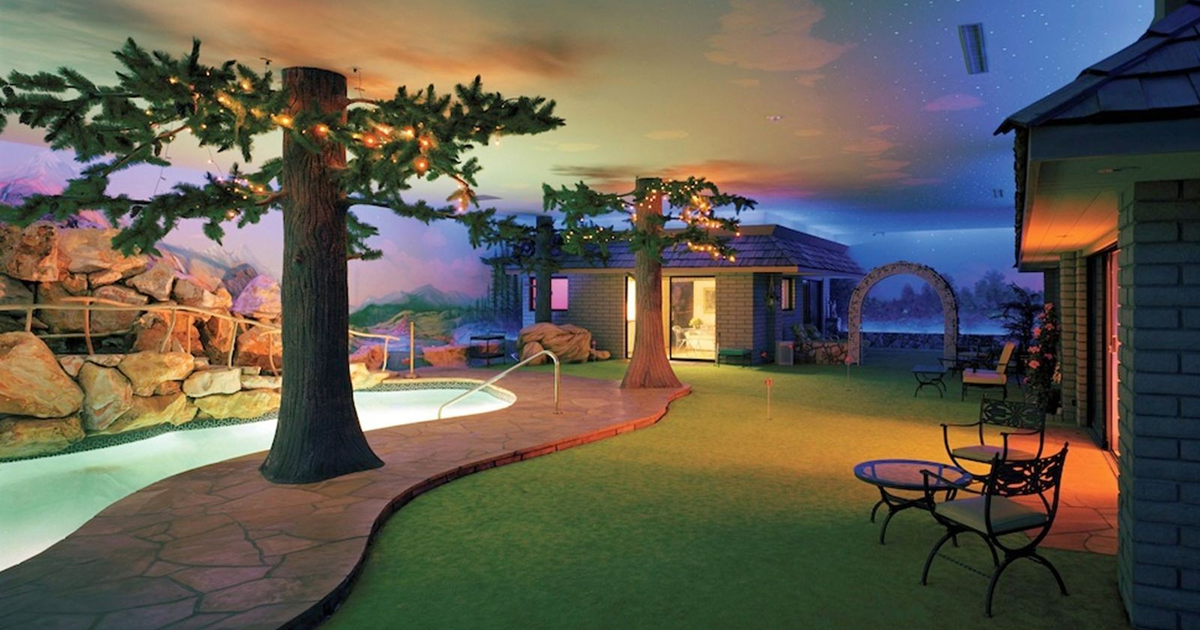

Some houses whisper history. Others politely display it with crown molding, terrazzo floors, or a dramatic fireplace that looks like it has opinions. Then there is the famous Las Vegas Underground House, a Cold War-era underground bomb shelter that practically shouts, “Welcome to the end of the world, please enjoy the indoor pool.”
Hidden beneath an ordinary-looking property at 3970 Spencer Street in Las Vegas, this underground mansion is one of the strangest, most fascinating residential listings in America. It was built in the 1970s, designed for self-sufficient living, and preserved with so much retro character that stepping inside feels less like touring real estate and more like entering a sealed 1978 dream sequence. Think artificial trees, painted landscape murals, shag-era design, a faux sky, a swimming pool, a putting green, saunas, bars, and enough theatrical charm to make a casino lounge blush.
The property became a viral real-estate sensation when it was listed for $18 million, a price that turned an already unusual home into a full-blown internet curiosity. While later listing records show the asking price changed over time, that original $18 million headline helped cement the home’s reputation as a luxury doomsday bunker, a 1970s time capsule, and a one-of-one piece of Cold War architecture.
A Normal House Above, A Hidden World Below
From the street, the property does not immediately reveal its secret. That is part of the fun. Above ground, there is a comparatively modest home, the kind of structure a passerby might glance at once before continuing toward the neon gravity of the Las Vegas Strip. But below the surface, about 26 feet underground, sits a sprawling subterranean estate that completely rewrites the meaning of “finished basement.”
The underground portion has been reported at more than 14,000 square feet, with newer listing details presenting the total property at roughly 16,936 square feet across the above-ground and underground residences. The layout includes five bedrooms, six bathrooms, multiple entertainment areas, a pool, spa-style amenities, a theater, a bar, and indoor “outdoor” spaces designed to create the illusion of open air. It is not just a shelter. It is a stage set for surviving disaster with a cocktail umbrella in hand.
The design is intentionally surreal. Grass-like carpeting stands in for a lawn. Artificial trees rise from the floor. Painted murals stretch across walls to suggest forests, mountains, skies, and landscapes far beyond Nevada. Instead of accepting that underground living might feel enclosed, the home attacks claustrophobia with theater, color, and a level of commitment usually reserved for theme parks and ambitious grandparents with holiday decorations.
Who Built This Underground Bomb Shelter?
The Las Vegas Underground House was built in 1978 by businessman Girard “Jerry” Henderson, a wealthy entrepreneur and former Avon Products director, working with architect Jay Swayze. Swayze was not a casual bunker enthusiast. He was a pioneer of underground residential design and had promoted the idea that underground homes could be safe, comfortable, and even luxurious.
Swayze’s earlier work included the “Atomitat,” an underground home concept that combined atomic-age preparedness with domestic comfort. His ideas gained visibility during the 1960s, including connections to underground-home exhibitions and the broader Cold War fascination with fallout shelters. Henderson, who had both money and imagination, took that idea and supersized it in Las Vegas.
The result was not a bare concrete bunker with canned beans stacked beside a crank radio. It was a luxury underground mansion. It was part survival strategy, part lifestyle experiment, part architectural theater, and part 1970s fantasy in which the world above might be falling apart but downstairs the lights still dimmed properly over the dance floor.
Why The 1970s Design Feels Like A Time Capsule
The phrase “time capsule” gets thrown around a lot in real estate. Sometimes it means a kitchen has avocado appliances and wallpaper that appears to be negotiating with the curtains. In this case, the description is accurate. The underground house preserves a specific vision of 1970s luxury: warm colors, bold patterns, theatrical lighting, playful leisure spaces, and an almost cinematic approach to indoor living.
The property’s interior does not chase today’s minimalist luxury trends. There are no endless white walls, no gray floors, no kitchen island large enough to land a small aircraft. Instead, the house leans fully into its era. It looks like the kind of place where someone might host a dinner party, discuss global tensions, then casually suggest a swim beneath a fake sky.
That is what makes the home so compelling. Many luxury houses try to be timeless and end up feeling anonymous. This underground bomb shelter does the opposite. It is deeply, proudly specific. It belongs to the Cold War, to the atomic age, to 1970s Las Vegas, and to a moment when wealthy homeowners could imagine security not as a steel door and a generator, but as an entire hidden world designed for comfort.
The Cold War Fear Behind The Fantasy
To understand why someone would build a mansion underground, it helps to remember the historical mood that shaped it. During the Cold War, Americans lived with the possibility of nuclear conflict as part of daily public consciousness. In the 1950s and 1960s, government agencies, civil defense campaigns, and private companies promoted fallout shelters as a practical response to an unthinkable threat.
Family shelters, community shelters, school drills, warning systems, and preparedness brochures became familiar pieces of American life. Public interest surged especially during tense moments such as the Berlin Crisis and the Cuban Missile Crisis. The idea was simple, even if the reality was terrifying: if nuclear fallout made the surface dangerous, protected underground spaces might give people a chance to survive.
By the late 1960s and 1970s, public enthusiasm for family fallout shelters had cooled. Cultural attention shifted, arms-control efforts changed the national conversation, and many Americans grew skeptical of the idea that a backyard bunker could make nuclear war manageable. Yet for some people, especially those with resources, the underground home remained a powerful symbol. It promised security, control, privacy, and escape from the unpredictability of the outside world.
The Las Vegas Underground House captures that contradiction beautifully. It is serious because it was built around the fear of disaster. It is playful because it responds to that fear with murals, mood lighting, a pool, and fake trees. It is both anxious and extravagant, which may be the most American combination ever poured into concrete.
Inside The Luxury Doomsday Bunker
The most memorable feature of the property is not simply that it is underground. Plenty of structures are underground. Basements exist. Parking garages exist. That one storage room in every office building with mysterious holiday decorations exists. What makes this home extraordinary is that it tries to make underground life feel like above-ground leisure.
The Faux Outdoor Landscape
The home’s artificial landscape is one of its signature details. Instead of plain bunker walls, the interior includes hand-painted murals and sculpted trees that create the illusion of a garden-like setting. These details were not random decoration. They were psychological design tools intended to reduce the feeling of being enclosed.
In a traditional shelter, occupants might feel protected but trapped. In this house, the goal was to make the underground environment feel open, scenic, and almost resort-like. It is an ambitious idea: if you cannot go outside, bring a version of the outside in. Of course, the “outside” in this case is heavily curated, climate-controlled, and unlikely to include mosquitoes, which is frankly a strong argument in its favor.
The Pool, Putting Green, And Entertainment Spaces
The house includes amenities that push it far beyond survival basics. An indoor pool, putting green, theater, bar, dance floor, saunas, and spa-like areas turn the shelter into an entertainment compound. The property was not merely designed to keep people alive. It was designed to keep them occupied, comfortable, and socially entertained.
This matters because it reveals the mindset behind the home. Henderson was not building a short-term panic room. He was imagining a complete lifestyle underground. The house suggests that if the outside world became dangerous, the residents could continue living with routine, pleasure, and status. It is survival with amenities, emergency planning with a lounge act.
The Programmable Sky
One of the most talked-about details is the faux sky system, designed to mimic different times of day. Lighting plays a huge role in how people experience interior spaces, and in an underground home, it becomes even more important. Without natural sunlight, artificial lighting must do more than illuminate. It must create rhythm, mood, and a sense of time.
The programmable sky is both charming and practical. It shows how carefully the house tried to solve the emotional problems of subterranean living. It also gives the entire property a delightfully retro-futuristic quality, like a mid-century prediction of tomorrow that somehow includes both nuclear dread and poolside leisure.
Why The $18 Million Listing Went Viral
Real estate becomes viral when it offers something people cannot stop talking about. A normal luxury mansion may be expensive, but it is not always memorable. Marble countertops and infinity pools are nice, but they rarely make readers pause mid-scroll and say, “Wait, is that a fake underground backyard?”
The Las Vegas Underground House had every ingredient for online fascination. It had a dramatic price tag. It had Cold War history. It had 1970s interiors. It had an unusual location near one of America’s most recognizable entertainment cities. Most importantly, it had photographs that looked unlike anything else on the market.
The $18 million listing raised obvious questions. Was the value based on the land? The architecture? The rarity? The cost of recreating such a structure? The novelty? The possibility of turning it into a venue, museum, attraction, or private retreat? The answer may be some combination of all of those. Unique properties are famously difficult to price because there are few comparable sales. How exactly does one compare a subterranean Cold War mansion with artificial trees to a standard luxury home? The appraisal spreadsheet probably needed a snack break.
A Difficult Property To Sell, But An Easy One To Remember
Unusual homes often attract attention faster than buyers. The same features that make a property unforgettable can also narrow its market. A buyer must not only afford the home but also understand its maintenance, zoning possibilities, preservation value, and long-term use. For a conventional buyer seeking a move-in-ready luxury residence, an underground 1970s bunker may feel like a bit much. For a collector, preservationist, entrepreneur, or hospitality visionary, it may feel like buried treasure.
That tension helps explain why the property has seen major price shifts over time. It has been marketed as a residence, a one-of-a-kind estate, a possible event space, and a cultural curiosity. Its value is not purely residential. It is architectural, historical, experiential, and commercial. It is a home, but it is also a story people pay attention to.
In that sense, the underground house may be more similar to a landmark than a typical listing. Buyers are not simply purchasing bedrooms and bathrooms. They are purchasing a conversation piece, a preserved Cold War fantasy, and a physical object that captures decades of American fear, wealth, design, and imagination.
What Makes This Underground Mansion Different From Modern Bunkers?
Modern luxury bunkers tend to emphasize technology: filtration systems, reinforced doors, off-grid energy, secure communications, medical rooms, hydroponic gardens, and discreet access. Many are designed with sleek contemporary finishes that hide their defensive purpose behind modern luxury aesthetics.
The Las Vegas Underground House is different because it is not trying to disappear into contemporary taste. It is proudly theatrical. Its charm comes from the fact that it was built before survival real estate became a polished industry for billionaires worried about pandemics, climate disasters, cyberattacks, or social unrest. This home belongs to an earlier era of fear, one shaped by mushroom clouds, civil defense posters, and atomic-age optimism.
Instead of saying, “The future will be sleek and secure,” it says, “The future will have a pool, a mural, and possibly a small putting green.” That makes it less efficient than a modern bunker, perhaps, but far more memorable.
The Architecture Of Escapism
At its core, this underground bomb shelter is about escapism. But not the ordinary kind. It is not a vacation home by a lake or a cabin in the woods. It is an escape from weather, war, noise, danger, and even daylight. It takes the desire for privacy and pushes it to the extreme.
Las Vegas is an especially fascinating place for such a home. The city itself is built on illusion, spectacle, controlled environments, and fantasy. Casinos simulate Venice, Paris, Egypt, and tropical islands. The underground house fits into that tradition perfectly. It simulates the outdoors while being indoors. It simulates normal life while preparing for abnormal disaster. It simulates safety in a world that often feels anything but safe.
That is why the house feels less like an oddity and more like a concentrated version of Las Vegas logic. If the desert city can build canals, pyramids, and artificial skylines, why not build an underground world where a nuclear-age millionaire could live beneath painted horizons?
Preservation Value: Why This 1970s Time Capsule Matters
Many old interiors are renovated out of existence. Wallpaper is stripped. Carpet is replaced. Wood paneling is painted white. Unique rooms become “updated,” which often means they begin to resemble every other house on the internet. The Las Vegas Underground House is valuable because so much of its original character remains legible.
Preservation is not only about beauty. It is about evidence. This home tells us how a specific generation imagined safety, wealth, leisure, and the future. It reveals how architecture responded to the psychological pressure of the Cold War. It shows how design could be used to soften fear, create comfort, and transform a shelter into a fantasy landscape.
For historians, designers, and architecture lovers, the house is a rare artifact. For real-estate watchers, it is an unforgettable listing. For everyone else, it is proof that the 1970s were not afraid of commitment. When that decade chose a theme, it brought wallpaper, lighting, furniture, and possibly a fake tree with structural responsibilities.
Could The Underground House Become A Museum Or Event Venue?
One of the most interesting possibilities for the property is adaptive reuse. Because the house is so visually striking, it has obvious potential beyond private residence. It could function as a museum-like attraction, a filming location, a private event space, a retro-themed venue, or an immersive tour experience.
That kind of use would require zoning, safety, operational planning, and preservation care. Underground spaces are not simple to manage for public access. Ventilation, emergency exits, accessibility, insurance, staffing, and maintenance all matter. Still, the concept is compelling. Many people would likely pay to see a preserved Cold War luxury bunker in Las Vegas, especially one with the visual drama of a movie set.
As a private residence, the home needs a very specific buyer. As an attraction, it could appeal to architecture fans, history buffs, design lovers, Cold War researchers, urban explorers, tourists, and people who simply enjoy saying, “I spent the afternoon in a luxury apocalypse basement.” That sentence alone has souvenir-shop potential.
Experiences Related To Touring A 1970s Underground Bomb Shelter
Experiencing a place like the Las Vegas Underground House is different from looking at a normal luxury listing. In a standard high-end home, the experience is often about admiration: the kitchen is expensive, the view is beautiful, the closet is larger than some apartments, and everyone nods respectfully. In an underground time-capsule bunker, the experience is more layered. It begins with surprise. The brain has to adjust to the fact that an entire domestic landscape exists beneath the ground, complete with leisure spaces that seem to deny the seriousness of why the structure was built.
The first emotional reaction is usually disbelief. The eye expects concrete walls and military plainness, but instead finds theatrical scenery and carefully staged comfort. That contrast creates a strange kind of delight. You are aware that the home was born from Cold War anxiety, yet the design responds with almost stubborn cheerfulness. The house does not whisper, “Be afraid.” It says, “Yes, danger may exist, but have you seen the pool?”
The second experience is sensory. Underground homes change the way sound, light, and space feel. Without normal windows, the lighting becomes part of the architecture. A faux sky can make a room feel playful, comforting, or slightly uncanny. Murals give the walls depth, even when your body knows there is soil and structure beyond them. Artificial trees and grass-like surfaces create a stage-managed nature that feels both cozy and strange. It is not nature, exactly. It is nature as remembered by someone with a design budget and a healthy fear of nuclear fallout.
The third experience is historical. A visitor cannot separate the home from the era that produced it. Every retro surface becomes a clue. The entertainment areas suggest optimism and status. The underground location suggests fear and preparation. Together, they reveal a mindset that is hard to summarize but easy to feel: the future might be dangerous, but it should still be comfortable, stylish, and maybe a little fabulous.
For homeowners and design fans, the lesson is not that everyone needs a subterranean mansion. Most people do not need a putting green beneath their living room, though it would make rainy days more interesting. The real lesson is that homes express what people worry about and what they hope for. In this case, the worry was global catastrophe. The hope was that design, money, planning, and imagination could create a protected world where life would continue.
For travelers, photographers, and architecture enthusiasts, a property like this offers a rare kind of immersion. It is not just a house to observe; it is an atmosphere to enter. It invites questions. Would living underground feel peaceful or isolating? Would the artificial scenery become comforting or surreal? Would the lack of natural daylight matter less if the home provided entertainment, privacy, and security? Those questions make the experience memorable long after the novelty wears off.
And perhaps that is why the Las Vegas Underground House continues to fascinate people. It is not merely expensive, old, or weird. It is emotionally complicated. It is funny and serious at the same time. It is a survival shelter dressed as a resort. It is a 1970s design fantasy wrapped around a Cold War fear. It reminds us that architecture is never just shelter from the weather. Sometimes it is shelter from history itself.
Conclusion
The underground bomb shelter from the 1970s is more than a viral real-estate listing. It is a preserved piece of American imagination, built at the intersection of Cold War anxiety, Las Vegas spectacle, luxury living, and retro design. Its $18 million listing made headlines because the property is almost impossible to categorize. Is it a house? A bunker? A museum? A time capsule? A survival retreat? A set for the grooviest end-of-the-world movie never made?
The answer is yes. It is all of those things at once. That is why it continues to capture attention years after its first viral listing. The Las Vegas Underground House shows how far people will go to feel safe, how boldly the 1970s embraced design personality, and how a private residence can become a cultural artifact. In a real-estate world crowded with predictable luxury, this subterranean mansion remains refreshingly strange, deeply historic, and completely unforgettable.
Note: The $18 million figure refers to the property’s earlier widely reported listing history. Later public listing records have shown lower asking prices, so readers should treat the $18 million amount as part of the home’s viral real-estate history rather than a guaranteed current price.