
Some buildings ask for a total makeover. Others give you a look that says, “Touch one more stone and we’re done here.” The storage barn in Vacallo, Switzerland, clearly belonged to the second category. Originally a four-story farm outbuilding, it had the kind of sturdy old-world presence that makes architects fall in love and building regulations raise an eyebrow. The twist is what makes the project so compelling: the exterior had to remain essentially untouched, so the transformation happened inside, where imagination had a little more room to stretch its legs.
That constraint is exactly what gives this renovation its charm. Instead of trying to make the barn pretend it was always meant to be a sleek modern home, the redesign embraces its agricultural bones, thick masonry walls, compact footprint, and vertical character. The result is a home that feels at once ancient and current, sparse but warm, restrained yet quietly dramatic. It is less “look what we added” and more “look what we understood.” In the age of over-designed everything, that is a pretty attractive flex.
What makes this Swiss barn conversion worth studying is not just the before-and-after story. It is the way the project captures several ideas that keep surfacing in great design: adaptive reuse, preservation without nostalgia, minimalism with texture, and small-space planning that uses volume instead of square footage to create generosity. This is the kind of home that proves a building does not need a sprawling footprint to feel memorable. Sometimes all it needs is a clear point of view and the discipline not to overdo it.
Why This Swiss Barn Conversion Feels So Fresh
Old barns are naturally good at atmosphere. They come with thick walls, worn materials, and the sort of honest geometry designers spend years trying to fake in new construction. But atmosphere alone does not make a livable home. That is where this project succeeds. It treats the barn not as a museum piece and not as a blank shell, but as a structure with a distinct personality that can still adapt.
That balance is the holy grail of adaptive reuse. If you preserve too much without reconsidering function, you get a beautiful inconvenience. If you modernize too aggressively, you erase the building’s reason for mattering in the first place. This project lands in the sweet spot. The barn still reads as a historic rural structure, but the interior has been edited for contemporary life with clarity, lightness, and precision.
There is also something deeply Swiss about the restraint. No shouting, no unnecessary drama, no giant sculptural staircase trying to become an influencer. The intervention is quiet. It works with the building’s existing mass and proportion rather than competing with it. In design terms, that is confidence. In human terms, it means the house feels peaceful instead of desperate for compliments.
When Preservation Rules Become a Design Superpower
One of the most interesting aspects of this reimagined storage barn is that strict planning rules reportedly prevented major exterior changes. That kind of limitation might sound like a creative nightmare, but it often pushes architects toward smarter solutions. If you cannot expand outward, you start thinking upward. If you cannot carve new openings all over the facade, you become more strategic about how light moves through the space. If you cannot distract with flashy exterior gestures, the quality of the interior has to do the heavy lifting.
Here, the design answer was brilliantly architectural rather than decorative. Instead of relying on a larger footprint, the renovation created a stronger sense of space through section. The insertion of a double-height living area turns a compact floor plate into something that feels surprisingly airy. It is a reminder that volume can be more powerful than size. A room with height, visual connection, and daylight often feels more luxurious than a bigger room chopped into a maze of mediocre boxes.
This is a lesson many homeowners could borrow. More square footage is not always the answer. Sometimes the real upgrade is removing visual heaviness, opening sight lines, and letting a building’s vertical dimension finally do its job. In other words, the smartest addition may be subtraction. Very rude to clutter, but excellent for design.
Inside the Barn: Small Footprint, Big Spatial Payoff
The Double-Height Living Room
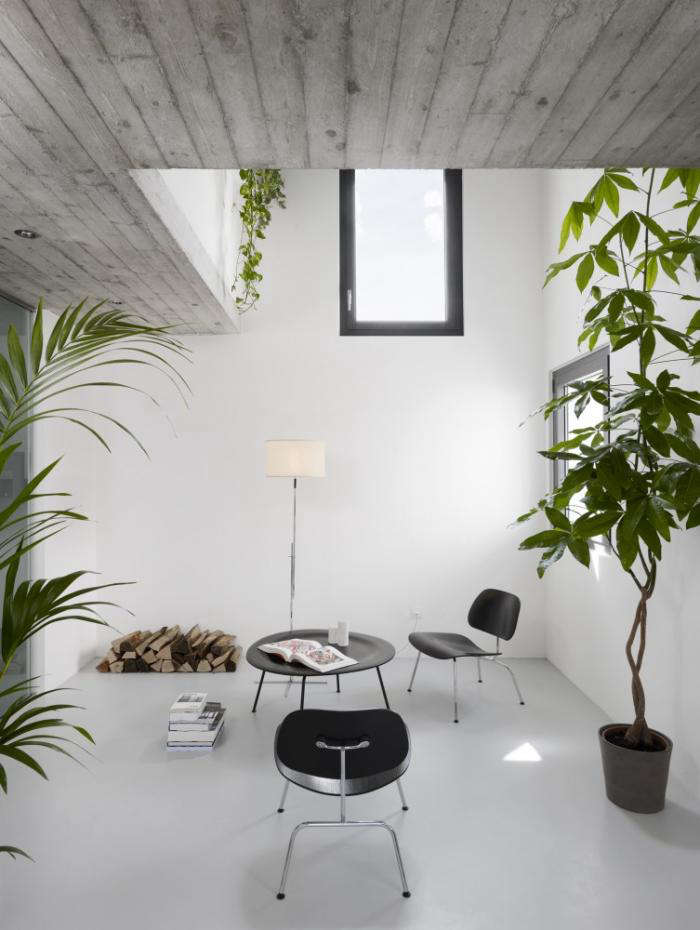
The star move of the project is the double-height living room. In a building with a compact footprint, that gesture changes everything. It introduces drama without gimmicks and makes the space feel taller, calmer, and more breathable. Rather than compressing the interior with multiple low ceilings, the redesign creates a central vertical void that gives the eye somewhere to travel. The space feels less like a stack of rooms and more like one cohesive interior landscape.
Inset Glazing and Thick Walls
One of the most memorable details is the way the windows reveal the barn’s thick original walls. Instead of trying to disguise that mass, the design emphasizes it by setting glazing inward. That move turns each opening into a deep frame, almost like a carved niche. It is both practical and poetic. The wall thickness becomes visible, tactile, and essential to the experience of the home.
Architecturally, this matters because thickness reads as permanence. Deep window openings give the house a sense of shelter that thin, flush surfaces simply cannot match. In emotional terms, the walls make the space feel safe and grounded. In visual terms, they create shadow, depth, and a rhythm of solid and void that feels sculptural without trying too hard.
Concrete, Metal, Glass, and Quiet Contrast
The material palette is minimal but not cold. Board-formed concrete floors introduce subtle texture, holding onto the memory of the wood forms used to cast them. An open metal stair and glass partition keep light moving across levels. White, black, and gray tones prevent visual clutter and let the architecture take center stage. The furnishings stay deliberately spare, which is exactly the right move in a space with this much character in the bones.
Minimalism gets a bad reputation because people sometimes confuse it with sterility. This house avoids that trap. The magic comes from contrast: rough and smooth, heavy and light, old and new, opaque and transparent. The original structure provides the soul. The inserted modern elements provide precision. Together, they create a home that feels edited rather than empty.
What the Project Gets Right About Adaptive Reuse
Adaptive reuse works best when the new use grows naturally from the old structure instead of fighting it. This barn conversion understands that principle. The building’s verticality, enclosure, and sturdy envelope are not treated as problems to erase. They become the very things that define the interior experience.
That is also why the redesign feels more durable than trend-driven farmhouse makeovers. It does not lean on clichés. There is no avalanche of “rustic” accessories, no panic-buying of lantern pendants, no suspiciously decorative wagon wheel trying to pass as heritage. The character comes from architecture, not costume.
Across successful barn and historic-building conversions, a few patterns keep repeating. Preserve what gives the structure identity. Make new interventions legible as new. Let daylight do as much visual work as possible. Use a disciplined palette so original materials can shine. And do not force every inch to perform. A little emptiness is often what allows old spaces to breathe again.
Design Lessons Homeowners Can Borrow
1. Let Existing Character Lead
The best renovations start by asking what should stay in charge. In this project, the answer was obvious: the mass of the walls, the compact proportions, and the agricultural honesty of the original barn. Homeowners do not need a Swiss outbuilding to use the same mindset. An old brick wall, exposed beam, unusual ceiling line, or deep window seat can become the anchor for an entire redesign.
2. Use a Tight Color Palette
A restrained palette is not boring when the architecture has texture. White, black, gray, stone, and wood can feel rich when light and shadow are doing the work. In older structures especially, a quiet palette helps original materials read more clearly. It also keeps small spaces from feeling visually fragmented.
3. Make Light a Material
Natural light is not just a finishing touch. In compact homes, it is part of the structural strategy. The open stair, glass elements, and double-height space in this barn allow light to travel farther and linger longer. That matters because brightness changes how people read size, comfort, and calm. Good lighting cannot solve every design problem, but it can rescue many of them.
4. Build Around Volume, Not Just Floor Area
People tend to think in square feet because real estate listings trained us that way. Architecture is smarter than that. Ceiling height, sight lines, and spatial layering shape how a home feels more than raw numbers alone. This barn is the perfect proof. By manipulating section instead of footprint, the redesign achieves spaciousness without excess.
5. Keep Furnishings Honest
When a building already has a strong identity, the furniture does not need to audition for its own spin-off series. A few well-scaled pieces, simple silhouettes, and natural textures usually outperform crowded styling. The goal is not to fill every gap. The goal is to make the space legible and livable.
Why “Reimagined” Matters More Than “Renovated”
The word reimagined earns its place here. Renovation can sometimes imply replacement: update the finishes, modernize the layout, move on. Reimagining is more nuanced. It means seeing what a building could become without denying what it has been. In this Swiss storage barn, the past is not frozen behind glass and the present is not bulldozed in. They coexist.
That coexistence is what makes the home memorable. You can sense the agricultural origin, but you also understand its current life. The structure still holds onto its history, while the interior supports a modern way of living that values clarity, functionality, and atmosphere. It is an architectural conversation, not a hostile takeover.
And maybe that is why so many barn conversions remain so irresistible in design culture. They let us imagine a better kind of progress, one where beauty is not created by erasing age but by collaborating with it. Old buildings are not obstacles to modern living. They are often the most interesting partners it can have.
Conclusion
A Storage Barn in Switzerland, Reimagined is a powerful example of how constraint can sharpen creativity. Faced with preservation rules and a tiny footprint, the design did not chase flashy solutions. Instead, it leaned into height, material honesty, deep-set openings, and a minimal interior language that lets the building’s original character stay visible.
The project succeeds because it understands something many renovations forget: a historic structure does not need to be “improved” into submission. It needs to be read carefully. In Vacallo, that reading led to a home that feels serene, intelligent, and deeply rooted in place. It is proof that a former farm outbuilding can become a refined contemporary living space without losing the gravity of its past.
For homeowners, architects, and design obsessives alike, the lesson is wonderfully clear. Keep what matters. Edit what does not. Let light work hard. Trust volume. Respect the bones. And whenever possible, resist the urge to decorate over what the architecture is already saying quite beautifully on its own.
Experiences Related to “A Storage Barn in Switzerland, Reimagined”
To understand why this kind of project resonates so strongly, it helps to think beyond floor plans and finishes and imagine the lived experience of the place. A reimagined Swiss barn would not greet people with flashy luxury. It would offer something rarer: calm. The approach would likely begin with the exterior still reading as a quiet agricultural structure, humble against the landscape, almost as if it had been there forever because, of course, it has. That first impression matters. It creates a sense of discovery, the feeling that something special is hidden inside a building that never needed to brag.
Inside, the experience would shift from rugged to refined without ever becoming slick. The thick walls would make the home feel hushed, almost protective, muting the outside world and turning daylight into a slow-moving event. Morning light would slip into the deep-set window openings and stretch across textured floors. Midday would sharpen edges, making concrete, glass, and plaster feel crisp and intentional. By late afternoon, shadows would collect in the recesses, and the architecture would begin to feel softer, warmer, and more intimate.
There is also something uniquely satisfying about living in a space where every move appears purposeful. The stair is not merely a way to get upstairs; it becomes part of the spatial rhythm. The balcony office is not just a workstation; it becomes a perch overlooking the heart of the home. A small footprint changes how daily life feels because it encourages attention. You notice the material underfoot, the temperature of the walls, the shape of the light, the way sound behaves when a room opens upward instead of outward. Nothing fades into background noise quite as easily.
In emotional terms, a reimagined storage barn offers an experience many modern homes struggle to produce: grounded simplicity. It does not overwhelm with options. It does not ask every room to be a performance. Instead, it creates an atmosphere where reading, cooking, working, or even doing absolutely nothing feels slightly more meaningful than usual. That may sound dramatic, but good architecture often changes mood before it changes habits. A home like this encourages slower mornings, cleaner surfaces, quieter evenings, and a stronger awareness of season and weather.
Perhaps that is the biggest appeal. A Swiss barn conversion suggests that comfort does not have to come wrapped in excess. It can come from proportion, restraint, texture, and thoughtful adaptation. In that sense, the project is not just visually successful. It is experiential design at its best, showing how an old agricultural building can become a deeply modern refuge without losing the dignity that made it worth saving in the first place.