
When a family celebration turns into a family takeover, the cake is not the problemthe boundaries are.
The Gender Reveal That Somehow Forgot the Pregnant Person
A gender reveal party is supposed to be simple: a baby is on the way, loved ones gather, someone cuts a cake or pops a balloon, and everyone pretends they did not already suspect the answer based on Aunt Linda’s suspiciously pink gift bag. But in one viral family story, the event took a sharp turn from “sweet celebration” to “who approved this emotional circus?”
The story centers on a pregnant daughter who did not want a gender reveal party. Not a huge one, not a tiny one, not a “just family” one, not even the modern virtual version where everyone stares at a screen and forgets to unmute themselves. She said no. Her husband agreed. That should have been the end of it.
Instead, according to the woman’s account, her mother insisted that the family needed a gender reveal anyway. The daughter had already offered a compromise: pink filters on ultrasound photos. That was apparently not dramatic enough. The mother planned a virtual gender reveal behind her daughter’s back, complete with decorations, pressure from family members, and the classic “just go along with it to keep the peace” chorus.
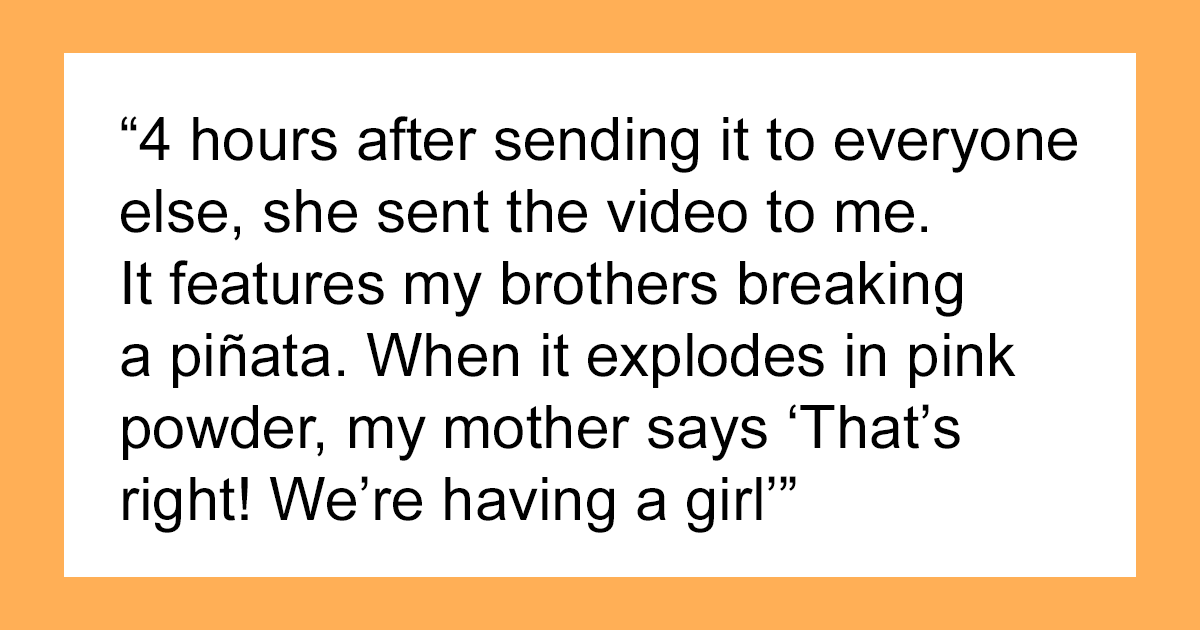
Then came the plot twist. After weeks of pressure, the mother softened her tone and asked only for a few photos with pink poppers during an upcoming visit. The daughter, exhausted and trying to keep things civil, agreed. But before that visit happened, congratulations started flooding her phone. Her mother had moved the reveal earlier, filmed it, sent it to relatives, excluded the pregnant daughter and her husband, and later acted confused about why anyone would be upset.
That is where the title earns its drama. Mom throws gender reveal without pregnant daughter, still thinks she’s the victim. Somewhere, a balloon arch is sweating.
Why This Story Hit a Nerve Online
Online readers reacted strongly because the conflict was not really about pink powder, a piñata, or whether gender reveal parties are fun. The deeper issue was consent. Pregnancy news belongs first to the pregnant person and, when applicable, their partner. It is medical, emotional, personal, and often more complicated than outsiders realize.
In this case, the daughter had previously experienced pregnancy loss, which made the stolen announcement even more painful. She and her husband had shared the baby’s sex only with immediate family. That detail matters. Many parents delay announcements because they are protecting their peace, processing anxiety, or choosing when and how to invite others into a vulnerable season.
The mother’s defenseessentially, “You did not want the reveal anyway”missed the point with the grace of a shopping cart with one broken wheel. Not wanting a gender reveal does not mean giving someone else permission to host one. Not wanting to be on stage does not mean your family gets to perform your life without you.
That is why the story resonated with people who have dealt with pushy relatives, overexcited grandparents, or family members who treat boundaries like polite suggestions. A boundary is not a debate invitation. It is not a rough draft. It is a line.
Gender Reveal Parties: Celebration or Spotlight Theft?
Gender reveal parties became popular in the late 2000s and exploded across social media because they are visual, emotional, and easy to share. Cake reveals, balloon pops, confetti cannons, colored smoke, and themed games can be harmless when the expecting parents genuinely want them. For some families, the reveal is a joyful moment that makes the pregnancy feel real.
But the trend has also attracted criticism. Some critics object to the way gender reveal parties often reinforce pink-and-blue stereotypes before a child is even born. Others point out that what is being revealed is usually fetal sex, not a child’s future gender identity. Medical and pediatric sources increasingly distinguish sex assigned at birth from gender identity, and many parents now prefer celebrations that focus less on “princess or quarterback” and more on “tiny human loading.”
There is also the matter of scale. A small cake cutting at home? Lovely. A safe backyard gathering with the parents’ full consent? Great. Pyrotechnics near dry grass? Please put the confetti cannon down and step away from the national forest. Gender reveal stunts have made headlines for fires, injuries, and environmental damage, turning what should be a family moment into a public cautionary tale.
Still, the issue in this viral story is not whether gender reveals are good or bad. The issue is choice. A gender reveal can be sweet when the parents want it. It becomes invasive when someone else uses the pregnancy as raw material for their own attention.
The Real Problem: A Mother Who Made the Moment About Herself
Family milestones can bring out the best in people. They can also bring out the relative who hears “we are keeping things private” and translates it as “challenge accepted.”
The mother in this story appeared to treat her daughter’s pregnancy as a family entertainment project. She wanted a reveal. The brothers wanted a reveal. Other relatives wanted the excitement. But the pregnant daughter and her husband did not. In healthy family dynamics, the people most affected by the event get the final say. Everyone else gets to have feelings, not voting rights.
When the mother moved the reveal date and excluded the parents-to-be, she did more than ignore a preference. She took control of the announcement. She decided who would know, when they would know, and how they would receive the news. That kind of behavior often leaves people feeling embarrassed, powerless, and betrayed.
Even worse, she framed the daughter’s reaction as unreasonable. This is a familiar pattern in boundary conflicts: someone crosses a line, then acts wounded when the person whose line was crossed objects. The problem is no longer the action; somehow, it becomes the reaction. That emotional switcheroo is exhausting. It turns the original issue into a debate about tone, gratitude, loyalty, or “family.”
In plain English: if you throw a party about someone else’s pregnancy without including them, you do not get to clutch your pearls when they are upset. The pearls have been revoked.
Pregnancy Announcements Are Not Community Property
Pregnancy is joyful, but it can also be physically uncomfortable, emotionally intense, medically uncertain, and deeply private. Expecting parents may be dealing with nausea, fatigue, anxiety, appointments, financial planning, family history, previous loss, or relationship stress. The public sees the cute announcement. The parents live the whole story.
That is why sharing pregnancy news should be handled with care. A grandparent may feel excited, but excitement does not override privacy. A sibling may want to celebrate, but celebration should not create pressure. A friend may mean well, but “I only told one person” is still a leak if the information was not theirs to share.
Healthy support sounds like: “How would you like us to celebrate?” Unhealthy support sounds like: “We already made invitations, and your refusal is ruining everything.” One respects the parents. The other drafts them into a production they never auditioned for.
There is also a trust issue. Once a relative shares private pregnancy news without permission, expecting parents may naturally limit what that person gets to know later. Due date details, hospital plans, baby names, ultrasound updates, and birth announcements may all go on an information diet. Not because the parents are cruel, but because trust is built by respecting small boundaries before being invited into bigger moments.
Why “Keeping the Peace” Often Means Sacrificing the Wrong Person
One of the most frustrating parts of stories like this is the family pressure campaign. The daughter said no, yet family members reportedly urged her to go along with it. Why? To keep the peace.
But whose peace?
Too often, “keep the peace” means “please absorb the discomfort so the loudest person does not have to change.” It asks the boundary-setter to become smaller, quieter, and more agreeable. Meanwhile, the person causing the conflict gets rewarded with compliance.
That does not create peace. It creates resentment wearing a cardigan.
Real peace requires mutual respect. It says, “We can be excited and still honor your decision.” It says, “We may be disappointed, but this is not our pregnancy.” It says, “We love you more than we love the idea of a party.”
In this story, the daughter’s cancellation of the visit was not an overreaction. It was a consequence. Boundaries without consequences are just decorative throw pillows: nice to look at, easy to ignore. When someone repeatedly disregards a clearly stated limit, taking space is a reasonable way to protect emotional safety.
How Grandparents Can Celebrate Without Taking Over
Grandparents often feel a powerful emotional rush when a new baby is coming. That excitement is real and understandable. A grandchild can feel like a new chapter, a second chance, a family legacy, and a reason to buy tiny socks that no newborn will keep on for longer than seven seconds.
But supportive grandparents remember one important truth: they are not the main characters of the pregnancy. They are beloved supporting cast members. Wonderful ones, hopefully. But still supporting cast.
Ask Before Announcing Anything
Before posting, texting, calling relatives, or casually telling the grocery store cashier, ask the parents what they are comfortable sharing. A simple question prevents a world of hurt: “Is this news public yet?”
Offer Help, Not Control
Instead of saying, “We are throwing you a party,” try, “Would you like help planning anything?” The difference is huge. One assumes ownership. The other offers support.
Respect the Answer the First Time
If the parents say no to a gender reveal, no to visitors, no to social media posts, or no to sharing the baby’s name early, accept it. You can feel disappointed privately. You can even eat a cupcake about it. But do not turn disappointment into pressure.
Remember That Access Comes From Trust
Grandparents who respect boundaries are often welcomed more warmly into the baby’s life. Not because they are perfect, but because they feel safe. Respect now builds closeness later.
What Expecting Parents Can Learn From This Family Drama
This story is dramatic, yes, but it also offers practical lessons for parents-to-be dealing with overbearing relatives. The earlier boundaries are set, the easier it becomes to protect the pregnancy, birth, and postpartum period.
First, be specific. “We are not doing a gender reveal” is clearer than “We are not really into gender reveals.” If someone pushes, repeat the same sentence instead of overexplaining. Overexplaining can accidentally make boundaries sound negotiable.
Second, decide what information is safe to share. If a relative has a history of spilling secrets, they may need to learn news later than others. That is not punishment; it is risk management. Some people get front-row seats. Some get the newsletter.
Third, align with your partner. When relatives pressure one parent, a united response helps prevent triangulation. “We have decided” is stronger than “She does not want to.” The first frames the decision as shared. The second invites others to blame one person.
Finally, follow through. If someone breaks a boundary, reduce access to sensitive information or take space from the conversation. Calm consistency teaches people how to treat you. It also teaches you that your own comfort matters.
The Bigger Conversation: Gender, Family, and Expectations
Gender reveal conflicts often expose deeper expectations. Some families are not just excited to learn the baby’s sex; they are already imagining a personality, wardrobe, hobbies, and future identity. Suddenly a fetus has been assigned a sports team, a wedding theme, and a preferred Halloween costume.
Modern parenting conversations are moving away from rigid assumptions. Many parents still enjoy pink or blue themes, and that is their choice. The problem begins when adults attach heavy meaning to those colors. A baby revealed with pink powder may grow into a child who loves dinosaurs, coding, soccer, ballet, mud puddles, or all of the above. A baby revealed with blue cupcakes may become gentle, artistic, bold, quiet, fashionable, mechanical, or wonderfully unpredictable.
Children are not color-coded products. They are people. Tiny, loud, sticky people, but people.
That is one reason some families now choose “baby celebration” parties instead of gender reveals. Others reveal the sex in low-key ways while avoiding stereotypes. Some skip the entire trend and wait until birth. All of these choices can be valid when they belong to the parents.
Experience Notes: What This Situation Feels Like in Real Life
Anyone who has dealt with a controlling relative during a major life event knows the strange emotional math involved. On paper, the conflict may look small. It is “just a party,” “just a post,” “just a phone call,” or “just one little announcement.” But emotionally, it rarely feels small. It feels like someone reached into a private moment and rearranged the furniture.
Many expecting parents describe pregnancy as a season when everyone suddenly has opinions. People comment on names, food choices, birth plans, body size, nursery colors, feeding preferences, and whether the baby “needs” seventeen blankets. Advice arrives like junk mail: constant, unsolicited, and somehow impossible to fully stop. When the advice is gentle, it can be useful. When it becomes pressure, it starts to feel like ownership.
A common experience is the fear of being labeled ungrateful. The pregnant person may think, “They are excited, so maybe I should let it go.” That thought is understandable, especially in families where saying no has always created drama. But gratitude and boundaries can exist together. You can appreciate love and still reject control. You can understand someone’s excitement and still say, “This is not your decision.”
Another real-life experience is the delayed reaction. In the moment, a person may freeze, smile awkwardly, or say “it is fine” because they are shocked. The anger may arrive later, after the phone stops buzzing and the reality sinks in. That does not make the reaction fake. It makes it human. Many people only recognize a boundary violation after their nervous system finally gets a quiet minute to file the paperwork.
There is also the awkward task of explaining the conflict to others. Relatives may say, “But your mom was just excited.” That may be true. But excitement is not a permission slip. A person can have good intentions and still cause harm. In fact, many painful family conflicts come from people who believe their love automatically makes their behavior acceptable.
For parents-to-be, the best takeaway is to practice small boundaries before the baby arrives. Try phrases like, “We are not sharing that yet,” “Please do not post anything,” “We will let everyone know when we are ready,” and “That does not work for us.” These sentences may feel stiff at first, like wearing new shoes. Over time, they become more comfortable.
For grandparents and relatives, the best takeaway is even simpler: ask, listen, and do not make yourself the injured party when the answer is no. Your future relationship with the baby’s parents is more important than one dramatic reveal. The goal is not to win the moment. The goal is to be trusted for many moments to come.
In the end, the daughter in this story was not upset because she hated celebration. She was upset because the celebration happened without consent, without inclusion, and without respect for her history or wishes. That distinction matters. A party should make the honored person feel loved, not ambushed. Otherwise, it is not a celebration. It is a boundary violation with snacks.
Conclusion: The Baby Was Not the Only Reveal
This family drama revealed more than a baby girl. It revealed who respected the parents’ choices and who treated those choices as obstacles. It revealed how quickly excitement can become entitlement. And it revealed that the most important boundary in pregnancy may be this: the expecting parents get to decide how their news is shared.
Gender reveal parties can be fun, sweet, and memorable when they are wanted. But when a pregnant person clearly says no, the respectful response is not negotiation, guilt, or secret party planning. It is acceptance. No pink popper is worth damaging trust. No piñata is worth making a daughter feel erased from her own pregnancy.
The mother in this story may have believed she was creating a joyful family moment. What she actually created was a lesson in boundaries. And honestly, that lesson may last much longer than the confetti.