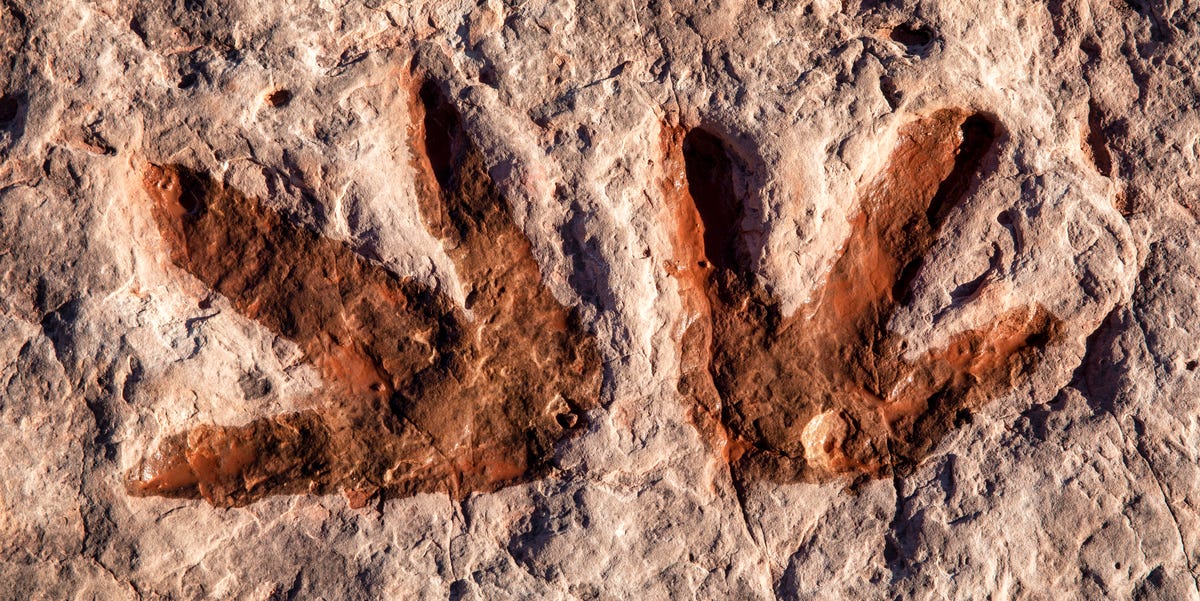

Every so often, the ancient world does something wonderfully dramatic. It refuses to stay in its assigned museum drawer. In northeastern Brazil, researchers studying a rocky landscape known as Serrote do Letreiro found something that sounds like the opening scene of an adventure movie: dinosaur footprints pressed into stone, with mysterious human-made symbols carved nearby.
No, this is not proof that humans were casually sharing walking trails with sauropods while complaining about the weather. The dinosaurs were long gonevery, very long gonebefore humans arrived. But that is exactly what makes the discovery so fascinating. At this site, the deep past meets the not-quite-as-deep past in one astonishing outdoor archive. Fossilized dinosaur tracks from the Early Cretaceous Period appear on the same rock surfaces as Indigenous petroglyphs, creating a rare conversation between paleontology and archaeology.
The discovery raises a deliciously human question: What did ancient people think when they saw these giant stone footprints? Did they see animal tracks, spirit marks, ancestral signs, natural wonders, or something else entirely? Archaeologists may not have a neat translation key, but the evidence suggests one thing clearly: the people who carved the symbols noticed the footprints and treated them with care.
Where Were the Dinosaur Footprints Found?
The site is called Serrote do Letreiro, often translated as “Signpost Hill.” It sits in Paraíba State, Brazil, within the broader Sousa Basin, an area already famous for dinosaur trackways. The region is part of the Vale dos Dinossauros, or Dinosaur Valley, a name that does not exactly whisper. It practically arrives wearing a safari hat.
The landscape includes flat, exposed rock surfaces known locally as lajeiros. These natural stone platforms preserve footprints left by dinosaurs that walked across wet sediment more than 100 million years ago. Over time, mud became rock, and quick steps became permanent signatures. Later, human communities came to the same surfaces and carved symbols into the stone.
Researchers identified tracks from several dinosaur groups, including theropods, sauropods, and iguanodontian dinosaurs. Theropods were typically meat-eating, two-legged dinosaurs; sauropods were the long-necked giants; and iguanodontians were plant-eating ornithopods. In simple terms, the rock records a prehistoric neighborhood with a surprisingly diverse guest list.
What Are the Mysterious Symbols?
The symbols are petroglyphs, which are designs carved directly into rock. At Serrote do Letreiro, many of them are circular, radial, or geometric. Some look like circles with internal lines. Others resemble starbursts, grids, or abstract patterns. A few designs even echo three-toed shapes, which is especially intriguing when they appear near dinosaur footprints.
Here is where the mystery becomes more thoughtful than spooky. The carvings do not appear randomly scattered across the landscape. Many were made close to the dinosaur tracks, sometimes only a few inches away, yet the artists generally avoided damaging the fossil footprints themselves. That careful placement matters. It suggests the ancient engravers were not simply doodling while waiting for lunch. They were responding to the footprints as meaningful features of the rock surface.
Were the symbols maps, rituals, stories, clan markers, teaching tools, or visual prayers? Researchers cannot say for certain. Petroglyphs rarely arrive with captions, which is inconsiderate of them but historically common. Still, their placement implies that the tracks had significance to the people who saw them.
How Old Are the Footprints and the Symbols?
The dinosaur footprints date to the Early Cretaceous Period, roughly 145 to 100 million years ago. That means the tracks were made when dinosaurs still ruled terrestrial ecosystems and flowering plants were beginning to change the world’s landscapes.
The petroglyphs are much younger, although their exact age remains uncertain. Researchers have compared the designs with similar rock art in northeastern Brazil and considered nearby archaeological evidence. Some estimates suggest the carvings may fall somewhere between about 9,400 and 2,620 years before present. That is still ancient by human standards, but compared with dinosaur time, it is basically yesterday with better stone tools.
This huge time gap is the heart of the discovery. The site does not show humans and dinosaurs living together. Instead, it shows ancient humans encountering traces of a vanished world and choosing to mark the same stone. That is far more interesting than a cartoon caveman riding a brontosaurus to work.
Why This Discovery Matters
Serrote do Letreiro is important because it combines two kinds of evidence that are usually studied separately: fossil tracks and human rock art. Paleontologists examine the dinosaur footprints to understand ancient animal movement, behavior, and environment. Archaeologists study the petroglyphs to understand human expression, symbolism, and relationships with place.
At this site, those two fields overlap. The footprints were not just geological curiosities. To ancient people, they may have been part of the living cultural landscape. The rock was not a blank canvas; it was already marked by nature and deep time. The human artists added their own layer without erasing the older one.
That makes the site a rare example of how prehistoric people may have interpreted fossils. Long before modern paleontology gave names like “theropod” and “sauropod,” humans were noticing unusual marks in stone. They may not have known the tracks came from dinosaurs, but they clearly recognized them as special.
Did Ancient People Understand They Were Dinosaur Tracks?
Probably not in the scientific sense. They did not have the word “dinosaur,” because that term was coined in the 19th century. They also did not have geology textbooks, museum labels, or that one friend who explains everything at parties whether invited or not.
However, ancient people were excellent observers of the natural world. Tracking animals, reading landscapes, recognizing patterns in stone, and interpreting environmental signs were essential skills. A giant three-toed impression in rock would not have gone unnoticed. The people who carved the petroglyphs may have interpreted the tracks through their own traditions, stories, and spiritual frameworks.
In other words, they may not have said, “Ah yes, an Early Cretaceous theropod passed through here.” But they may have understood that the marks represented powerful traces of something unusual, ancient, or important. That kind of awareness is meaningful even without modern scientific vocabulary.
The Careful Placement of the Petroglyphs
One of the most compelling details is how the carvings relate spatially to the footprints. In several cases, the petroglyphs appear beside the tracks rather than on top of them. This suggests intentional respect for the existing impressions. The artists could have carved over the tracks, but often they did not.
That restraint is a clue. It tells us the engravers noticed the footprints and treated them as features worth preserving. The site may represent a form of visual dialogue: dinosaurs left accidental marks in soft sediment, and humans later created intentional marks in hardened stone.
Imagine walking across a rocky outcrop and seeing giant footprints embedded in the ground. Even today, with all our science, dinosaur tracks can make adults suddenly speak in museum-gift-shop voices. For ancient observers, the experience may have been even more powerful. The tracks were not fossils in a glass case. They were part of the land underfoot.
What Dinosaur Footprints Can Reveal
Dinosaur footprints are more than prehistoric shoe prints. They can reveal how animals moved, whether they traveled alone or in groups, how fast they walked, and what kind of surface they crossed. A single skeleton shows anatomy; a trackway shows behavior. Bones say, “This animal existed.” Footprints say, “This animal was here, moving through this place.”
At Serrote do Letreiro and other sites in the Sousa Basin, fossil tracks help reconstruct ancient environments. The dinosaurs likely crossed wet, muddy surfaces near rivers, lakes, or floodplains. Conditions had to be just right: soft enough to receive a footprint, firm enough to hold its shape, and quickly buried or stabilized before erosion erased it.
That is a narrow preservation window. Most dinosaur steps vanished almost instantly. The ones that survived did so because geology, chemistry, sediment, water, and time accidentally teamed up like the world’s slowest preservation committee.
What Petroglyphs Can Reveal
Petroglyphs offer a different kind of evidence. They do not show dinosaur behavior; they show human attention. They reveal where people stopped, what surfaces they selected, and what patterns they considered worth creating.
The symbols at Serrote do Letreiro are not easy to decode, but their existence tells us that the site mattered. Rock art often appears in places with social, ceremonial, territorial, or memory-related importance. A carved circle may look simple, but its meaning could have been layered: connected to identity, cosmology, storytelling, routes, seasonal movement, or ritual practice.
The best interpretation is cautious. The symbols are mysterious because we do not know exactly what they meant to their makers. But “mysterious” should not become a free ticket to wild claims. Good archaeology does not fill every gap with fireworks. Sometimes the most honest answer is: we know the carvings were intentional, we know they were placed near tracks, and we know that relationship was likely meaningful.
Why the Discovery Feels So Modern
There is something deeply relatable about the site. Humans have always been curious about strange marks in the landscape. Today, we take photos, post them online, and ask strangers to identify them. Ancient people carved symbols beside them. Different tools, same basic human impulse: “This is unusual. Pay attention.”
Serrote do Letreiro reminds us that people in the past were not passive background characters in history. They observed, interpreted, remembered, and responded creatively to the world around them. They saw patterns where others might have walked by. They made meaning from stone.
The dinosaur footprints also remind us that Earth is not organized according to our tidy timelines. The same surface can hold events separated by more than 100 million years. One layer belongs to giant reptiles crossing wet ground. Another belongs to humans carving symbols into exposed rock. Together, they create a time sandwich with extra awe.
Could There Be More Sites Like This?
Yes, and that possibility is exciting. Fossil footprints and rock art have both been found in many parts of the world, but their close association is rare. It may be rare because the combination truly is unusual, or because researchers have not always studied paleontological and archaeological evidence together.
In the past, a paleontologist might focus on tracks while an archaeologist focused on carvings. Serrote do Letreiro shows why interdisciplinary research matters. When experts compare notes, the landscape becomes richer. A footprint is not only a fossil. A carving is not only art. Their relationship can reveal how humans noticed and interpreted deep time.
Future research may use advanced imaging, 3D modeling, and chemical analysis to document the site more precisely. Direct dating of petroglyphs remains difficult, but new techniques may help narrow the timeline. Conservation will also be essential. Exposed rock art and fossil tracks can be damaged by weathering, erosion, vandalism, and careless tourism. The past may be tough, but it is not invincible.
What This Discovery Teaches Us About Wonder
The most powerful part of the discovery is not that ancient people “knew dinosaurs” in a modern sense. It is that they recognized something extraordinary and responded to it. That is a very human act.
Science often begins with noticing. A track in stone. A pattern on a wall. A question that refuses to sit quietly. The ancient artists at Serrote do Letreiro may have had different explanations for the footprints than we do today, but they shared the first step of discovery: attention.
Modern researchers then added another layer of attention by documenting the footprints and petroglyphs together. The result is a site that connects dinosaur movement, Indigenous expression, geology, archaeology, and human curiosity. Not bad for a few marks in stone.
Experience Section: Standing Where Deep Time Leaves a Trail
To understand why a place like Serrote do Letreiro captures the imagination, picture the experience of approaching a sun-warmed rock outcrop in a dry northeastern Brazilian landscape. The air is bright, the vegetation is tough, and the stone underfoot looks ordinary at first. Then the surface changes. A depression appears. Then another. Suddenly, the rock is not just rock anymore. It is a pathway.
The first feeling would probably be surprise. Dinosaur footprints are strangely intimate fossils. A bone can feel like a specimen, but a footprint feels like a moment. It marks weight, direction, movement, and presence. Something alive stepped there. It shifted its body, pressed into soft ground, and moved on. The animal did not know it was making history. It was simply walking, which is honestly the most casual way to become famous.
Then the petroglyphs change the experience again. Seeing carved circles and radial signs near the tracks would make the place feel less like a fossil site and more like a meeting point between minds. The dinosaur left an accidental record. The human artist left an intentional one. One mark came from movement; the other came from meaning.
For a visitor, student, or researcher, that combination can be unforgettable. It teaches patience. You have to look closely, because the most important details are not always dramatic at first glance. A shallow footprint can hide in the angle of sunlight. A carved line can blend into cracks and mineral stains. The landscape rewards slow observation, the kind our fast-scrolling brains desperately need.
The experience also encourages humility. We often imagine ourselves as the first generation to be amazed by fossils, but Serrote do Letreiro suggests otherwise. Long before laboratory analysis and academic journals, people noticed these strange tracks. They may have built stories around them. They may have returned to them. They may have taught younger members of the community to see them as important. The site reminds us that wonder did not begin with modern science; modern science inherited it.
There is also a conservation lesson. Places like this are fragile. A careless step, a scratched name, a poorly managed tourist path, or simple neglect can damage evidence that survived for thousands or millions of years. Visiting such a site responsibly means resisting the urge to touch, trace, wet, chalk, or “improve” the marks for a better photo. The best souvenir is attention, not abrasion.
In the end, the experience of a dinosaur-track-and-petroglyph site is not just about seeing the past. It is about feeling time stacked beneath your feet. The dinosaurs walked first. Humans came later and carved their symbols. Researchers arrived after that and began piecing together the relationship. Now readers around the world can encounter the story and feel the same spark: the sense that Earth has been keeping a very long diary, and occasionally, if we are lucky, it lets us read a page.
Conclusion
The discovery of dinosaur footprints beside mysterious petroglyphs at Serrote do Letreiro is not a fantasy about humans meeting dinosaurs. It is something better: real evidence that ancient people encountered fossil tracks, noticed their power, and responded with symbols of their own. The site brings together deep geological time and human creativity in a way that feels both scientific and poetic.
For paleontologists, the footprints preserve dinosaur movement from the Early Cretaceous. For archaeologists, the petroglyphs reveal human attention, symbolism, and cultural interaction with the landscape. For the rest of us, the site offers a reminder that curiosity is one of humanity’s oldest tools. Sometimes, all it takes is a footprint in stone to make people stop, wonder, and leave a mark beside it.
Note: This article is based on real published research and reputable science reporting. The petroglyphs are mysterious because their exact meanings are unknown, not because they prove unsupported claims about humans living with dinosaurs.