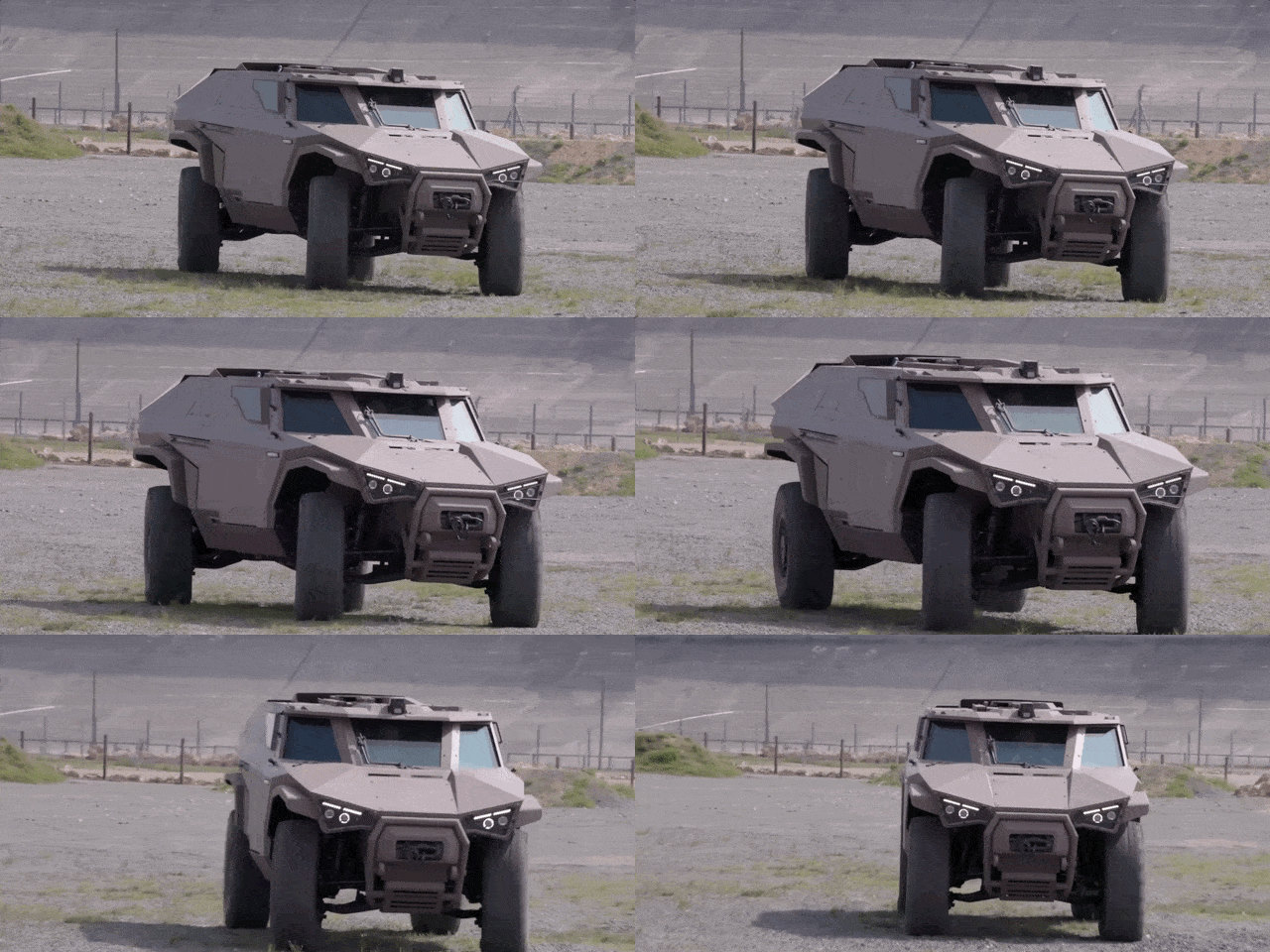

Some vehicles are built to blend in. This one looks like it escaped from a military design lab after drinking three espressos and deciding the laws of ordinary steering were merely polite suggestions. The machine at the center of all the buzz is commonly described in U.S. headlines as a weird Humvee, but the more accurate name is the Arquus Scarabee: a compact, armored reconnaissance vehicle with hybrid power, stealthy electric running, and the kind of crab-style movement that makes even seasoned car nerds do a double take.
And yes, it really can move in a sideways-ish, diagonal, “did-my-eyes-just-buffer?” kind of way. No, it is not literally moonwalking like a sci-fi hover tank. But compared with conventional military trucks, it behaves like a tactical beetle with a graduate degree in weirdness. That combination of four-wheel steering, hybrid drivetrain, and battlefield maneuverability is what makes this vehicle so fascinating.
If you love military vehicles, off-road technology, or machines that look like they were styled by a person whose mood board included “stealth fighter,” “scorpion,” and “do not parallel park me unless you dare,” this thing deserves a closer look.
What Is This “Weird Humvee,” Exactly?
The headline-friendly nickname exists because the Scarabee occupies a familiar space in the public imagination: it is compact, armored, rugged, and meant to carry troops and gear through ugly terrain. In other words, it feels Humvee-adjacent. But it is not a standard U.S. HUMVEE. It is a French-built reconnaissance and combat-support vehicle developed by Arquus, a defense company linked to Volvo Group.
That difference matters, because the Scarabee is not simply another boxy battlefield mule. It was designed from the ground up as a modern scout platformlighter, smarter, and more agile than the old-school brute-force formula. Instead of relying only on armor and attitude, it leans into mobility, discretion, and tactical flexibility.
In plain English, this machine is meant to sneak, watch, move fast, dodge trouble, and keep its crew alive while doing all of the above. That is a very different mission profile from the classic image of a big, loud, straightforward military truck rumbling through the desert like it owns the ZIP code.
Why Everyone Freaked Out About the Sideways Driving
The Scarabee’s signature trick is its crab-like movement. Thanks to advanced steering geometry, the front and rear wheels can work together in more creative ways than a typical truck’s setup. That lets the vehicle move diagonally, slip out from behind cover, and reposition without making wide, clumsy turns.
For civilians, it looks like a party trick. For military operators, it can be a survival trick.
Imagine a reconnaissance team using terrain as cover. In a normal vehicle, pulling out to observe a threat and then retreating means exposing more of the vehicle’s weaker angles during the maneuver. A vehicle that can creep diagonally can reduce that exposure. It can peek out, keep its attention directed toward the threat, and then slide back into cover with less awkward repositioning. That is the battlefield version of backing your shopping cart out of a crowded aisle without taking out the cereal displayexcept with much higher stakes and fewer coupons.
This is why the Scarabee caught so much attention in U.S. media: the motion looks bizarre, but the logic behind it is surprisingly practical. The vehicle is not weird for weirdness’s sake. It is weird because weird sometimes works better.
How the Steering System Makes the Magic Happen
Not true sideways travel, but close enough to make people stare
Let’s be precise. The Scarabee does not turn into a chess rook and move perfectly perpendicular to its own body like a lab demo vehicle with 90-degree wheel modules. What it does offer is a form of diagonal mobility that feels dramatic in motion and can be tactically useful in confined spaces or exposed positions.
Its front and rear steering systems can work in opposite directions for tight turning, or in coordinated directions for crab-like movement. That means the vehicle can pivot tightly when needed, then switch to a motion pattern that helps it sidestep awkward terrain or retreat from cover more smoothly.
Why this matters in the real world
Military vehicles rarely operate on neat pavement with cheerful lane markings and forgiving curbs. They deal with rubble, ditches, tight urban corridors, rocky trails, and terrain that seems personally offended by tires. A platform that can shrink its turning drama and reposition with less wasted movement has a real advantage.
This same concept has shown up in consumer vehicles like the GMC Hummer EV’s CrabWalk feature, which also uses four-wheel steering to move diagonally at low speeds. The civilian version is aimed at trail maneuvering and parking-lot wizardry. The military idea is more serious: less exposure, more agility, better survivability.
Hybrid Power: The Secret Sauce Behind the Strange
Now let’s talk about the other reason the Scarabee stands out. This vehicle uses a hybrid powertrain, pairing a diesel engine with an electric motor. On paper, that sounds like an engineering compromise. In practice, it is one of the most interesting parts of the whole package.
Military vehicles traditionally prioritize durability, range, and payload. Electric operation historically sounded too fragile, too limited, or too infrastructure-hungry for battlefield use. But hybrid systems change the equation. The Scarabee can draw on electric power for quiet operation and reduced heat signature while still using diesel power for extended range and higher-demand situations.
That matters because modern reconnaissance is not only about seeing the enemy. It is about not being seen by the enemy’s sensors. A quieter vehicle with a lower thermal signature has a better chance of operating discreetly. In other words, the Scarabee is not just trying to avoid being loud. It is trying to avoid becoming the glowing red blob on someone else’s screen.
The hybrid layout also supports “silent watch” style operations, where onboard electronics, sensors, or communications gear can stay active without making the vehicle sound like a generator strapped to a shopping cart. For scouting missions, surveillance, and quick repositioning, that is a big deal.
Small, Fast, and Meant to Be Sneaky
The Scarabee is not a giant armored brick. It is relatively compact for its class, which is part of the point. Reports have described it as an 8-ton-class vehicle with room for a crew of up to four, built for scouting, reconnaissance, and quick support roles. It is also designed to fit transport requirements that matter in modern operations, including compatibility with aircraft like the C-130.
That combination of size and agility gives it a distinct personality. It is less “rolling bunker” and more “armored pouncer.” It can reportedly reach highway-like speeds, negotiate gradients, cross obstacles, and operate in terrain that would make ordinary vehicles question their life choices.
Its adjustable suspension and compact dimensions also help it adapt to multiple environments. It can be set up to move aggressively off-road, yet still remain transportable and mission-flexible. This is exactly why it feels like a next-generation scout platform rather than a warmed-over relic in tactical clothing.
What Makes It Different From a Classic HUMVEE
Old-school toughness vs. new-school mobility
The classic HUMVEE earned its place through durability, versatility, and sheer military ubiquity. It became an icon because it was everywhere, did almost everything, and looked like it could survive being dropped into a sandstorm and then blamed for the sandstorm.
But the battlefield has changed. Today’s threats include thermal imaging, drones, networked surveillance, and urban environments where maneuverability matters as much as raw toughness. That pushes designers toward vehicles that can move smarter, not just harder.
The Scarabee represents that shift. Its value proposition is not simply “I am armored.” It is “I can approach quietly, reposition cleverly, and reduce the odds of getting caught in a bad angle.” That is a different philosophy from legacy tactical trucks, and it helps explain why so many analysts and enthusiasts perked up when they saw it.
Even AM General is thinking about what comes next
This is not happening in isolation, either. The broader military vehicle world is clearly moving toward more electrification, more integration, and more flexible mobility. GM Defense has already explored military concepts based on the GMC Hummer EV platform, while AM General has been showcasing its own ideas for the future evolution of the HUMVEE. So even though the Scarabee is not an American HUMVEE, it is part of a much bigger conversation about where tactical mobility is headed.
Could Sideways-Driving Tech Become Common?
In flashy consumer marketing, crab-style driving can look like the automotive equivalent of a magician pulling a rabbit out of a charging cable. But beneath the spectacle lies a serious trend: advanced four-wheel steering is becoming more valuable in large, heavy, high-capability vehicles.
For military use, the benefits can include tighter turns, safer repositioning, lower exposure, and better route handling in urban or rough terrain. For consumer vehicles, the same principles help with trail driving, parking, and maneuvering giant trucks that otherwise feel like they need their own zip codes.
Will every future tactical vehicle drive diagonally? Probably not. Cost, complexity, reliability, and maintenance always get a vote. Military planners love innovation right up until innovation asks for a new supply chain. But as electric and hybrid systems improve, and as software takes a larger role in vehicle control, features that once seemed exotic may start looking normal.
That is usually how futuristic tech enters the mainstream. First it looks ridiculous. Then it looks expensive. Then, one day, it shows up in a parking lot next to a coffee shop and nobody blinks.
Why the Scarabee Captures the Imagination
There are plenty of armored vehicles in the world. Most of them inspire some version of the same reaction: “Yep, that looks extremely serious and probably terrible for fuel economy.” The Scarabee does something rarer. It makes people curious.
Part of that is the styling, which looks equal parts insect, stealth gadget, and angry dune toy. Part of it is the hybrid stealth angle. But mostly, it is the movement. Human beings are deeply wired to notice when a large object behaves in a way that contradicts our expectations. Trucks are supposed to turn. This one sort of scuttles. Your brain files that under important weirdness.
That makes the Scarabee more than a military hardware story. It becomes a story about how design changes when mobility, sensors, and survivability all evolve together. It asks a fun question with a serious answer: what should a modern scout vehicle look like if it is being built for a battlefield full of drones, cameras, thermal sensors, and tight terrain?
Apparently, the answer is: like a compact armored beetle that can shuffle sideways and vanish quietly enough to make your old tactical truck feel like a marching band.
Experience Section: What It Feels Like to Encounter a Sideways-Driving Machine Like This
Even if you have never stood near the Scarabee in person, you can understand the reaction it creates by imagining the scene. At first glance, your brain labels it as familiar: armored body, serious stance, military purpose, no nonsense. Then it starts moving, and suddenly familiar becomes bizarre.
There is something deeply unsettlingin the best possible wayabout watching a heavy vehicle drift diagonally while still facing mostly forward. It feels like seeing a refrigerator corner like a sports car, or a rhinoceros execute ballet footwork. The body language of the machine stops matching the rules you have learned from every ordinary vehicle on the road.
That is the first experience this kind of machine delivers: surprise. The second is respect. Because once the novelty wears off, you realize the motion is not a gimmick layered onto a normal platform for internet applause. It is functional. The sideways creep, the tight-turning capability, the quiet hybrid runningall of it serves a purpose. The vehicle is communicating that it was designed by people obsessed with the problem of movement under pressure.
There is also an emotional contrast that makes the topic memorable. The Scarabee looks aggressive, but its smartest moves are subtle. It is armored, yet one of its biggest strengths is stealth. It appears brutal, but its magic comes from finesse. That contrast is what makes it feel so modern. The old fantasy of military mobility was brute force: bigger engine, bigger tires, bigger noise, bigger dust cloud. The new fantasy is intelligent controlless drama, more precision.
For enthusiasts, that creates a kind of mechanical delight. You are not just admiring horsepower or armor thickness. You are admiring a solution. The vehicle becomes interesting not because it is loud or oversized, but because it solves a real tactical problem in a visually unforgettable way. That is catnip for anyone who likes engineering stories.
And then there is the simple joy of weird machines. Let’s be honest: part of the appeal is that the Scarabee looks like something a kid would draw after being told to invent the coolest military truck ever, only to grow up, become an engineer, and actually build it. Big tires, tough body, stealth mode, diagonal movement, aircraft transportabilitythis is not a shy machine. It is the vehicular equivalent of showing up to a group project with a laser pointer, a drone, and way too much confidence.
If that sounds like a compliment, it is. Because in a world full of samey crossovers and predictable pickup designs, a sideways-driving armored scout vehicle reminds us that engineering can still surprise us. It can still make us laugh, lean closer, and say, “Wait, it does what?” That sense of wonder is rare. The Scarabee earns it honestly.
Conclusion
This weird Humvee is a sideways-driving freak machine because it combines battlefield logic with headline-grabbing engineering. The Arquus Scarabee is not famous just because it looks cooland, to be fair, it looks very cool. It stands out because its crab-like motion, hybrid stealth capability, compact size, and scout-focused design reflect a real shift in how modern tactical vehicles are being imagined.
It is a glimpse of where military mobility may be headed: more agile, more sensor-aware, less predictable, and smarter about exposure. The old model was raw toughness. The new model adds finesse. When a vehicle can move diagonally, operate quietly, transport easily, and still carry the hardware needed for real missions, it stops being a novelty and starts looking like a signpost.
In other words, this machine is not weird because it is broken. It is weird because the future often arrives looking a little ridiculous right before it starts making perfect sense.