
Glass shower doors are supposed to say “spa day.” Too often, they scream “frosted glass privacy upgrade”
(that nobody asked for). If your door looks cloudy, streaky, or permanently polka-dotted, you’re not
failing at adulthoodyour shower is simply hosting two very clingy houseguests: soap scum and
hard-water minerals.
The good news: you don’t need a power washer, a monk’s patience, or a ten-step ritual involving crystals
and a full moon. You need the right cleaner for the right mess, a repeatable method, and one small habit
that changes everything (spoiler: it’s drying the glass). Below is a tested-and-vetted lineup of standout
cleaners plus an easy routine that keeps glass doors sparkling without turning every shower into a part-time job.
Why Glass Shower Doors Get Cloudy (and Why “Just Glass Cleaner” Often Flops)
That haze usually isn’t dirtit’s chemistry:
- Soap scum: a stubborn mix of soap residue, body oils, and minerals. It smears, clings, and laughs at casual effort.
- Hard-water stains: mineral deposits (often calcium and magnesium) left behind when water evaporates. They look chalky, spotty, and “I swear I cleaned this yesterday.”
- Bonus troublemakers: humidity (hello, mildew), bar soap buildup, and letting water air-dry on glass like it pays rent.
Most everyday glass sprays are designed for fingerprints and dustnot bathroom buildup. When you’re dealing with
soap scum and mineral deposits, you’ll get better results from formulas that can dissolve those specific layers.
Before You Clean: Three Rules That Save Your Door (and Your Lungs)
1) Match the cleaner to the problem
Soap scum responds well to surfactants and “soap scum” formulas. Hard-water stains often need a descaling approach.
Mold and mildew stains may require a disinfecting product. One bottle rarely does everything perfectly.
2) Don’t turn your shower into a chemistry lab
Never mix household cleaners. Especially keep bleach away from ammonia, vinegar, or other acids. Use one product,
rinse thoroughly, ventilate, and keep it simple.
3) Avoid unnecessary abrasion
Glass is tough, but it can still get scratched or dulled by overly abrasive pads and powders. When in doubt, start gentle:
microfiber cloth, soft sponge, non-scratch scrub pad, and a cleaner designed for shower glass.
How “Tested” This List Is (and How You Can Re-Test It at Home)
Many outlets test cleaners by scoring them on factors like ease of use, scent, performance, and value, then
applying products to separate taped-off sections of glass to compare results fairly. That approach works at home, too:
pick a small section, follow label directions exactly (especially wait time), rinse well, then dry and inspect in bright light.
Quick Verdict: Best Cleaners by Situation
- Best all-around cleaner for routine glass-door grime: CLR Pro Industrial Strength Bath Daily Cleaner
- Best for soap scum (minimal elbow grease): Rejuvenate Scrub-Free Soap Scum Remover
- Best for hard-water spots and mineral haze: CLR Calcium, Lime & Rust Remover
- Best “spray now, rinse later” weekly option: Wet & Forget Weekly Shower Cleaner
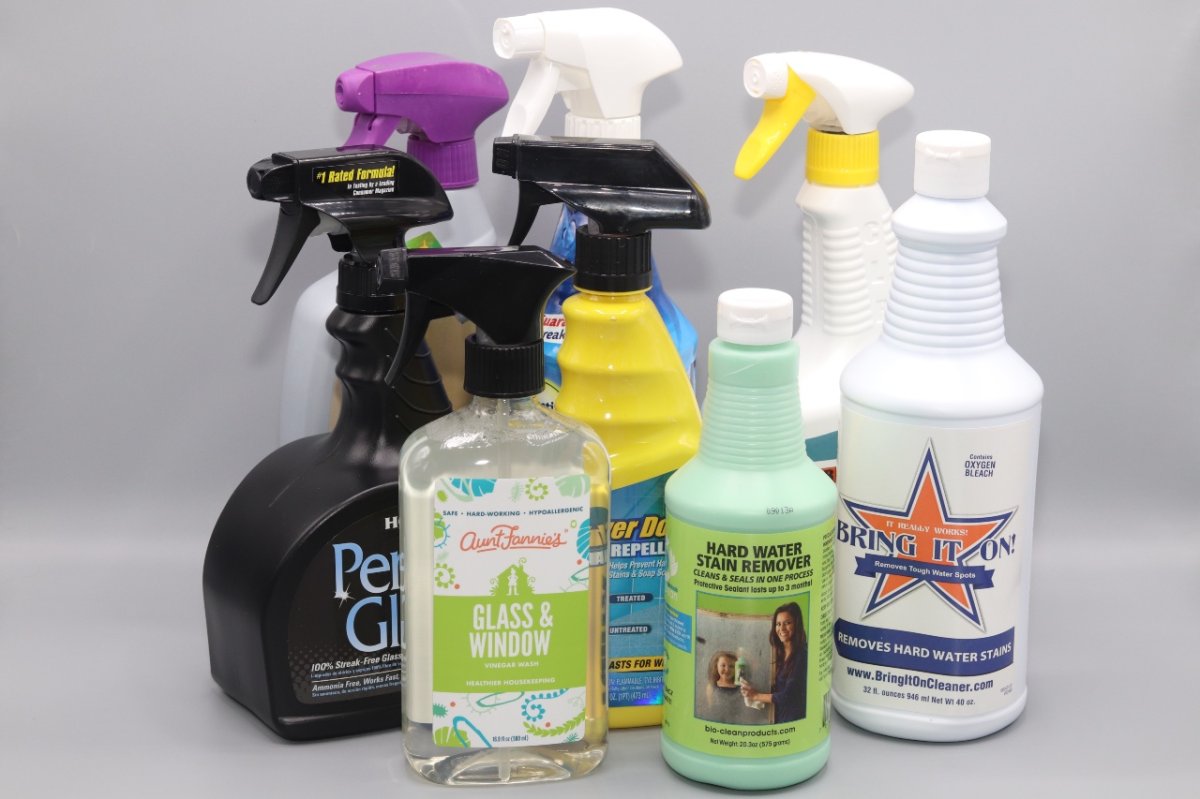
- Best targeted hard-water remover for tough deposits: Bio-Clean Hard Water Stain Remover
- Best foam that clings to vertical glass: Zep Foaming Shower, Tub & Tile Cleaner
- Best finishing spray for a polished look: Hope’s Perfect Glass Cleaner
- Best prevention product (reduce future spots): Rain-X Shower Door Water Repellent
The Best Cleaners for Sparkling Glass Shower Doors
1) Best Overall: CLR Pro Industrial Strength Bath Daily Cleaner
If you want one dependable bottle for regular “why does this door hate me?” buildup, this is a strong pick.
It’s designed to tackle everyday bathroom grime and can handle light mineral buildup while still being workable for soap scum.
Best for: Routine cleaning, light hard-water marks, general haze.
Watch-outs: Strong smell for some people; older, heavily layered buildup may need a more targeted hard-water remover.
- Apply to a cool, mostly dry door for better cling.
- Let it sit for the label’s recommended contact time.
- Wipe or lightly scrub (soft sponge), rinse thoroughly, then dry with microfiber.
2) Best for Soap Scum: Rejuvenate Scrub-Free Soap Scum Remover
Soap scum is the clingiest roommate you’ve ever had. Rejuvenate is built specifically to dissolve it without demanding
a CrossFit workout. If your glass feels tacky or looks filmy, start here.
Best for: Soap scum film, oily residue, dull “grayish” haze.
Watch-outs: Not a dedicated hard-water dissolver; severe mineral spotting may need a descaler afterward.
- Spray evenly across the glass.
- Let it sit (time matters).
- Rinse well and dry immediately to prevent new spots while it air-dries.
3) Best for Hard-Water Stains: CLR Calcium, Lime & Rust Remover
When your door has that chalky, spotty “constellation” look, you’re dealing with mineral deposits.
A descaling product can dissolve what regular sprays leave behind.
Best for: Mineral haze, limescale, stubborn hard-water spots.
Watch-outs: This category often has an acidic smell; ventilate well and avoid using on natural stone unless the label allows it.
- Spot-test an inconspicuous corner first.
- Apply to affected areas and let it work brieflydon’t “marinate” the glass longer than directed.
- Gently agitate with a non-scratch pad if needed, rinse thoroughly, and dry.
4) Best Budget Weekly Option: Wet & Forget Weekly Shower Cleaner
This is for the “I will clean it… but I’m not emotionally available for scrubbing” crowd. It’s designed for a weekly routine:
spray today, rinse later. Not glamorousjust practical.
Best for: Weekly upkeep, preventing heavy buildup, cutting down scrubbing sessions.
Watch-outs: Follow surface restrictions; some weekly sprays aren’t recommended for certain stone surfaces.
5) Best for Stubborn Mineral Deposits: Bio-Clean Hard Water Stain Remover
For thicker mineral crust or “I moved in and this was already here” stains, a specialty hard-water stain remover can be a lifesaver.
Think of it as the heavy artillerystill used carefully, still used with a gentle touch.
Best for: Set-in mineral deposits and stubborn spots that laugh at lighter cleaners.
Watch-outs: Requires some agitation and patience; always spot-test and avoid scratching tools.
6) Best Clinging Foam: Zep Foaming Shower, Tub & Tile Cleaner
Foam has one huge advantage: it sticks. That means more contact time on vertical glass and less of your cleaner
sliding away like it has plans. It’s a strong option for soap scum and light deposits.
Best for: Vertical surfaces, soap scum, grime, and light mineral buildup.
Watch-outs: Some foam formulas can be harsh; check label restrictions (especially around natural stone).
7) Best “Final Pass” for a Streak-Free Shine: Hope’s Perfect Glass Cleaner
Sometimes the door is clean…but it doesn’t look clean. A finishing spray can help polish away light streaks after you’ve
removed the real gunk with a soap-scum or hard-water product.
Best for: A crystal-clear “after” photo, quick touch-ups, mirrors and glass beyond the shower.
Watch-outs: Not the best first step for heavy soap scum or mineral depositsuse it as the final step.
8) Best Prevention Product: Rain-X Shower Door Water Repellent
Cleaning is great. Cleaning less is better. A water repellent helps water bead up and slide off, which can reduce
the amount of residue that dries onto the glass. It’s like a raincoat for your shower door.
Best for: Reducing future water spots and buildup, extending time between deep cleans.
Watch-outs: Application takes a little time (apply, let haze, buff). Worth it if you hate frequent cleaning.
The 15-Minute “Sparkle Reset” Method (Works With Most Products)
- Rinse the door with warm water to remove loose grime.
- Pick your main cleaner (soap scum remover for film; descaler for mineral haze).
- Apply on mostly dry glass so the product clings instead of sliding away.
- Wait the full contact time listed on the bottle (set a timeryour future self will thank you).
- Gently agitate with a soft sponge or non-scratch pad where needed.
- Rinse thoroughly until the glass feels squeaky-clean (not tacky).
- Dry immediately with a microfiber cloth to prevent fresh spots.
- Optional: Apply a water repellent to reduce future spotting.
Maintenance That Actually Works (and Doesn’t Require a New Personality)
Daily (30 seconds)
- Squeegee the glass after your shower or wipe it with a microfiber towel.
- Leave the door open for airflow and run the exhaust fan to reduce moisture.
Weekly (5–10 minutes)
- Use a weekly shower cleaner or a soap scum remover and rinse well.
- Spot-treat corners and the lower track area where residue collects.
Monthly (10–20 minutes)
- If you have hard water, use a descaler on mineral haze before it turns into a renovation project.
- Reapply water repellent if you use one.
DIY Options (Because Sometimes the Best Cleaner Is Already in Your Kitchen)
Vinegar + Water + a Drop of Dish Soap (Hard-Water-Friendly DIY)
A classic approach is a spray made from vinegar and water, often boosted with a small amount of dish soap.
The vinegar helps with mineral deposits and the dish soap helps break down oily residue and scum.
Important: Skip vinegar on natural stone and follow any manufacturer guidance for your shower materials.
Daily Spray Shortcut
Daily shower sprays (store-bought or DIY) can reduce how often you need to deep clean. The trick is consistency:
a little prevention beats a Saturday morning scrubbing marathon.
FAQ: Glass Shower Door Cleaning
Why do my doors look cloudy even after cleaning?
Usually it’s either remaining mineral deposits (needs a descaler) or leftover product residue (needs a thorough rinse and dry).
Bright light reveals everythingdry with microfiber and check from multiple angles.
Can I use a magic eraser on shower glass?
Eraser-style sponges can help with spot-cleaning, but they’re mildly abrasive. Use gently, test first, and avoid aggressive pressure.
How do I keep water spots from coming back?
Dry the glass after each shower, improve ventilation, and consider a water repellent. If your water is very hard,
longer-term solutions like water softening may reduce the problem at the source.
Experience Notes: What You’ll Notice When You Actually Follow This Routine (500+ Words)
Here’s the funniest part about glass shower doors: they don’t require perfectionjust momentum. In real bathrooms,
the difference between “sparkling” and “perma-cloudy” is rarely one miracle product. It’s what happens in the first
72 hours after you clean. If you deep-clean your doors until they gleam, then go right back to letting water air-dry
on the glass, the door will start rebuilding its little mineral kingdom immediately. That’s not a moral failing;
that’s evaporation doing its job.
The first “aha” moment most people have is how much easier everything gets once the initial buildup is gone.
When you remove that layered soap scum film, your weekly clean stops being a wrestling match and becomes a quick wipe-down.
You also start noticing that streaks are often a drying problem, not a cleaning problem. Two doors can be
equally clean, but the one dried with microfiber looks like a magazine photo, while the one left to drip-dry looks like
it’s wearing a cloudy filter. If you want the biggest visual payoff for the smallest effort, drying wins.
The second surprise is that “soap scum vs. hard water” is not just triviait’s the whole game. Soap scum tends to smear
and feel slightly tacky. Hard-water deposits look like crisp dots or a chalky haze. When you use the wrong product,
you feel like the glass is mocking you: you scrub harder, you waste time, and you end up convinced your door is beyond help.
The moment you switch to a soap-scum remover for film or a descaler for mineral haze, the cleaning session suddenly becomes
suspiciously reasonable. It’s almost annoying how quickly “impossible” becomes “oh, that was it?”
Another real-life detail: cleaning the bottom edge and track area matters more than you think. That’s where
runoff collects, evaporates, and leaves concentrated residue. Even if you only have the energy to detail one zone, make it
the lower third of the door. That’s where hard-water spots begin and where grime likes to quietly evolve into “why is this
stuck on here?” territory.
If you try a water repellent, expect a different kind of satisfaction. It’s not the instant gratification of watching scum
dissolveit’s the future payoff of watching water bead and slide off and realizing your door stays clearer longer. The
trade-off is application time: you’ll spend extra minutes buffing, but you get back time later by needing fewer deep cleans.
People who love repellents tend to be the same people who love “set it and forget it” systems. People who hate repellents
usually hate buffing anything, ever, under any circumstances (valid).
Finally, the most realistic “secret” is that your routine should match your life. If you’re a daily squeegee person, amazing.
If you’re not, pick a daily shower spray you’ll actually use, because a “perfect” plan that never happens is just decorative
guilt. The best cleaner is the one that fits your habitsbecause the real enemy of sparkling glass isn’t hard water, soap scum,
or even mildew. It’s the moment you look at the door, sigh, and decide it’s a problem for Future You.