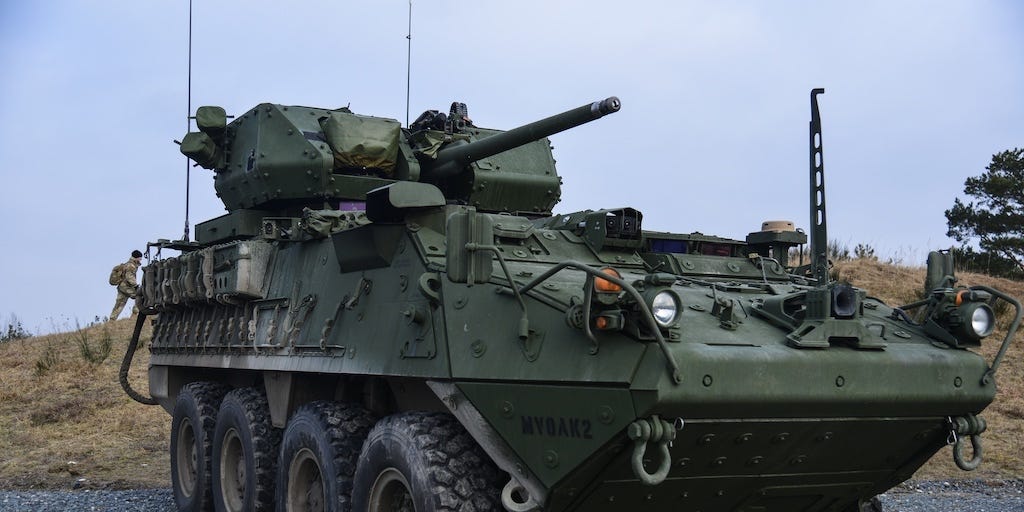

The U.S. Army’s Stryker armored vehicle has always been the military equivalent of a reliable pickup truck wearing body armor: fast, practical, adaptable, and very popular with commanders who need troops moved quickly without dragging a tank battalion behind them. But for years, one complaint followed the Stryker around like a squeaky track pad: it needed more punch.
Now the Army is upgrading the Stryker armored vehicle with a bigger gun, replacing the traditional machine-gun-heavy setup on many infantry carrier variants with a 30mm Medium Caliber Weapon System, often shortened to MCWS. In plain English, that means the Stryker is getting a serious firepower boost through an unmanned turret and an automatic cannon that can hit harder, reach farther, and give Stryker Brigade Combat Teams a better chance against modern battlefield threats.
This is not about turning the Stryker into a tank. Please do not picture an eight-wheeled Abrams wearing sunglasses. The Stryker remains a medium armored vehicle designed to carry infantry, move fast, and operate across large areas. The bigger gun simply gives it sharper teeth.
What Is the Stryker Armored Vehicle?
The Stryker is an eight-wheeled armored combat vehicle used by the U.S. Army in Stryker Brigade Combat Teams. It was designed to fill the space between light infantry, which can deploy quickly but lacks armor, and heavy armored forces, which bring tremendous power but require more logistics, fuel, transport, and maintenance.
Think of the Stryker as the Army’s middleweight boxer. It is not the heaviest fighter in the ring, but it can move quickly, absorb punishment, carry a squad, and show up where heavier vehicles may be too slow or too demanding to deploy. The Stryker family includes infantry carriers, reconnaissance vehicles, mortar carriers, command vehicles, medical evacuation variants, engineer vehicles, anti-tank guided missile carriers, and other specialized models.
For many years, the standard Stryker Infantry Carrier Vehicle relied mainly on weapons such as the M2 .50 caliber machine gun, the MK19 40mm automatic grenade launcher, or other remotely operated weapon stations. These were useful, proven, and deadly in the right situation. But against newer armored vehicles, fortified positions, drones, and near-peer battlefield threats, the Army wanted something with more reach and more destructive effect.
Why the Army Wants a Bigger Gun on the Stryker
The short answer is simple: the battlefield changed. The longer answer involves Russia, China, infantry fighting vehicles, urban warfare, drones, and the uncomfortable realization that a .50 caliber machine gun is not always enough when the other side brings a 30mm cannon to the party.
During years of counterinsurgency operations, Strykers were valued for protected mobility, road speed, and the ability to move soldiers around dangerous environments. But as the Army shifted its attention back toward large-scale combat operations, the Stryker’s firepower gap became harder to ignore.
Potential adversaries field armored personnel carriers and infantry fighting vehicles armed with cannons in the 30mm class. That matters because a 30mm cannon can engage light armor, enemy fighting positions, walls, windows, tree lines, and other targets at distances where smaller weapons may struggle. It gives commanders more options before they call for artillery, missiles, or close air support.
The 30mm Medium Caliber Weapon System Explained
The centerpiece of the upgrade is the 30mm Medium Caliber Weapon System, an unmanned turreted autocannon mounted on the Stryker Double-V Hull A1 Infantry Carrier Vehicle. The turret being unmanned is a big deal. It means the crew does not need to sit inside the turret basket like they are auditioning for the world’s loudest elevator ride. Instead, soldiers operate the system from inside the protected vehicle.
The 30mm cannon gives the Stryker more range, improved accuracy, and better lethality against a wider set of battlefield targets. It is intended to support dismounted infantry, suppress enemy positions, defeat lighter armored threats, and provide a more credible direct-fire capability to Stryker units.
The Army selected Oshkosh Defense, working with partners including Pratt Miller and Rafael, to integrate the MCWS onto Stryker vehicles. The program has involved a requirements contract potentially covering multiple Stryker brigades, with production orders moving the upgraded vehicles from concept to testing and fielding.
From Dragoon to MCWS: How the Upgrade Started
The Stryker’s bigger-gun story did not appear out of nowhere. It began with an urgent need from U.S. soldiers in Europe, especially the 2nd Cavalry Regiment. Facing Russian armored formations and observing the firepower carried by potential adversary vehicles, Army leaders concluded that Stryker formations needed more direct-fire capability.
The first high-profile answer was the Stryker Infantry Carrier Vehicle-Dragoon, commonly called the Stryker Dragoon. This version mounted a 30mm cannon and was fielded to the 2nd Cavalry Regiment in Europe. Soldiers tested it, trained with it, and helped the Army understand what worked and what needed improvement.
The Dragoon experience became a practical laboratory. It showed that a 30mm-armed Stryker could dramatically improve unit lethality, but it also revealed the complexity of integrating a bigger weapon onto a vehicle that was not originally designed around that turret. The later MCWS program built on those lessons with a broader modernization effort.
What the Bigger Gun Actually Changes
1. Better firepower against light armor
A 30mm cannon gives Stryker crews a stronger answer to enemy armored personnel carriers, infantry fighting vehicles, and lightly protected platforms. It does not make the Stryker a tank killer by itself, but it gives it a much better chance against threats that would laugh rudely at smaller weapons.
2. Improved support for infantry
Strykers exist to move infantry and support them. When soldiers dismount, the vehicle can overwatch, suppress enemy positions, and help shape the fight. A 30mm cannon gives the crew more precision and power when supporting troops moving through open ground, urban streets, or complex terrain.
3. More options before using missiles or artillery
Not every target deserves a Javelin missile, artillery mission, or airstrike. Sometimes a commander needs a fast, direct, proportional response. The 30mm cannon fills that space. It is powerful enough to matter but still practical for repeated use during maneuver operations.
4. Room for advanced ammunition
The Army has also invested in 30mm ammunition, including programmable airburst rounds designed to improve effects against troops in the open, behind cover, or inside urban structures. That turns the cannon from “bigger bullet launcher” into a more flexible battlefield tool.
The Stryker Is Still Not a Tank
One of the biggest misunderstandings about the Stryker upgrade is the idea that a bigger gun changes the vehicle’s entire identity. It does not. A Stryker with a 30mm cannon is more lethal, but it is still a wheeled armored vehicle with different protection, mobility, and tactical roles than a main battle tank.
The Abrams is built to smash through heavy armored threats. The Bradley is a tracked infantry fighting vehicle with heavier firepower and protection than a traditional personnel carrier. The Stryker is designed around speed, deployability, and infantry movement. Adding a 30mm cannon gives it more battlefield authority, but commanders still have to use it intelligently.
In other words, the Stryker got a bigger microphone, not a new personality.
Why an Unmanned Turret Matters
The unmanned turret is one of the most important parts of the MCWS upgrade. Traditional manned turrets take up internal space and can expose crew members to additional risk. An unmanned turret allows the weapon system to sit above the vehicle while the crew remains under armor.
This arrangement helps preserve space inside the Stryker for soldiers and equipment. It also reflects a wider trend in armored vehicle design: keep the crew protected, use sensors and digital controls, and reduce exposure whenever possible. Modern armored warfare is already stressful enough without asking soldiers to poke their heads into danger like curious prairie dogs.
The Acquisition Story: Fast Need, Real Problems
The Army’s Stryker firepower upgrade is also a case study in modernization pressure. The need was real, and the Army moved quickly. But integrating a 30mm turret, fire-control software, sensors, vehicle power, ammunition handling, crew controls, and safety systems is not as simple as bolting a cannon on top and calling it a patriotic home improvement project.
Government reviews found that the program faced production, hardware, and software challenges. Fielding timelines were affected as the Army and industry worked through issues. That is not unusual in complex defense programs, but it is important. Modern combat vehicles are rolling networks of mechanics, electronics, sensors, and software. A glitch in one system can affect the whole vehicle.
The lesson is clear: battlefield urgency can accelerate innovation, but speed must be balanced with testing, production discipline, and soldier feedback. A rushed upgrade that is unreliable helps nobody. A reliable upgrade that arrives too late also helps nobody. The Army has been trying to land somewhere in the middle, which is much easier to say in a conference room than to do in a factory.
How the Bigger Gun Changes Stryker Brigade Combat Teams
Stryker Brigade Combat Teams are built for mobility and flexibility. Adding 30mm-armed vehicles changes how those brigades can fight. It improves their ability to screen, maneuver, support infantry, and respond to enemy light armor. It may also reduce the need to rely immediately on attached heavy armor in certain scenarios.
For soldiers, the upgrade means new training. Vehicle commanders, gunners, drivers, maintainers, and infantry leaders all need to understand the weapon’s capabilities and limits. The cannon changes engagement ranges, ammunition planning, target selection, maintenance routines, and tactical decision-making.
For logistics teams, it means another ammunition type, more specialized parts, and additional maintenance knowledge. Bigger guns bring bigger possibilities, but also bigger supply conversations. Somewhere, a logistics officer just felt a disturbance in the Force.
What About the Old Stryker Mobile Gun System?
The Army previously operated the M1128 Stryker Mobile Gun System, which carried a 105mm gun. That sounds much larger than 30mm, and it was. But the MGS had long-running problems, including issues related to obsolescence, sustainment, and its automatic loader. The Army decided to divest the system by the end of fiscal year 2022.
The 30mm MCWS is not a direct replacement for a 105mm assault gun. Instead, it reflects a different philosophy: distribute more firepower across infantry carrier formations rather than depending on a smaller number of specialized gun vehicles. In many situations, having more Strykers with useful cannon fire can be more practical than having a few vehicles with a bigger but harder-to-sustain system.
Why This Upgrade Matters in Modern Warfare
Modern ground combat is crowded, fast, and unforgiving. Armored vehicles face drones, anti-tank missiles, mines, artillery, electronic warfare, loitering munitions, and enemy vehicles with increasingly capable weapons. No single upgrade solves all those problems. The 30mm Stryker is not a magic wand, unless the wand weighs several tons and requires a maintenance schedule.
Still, firepower matters. A Stryker unit that can identify and engage threats at longer ranges has more tactical breathing room. A cannon that can defeat light armor or suppress fortified positions gives infantry more confidence. A vehicle that can bring precision fire while keeping its crew protected is more useful in both open terrain and urban combat.
The bigger gun also fits into the Army’s broader modernization push. The service is not only buying new vehicles; it is upgrading existing platforms, improving sensors, networking units, and developing better ammunition. The Stryker MCWS is one piece of that larger puzzle.
Practical Experience: What This Upgrade Feels Like at Unit Level
To understand the Stryker 30mm upgrade, imagine the experience from the ground up. A Stryker crew that previously trained around a machine gun or grenade launcher now has to think like a cannon crew. The vehicle commander is not merely asking, “Can we suppress that position?” but also, “What round is appropriate, what is behind the target, what is the range, and how does this affect the infantry moving beside us?”
For the gunner, the bigger weapon changes rhythm. A 30mm cannon is not a casual tool. It requires careful target identification, fire discipline, and understanding of ammunition effects. Training becomes more technical because the gunner must work with optics, fire-control systems, stabilization, and turret controls. The reward is confidence: when the crew sees a light armored threat or a fortified enemy position, it has a weapon that can do more than make noise and ask politely for the enemy to reconsider.
For the driver, the upgrade adds awareness of weight, balance, and turret movement. A Stryker is still wheeled and mobile, but the crew must respect how added equipment affects handling, clearance, and vehicle behavior. Drivers also need to position the vehicle so the weapon can be used effectively without exposing the hull unnecessarily. Good driving becomes part of good shooting.
For infantry riding inside, the upgrade changes confidence and expectations. Dismounted soldiers want to know that their vehicle can support them when they move across exposed ground or approach a dangerous building. A 30mm cannon gives them a stronger overwatch partner. But it also requires coordination. Infantry leaders must understand where the gun can fire, where it cannot fire, and how to avoid creating risks for friendly troops.
For maintainers, the bigger gun means more inspections, more diagnostics, and more specialized parts. The turret, cannon, sensors, electronics, and software all become part of the readiness equation. A vehicle can have an impressive weapon on paper, but if the turret will not rotate, the software misbehaves, or the cannon needs parts stuck in a supply chain, the vehicle becomes a very expensive conversation starter.
For planners, the upgraded Stryker changes how missions are built. Commanders can distribute cannon-equipped vehicles across formations, assign them to overwatch positions, pair them with Javelin-capable vehicles, and use them to strengthen reconnaissance and security tasks. The goal is not to charge into tank battles. The goal is to give medium forces enough punch to survive and win the fights they are actually designed to fight.
That is the real experience of modernization: not one dramatic movie scene, but hundreds of small changes in training, maintenance, planning, and soldier confidence. The bigger gun matters because it changes what a Stryker crew can credibly do when the fight gets serious.
Conclusion: A Bigger Gun for a More Dangerous Battlefield
The Army’s decision to upgrade the Stryker armored vehicle with a bigger gun is a practical response to a tougher battlefield. The 30mm Medium Caliber Weapon System gives Stryker units more lethality, better range, improved infantry support, and a stronger answer to light armored threats. It also brings new training, maintenance, logistics, and acquisition challenges.
The Stryker is not becoming a tank, and it does not need to become one. Its value comes from mobility, adaptability, and the ability to move infantry quickly while providing protection. The 30mm cannon strengthens that mission. It gives the Stryker a louder voice in the fight, and unlike most loud voices, this one may actually be useful.
Note: This article is based on publicly reported information from official U.S. Army materials, government oversight reporting, defense industry announcements, and reputable defense news coverage. It is written for general informational and SEO publishing purposes.