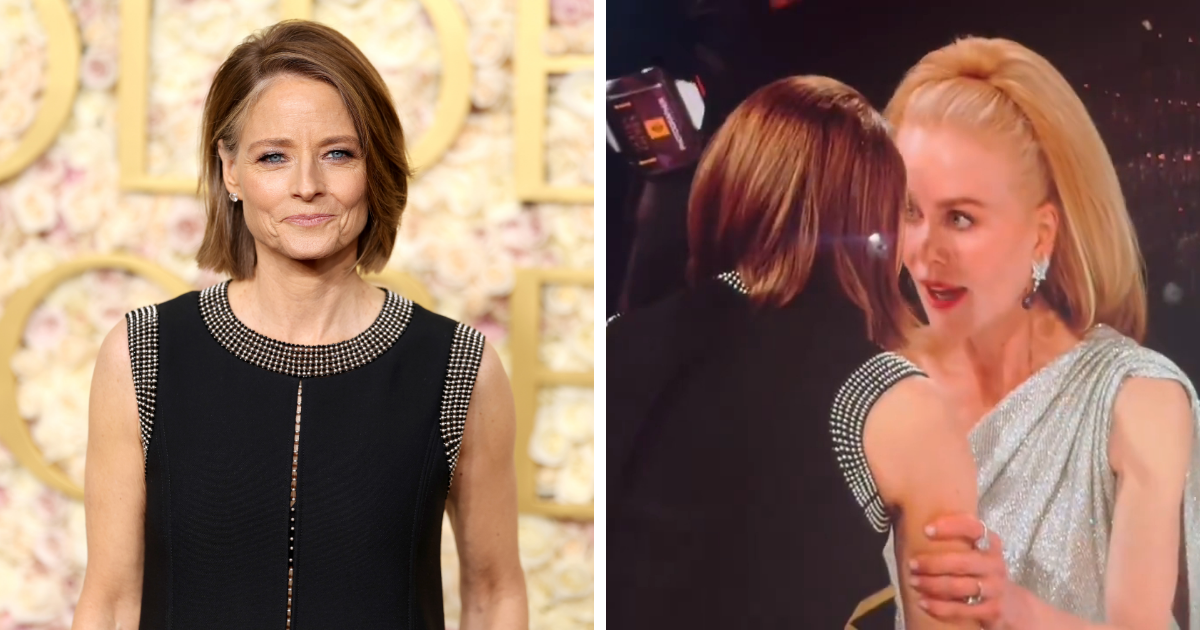

Every awards season gives us two kinds of drama: the kind in the movies… and the kind in the commercial breaks.
This year’s buzziest blink-and-you-miss-it moment wasn’t a surprise winner or a chaotic mic cut. It was a short,
silent-on-TV exchange between Nicole Kidman and Jodie Foster that looked, to the internet’s collectively caffeinated
eyeballs, like a private conversation delivered at maximum intensity.
Cue the hot takes: “They’re fighting.” “She’s consoling her.” “She’s recruiting her for Panic Room 2.”
“She’s doing the emotional equivalent of grabbing someone by the lapels and saying, ‘Listen, babe.’”
And then, inevitably, the crowd that arrives five minutes later to yell: “Stop talking about it!”
The truth (and the boring part) is that we can’t know exactly what was said from a short clip, shot in a loud room,
with no audio. The interesting part is why it looked so “insistent” on cameraand what communication science
and credible commentary suggest we can (and can’t) infer from a few seconds of body language.
What Happened: The Viral “Locked-In” Golden Globes Moment
The interaction took place during the 82nd Annual Golden Globe Awards at The Beverly Hilton in Beverly Hills,
during an off-air break when cameras sometimes catch stars mid-conversation. In the clip that spread online,
Foster leans in; Kidman appears to hold or grasp Foster’s arms while maintaining strong eye contact; both look
focused, serious, and engaged. Thenlike all great mysteriescut to commercial, and the internet does what it does.
Context matters here. That same night, Foster won a Golden Globe for True Detective: Night Country.
Kidman was nominated for Best Actress in a Motion Picture – Drama for Babygirl.
(Awards rooms are basically high-end pressure cookers with better tailoring.)
Why It Looked “Insistent” on Camera (Even If It Wasn’t)
Let’s translate the vibe without turning this into a “one weird trick to read minds” situation.
Nonverbal communication is powerful, but it’s also notoriously easy to misread when we strip it from context.
A gesture that signals warmth in one setting can look like dominance in another.
1) Proximity + Noise = The Lean-In Effect
Awards shows are loud. Like, “I’m speaking English but it’s coming out as interpretive dance” loud.
When people can’t hear, they naturally move closer, angle their bodies toward each other, and lock eyes to reduce
distraction. On a telephoto lens, that normal “I’m trying to hear you” posture can read as
“We are about to settle something from 2002.”
2) Touch Can Be Support… or a Spotlight Magnet
The arm-grasp is the moment’s headline act. In everyday life, a hand on the arm can signal reassurance, excitement,
empathy, or “I need you to stay right here because the room is chaos.” Research on touch and nonverbal behavior
suggests observers often interpret touch as communal or affiliative by defaultbut again, context is everything.
In a viral clip with no sound, touch becomes a Rorschach test.
3) Sustained Eye Contact Looks “Serious” Because It Is
Strong eye contact can mean: “I’m fully with you.” It can also mean: “I’m persuading you.” Or: “I’m apologizing.”
Or: “I’m begging you not to read my lips because Twitter is feral.” Eye contact is one of the clearest signals of
attentionand attention can look intense even when it’s friendly.
What the Commentary Actually Said (and What It Didn’t)
A few entertainment outlets noted how the exchange was framed online: “intense,” “locked in,” “deeply focused.”
Coverage also pointed out that body language can be interpreted in multiple ways.
One widely circulated expert take suggested that the close distance and strong eye contact could imply dominance or conflict
if it weren’t part of a friendly, familiar dynamicemphasizing that the same behaviors can flip meaning depending on relationship and setting.
Meanwhile, other reporting added a plausible “why now?”: Foster had just won, and earlier in the night there was a playful,
attention-grabbing moment involving Sofia Vergara reacting to Foster’s win. Some observers speculated the conversation could have been
supportivesomething like reassurance, congratulations, or a quick “You handled that with grace.” Importantly, that’s still speculation;
neither actor publicly confirmed the content of the conversation.
The Internet’s Favorite Sport: Writing Dialogue for Silent Videos
Whenever a clip goes viral, “lip-reading” claims inevitably show upusually with the confidence of someone who just discovered
punctuation and is ready to teach a masterclass. But even trained professionals can struggle with short, low-resolution, angled footage.
And beyond that, communication researchers and psychologists repeatedly warn against overconfident “decoding” of isolated nonverbal cues.
In other words: a single gesture rarely has one fixed meaning. And when we treat body language like a secret subtitle track,
we’re not analyzingwe’re fan-fictioning.
A More Grounded Interpretation: “Insistent” Can Mean “Invested”
If we strip away the clickbait and keep the useful parts, here’s the most defensible reading:
the conversation looked intense because both people were fully engaged.
In a room full of distractionscameras, applause, chatter, adrenaline“fully engaged” stands out.
Especially when it’s two famous actors who know how to use focus like a spotlight.
Also, consider the setting. Award shows create quick emotional pivots: disappointment, pride, relief, joy, and awkward comedy all
happen within minutes. People don’t always have time to process privately. So they process in micro-conversations:
a squeeze of the arm, a tight hug, a serious look, a few concentrated sentences. It can be mundane and meaningful at the same time.
What This Moment Teaches Us About Real-Life Communication
Okay, now for the part where we use celebrity chaos to improve our own livesbecause if a Golden Globes commercial break can’t teach
us something, what are we even doing here?
Active listening looks intense when it’s done right
Many people think listening is passivelike waiting politely for your turn to talk.
But active listening is an action: attention, curiosity, reflection, and asking clarifying questions.
It often includes nonverbal signals like nodding, mirroring, and focused eye contact.
When someone is truly listening, they can look “insistent” simply because they’re not mentally drafting their reply.
Use “permission-based” touch
Touch can communicate support fast, but it can also be misreador unwelcome. If you’re not sure about someone’s comfort level,
keep it optional: a brief shoulder touch paired with a verbal check-in (“Is it okay if I…?”) or skip it and rely on words.
The goal is connection, not confusion.
Try the “quiet corner” move
If your conversation needs depth, move your bodiesnot just your feelings. Step aside, face each other, lower the sensory noise.
Half of “intense” is just “this room is too loud for normal human interaction.”
Replace mind-reading with a simple check
If you think someone is upset, ask. If you think you upset someone, ask. If you’re about to build a theory based on a facial twitch,
pause and consider: “What else could explain this?” Context beats detective cosplay.
5 Practical Ways to Have a Big Conversation Without Looking Like You’re Starting a Feud
- Open with intent: “I want to check in about somethingdo you have a minute?”
- Lower the intensity with posture: soften shoulders, keep hands visible, unclench jaw (yes, really).
- Use short summaries: “So you’re saying…” and “What I’m hearing is…”
- Ask one good question: “What do you need right now?” beats 10 guesses.
- Close with clarity: “I’m with you,” “Congrats,” “I’m sorry,” or “Let’s talk later”pick one and land it.
Real-World Experiences: When a Conversation Looks “Intense” (and It’s Totally Fine)
Most of us have lived our own version of the “Kidman–Foster moment,” minus the couture and the camera zoom.
You’re at a loud eventmaybe a work mixer, a wedding, or the kind of birthday party where the playlist is basically a hostage situation.
Someone you care about is having a big moment: they got promoted, they got dumped, they got a diagnosis, they got a surprise compliment
that hit a little too deep. You lean in because the room is loud, but also because the moment is loud in a different way.
Suddenly you’re close, your face is serious, your hands are doing that “please stay with me” thing, and from across the room you probably look
like you’re negotiating a peace treaty.
I’ve watched this happen at networking events: one person is trying to be upbeat, but their eyes say, “I’m not okay.”
The friend who notices doesn’t say, “Let’s schedule a calendar invite to process your emotions.” They move closer, lower their voice,
and create a pocket of privacy in public. Sometimes that includes a hand on the forearmless “I’m controlling you” and more
“I’m anchoring you so the rest of the room can’t steal your attention.” If a stranger filmed it without audio, it could look dramatic.
But inside the moment, it’s just care moving quickly.
Or take the classic family gathering: your cousin says something that lands wrong, someone else reacts, and suddenly there’s a tiny storm cloud
hovering over the potato salad. You pull them aside. You lock eyes. You say the thing that matters, fast: “Are you okay?” “Do you want to leave?”
“I’m sorrylet me fix it.” The conversation is intense because it’s efficient. People confuse intensity with hostility, but sometimes intensity is
just urgency plus affection.
Even on Zoom, you can recreate the vibe. Ever been on a video call where someone’s face freezes in a way that screams,
“This meeting just became my villain origin story”? You can’t lean in physically, so you do it verbally: you slow down,
you ask one direct question, you reflect what you’re seeing. That kind of attention can feel “insistent” to someone who’s used to polite,
surface-level talk. But it’s often the difference between a misunderstanding and a real connection.
The big lesson: we should stop treating “serious” as suspicious. Sometimes a focused conversation is exactly what healthy relationships look like,
especially in chaotic environments. If anything, the most relatable part of the viral moment isn’t the mystery of what was saidit’s the reminder
that showing up for someone can look dramatic from the outside and feel simple on the inside. And if the internet insists on adding subtitles?
Fine. Just make them kinder, shorter, and less certain.
Conclusion
The “Stop Talking” discourse will fade, as it always does, when the next viral clip arrives. But the communication lesson sticks:
nonverbal cues are real, powerful, and easy to misinterpret when we remove context. The Kidman–Foster moment reads as “insistent” largely because it
shows what attention actually looks likeclose, focused, and human. If you want to take anything from it, take this:
listen better than you guess, ask more than you assume, and remember that sometimes intensity is just care in a loud room.