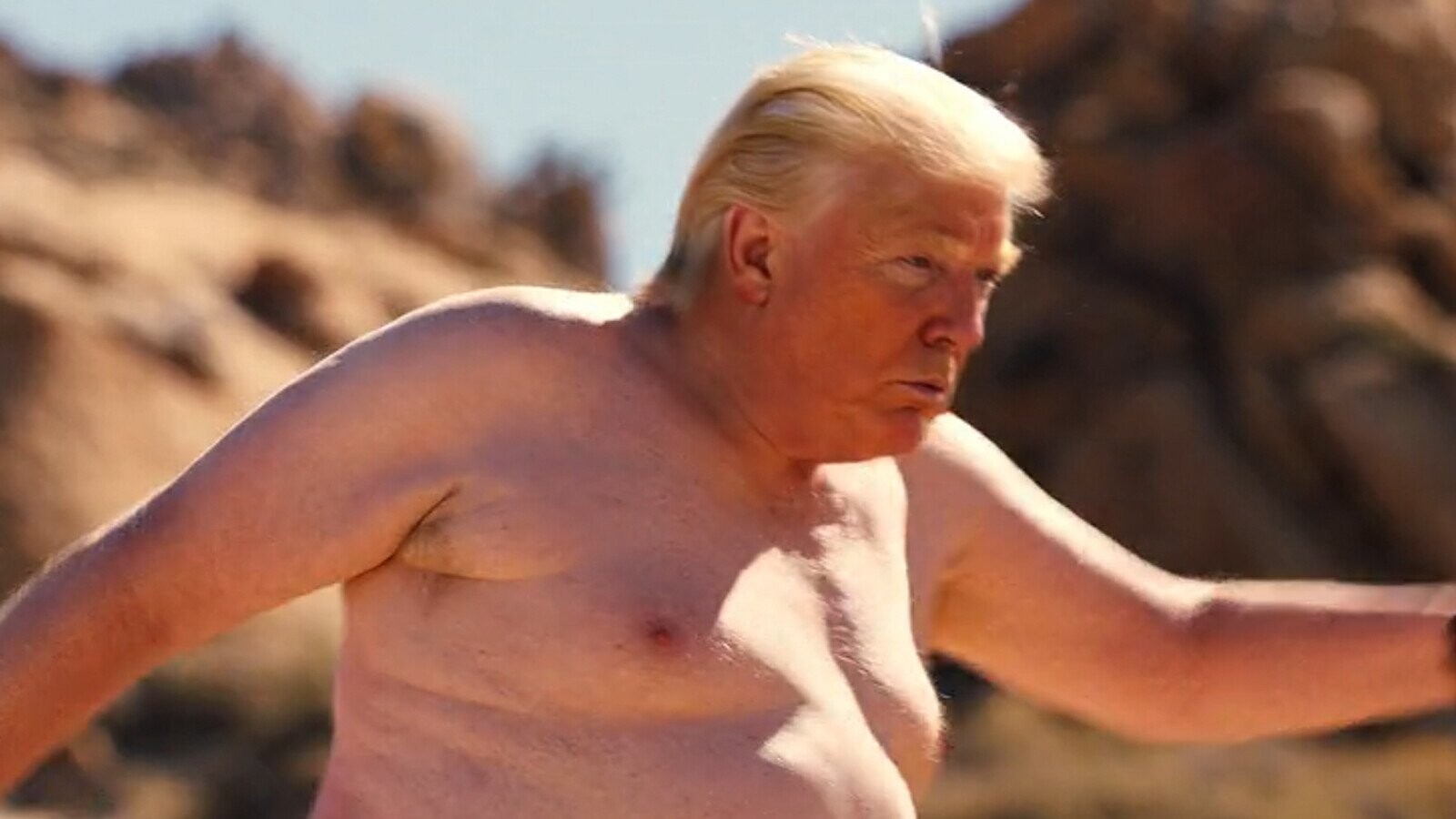

When the Season 27 premiere of South Park ended with a hyper-realistic,
deepfake Donald Trump stumbling naked through the desert, a lot of viewers had the same
question: “Wait… how did they even make this?” The scene looked too slick to be a
last-minute gag, too weird to be a traditional VFX shot, and way too specific to be
something they tossed together on a random Tuesday in the writers’ room.
As it turns out, the answer is extremely on-brand for Trey Parker and Matt Stone:
they recycled it from a different, much bigger, and completely unproduced movie idea.
According to reporting highlighted by Cracked.com, that desert-stranded Trump was born
out of a shelved deepfake feature called Deep Fake: The Movie,
developed by the duo with actor Peter Serafinowicz and their AI/VFX studio,
Deep Voodoo. The film never happened, but the footage and the
concept eventually mutated into one of the wildest moments in the show’s history.
From Deepfake Side Project to Full-Blown Trump Movie
To understand how a lost movie wound up inside a half-hour cartoon, you have to rewind
to the early pandemic era. While most of us were learning to bake sourdough,
Parker and Stone were experimenting with deepfakes. Working with Peter Serafinowicz,
they created a web project called Sassy Justice, starring a local Wyoming TV
reporter named Fred Sassy who just happened to have Donald Trump’s face.
Sassy Justice wasn’t just a goofy one-off. It was the proof-of-concept for a
much larger idea. The team had gathered a small army of digital artists under the
Deep Voodoo banner, trained models on hours of Trump footage, and started building
a feature-length story built almost entirely around deepfake performance. The planned
movie, bluntly titled Deep Fake: The Movie, would have used
Serafinowicz’s physical acting and voice combined with AI-generated Trump visuals to
tell a full narrative about a guy who looks exactly like the former president because
his face is literally deepfaked onto him.
Then reality happened. COVID-19 shut down productions, schedules detonated, and a weird,
experimental deepfake movie slid way down the priority list. The project went “on hold”
and quietly drifted into the pile labeled
stuff we’ll maybe get back to someday. What remained was a collection of ideas,
test scenes, and partially built sequences including the image of a Trump figure
being stripped of his power and dignity in a barren landscape.
How the Lost Movie Became South Park’s Deepfake Trump
Fast-forward a few years and South Park finds itself in a perfectly
South Park situation: they’ve just navigated a messy real-world legal dispute
involving Donald Trump and Paramount, and they’re clearly itching to respond in the
pettiest, most elaborate way possible. Deepfake technology has only gotten better.
Their own studio, Deep Voodoo, is now a full-fledged operation. And somewhere on a hard
drive is the DNA of a Trump deepfake movie just begging to be used.
The Season 27 premiere, “Sermon on the ’Mount,” sets the table with a classic
small-town panic. The residents of South Park, terrified of power and punishment,
become obsessed with pumping out pro-Trump propaganda to save themselves. The joke
escalates until the ending, which drops the animated style entirely and cuts to what
looks like a prestige short film: a hyper-real Trump, wandering the desert, slowly
stripping off his clothes as reverent voice-over praises his sacrifice for the
American people.
That closing sequence feels too specific and too polished to be a one-off sketch,
and for good reason. It draws from the unproduced Deep Fake: The Movie concept:
Trump laid bare, literally and metaphorically, trudging through a wasteland of his
own making. The structure is pure satire a fake inspirational PSA turned up to 11
but the look and tone come straight from a more cinematic, long-form project.
Deep Voodoo’s Fingerprints All Over the Scene
Viewers initially assumed that the entire sequence was generated by AI a fully
artificial Trump conjured out of a neural net fever dream. But behind-the-scenes
images later showed that Parker and Stone did things the old-fashioned way first:
they went to the desert with a stand-in, shot the scene practically, and then used
Deep Voodoo’s tech to map Trump’s face onto the actor’s body.
The result is that unnervingly in-between feeling: it looks like Trump, moves like a
human, but doesn’t quite behave like any footage you’ve ever seen of him. That’s
deepfake satire as a filmmaking choice, not a lazy prompt. The creators didn’t hand
everything over to AI and hope for the best; they choreographed, staged, and then
weaponized the technology to land a joke that’s both visual and political, while still
grounded in live-action craft.
Why Deepfake Trump Works So Well as Satire
South Park has mocked politicians for decades, but deepfake Trump hits differently.
Instead of a flat caricature or a simple animated stand-in, we get a version of Trump
that lives in the uncanny valley close enough to reality to unsettle you, but
stylized enough to be clearly comedic.
That tension does a few things at once:
-
It reminds viewers how easily modern tools can fabricate “real” footage of public
figures doing anything, from the absurd to the dangerous. -
It lets the show go further visually than it ever could with stock news clips or
traditional animation, because this Trump isn’t archival footage he’s a character. -
It pushes the satire into the realm of parody performance art: part sketch, part
tech demo, part political cartoon.
The desert PSA also functions as a commentary on hero worship, propaganda, and
media spin. On the surface, the narration treats Trump as a martyr, someone whose
suffering proves his greatness. Visually, though, he’s stumbling, exposed, and
weirdly small literally at the mercy of the filmmakers. The joke lands not because
the show takes a policy stance, but because it shows how malleable an image can
become once you’ve separated “what happened” from “what we can make it look like.”
From Sassy Justice to Sermon on the ’Mount: The Deep Voodoo Pipeline
That final montage doesn’t exist in a vacuum. It’s the latest stop on a longer road
that started with Peter Serafinowicz’s “Sassy Trump” impressions, evolved into
Sassy Justice, and then expanded into the abandoned feature film. All of
that experimentation gave Parker, Stone, and their Deep Voodoo team something most
comedy creators don’t have: a fully stocked deepfake toolbox.
By the time they got to the Season 27 premiere, they already knew:
- How to map Trump’s face convincingly onto a performer with different features.
- Which angles and lighting made the deepfake look most realistic.
- How far they could push expressions before the face started to “break.”
-
How to use editing and sound design to sell the bit even if viewers only half
consciously registered the fakery.
In other words, the South Park episode got to stand on the shoulders of an entire
scrapped movie and a viral web series. What could have been a forgotten pandemic
side project instead became fodder for one of the show’s most talked-about scenes
in years.
The Ethics Question: When Deepfakes Are the Joke
Of course, anytime you talk about deepfake Trump, alarms go off. We live in a world
where manipulated videos can spread misinformation, smear real people, and muddy the
difference between truth and fiction. That’s scary, and comedy doesn’t erase those
risks.
But South Park is unusually transparent about what it’s doing. The sequence
is so heightened and so obviously stylized that it couldn’t pass for genuine news
footage. The show telegraphs that this is parody, not a “leaked” video. And by
exaggerating the scenario the desert, the grandiose narration, the over-the-top
nudity it encourages viewers to think critically about what they’re seeing instead
of passively absorbing it.
That doesn’t magically solve the deepfake problem, but it does flip the script:
instead of deepfakes being the invisible enemy lurking in your social media feed,
they become the subject of the joke. The technology is on display and part of the
conversation, not quietly hiding behind a shaky caption and a repost button.
How Audiences and Critics Responded
Reactions to the deepfake Trump sequence have landed in a predictable spread:
some called it brilliant, some called it gross, and some thought it was both at
the same time which, to be fair, is basically the show’s brand.
Critics pointed out that the desert PSA brought together a bunch of threads:
long-running jokes about political power, the show’s ongoing war with corporate
overlords, and an increasingly anxious debate over AI and artistic control.
Late-night commentary framed the scene as a pointed reminder that creative
freedom still exists, even when technology makes everything feel manipulated.
Viewers, meanwhile, did what viewers do: paused, screenshotted, and argued online
about whether the scene went too far or not far enough. But underneath the memes
was something more interesting a recognition that this wasn’t just a tech demo.
It was the ghost of an unmade movie haunting an animated series, smuggled back
into the culture under the cover of a cartoon.
Lessons from an Unproduced Deepfake Movie
The strangest, and maybe most inspiring, part of this story is that
Deep Fake: The Movie never had to exist for its DNA to make an impact.
The hours of R&D, testing, and performance work that went into it didn’t just
disappear. They migrated. They resurfaced in Sassy Justice, in Deep
Voodoo’s subsequent projects, and finally, in a single jaw-dropping scene on basic
cable and streaming.
For creators, that’s a reminder that “unproduced” doesn’t always mean “wasted.”
Sometimes the work you shelve becomes raw material for something weirder, shorter,
and ultimately more widely seen than the original dream. In this case, a never-made
deepfake feature ended up helping power a 90-second sequence that people will be
dissecting for years.
of Deepfake Trump Experience: What It Feels Like to Watch It
If you’ve ever watched the South Park deepfake Trump sequence with a crowd, you
know there’s a very specific emotional arc in the room. It usually starts with
confusion. The picture cuts from animation to live-action desert, and there’s a
half-second of “Did I sit on the remote?” Everyone leans forward a little, trying
to figure out whether they’re seeing a real news clip or some long-lost art film
from the bargain bin.
Then the face registers. People recognize Trump almost instantly that’s how our
brains work with famous politicians but something feels off. The features are
a little too smooth, the expression a bit too locked in, the movement just
slightly mismatched. You can almost hear the mental gears turning:
“Oh. Oh. This is a deepfake. They’re actually doing this.”
Once the realization hits, the laughter usually follows, but it’s not the usual
quick sitcom chuckle. It’s closer to nervous laughter, the kind you hear when a
magician cuts someone “in half,” or when a movie jumps from a joke to a jump scare.
People are reacting to the audacity as much as the punchline. There’s a weird thrill
in seeing a comedy show use the same tools we’re all supposed to be terrified of
but instead of breaking democracy, they’re breaking the fourth wall.
The scene also has a way of making you hyper-aware of how much you trust your own
eyes. Even though you know, logically, that this is a constructed moment, your brain
keeps whispering, “But what if it were real? What if this exact clip, with a different
voice-over and a scary caption, showed up in your feed with no context?” The joke
lands in that gap between what you know and what you feel. Technically, it’s a gag
about a naked guy in the desert. Emotionally, it’s a tutorial in how easy it would
be to distort reality if someone wanted to.
That uneasiness is part of the experience. In conversations afterward, fans often
describe a mix of admiration and discomfort. On one hand, the craftsmanship is
impressive. The desert cinematography, the deepfake quality, the deadpan narration
it all feels like it could live in a film festival shorts block. On the other hand,
there’s a lingering chill: if this is what a small comedy team can do as a joke,
what could a well-funded bad actor do on purpose?
Still, there’s something oddly hopeful about watching the scene with that awareness
dialed up. Comedy has always borrowed the tools of power and flipped them around.
Cartoons once mocked kings; late-night monologues chopped presidents down to size.
Deepfake satire sits in that same tradition, just with newer software. The South Park
deepfake doesn’t pretend to solve the problems of AI-generated media. But it does
invite you to look directly at the technology, laugh at its possibilities, and
remember that critical thinking is still part of the deal.
Maybe that’s why the deepfake Trump sequence tends to stick with people after the
credits roll. It’s more than an outrageous image or a spicy headline. It’s a little
crash course in living with synthetic media: how it can shock, how it can entertain,
and how easily it can cross the line from satire to manipulation. You don’t walk
away with a moral of the story neatly underlined. You walk away with a question:
“If this is what comedians are doing with deepfakes, what do I need to watch out
for when it’s not a joke?”
Conclusion
The wild thing about South Park’s deepfake Trump is that it’s both the punchline to
a long production saga and a preview of the media landscape we’re all heading into.
A scrapped movie, a viral web series, and a cutting-edge VFX studio all eventually
converged on a single, unforgettable montage in the desert. The result is a piece of
satire that feels like it escaped from a different format entirely because, in a
way, it did.
Whether you find the scene hilarious, disturbing, or both, it does exactly what good
satire is supposed to do: it takes something powerful and untouchable in this case,
both a former president and an intimidating technology and turns it into a thing
you can examine, question, and laugh at. The unproduced deepfake movie may never hit
theaters, but its spirit lives on in a few minutes of TV that remind us how strange,
flexible, and deeply weird our visual reality has become.