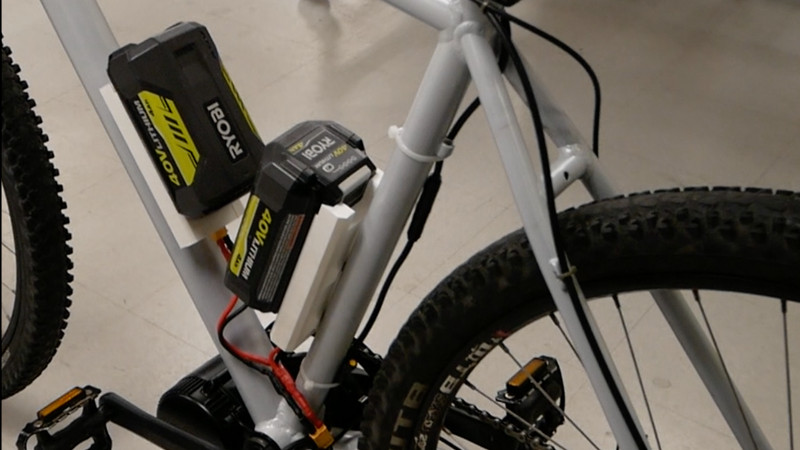

At some point, every DIY-minded rider has the same thought: “I already own a pile of Ryobi batteries. My ebike needs a battery. My wallet needs a break. What could possibly go wrong?” The idea is wonderfully logical right up until physics, chargers, vibration, weather, and fire safety walk into the garage like uninvited party guests.
Still, the idea is not nonsense. Ryobi power packs are removable, easy to swap, common in American garages, and built around lithium-ion cells. On paper, they even offer enough energy to make the thought feel less like a caffeine hallucination and more like a spreadsheet with ambition. A Ryobi 18V 8Ah pack works out to about 144 watt-hours. A Ryobi 40V 6Ah pack lands around 240 watt-hours. A Ryobi 40V 8Ah pack comes in around 320 watt-hours. Those are real numbers, not backyard magic.
But an ebike battery is not just a box full of cells with a handle. A proper ebike battery is part of an electrical system: battery, battery management electronics, charger, wiring, mount, and controller all designed to behave like civilized adults together. That is where the dream of using Ryobi power packs as ebike batteries gets interesting, complicated, and occasionally spicy in the bad way.
Why This Idea Is So Tempting
Ryobi has built its battery ecosystems around convenience. The 18V ONE+ lineup spans hundreds of products, and the 40V system covers a huge outdoor-power lineup. If you already use Ryobi tools, you may own several packs, a charger or two, and a deep belief that one battery should rule them all. It is the cordless version of meal prep: one platform, many uses, fewer headaches.
That convenience maps neatly onto what ebike riders want. Ebike owners love removable batteries because they are easy to charge indoors, easy to swap, and easier to live with than a permanently attached power brick. The bicycle industry has leaned hard into that idea. Brands like Aventon, Trek, Lectric, and Specialized all frame battery capacity in watt-hours and treat removable packs or range extenders as practical tools for longer rides, easier charging, and better daily usability.
So the attraction is obvious. Ryobi packs are portable. They have recognizable form factors. Some have onboard fuel gauges. They are easy to buy. They feel robust. In a world where replacement ebike batteries can be painfully expensive, a shelf full of tool batteries can look like a loophole with green plastic.
The Good News: The Energy Math Is Not Crazy
Watt-hours are the number that matters
When people compare batteries, they often obsess over volts or amp-hours alone. That is like comparing pickup trucks by cupholder count. Useful? Maybe. The whole picture? Not even close.
For ebikes, watt-hours are the cleaner comparison. Watt-hours tell you how much energy a battery actually stores. The basic math is simple:
Watt-hours = volts × amp-hours
That makes a Ryobi 18V 4Ah pack roughly 72Wh. A Ryobi 18V 8Ah pack is roughly 144Wh. A Ryobi 40V 6Ah pack is about 240Wh. A Ryobi 40V 8Ah pack is about 320Wh.
Those numbers explain why the idea refuses to die. A 144Wh tool battery is not toy-sized. In fact, it is in the same neighborhood as Specialized’s 160Wh SL range extender, which adds meaningful extra ride time to certain lightweight e-bikes. Meanwhile, 320Wh from a Ryobi 40V 8Ah pack starts to look like enough energy for a modest short-range build.
But before anyone zip-ties an adapter to a downtube and calls it innovation, context matters. Many removable batteries on full-size commuter and cargo ebikes are much larger. Aventon, for example, highlights removable battery setups around 614Wh, 672Wh, 708Wh, and 720Wh on several models. That means even a large Ryobi 40V pack may still be well below the capacity many riders expect from a modern commuter ebike.
Ryobi 40V makes more sense than Ryobi 18V
If the goal is propulsion, the 40V platform is the more realistic starting point. Not because it is perfect, but because it is closer to the voltage class used by many lower-voltage ebike systems. By contrast, 18V is simply too low for most mainstream ebike controllers unless you begin stacking batteries in series or adding voltage-boost electronics. The moment you start doing that, the project moves from “clever hack” to “electrical engineering final exam.”
Two 18V packs in series may seem like a clever shortcut, and electrically it can be. But now you have doubled the opportunities for imbalance, connection problems, charging mistakes, and unhappy surprises. A single 40V Ryobi pack is at least conceptually cleaner.
The Big Problem: An Ebike Battery Is a System, Not a Brick
This is the point most DIY fantasies hit a pothole the size of common sense.
UL 2849, the safety standard widely cited for e-bikes, evaluates the electrical system of the bike: drivetrain, battery, and charger working together. In plain English, the safety question is not just “Is this battery decent?” It is “Does this battery behave safely with this charger, this mount, this wiring, this controller, this bike, over time, under real use?”
That is a very different standard from “It powered the wheel in my driveway for ten minutes and only smelled a little weird.”
Bosch makes this system-level mindset crystal clear in its U.S. battery guidance. It treats battery safety, charger compatibility, storage, transport, and battery management as part of one integrated package. That same guide even warns that the company’s batteries are designed and certified for use with e-bikes specifically, and it does not guarantee reliable operation in other applications. Flip that logic around and the message is hard to miss: a tool battery is designed for tools, not for potholes, curb drops, rain spray, controller spikes, and forty-minute hill slogs.
Voltage mismatch is the first reality check
Modern consumer ebikes commonly live in the 36V and 48V world. Aventon’s own comparisons between models show how a 36V setup and a 48V setup behave differently. Lectric says all of its e-bikes use 48V batteries. That means a Ryobi 18V pack is not even in the right neighborhood for most mainstream bikes unless you combine packs or redesign the whole power path.
A Ryobi 40V pack is closer to the 36V class, which is why it gets so much DIY attention. But “closer” is not the same as “plug and play.” Controllers, chargers, low-voltage cutoffs, connector shapes, and pack communication expectations all matter. Matching one spec on paper does not magically align the rest of the system.
Current draw is the second reality check
An ebike motor does not care that your battery came from a lawn tool aisle. It wants current, and it wants it now. A 500W motor cruising gently is one thing. The same motor starting from a stop, climbing a hill, or hauling a heavier rider is another. Peak demand can jump well beyond the number printed on the motor sticker.
Ryobi batteries are designed for demanding applications, and the company advertises features like better cooling, anti-vibration design, premium cells, and electronic battery management. Those are real advantages. But they do not automatically make a tool battery a perfect substitute for a propulsion battery that is expected to deliver sustained current in a different enclosure, with different airflow, on a vibrating frame, in changing weather, while connected to a controller that was not designed around it.
That difference matters. A battery that works beautifully on a blower or saw may behave very differently when asked to push a bike uphill for long stretches. Heat, voltage sag, connector stress, and unexpected cutoffs can all show up faster than your optimism.
Safety Is the Part You Should Not “Wing”
There is a reason U.S. regulators and testing organizations keep returning to lithium-ion micromobility safety. The Consumer Product Safety Commission has repeatedly warned that noncompliant micromobility products can pose serious fire risks. UL’s e-bike certification language focuses on the entire electrical system because charger compatibility, battery protection, enclosure design, and fault handling all matter when a lithium pack lives in the real world instead of a tidy spec sheet.
CPSC’s recent draft regulatory work also highlights the hazards around aftermarket batteries and chargers, including reverse-polarity concerns, matching chargers to intended battery packs, and clear marking of which products a user-replaceable battery is meant to power. Translation: the government has noticed that “random battery plus random charger plus random adapter” is not a recipe for national tranquility.
That does not mean every DIY project bursts into flames. It does mean the risk profile changes the moment you step outside a designed, tested, and compatible battery ecosystem.
Charging is where many bad ideas become expensive
One of the worst mistakes in this space is assuming that if a battery can power the bike, any charger can top it up. Absolutely not. Ryobi chargers are built for Ryobi packs. Ebike chargers are built for the battery systems they are meant to charge. Once you start stacking packs, hacking adapters, or bypassing intended use, charging becomes the place where small misunderstandings become very large regrets.
Even legitimate ebike makers are conservative here. Bosch recommends compatible chargers and original spare parts for a reason. A battery system is only as smart as the dumbest thing connected to it.
Storage and handling still count
Good lithium-ion etiquette does not stop mattering just because a build is homemade. Bosch recommends storing ebike batteries in a dry, well-ventilated place, ideally away from heat sources and flammable materials, and suggests that 30% to 60% charge is ideal for storage. Rad Power Bikes also emphasizes moderate temperatures and keeping batteries away from heat and direct sun. Those are not fussy little suggestions. They are the habits that keep a battery healthier and less dramatic over time.
If a Ryobi-powered ebike project lives in a hot shed, gets charged immediately after a hard ride, or bounces around loose in the frame bag like a caffeinated brick, the project is not just rough around the edges. It is asking for trouble.
Can Ryobi Power Packs Work on an Ebike?
Technically, yes. With enough design work, the right controller, proper fusing, appropriate connectors, weather protection, strain relief, and careful charging discipline, a Ryobi-based build can move a bike. Hobbyists do stranger things before breakfast.
Practically, usually no for daily transportation. That is the distinction that matters.
If the project is a low-power experiment, a garage-built pit bike, a compact off-road cruiser on private land, or a short-range tinkering platform, Ryobi batteries can make sense as a proof of concept. In that role, a 40V pack is the more sensible starting point. It offers a cleaner path than trying to build a propulsion system around 18V packs that were never meant to be paired and balanced as a main traction battery.
But if the goal is a dependable commuter, an apartment-friendly daily ride, or something that needs to survive rain, potholes, curb hits, temperature swings, and hundreds of charge cycles without turning you into the neighborhood’s unofficial fire marshal, a purpose-built ebike battery is still the smarter move.
What Riders Usually Underestimate
Range disappears faster than expected
Tool battery projects often look great when the math is done on flat ground, in a good mood, with a light rider, tailwind, and the sort of optimism usually associated with lottery tickets. Real riding is less polite. Hills, stop-and-go traffic, throttle-heavy riding, cold weather, cargo, and underinflated tires all chew through energy faster than expected.
Trek’s guidance on range extenders makes the core point beautifully: watt-hours are what matter for distance. Double the watt-hours, and under similar conditions you can roughly double the distance. The flip side is equally true. Start with a small battery, and your range ceiling arrives fast.
Battery swapping sounds cooler than it feels
In theory, carrying several Ryobi packs sounds wonderfully modular. In practice, frequent swapping can become annoying in a hurry. It is one thing to swap a drill battery. It is another to stop mid-ride, unmount a pack, reconnect an adapter, secure the wiring, and hope nothing jiggles loose on the next bump.
What looks “modular” on a workbench can feel “fiddly” on the side of the road.
The accessory role may be the smarter role
Here is the underrated compromise: Ryobi power packs may make more sense around an ebike than as the main ebike battery. If you love the convenience of Ryobi batteries, use them to power lights, camp gear, USB charging, or worksite accessories through official power-source attachments. Let a proper ebike battery handle propulsion. That setup scratches the cordless itch without asking a tool pack to pretend it is something it is not.
Final Verdict
Ryobi power packs as ebike batteries are one of those ideas that are smarter than they sound and riskier than they look. The energy math is real. The convenience is real. The temptation is very real. But so are the mismatches in voltage class, current demand, charger compatibility, mounting requirements, vibration exposure, and system-level safety expectations.
If the goal is experimentation, learning, and a controlled DIY build, Ryobi batteries can play a role. If the goal is reliable transportation, long-term safety, and fewer opportunities for your bike to audition for a cautionary YouTube video, a purpose-built ebike battery system is the better answer.
In other words: can Ryobi batteries run an ebike? Sometimes. Should they be your default ebike battery solution? Only if your risk tolerance is higher than your tire pressure.
Real-World Experience: What This Setup Tends to Feel Like Over Time
The first experience with a Ryobi-powered ebike build is usually delight. The bike moves. The battery clicks in with that familiar, satisfying tool-battery confidence. There is a moment where the whole thing feels brilliant, like you outsmarted both the ebike industry and your bank account before lunch. The garage suddenly feels like a startup incubator with better snacks.
Then the second experience arrives, and it is called the hill. On flat pavement, the setup may feel surprisingly normal, especially if the controller is conservative and the rider is helping with the pedals. But the moment the route gets steeper, stop signs get more frequent, or the bike carries more weight, the system begins to reveal its personality. Voltage sag becomes less of an abstract engineering term and more of an emotional event. Acceleration softens. Cutoff behavior becomes memorable. The battery that felt heroic in the driveway starts acting like it has somewhere else to be.
That is when people begin to notice how different “works” and “works well” really are. A Ryobi pack can absolutely make a bike move. The question is whether it does so smoothly, repeatedly, safely, and without demanding constant babysitting. Many DIY users discover that they spend more time watching battery indicators, checking connector warmth, and thinking about the next swap than actually enjoying the ride.
The third phase is usually logistical comedy. Spare batteries seem like freedom until they are rattling in a backpack, living in a frame bag, or being rotated like bullpen pitchers. One pack for the ride. One pack for the return. One extra just in case. Suddenly the “cheap battery solution” involves adapters, mounts, fuses, protective cases, and the kind of cable management that makes the bike look like it moonlights as a science fair project.
Weather also changes the mood. A proper removable ebike battery is usually integrated into the bike with weather resistance and secure mounting in mind. A DIY Ryobi arrangement often feels less confident when the forecast turns wet or the road gets ugly. Riders begin to baby the system. Puddles look deeper. Rain looks meaner. Every pothole feels like a trust exercise between the pack, the adapter, and gravity.
Over time, the biggest real-world lesson is not usually “It never worked.” It is more often, “It worked, but it asked a lot from me.” It asked for more monitoring, more charging discipline, more careful route planning, more compromises on speed and range, and more tolerance for the occasional weird moment. For tinkerers, that can still be fun. For commuters, it gets old fast.
That is why many people who start excited about Ryobi power packs as ebike batteries end up with a more nuanced opinion. They do not always regret the experiment. In fact, they often learn a ton from it. But they also come away with a deeper respect for what a real ebike battery system is doing behind the scenes. Reliability is not just cells in a plastic shell. It is the quiet magic of a battery, charger, mount, controller, and safety system that all agree to behave themselves every single day.
And honestly, that kind of boring reliability is underrated. Especially when the alternative is explaining to your friends why your bicycle has the electrical temperament of a garage band.