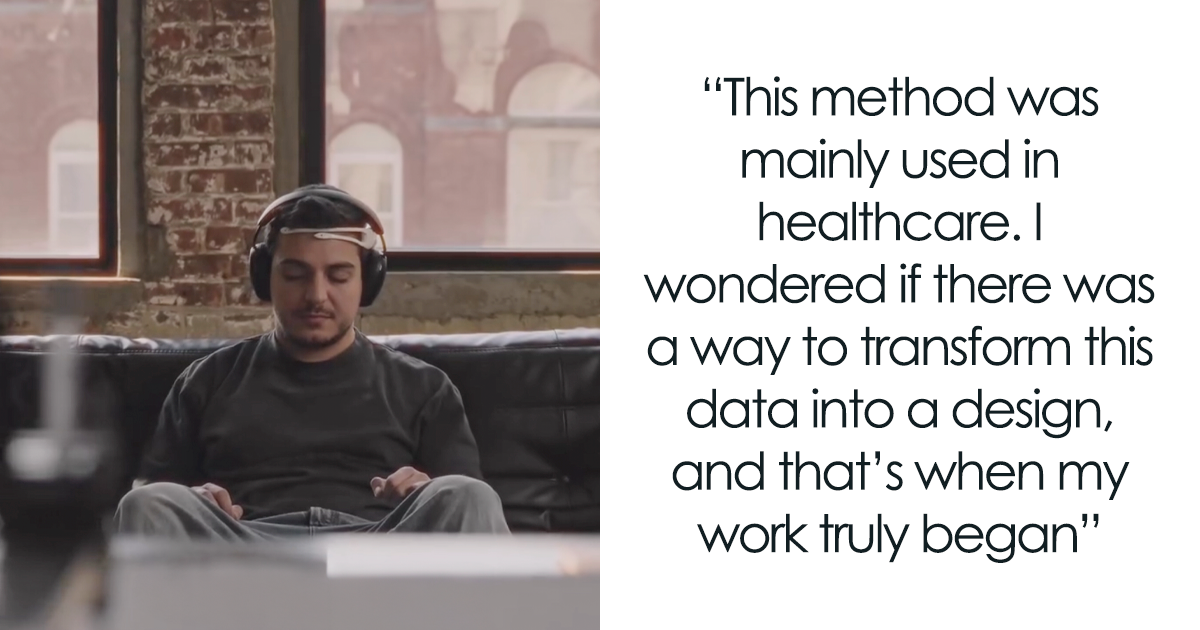

Some tattoo artists ask what you want. Okan Uckun, the NYC-based artist known for razor-clean minimalist and geometric work, asks a weirder question: what is happening inside your mind right now? Not in a spooky crystal-ball way. Not in a “please place your thoughts in the tray next to your keys” way. He means it literally. Through a process involving EEG readings, custom software, and his own design language, Uckun turns brain activity into a tattoo concept that can be refined, selected, and permanently inked onto skin.
That alone would make for a killer dinner-party sentence. But the real story is more interesting than the headline. Uckun’s work sits at the intersection of tattoo culture, architecture, data visualization, neuroscience-inspired tech, and deeply personal storytelling. In a moment when people want tattoos to mean more than “I was 22 and felt invincible,” his brain-wave project feels less like a gimmick and more like a new chapter in how body art can hold memory, emotion, and identity.
Who Is Okan Uckun?
Okan Uckun is not a random guy who bought a headset and decided to cosplay as a cyberpunk neurologist. He has a long creative track record. Uckun trained in architecture and modern art, later dedicating himself fully to tattooing. That background matters because his work has long been defined by balance, structure, negative space, and clean line precision. In plain English: his tattoos look like someone taught geometry how to whisper.
After moving to New York in 2017, Uckun continued building a reputation for fine-line, minimalist, and geometric tattooing. He later co-founded Monolith Studio in Brooklyn, a contemporary studio built around high-level craft and a forward-looking design sensibility. His broader body of work already showed an interest in turning systems, patterns, and visual discipline into wearable art. The brain-wave project did not come out of nowhere. It looks more like the logical next move of an artist who was always headed toward data-driven expression.
What Makes These Brain-Wave Tattoos Different?
The big idea is simple, even if the execution is not. Uckun uses EEG technology to capture electrical activity from the brain. That data is then fed into custom generative software, which transforms the readings into visual outputs. The final tattoo is not a stock design. It is shaped by the client’s own recorded signals, filtered through Uckun’s aesthetic system, and developed into something wearable.
That last part is important. A raw EEG graph is not automatically good art. It is data. And data, left alone, often looks like your laptop had a nervous breakdown. Uckun’s real innovation is not merely collecting brain-wave information. It is designing a process that translates invisible activity into a coherent visual language without losing artistic integrity.
According to interviews about the project, sessions may involve multiple rounds of readings. Clients can move through emotionally charged experiences, music, or other prompts while the system saves outputs during moments of high intensity. The client then reviews multiple generated designs and chooses the one that resonates most. In other words, the tattoo is not simply “what the machine spit out.” It is a collaboration among brain activity, algorithmic interpretation, emotional context, and artistic judgment.
Why This Concept Hits So Hard Right Now
There is a reason this idea lands in 2026 with such force. People are tired of flat personalization. We have had enough products that claim to be “custom” because they let you pick beige or slightly different beige. A brain-wave tattoo offers something far more compelling: a permanent artwork shaped by a specific moment in your own internal life.
That matters because tattoo culture has shifted. For years, tattoos were often framed as rebellion, decoration, or symbolism. Those things still matter, of course. But more people now see tattoos as archives. They mark grief, recovery, transition, family, identity, and the moments that divide one life chapter from another. Uckun’s project speaks directly to that hunger for meaning. It makes the body a record not just of a picture or phrase, but of an experience.
And let’s be honest, it also taps into our era’s obsession with measurable selves. We track sleep, heart rate, steps, oxygen, moods, calories, focus, and whether we had a “productive Tuesday.” Uckun’s work pushes that culture into art. Instead of turning data into a dashboard, he turns it into a tattoo. That is either brilliant, poetic, or the most stylish thing ever done with biometric information. Possibly all three.
The Science Part, Minus the Lab Coat Panic
Electroencephalography, or EEG, records the brain’s electrical activity through electrodes placed on the scalp. In medicine, EEG is commonly used to help evaluate seizures, epilepsy, and other brain-related conditions. It is a safe and painless test. The electrodes detect tiny electrical signals produced by brain cells, which are then displayed as wave-like patterns for interpretation.
That does not mean an EEG can read your soul, decode your childhood, or reveal whether you secretly skip the intro and then pretend you do not. What it can do is capture electrical patterns associated with brain activity in real time. In Uckun’s artistic workflow, those patterns become the seed for visual generation. So the tattoo is not a diagnostic map of your mind. It is an artistic translation of measurable neural activity during a particular experience.
This distinction matters for credibility. The most exciting thing about the project is not fake sci-fi language about “reading minds.” It is the honest fusion of art and signal-based input. Uckun has described the challenge not as collecting the data, but as transforming that data into a meaningful and aesthetically consistent design. That is the smart way to frame it. He is not replacing art with technology. He is using technology to give art a new source material.
From Architecture to Skin: Why Uckun’s Style Fits the Medium
Not every tattoo artist could pull this off. A concept like brain-wave tattooing needs a visual style that can absorb structure, pattern, abstraction, and precision. Uckun’s background makes him unusually well suited for that challenge. Architecture trains people to think in systems, rhythm, proportion, and composition. Tattooing demands sensitivity to the body, permanence, and clarity. Generative design adds another layer: the ability to turn rules into visual possibilities.
Put all that together and you get an artist who can take something invisible and unstable, like live electrical activity, and translate it into something refined enough to wear forever. That is a much bigger achievement than slapping “AI-inspired” on a concept and calling it innovation.
His earlier recognition for geometric and art-informed tattoos also helps explain why this project feels credible. Uckun’s work has previously been highlighted for its clean graphic sensibility and for transforming major visual influences into tattoo form. The brain-wave project expands that history rather than abandoning it. The output still has to feel like an Okan Uckun tattoo, not an unreadable glitch graph that looks like a seismograph after too much espresso.
The Emotional Power Behind the Process
The most fascinating part of Uckun’s project may be the emotional setup. He has discussed how different experiences can shape the resulting data and, by extension, the final design. Music-based sessions have attracted interest, but he has also explored other emotionally charged scenarios and scripts. That opens the door to tattoos that are less about a static image and more about a lived event.
Imagine a tattoo generated while hearing a song that got you through grief. Or during a moment of movement, concentration, or overwhelming memory. Or during a first encounter with a voice message you have been too afraid to hear. In that context, the tattoo is not simply decorative. It becomes a trace of encounter, a record of emotional pressure converted into line and form.
This is why the project feels unusually contemporary. It does not just offer uniqueness as a marketing word. It makes uniqueness part of the method. The final work is tied to a non-repeatable moment. Even if two people listened to the same song in the same room, their data, responses, and final designs would differ. That gives the project a rare combination of intimacy and material evidence.
What This Means for the Future of Tattoo Art
Uckun’s brain-wave tattoos point toward a bigger shift in tattooing: the move from symbolic imagery toward process-based authorship. Traditionally, a tattoo’s uniqueness came from who drew it, what it depicted, and why the wearer chose it. Now there is another layer. The design can emerge from the wearer’s own physiological data.
That does not mean classic tattoos are going anywhere. Roses, snakes, lettering, sacred geometry, and memorial portraits are safe from extinction. But projects like this widen the field. They suggest that future tattoos may pull from voice patterns, movement, sleep cycles, family audio, or other forms of personal data, with artists acting as interpreters rather than mere illustrators.
If that sounds futuristic, it is. But it is also deeply old-fashioned in one way: tattoos have always been about turning experience into marks. The tools change. The impulse does not. People still want to carry proof that something mattered.
A Quick Reality Check on Tattoo Safety
No matter how advanced the concept, a tattoo is still a tattoo. The FDA continues to warn that tattoo inks can pose risks, including contamination and allergic reactions, and that even sealed products may harbor microorganisms. So the glamorous part of “brain-wave tattoo” should not distract from the practical basics: sterile procedures, reputable studios, proper aftercare, and informed decision-making still matter a lot.
That reality actually strengthens Uckun’s project rather than weakening it. The more conceptually ambitious a tattoo becomes, the more important it is that the execution remains grounded in professionalism. Permanent art deserves permanent-level seriousness.
Conclusion
NYC-based artist Okan Uckun is doing more than making unusual tattoos. He is testing what tattooing can become when neuroscience-adjacent tools, generative design, and emotional storytelling meet a disciplined artistic hand. His brain-wave tattoo project works because it is not trying to replace human meaning with machine novelty. It uses measurable signals to deepen the relationship between a person, a moment, and the artwork they choose to live with.
In a culture overflowing with copy-paste visuals and mass-produced “personal” products, Uckun’s approach stands out by making personalization genuinely difficult, thoughtful, and specific. That is a good thing. A tattoo should not feel like a default setting. It should feel earned. In Uckun’s case, it may even feel measured, translated, and immortalized one neural pulse at a time.
Extended Reflections: The Experience of a Brain-Wave Tattoo
What makes a brain-wave tattoo especially compelling is not just the final image, but the experience surrounding its creation. Most tattoo appointments begin with references, sketches, placement talk, and a little bit of that universal “yes, I am brave, why do you ask?” energy. Uckun’s process appears to begin somewhere more intimate. Before the needle ever touches skin, there is a moment of recording, waiting, and sensing. The client is not only choosing a design. They are participating in the conditions that shape it.
That changes the emotional texture of the appointment. A traditional tattoo session often reflects a decision that happened earlier. A brain-wave tattoo makes the session itself part of the authorship. The design is tied to a real-time event: a song, a memory, a movement, a buildup of feeling, a moment of concentration, or an emotional threshold that gets translated into form. It is less like selecting art from a portfolio and more like creating a live imprint of an inner state.
There is also something quietly powerful about surrendering some control while still keeping meaning. The client cannot script every line in advance because the process depends on data gathered in the moment. At the same time, they are not passive. Their body, attention, and emotional state all matter. That tension between unpredictability and intention is probably part of the appeal. It feels personal without being rigid. It feels surprising without being random.
For some people, that experience could be meditative. Sitting still with electrodes on your scalp, aware that your thoughts or reactions are helping generate a permanent design, may encourage a strange kind of honesty. You cannot exactly bluff your nervous system. The body contributes whether or not you are ready with a polished explanation. In that sense, the tattoo becomes a collaboration with parts of yourself that do not usually get a vote in visual design.
For others, the experience might feel memorial, cathartic, or even ceremonial. Reported examples connected to music, grief, movement, and emotionally loaded prompts suggest that this process can become a container for events people have not fully processed in words. That may be one reason the project resonates so widely. Plenty of people know what they feel, but not how to draw it. A brain-wave tattoo offers a bridge between sensation and symbol.
And perhaps that is the heart of the whole idea. The lasting appeal is not that technology has entered tattooing. Technology has been entering everything with the grace of a marching band. The appeal is that Uckun uses tech to make tattoos feel more human, not less. The process invites reflection, vulnerability, curiosity, and embodiment. It asks the wearer to think about what moment they want to capture and what kind of trace they want to carry forward. That is not cold innovation. That is personal art with better instruments.
So yes, the headline is flashy. Brain waves. Algorithms. One-of-a-kind tattoos. Very futuristic. Very headline-friendly. But the deeper story is about experience: what it means to turn a fleeting state of mind into an object of permanence, and what it says about us that we keep searching for better ways to make the invisible visible. Uckun’s project answers that search with ink, discipline, and a surprisingly poetic use of data.