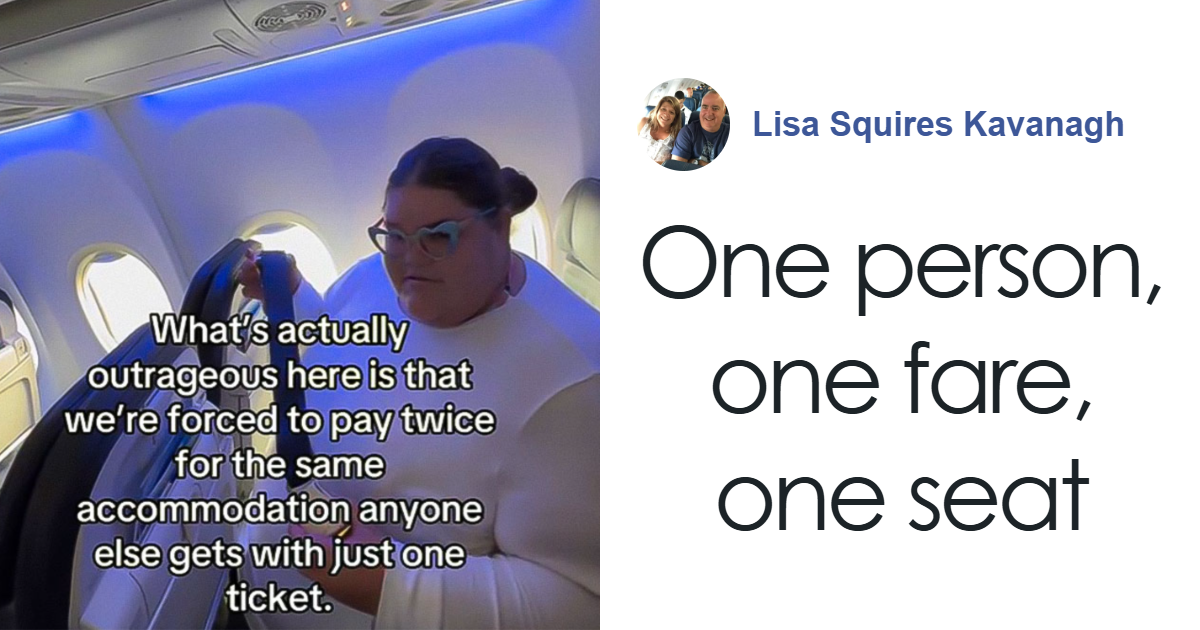

Air travel has a special talent for turning reasonable adults into human pretzels. You arrive at the airport hopeful, hydrated, and maybe even wearing comfortable shoes. Three hours later, you are wedged into an economy seat wondering whether your knees are still legally yours. So when a plus-size traveler demanded that airlines provide free extra plane seats for larger passengers, the internet did what the internet does best: it calmly considered all sides, held hands, and reached a thoughtful conclusion.
Just kidding. It exploded.
The debate around plus-size travelers and extra airline seats has become one of the most emotionally charged travel conversations online. On one side are advocates who argue that flying should be accessible, safe, and humane for people of all body sizes. On the other side are critics who say that extra space costs money, aircraft seats are limited, and “nothing in life is free” applies just as much at 35,000 feet as it does at the grocery store.
At the center of the latest viral storm is a broader question: should plus-size passengers be given an extra seat at no additional cost, or should they pay for any space beyond one standard airline seat? The answer is not as simple as social media wants it to be. Like most aviation issues, it involves safety rules, airline economics, passenger comfort, federal regulations, dignity, and the grim reality that airplane seats seem to have been designed by someone who has never owned shoulders.
The Viral Demand That Split the Cabin
The controversy gained traction after plus-size travel advocates called for U.S. airlines to adopt a clearer “one person, one fare” approach. The idea is that a passenger should not be financially penalized for needing more room to fly safely and comfortably. In some versions of the proposal, airlines would provide one extra seat, or even multiple seats, depending on a traveler’s size. In other versions, plus-size passengers could buy an additional seat and later receive a refund.
Supporters say this is not about luxury. They argue that many plus-size travelers are simply trying to avoid bruising, humiliation, painful armrests, public confrontation, and the stress of being judged by gate agents or seatmates. They also point out that airlines have steadily packed cabins more tightly over the years while selling comfort back to passengers through upgrades, extra-legroom seats, and premium cabins.
Critics, however, hear “free extra seat” and immediately ask the practical question: free for whom? Airlines do not manufacture empty seats out of kindness and fairy dust. If a seat is given away, someone absorbs the cost. That could be the airline, the passenger who needs the space, or, eventually, everyone else through higher fares. Hence the sharp online refrain: “Nothing in life is free.”
Why Plus-Size Passengers Say This Is About Dignity
For plus-size travelers, flying can be a stressful experience long before boarding begins. Many worry about whether the seat belt will fit, whether they will need an extender, whether the armrests will lower, whether the passenger beside them will complain, or whether airline staff will publicly decide they need to buy another seat.
That anxiety is not imaginary. Some passengers of size have reported being stared at, mocked, refused by seatmates, or forced into awkward conversations at the gate. Even when airlines have written policies, the passenger experience can depend heavily on the mood, training, and discretion of employees. A rule that looks manageable on a website can feel very different when discussed in front of a boarding line full of tired strangers clutching neck pillows.
Advocates argue that a consistent, respectful policy would reduce public embarrassment and make air travel more accessible. They say airlines already accommodate many needs, including wheelchair assistance, medical equipment, service animals, and family seating concerns. In their view, larger bodies should not be treated as a personal inconvenience but as part of the real diversity of the traveling public.
Why Other Passengers Push Back
Opponents are not always arguing that plus-size travelers deserve discomfort. Many are reacting to the idea that one passenger’s additional space should automatically be subsidized by others. Economy-class passengers already pay extra for nearly everything: bags, seat selection, early boarding, snacks, legroom, flexibility, and sometimes the privilege of not sitting in a middle seat between two armrest warlords.
For these travelers, the demand for free extra seats feels unfair. Tall passengers pay more for extra legroom. Parents often pay to select seats together. Travelers with broad shoulders may upgrade. People with injuries may book aisle seats or premium cabins. From this point of view, needing more space is understandable, but the cost should belong to the person using that space.
There is also the issue of availability. On a full flight, a “free extra seat” is not just an unused cushion. It may represent a seat another paying passenger could have booked. If the plane is sold out, accommodating one traveler with two seats could mean rebooking someone, delaying the plus-size traveler, or creating a conflict at the gate. None of those options makes for a cheerful boarding process.
What U.S. Airline Policies Actually Say
Airline policies vary widely, which is one reason the debate keeps resurfacing. Southwest has long been known for one of the more accommodating approaches toward “customers of size.” Its policy has included options for passengers to purchase an extra seat and request a refund under certain conditions, and recent reporting shows the airline has continued adjusting how it handles complimentary adjacent seats when available.
American Airlines tells passengers who need more than one seat to travel comfortably and safely that they must book an additional seat by contacting reservations. Delta says passengers who need more space than a standard economy seat can book two seats, upgrade, or ask onboard whether reseating next to an empty seat is possible. United states that passengers may need additional arrangements if they cannot sit comfortably in one seat, buckle with a seat belt and extender if needed, keep armrests down, and avoid significantly encroaching on nearby seats.
In other words, the industry does not have one universal rule. Some airlines offer more flexibility. Others place the responsibility more clearly on the traveler to purchase additional space in advance. That inconsistency is exactly what plus-size travel advocates want changed.
The Legal Reality: Airlines Can Charge for More Than One Seat
One detail often missing from social media arguments is the legal framework. Under federal disability-related air travel rules, airlines generally may not charge passengers for required disability accommodations. However, the rules also allow carriers to charge a passenger for more than one seat if the passenger’s size or condition causes them to occupy more than one seat. That means a mandatory “free second seat” policy is not currently the standard legal requirement across U.S. airlines.
This is where the debate becomes less about what airlines must do and more about what airlines should do. Should carriers absorb the cost as part of inclusive service? Should the government require larger minimum seat sizes? Should passengers who need extra room pay for it, but receive refunds when flights are not full? Should airlines create a private, standardized booking process to avoid gate-side embarrassment?
The current system leaves too many of those answers up in the air, which is appropriate for planes but not ideal for policy.
Are Airline Seats Too Small?
Even people who disagree with free extra seats often agree on one thing: economy seats are tight. Seat width and pitch vary by aircraft and airline, but many standard economy seats hover around 17 inches wide, with legroom often in the 30-to-32-inch range and sometimes less on dense configurations. For passengers with larger bodies, tall frames, mobility challenges, or chronic pain, that can turn a short flight into a full-body negotiation.
The Federal Aviation Administration has taken public comments on minimum seat dimensions necessary for safety, particularly evacuation safety. Consumer advocates have argued that shrinking seats are not just uncomfortable but potentially dangerous during emergencies. Airlines, meanwhile, argue that aircraft layouts must balance safety, affordability, demand, and economics.
The uncomfortable truth is that the modern economy cabin was not built around generosity. It was built around efficiency. Every inch matters because every row matters because every seat can produce revenue. Passengers feel this physically. Airlines feel it financially. The result is a cabin where everyone wants more space, and almost nobody wants to pay more for it.
The Economics of “Free” Extra Seats
The phrase “free extra seat” sounds simple until you ask who eats the cost. Airlines operate with complex pricing models, high fixed costs, fuel expenses, labor costs, maintenance requirements, airport fees, and unpredictable demand. A seat that flies empty may not always represent a full lost fare, especially if the flight was not sold out. But on high-demand routes, peak travel days, or packed holiday flights, an extra seat can be valuable inventory.
If airlines made extra seats free for all passengers who requested them, they would likely need rules to prevent abuse. Who qualifies? Is it based on armrest position? Seat belt length? Passenger self-identification? Gate agent evaluation? Medical documentation? Each option comes with problems. Self-identification is respectful but may be difficult to manage on full flights. Agent evaluation can become humiliating or inconsistent. Medical documentation raises privacy concerns and does not neatly apply to body size.
That is why some observers suggest a compromise: let passengers buy an extra seat in advance, then refund it when the flight departs with empty seats. This approach protects the traveler’s space while reducing the airline’s financial risk. It is not perfect, but it avoids the chaos of waiting until boarding to discover whether a second seat is available.
Safety Is Not Optional
Beyond comfort, there are safety considerations. Passengers must be able to buckle their seat belts, sometimes using an airline-provided extender. Personal seat belt extenders are generally discouraged or prohibited by carriers because airlines cannot verify their compatibility, condition, or maintenance history. Exit row seating also comes with special safety requirements, and travelers who need extenders may be moved out of those rows depending on airline policy and aircraft rules.
Armrests matter too. Airlines often use the ability to lower armrests as a practical boundary between seats. If a passenger cannot sit with the armrest down without encroaching on a neighbor, the airline may require an additional seat or other arrangement. That is not only about comfort for the neighboring passenger; it can also affect safe seating posture and access to aisles.
Still, safety should not be used as a polite disguise for shaming. A well-run airline can address seat belt extenders, armrest issues, and extra seating needs discreetly. The problem is not that safety rules exist. The problem is when those rules are applied inconsistently, loudly, or without compassion.
Public Reaction: Empathy Meets Frustration
The online backlash to free extra seat demands often follows a familiar script. Supporters say, “Everyone deserves to travel without pain.” Critics respond, “Everyone deserves the space they paid for.” Supporters say, “Airlines made seats too small.” Critics reply, “Then blame airlines, not other passengers.” Then someone with a cartoon avatar appears and says something completely unhelpful in all caps.
But buried under the noise is a valid tension. Plus-size travelers are asking for dignity, predictability, and safe accommodation. Other passengers are asking for fairness, personal space, and transparent pricing. Both concerns can be real at the same time.
The worst version of the debate turns into body-shaming. The better version asks how airlines can design policies that reduce embarrassment, protect seatmates, and clearly explain costs before travelers reach the gate. The goal should not be to make plus-size passengers feel like a problem. It should be to make the rules clear enough that nobody has to argue over armrests while boarding group C forms a human traffic jam.
What Airlines Could Do Better
Airlines do not need to wait for a viral controversy to improve the experience. They could publish clearer passenger-of-size policies in plain English, including exact steps for booking extra seats, refund eligibility, seat belt extender rules, aircraft seat dimensions, and what happens if a flight is full.
They could train agents to handle these conversations privately and respectfully. They could allow passengers to confidentially flag seating needs during booking. They could make refund policies easier to understand. They could display seat width and pitch more prominently before checkout. They could reserve a limited process for extra-seat requests without forcing travelers to explain their bodies at the gate.
Better design would help too. Wider seats, more flexible armrests, and accessible lavatories would benefit not only plus-size passengers but also travelers with disabilities, older adults, parents helping children, injured passengers, and frankly anyone who has ever tried to retrieve a backpack from under the seat without performing airport yoga.
What Plus-Size Travelers Can Do Now
Until policies become more consistent, preparation matters. Plus-size travelers should check airline rules before booking, because policies can differ dramatically. Calling reservations may help ensure that two seats are linked properly under the same passenger name. Booking early increases the chance of finding adjacent seats. Choosing aircraft and seat maps carefully can reduce surprises, especially because seat width varies by plane type, cabin, and row.
Travelers who may need a seat belt extender should ask the flight attendant after boarding rather than bringing a personal extender. It is also wise to avoid exit rows if an extender may be needed. When possible, aisle or window seats can provide a little more psychological comfort, although the middle seat remains the official headquarters of human suffering.
Most importantly, passengers should document policies before travel. Screenshots, confirmation emails, and written refund rules can make post-flight claims easier. That may not solve every issue, but it gives travelers more control in a system that often feels designed to remove it.
The Bigger Question: Comfort, Cost, or Civil Rights?
The free extra seat debate is not really just about one influencer, one petition, or one viral comment section. It is about whether air travel is a basic public necessity or a market product where every inch has a price. In the United States, flying often functions as essential transportation. People fly for work, family emergencies, medical care, education, weddings, funerals, and the occasional vacation where everyone pretends airport nachos are a meal.
If flying is essential, accessibility matters. But if every seat is revenue, airlines will resist giving space away without a clear rule or business reason. That is the conflict. Advocates want the industry to treat body diversity as a normal part of travel. Critics worry that fairness disappears when one person receives extra inventory that another person must pay for.
A humane solution probably sits somewhere between “give unlimited free seats to anyone who asks” and “figure it out yourself.” Airlines could create clearer refund-based extra-seat programs, improve seat transparency, expand accessible cabin design, and train staff to treat passengers with dignity. Regulators could continue examining minimum seat dimensions and safety impacts. Travelers could debate the issue without turning it into a public roast of someone’s body.
Experiences Related to Plus-Size Air Travel: What This Debate Feels Like in Real Life
Imagine booking a flight while already rehearsing an apology to a stranger you have not met yet. That is the reality many plus-size travelers describe. They are not thinking only about destination weather, hotel check-in, or whether their suitcase is one sock away from the overweight baggage fee. They are thinking about the moment they walk down the aisle and scan the row, hoping the person beside them does not sigh, glare, or make a comment loud enough for row 22 to enjoy.
For some travelers, the hardest part is uncertainty. A seat map may show three empty seats together, but that can change by boarding time. A policy may say an extra seat can be refunded, but the traveler may not know whether the flight qualifies. A gate agent may be kind and discreet, or they may ask questions in a voice that carries across the terminal. The emotional burden begins long before the aircraft door closes.
There are also practical challenges. A traveler may buy two seats but still have trouble convincing the airline system that both seats belong to one person. A second boarding pass may confuse passengers who see an empty seat and try to sit there. A flight attendant may understand the arrangement immediately, or the passenger may have to explain it again while everyone waits. That is not exactly the glamorous jet-set lifestyle shown in airline commercials, where everyone smiles over sparkling water and somehow has elbow room.
Seat belt extenders create another layer of anxiety. Some travelers quietly ask as they board. Others wait until they are seated, hoping not to draw attention. A sensitive crew member can make the exchange feel routine. A careless one can make it feel like a spotlight has been turned on. The extender itself is not the issue; the fear of being publicly judged is.
Seatmates have experiences too. A passenger who paid for one seat may feel frustrated if someone else’s body overlaps into their space for a long flight. They may not want to be cruel, but they also do not want to spend four hours leaning into the aisle or sacrificing an armrest they paid for. This is why the issue cannot be solved by simply telling people to “be nicer.” Kindness helps, but policy prevents conflict.
Families, tall travelers, disabled passengers, and people with temporary injuries understand similar frustrations. A six-foot-seven traveler may pay for extra legroom because standard pitch crushes their knees. A parent may pay seat-selection fees to avoid being separated from a child. A passenger recovering from surgery may need an aisle seat. Air travel often turns human needs into add-ons, and everyone has a receipt.
The best real-world experiences happen when expectations are clear. If a plus-size traveler knows exactly how to book an extra seat, whether it can be refunded, where to sit, how to request an extender, and what to do if the flight is full, the trip becomes less stressful. If nearby passengers know the airline has handled the arrangement properly, they are less likely to feel cheated. If staff are trained, nobody has to improvise a policy while boarding music plays and someone blocks the aisle searching for headphones.
That is the lesson behind the controversy. The internet may frame it as a fight between entitlement and discrimination, but real travel is messier. People need space. Space costs money. Airlines make seats smaller because smaller seats make financial sense. Passengers then argue with each other over discomfort created by cabin design and pricing decisions. It is like fighting over the last inch of a couch while the furniture company quietly removes another cushion.
A better system would reduce shame, reduce surprise costs, and reduce conflict. Plus-size passengers should not have to gamble with dignity every time they fly. Other passengers should not lose space they paid for. Airlines should not hide behind vague policies. And regulators should keep asking whether the modern economy cabin still works for the bodies that actually use it.
Until then, the phrase “nothing in life is free” will continue to echo through the debate. It is catchy, but incomplete. Nothing in aviation is simple, either.
Conclusion
The controversy over plus-size travelers demanding free extra plane seats reveals a deeper problem in modern air travel: the cabin has become too cramped, the policies too inconsistent, and the conversation too cruel. Plus-size passengers deserve dignity, safety, and clear rules. Other passengers deserve the space they paid for. Airlines must balance both without turning boarding into a courtroom drama over armrests.
The smartest solution is not online shaming or blank-check free seating. It is transparent policy, discreet service, fair refund options, better seat information, and long-term cabin designs that recognize passengers are not all built like carry-on luggage. Air travel may never be luxurious for everyone, but it can be less humiliating, less confusing, and a lot more humane.