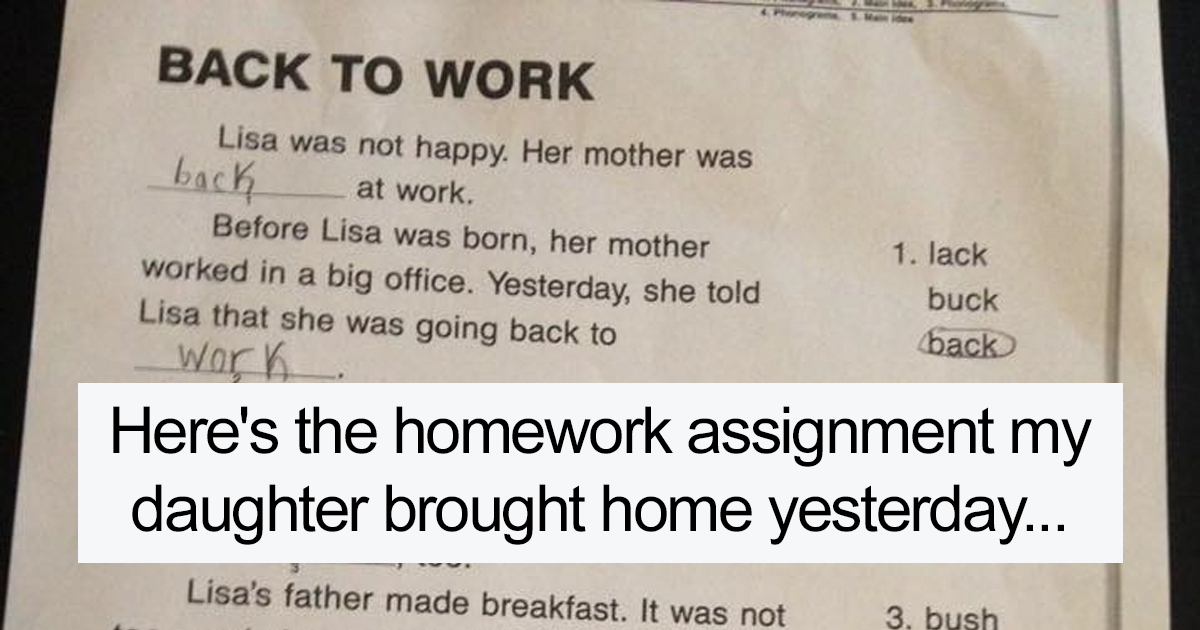

If you’ve ever stared at your kid’s homework and thought, “Wow, this feels like it came straight from 1952,” you’re not alone. That’s exactly what happened to one New York mom when her 6-year-old daughter brought home a worksheet that quietly suggested moms should stay in the kitchen, dads can’t cook, and kids are only happy when mom quits her job.
Instead of just rolling her eyes and signing off on it, this mom grabbed a pen, rewrote the whole thing, and accidentally started an international conversation about sexist homework, gender stereotypes, and what we teach kids about work and family. The story later landed on Bored Panda and across major news sites, where millions of parents nodded, sighed, and hit “share.”
Let’s unpack what happened, why this simple worksheet hit such a nerve, and what parents and teachers can actually do to push back against outdated lessons hiding in children’s schoolwork.
The Night a “Simple” Homework Sheet Went Viral
The mom at the center of the story is Lynne Polvino, a children’s book editor and working mother from Queens, New York. One evening, she sat down to help her first-grade daughter, Hazel, with a language arts worksheet called “Back to Work.” The exercise asked kids to fill in missing words to complete a story about a little girl named Lisa whose mom is returning to work.
On the surface, it looked harmless: just another reading comprehension exercise. But as Lynne read through the worksheet, her frustration grew. The original story painted this picture:
- Lisa’s mom used to stay home and take care of the house and kids.
- She goes “back to work,” and suddenly everything falls apart.
- Lisa is unhappy, the house is a mess, dad can’t handle breakfast, and everyone is stressed.
- The implied “solution”? Mom should quit her job and go back to staying home.
It was a neatly packaged narrative that suggested working moms are selfish or irresponsible, dads are incompetent caretakers, and kids only feel secure when mom’s professional life disappears. For a mom who both loves her job and her child, it felt like homework-sponsored guilt.
Polvino later described herself as already tired and frazzled from a long dayso this worksheet was the last straw. Instead of letting the message slide, she did what editors do best: she revised it.
What Exactly Was Sexist About the Homework?
Some people might look at the original worksheet and shrug: “It’s just a story.” But stories matter, especially the ones we hand to 6-year-olds as “schoolwork.” Here’s what was so problematic about the assignment’s underlying messages:
1. It framed working moms as a problem to be fixed
The original version implied that when mom goes back to work, the family suffers. The home becomes chaotic, the child is sad, and the only way to make things right is to put mom back in the kitchen. It reinforced the idea that a “good mother” is one who stays home, and that paid work is somehow in competition with love and responsibility.
2. Dad was treated like a lovable, but hopeless, side character
The dad in the worksheet was portrayed as the classic sitcom trope: the guy who can’t cook breakfast without burning it, and who struggles to manage basic household tasks. That may sound lighthearted, but it reinforces a real stereotype: that men are naturally bad at caregiving and domestic work, so women should do it all.
3. The child’s feelings were used to police mom’s choices
Lisa’s sadness wasn’t treated as something to be discussed or understoodit was used as evidence that mom working was “wrong.” Instead of presenting a family figuring out new routines, the story suggested that mom’s job is the problem, not the lack of support or shared responsibility.
4. It reflected one narrow idea of “normal” family life
The worksheet didn’t leave room for dual-career families, single parents, stay-at-home dads, or households where everyone pitches in. It quietly promoted the old-school model: mom at home, dad at work, and anything else equals trouble.
On its own, this may sound like “just one worksheet.” But for young kids who are still forming their ideas about what moms, dads, and kids are “supposed” to do, these patterns add upand they often match stereotypes they see in media, toys, and even the way adults talk.
Mom’s Rewrite: Same Worksheet, New Story
Flipping the Script
Instead of letting her daughter fill in the original story, Lynne rewrote it completely. She kept the basic structuresame characters, similar sentence length, same reading levelbut swapped the message.
In the revised version:
- The morning is described as “wonderful,” not disastrous.
- Both Lisa and her mom have somewhere important to be: school and work.
- Mom’s workplace is supportive; she has parental leave and flexible hours because her contributions are valued.
- Dad cooks breakfast calmly and competentlyno burned pancakes, no chaos.
- Both parents share responsibilities at home, from cooking to helping with homework.
- Lisa feels proud and secure, not abandoned.
Same grammar skills. Same reading practice. Completely different worldview.
The rewrite managed to hit multiple positive notes at once: respect for working parents, competent dads, shared household duties, and a kid who’s okay because the grown-ups are actually working as a team.
From Facebook Post to Bored Panda Headline
After she finished the rewrite, Lynne posted side-by-side photos of the original worksheet and her updated version on Facebook, along with a caption explaining why the assignment bothered her so much as a working mom. Friends reacted stronglymany had seen similar problems in their kids’ homework.
From there, the post spread quickly. Parenting sites, lifestyle outlets, and news organizations picked it up. Bored Panda ran the now-famous headline about the mom who rewrote her daughter’s sexist homework and went viral. Other outlets like Scary Mommy, Yahoo, Romper, Glamour, AOL, and local news stations covered the story, highlighting both the humor and the serious point behind the edit.
Importantly, Lynne also emailed her daughter’s teacher. The teacher reportedly agreed that the worksheet was outdated and promised to review the materiala reminder that sometimes educators are stuck with old resources they didn’t create, and they’re open to feedback when parents speak up respectfully.
Why This Story Hit a Nerve with So Many Parents
The viral response wasn’t just about one worksheet. It tapped into something a lot of families are already feeling.
The guilt tax on working moms
Working mothers are regularly bombarded with subtle (and not-so-subtle) messages that they’re doing it “wrong”too busy, too ambitious, not present enough. A homework sheet that frames a mom’s job as the reason her child is upset lands right on that sore spot.
The reality, of course, is more complicated. Many families need two incomes just to stay afloat. Many moms like their work and don’t want to give it up. Kids can absolutely thrive with parents who work, as long as they’re loved, supported, and cared forby parents, caregivers, relatives, and communities.
Gender stereotypes still show up in classrooms
Research on education and gender stereotypes has repeatedly found that boys and girls pick up signals about what they’re “supposed” to be like from a very young agethrough stories, toys, classroom roles, and yes, worksheets. These subtle cues can shape everything from self-esteem to career aspirations later on.
When curriculum materials always show mothers doing the housework, or portray fathers as clumsy or absent, kids see that as normal. Even if their own family doesn’t fit that mold, they start to absorb the idea that certain roles belong to one gender or the other.
Parents are tired of “just a joke” excuses
For years, parents who complained about sexist homework were told they were overreactingthat it’s just a story, or “harmless.” But as more families speak up, it’s becoming clear that a lot of people are done laughing off stereotypes that make their kids feel boxed in.
The viral popularity of this mom’s rewrite showed how many parents want homework that reflects real, modern familiesand doesn’t shame anyone for going to work, sharing chores, or being different from the old-fashioned norm.
What Gender-Stereotyped Homework Actually Teaches Kids
Even when a worksheet doesn’t mention “gender stereotypes” directly, it teaches values under the surface. Here’s what kids can learn from assignments like the original “Back to Work” story.
“Moms do the housework, dads ‘help’ (badly)”
If children repeatedly see moms cooking, cleaning, and caring, while dads are either absent or portrayed as incompetent, they start to assume those roles are natural and fixed. Boys may feel less encouraged to be nurturing and responsible at home. Girls may feel pressure to prioritize domestic tasks over independence or ambition.
“Work and family can’t coexistespecially for women”
A story that blames chaos on a mom’s job suggests that a woman’s career is inherently harmful to her family. That’s not only unfairit’s untrue. Healthy families come in countless configurations: two working parents, one working parent, single parent households, extended family systems, and more.
“Kids should internalize the guilt”
When a child character is written as sad because mom works, but no one talks about it or problem-solves, the only takeaway is: “This is bad and I just have to feel bad about it.” A better story would model communicationparents explaining what’s happening, reassuring their child, and making plans together.
How Teachers and Schools Can Avoid Sexist Homework
Teachers are often using worksheets and stories that were printed years ago, long before anyone thought carefully about representation. The good news: there are practical ways to improve things without rewriting the entire curriculum overnight.
- Audit old materials. Take a quick pass through commonly used worksheets and stories. Do moms always cook? Are dads always away or bumbling? Are girls mostly caring and boys mostly active or tough? Flag the worst offenders.
- Balance the roles. Use examples where dads pack lunches, moms work in offices or on construction sites, grandparents pick up from school, and kids see all genders doing different types of jobs and chores.
- Update “family” examples. Include families with single parents, same-sex parents, blended families, and shared caregiving. Kids already know these exist; seeing them in school validates their reality.
- Watch the adjectives. Who is “bossy,” “emotional,” “brave,” or “smart” in your worksheets? Spread those traits around instead of locking them to one gender.
- Invite critical thinking. Occasionally ask students, “Is this story fair? Could we tell it another way?” That simple question can open up great discussion and awareness.
- Listen to parents. When a parent flags something as problematic, see it as an opportunity, not a personal attack. Lynne’s teacher responded with openness and a willingness to review materiala model response.
What Parents Can Do When Homework Feels Off
You don’t have to go viral to make a difference in your own home and school. If you come across an assignment that feels sexist, outdated, or unfair, here are some practical steps you can take.
1. Talk it through with your child
Before you grab a pen, start with a conversation: “What do you think about this story? Do you think it’s fair? Does it look like our family?” Kids often notice things we assume they miss. This helps them build their own critical thinking skills instead of just absorbing the message silently.
2. Add context or alternatives
You can say, “This is one way a family might look, but not the only way.” Share how your household actually works: maybe both parents work, maybe dad is the main cook, maybe grandma does after-school pickups. Let your child know different set-ups are normal and okay.
3. Turn it into a mini rewrite
Follow Lynne’s lead and invite your child to imagine a fairer version. How could the story show everyone helping? How could the child talk about their feelings? What would it look like if the family supported mom’s job instead of treating it as a problem?
4. Communicate with the teacher (kindly)
A respectful email goes a long way: explain what bothered you, how it clashes with your family’s reality, and suggest updating that material or using a different example next time. Most teachers genuinely don’t want to reinforce harmful stereotypes and are open to constructive feedback.
5. Celebrate progress when you see it
If your child brings home a story showing a stay-at-home dad, a mom who travels for work, or kids challenging stereotypes, point it out and praise it. Positive reinforcement helps schools see which materials are working better for families today.
Why Rewriting One Worksheet Actually Matters
It’s easy to roll your eyes at viral stories and think, “Okay, but what does this really change?” In this case, it actually changed quite a bit.
- It pushed a school to reconsider outdated materials.
- It gave thousands of parents language to express what’s been bothering them for years.
- It showed a fun, practical way to challenge sexism with creativity instead of just anger.
- It reminded families that kids deserve stories reflecting modern realitiesnot recycled guilt trips.
And for one little girl, it did something else: it showed her that her mom’s job is not the villain of the storyand that grown-ups can, and should, rewrite scripts that don’t make sense anymore.
Real-Life Experiences and Lessons from “Sexist Homework” Moments
The story of Lynne and her daughter is memorable partly because it feels so familiar. Parents all over the world have looked at a worksheet or a school book and thought, “Yikes… this is not the message I want for my kid.” While each situation is unique, the experiences around these moments have a lot in common.
That instant gut reaction
Often, parents describe the same first feeling: a little jolt of disbelief. You’re tired, you’re halfway through checking math problems or spelling words, and then you hit a story that says girls are bad at science, boys don’t cry, or moms should be at home all day. Your brain goes from autopilot to alert mode in one sentence.
That gut reaction matters. It’s usually your values tapping you on the shoulder, saying, “Hey, this doesn’t line up with what we teach at home.” Instead of ignoring it, treating it as a red flag can help you decide what to do next.
Balancing “pick your battles” with “this is worth it”
Parents are always told to pick their battles, and honestly, that’s fairno one has the energy to rewrite every clumsy worksheet. But families who’ve navigated situations like this often describe a moment when something crosses a line: the message is too strong, too outdated, or hits too directly at their child’s sense of self.
In those moments, many parents choose to act, not because they’re perfectionists, but because they know their kids are watching. When you challenge something that feels wrong, you’re modeling how to speak up respectfully when a system doesn’t match your values.
Turning frustration into a teachable moment
One of the most powerful moves parents make is inviting their kids into the process. Instead of just saying, “This homework is dumb,” they might say:
- “How else could we tell this story?”
- “What would make it fairer?”
- “Does this sound like our family or like families you know?”
Kids are often surprisingly sharp about spotting what’s unfair. They may notice that it’s strange that a dad “can’t” cook, or that a girl is always the one helping, or that a boy who cries is mocked. Once they see the problem, they’re usually very willing to help fix itby drawing, rewriting, or acting out a new version.
Keeping the teacher on your team
Parents who’ve had positive outcomes often talk about approaching the teacher as a teammate rather than an enemy. Instead of blasting them, they share how the assignment landed in their home: “This was hard for us because…,” “This doesn’t really match our family’s reality,” or “I’m worried about the message this sends to all the kids, not just mine.”
Sometimes the teacher was just grabbing a worksheet from an old binder or district resource without really thinking about its deeper message. When a parent points it out kindly, it gives the teacher permissionand motivationto swap it out for something better.
Showing kids that stories aren’t carved in stone
Perhaps the best long-term lesson to come out of situations like this is surprisingly simple: stories can change. When a child sees a grown-up literally rewrite a narrative, they learn that books and worksheets aren’t sacred objectsthey’re tools. If a tool is broken or harmful, we can fix it.
For kids growing up in a world where they’ll encounter all kinds of messagesfrom social media to advertising to school materialsthat’s a powerful mindset. It teaches them:
- They’re allowed to question what they’re given.
- They can imagine fairer, kinder, more accurate stories.
- Their voice matters in shaping the world they live in.
So yes, it was “just” one worksheet about a girl named Lisa and her working mom. But for Hazel, for her class, and for the millions of people who saw that Bored Panda post, it became something much bigger: a funny, sharp, hopeful reminder that when the story is sexist, we don’t have to accept it. We can rewrite itand in doing so, we quietly teach our kids they can, too.
“`
Sources consulted for factual background about the original worksheet, the rewrite, and media coverage of the story include reporting and summaries from Bored Panda, Scary Mommy, Yahoo, Romper, Glamour, AOL, and other outlets, as well as research on gender stereotypes and education and commentary on sexist homework. ([Bored Panda][1])
* [people.com](https://people.com/mom-influencer-defends-doing-her-kids-homework-for-years-11790258?utm_source=chatgpt.com)
[1]: https://www.boredpanda.com/working-mom-homework-rewrite-lynne-polvino/?utm_source=chatgpt.com “Mom Gets Shocked After Seeing Her 6-Year-Old …”