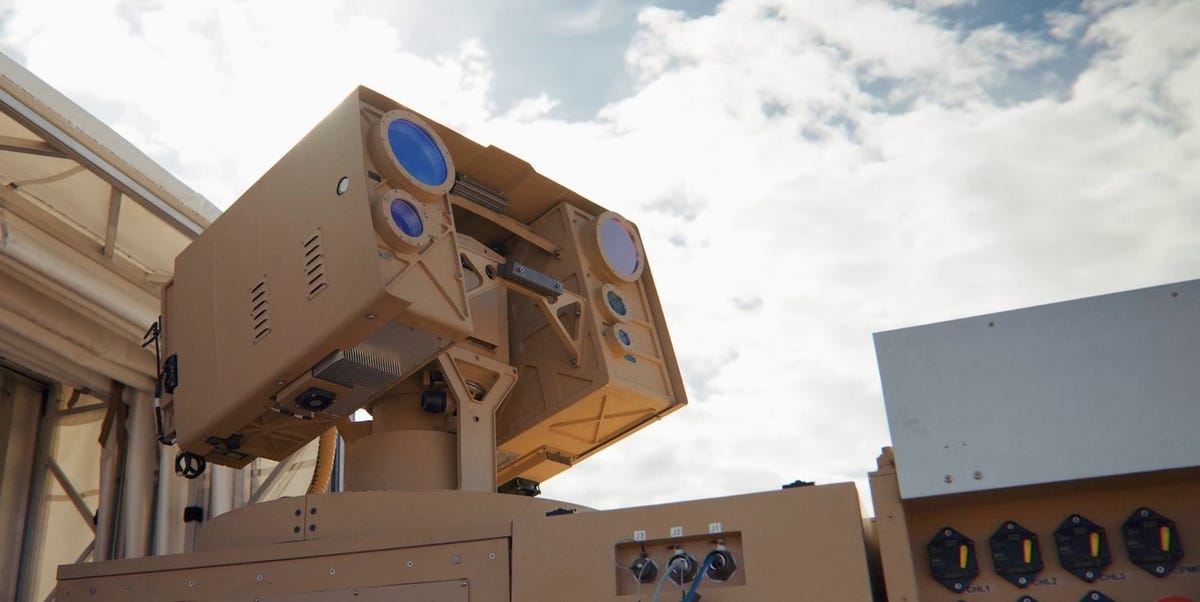

Not that long ago, “laser weapons” sounded like something you’d find on the Millennium Falcon,
not on a very real, very gray Navy destroyer. Yet here we are: modern militaries are quietly
wiring up ships, trucks, and even future aircraft with high-energy laser systems designed to
swat drones out of the sky at the speed of light and for about the price of a fancy latte
(or less) per shot.
This isn’t just a cool tech flex. Cheap drones and drone swarms have become one of the toughest
problems in modern warfare. Traditional air defenses were built to handle big, expensive threats:
jets, cruise missiles, ballistic missiles. Now the battlefield is crowded with small, low-flying,
low-cost unmanned aircraft that can spy, jam, or slam into targets for only a few hundred or a
few thousand dollars each. Trying to stop those with missiles that cost six figures a launch is
a losing business model.
That’s exactly where laser weapons more broadly known as directed energy systems might shine.
They’re not magic, and they definitely aren’t perfect. But when it comes to changing the
economics of drone defense and adding another layer to the air-defense stack, lasers have some
very real advantages.
The Drone Problem: Cheap, Small, and Everywhere
The “drone problem” isn’t just about one country or one battlefield. From Ukraine to the Middle
East, small unmanned aerial systems (sUAS) are spotting targets, correcting artillery fire,
dropping grenades, and performing kamikaze attacks on vehicles and infrastructure. They’re
affordable, easy to modify, and getting smarter every year.
From hobby quadcopters to kamikaze drones
On the low end, you have commercial quadcopters that anyone can order online. Militaries and
irregular forces strap on improvised munitions, tweak the software, and suddenly that “flying
selfie stick” becomes a guided weapon. On the higher end, purpose-built loitering munitions
and one-way attack drones can travel dozens or hundreds of miles, fly low, and strike with
pretty impressive precision for their cost.
None of these systems is individually terrifying. The issue is scale. When you can launch tens,
hundreds, or even thousands of drones, even a good air-defense system can get overwhelmed.
Each incoming object forces a decision: track it, jam it, shoot at it, or accept the risk.
When the defender spends $150,000 to knock down a $1,500 drone, the attacker is winning the
math problem, even if the drone never reaches its target.
Why traditional defenses are struggling
Existing air-defense tools missiles, anti-aircraft guns, and electronic warfare systems
are effective but have limits:
- Missiles work well, but they’re expensive, limited in number, and slow to reload.
- Guns are cheaper per shot but need lots of ammo and struggle against very small, agile targets.
- Jammers can disrupt GPS or control links, but many newer drones can fly autonomously or use hardened links.
What’s missing is a low-cost, deep-magazine option that can engage many targets quickly without
burning through a ship’s or battery’s entire stock of missiles. That’s the niche laser weapons
are trying to fill.
Why Lasers Are Suddenly a Big Deal
Lasers as weapons aren’t new in theory; they’ve been discussed since at least the Cold War.
What’s changed is the technology. Advances in solid-state lasers, industrial fiber lasers,
beam control, and compact power systems have finally made it possible to mount meaningful
laser weapons on real platforms: ships, tactical vehicles, and ground sites.
Speed-of-light intercepts
When you fire a missile or a shell, there’s flight time. With a laser, the “projectile” is a
beam of light. Once you’re locked onto the target and fire, the effect is essentially
instantaneous at tactical ranges. That brings several advantages:
- Very fast engagements against small, nimble drones.
- High precision – you can focus energy on specific parts like sensors or control surfaces.
- Reduced collateral damage, especially when you’re just blinding optics or burning electronics.
Pennies per shot, not hundreds of thousands
Perhaps the biggest talking point is cost. Once a laser system is built and installed, each
shot is essentially the cost of electricity and maintenance. Compared with missiles that can
cost tens or hundreds of thousands of dollars each, a laser shot can be effectively “dollars
or cents on the dollar” by comparison, dramatically improving the cost-exchange ratio against
cheap drones.
That’s a fancy way of saying: if your defense is cheaper than the offense, you can afford to
keep shooting longer than the other side can afford to keep attacking. For drones, that’s huge.
Almost “unlimited” magazines
A missile launcher empties out. A laser “magazine” is limited by power generation and cooling.
As long as the platform has fuel to make electricity and can shed heat, the laser can keep
firing. On a large ship with big generators, that’s a massive advantage; on a truck or small
vehicle, it still gives more engagements than you’d get from a handful of interceptor missiles.
What’s Already in the Field
This isn’t just PowerPoint and prototypes. Several militaries already have deployed or
combat-tested laser systems for counter-drone missions, with more on the way.
On the water: Shipboard laser defenses
The U.S. Navy has spent years experimenting with ship-mounted lasers. Early systems like the
Laser Weapon System (LaWS) were tested on the USS Ponce, where sailors used a
30-kilowatt-class laser to disable small boats and unmanned aerial vehicles during
demonstrations. Newer systems such as HELIOS and Layered Laser Defense (LLD) are designed
not only to burn or dazzle drones, but also to provide high-resolution tracking and
battle-damage assessment through their telescopes.
The Navy’s newer concepts, like projects aimed at defending against massed drone and
missile attacks without “running out of missiles,” are all about preserving expensive
interceptors for higher-end threats while letting lasers and other directed-energy
systems handle low-cost drones and small boats.
On land: Strykers, trucks, and tactical vehicles
The U.S. Army is also investing heavily in high-energy lasers for short-range air defense.
A key example is the Directed Energy Maneuver Short-Range Air Defense (DE M-SHORAD) system,
which mounts a roughly 50-kilowatt laser on a Stryker armored vehicle along with radars and
sensors. This combination is meant to protect maneuvering forces from drones, rockets, and
artillery shells.
At the same time, the Army has been testing smaller 20-kilowatt-class systems on lighter
vehicles, with the goal of giving infantry units their own mobile counter-drone lasers.
Contractors have unveiled Stryker variants loaded with lasers, guns, and rockets to offer a
layered defense on one platform. It’s very “Swiss Army knife meets sci-fi cover art.”
Not everything is perfect, of course. Government watchdogs and testing reports have flagged
issues with maturity, reliability, and environmental performance for some of these systems.
That’s normal in cutting-edge programs especially when you’re trying to put what used to
be a laboratory-sized physics experiment on a bouncing, dusty vehicle in harsh weather.
In the air and beyond: Microwaves and allied systems
Lasers aren’t the only directed-energy tool against drones. The U.S. Air Force has been
testing high-power microwave systems, such as the Tactical High-power Operational Responder
(THOR), which can knock out entire swarms by frying their electronics. Instead of burning
one drone at a time, microwaves can disrupt many drones within a cone of energy.
Allies are also pushing ahead. Israel’s “Iron Beam” program a high-energy laser intended
to complement the famous Iron Dome missile system has been touted as a way to intercept
rockets, mortars, and drones at very low cost per shot. Israeli forces have already used
high-power lasers operationally to bring down drones in combat, marking one of the first
real-world demonstrations of this technology under fire.
International competition is heating up, too. Other nations are testing their own naval and
ground-based laser weapons specifically aimed at countering drones, cruise missiles, and
even aircraft. We’re watching the early days of a directed-energy arms race.
The Fine Print: Limits and Trade-Offs
If lasers were perfect, we’d already have them everywhere. The fact that we don’t is a good
reminder that physics still gets a vote.
Weather and atmospheric conditions
Lasers love clear, dry air. They are less happy when it’s foggy, smoky, dusty, or raining.
All that stuff in the atmosphere absorbs and scatters the beam, reducing range and power at
the target. If you’ve ever driven your car in heavy fog and watched your headlights turn into
a glowing wall, you’ve seen a similar effect.
For militaries, that means lasers are part of the toolkit, not the entire toolkit. When
visibility and air quality are good, lasers can take the lead. In bad weather or through
heavy smoke and dust, missiles, guns, and electronic warfare still have to carry the load.
Power and cooling: No free lunch
High-energy lasers need serious power and serious cooling. On a large ship with built-in
generators, that’s manageable. On smaller vehicles, engineers have to make trade-offs:
how much weight and space to devote to batteries, generators, and heat exchangers versus
armor, ammo, and other gear.
As laser power scales up from tens of kilowatts toward 100 kilowatts and beyond those
challenges get sharper. It’s not just “can we build the laser?” but “can we power and cool
it on a mobile platform without turning the vehicle into a rolling science fair project?”
Targeting tiny, fast, and many
Tracking and holding a laser on a small, fast-moving target is hard. Modern systems use
advanced sensors, stabilized optics, and sophisticated software to keep the beam locked on
the same spot on the drone long enough to do damage. That’s relatively straightforward for
a single target; it becomes more complex when you’re facing a coordinated swarm attacking
from multiple directions and altitudes.
This is one reason you’ll see a mix of lasers, microwaves, guns, and missiles proposed for
future counter-drone defenses. Lasers might be great for burning out the “lead” drones or
those closest to high-value assets, while other systems deal with the rest of the swarm.
Legal, ethical, and strategic questions
Lasers raise policy questions, too. International agreements restrict blinding weapons
aimed directly at human eyes, which shapes how certain systems are designed and used. There
are also strategic questions: if lasers make defending against drones cheaper and easier,
does that encourage even more use of cheap unmanned systems by everyone? Or does it tilt the
balance back toward defenders for a while?
For now, policymakers and lawyers are trying to keep up with the technology, figuring out
how existing law of armed conflict rules apply to weapons that melt plastic instead of
launching explosives.
How Lasers Fit into a Layered Drone Defense
The key idea is not “lasers will replace everything,” but “lasers will sit alongside
everything.” Think of it as building a layered air-defense system that makes smart use of
different tools at different ranges, against different threats.
- Long range: missiles and advanced interceptors for large drones, cruise missiles, and aircraft.
- Medium range: guns, missiles, and some higher-power lasers for medium-sized drones and rockets.
- Short range: lasers, high-power microwaves, close-in guns, and jammers for small drones and swarms.
In this model, lasers are the “workhorse” for small, cheap aerial threats. They save the
expensive missiles for high-value targets and help prevent the defender from being bled dry
financially by endless cheap drone salvos.
Over time, as power levels increase and beam control improves, lasers could reach out farther
and handle tougher targets. But even at today’s power levels, they’re already good enough for
certain categories of drones, rockets, and small boats and that’s exactly where the problem
has been most acute.
On-the-Ground Experience: How It Feels to Fight with Lasers (Approx. +)
So what is it actually like to use a laser weapon against drones? While the details of live
operations are usually classified, we can piece together a picture from training exercises,
test ranges, and public demonstrations.
Imagine you’re part of a short-range air-defense crew on a Stryker vehicle equipped with a
high-energy laser. Your screen shows a cluttered sky: friendly aircraft, birds, and now a
small quadcopter-sized drone that just popped up over the horizon. Instead of loading a
missile canister, your job is to verify the target, align the system, and authorize the
laser engagement.
The fire control system slews the turret, finds the drone, and locks the tracking beam.
On your display, you see a small box snap onto the target. With a verbal confirmation from
your commander, you press the fire button. There’s no loud boom, no missile launch, no big
muzzle flash. The vehicle’s generators surge slightly, cooling systems ramp up, and the
invisible beam goes to work.
For a second or two, nothing dramatic appears to happen. Then the drone starts to wobble.
Its motor casing heats up, its battery or electronics fail, and gravity takes over. On the
tracking screen, the target symbol goes from “engaging” to “kill confirmed.” You reset the
system and move on to the next target in the queue.
Operators who have participated in such tests often highlight how “quiet” laser engagements
feel compared with conventional fire. There’s less sensory drama but a strong focus on
procedure: target ID, rules of engagement, safety checks, and coordination with other
air-defense assets. The weapon may feel futuristic, but the discipline around using it
remains very traditional.
At sea, sailors talk about using the laser’s high-quality optics as much as the beam itself.
Before anyone fires, the system acts like a super-telescope, allowing watchstanders to zoom
in on potential threats at long distances. That dual role sensor and shooter is
particularly valuable in environments where many objects (fishing boats, civilian drones,
commercial aircraft) could be present.
Training with lasers also means learning their limits in a very practical way. Crews see how
performance changes with weather, how long they can sustain repeated shots before thermal
limits kick in, and how fast they can transition between targets in simulated swarm attacks.
Exercises may devote entire days to running through “drone raids” where operators must
decide when to use the laser, when to rely on guns or missiles, and when to hand off targets
to other units.
Perhaps the biggest mental shift is the idea of “firing without flinching at the cost.”
With missiles, every shot is a budget decision. With lasers, once the system is fielded,
each shot is comparatively cheap. That changes the calculus: commanders can authorize
multiple engagements on marginal threats without worrying they’re burning through millions
of dollars in hardware. It’s not “free,” but it feels a lot closer to “use as needed” than
any previous intercept capability.
Over time, as more units gain experience, there will likely be a body of best practices:
how to integrate lasers into base defense, convoy protection, and maritime patrols;
how to write smart engagement rules for mixed environments; and how to coordinate with
allied forces using different but complementary systems like high-power microwaves or
kinetic interceptors. Those lessons learned will be just as important as the technology
itself in determining whether lasers truly “solve” the military’s drone problem or just
become another tool in an ever-growing toolbox.
Conclusion: Not a Death Ray, but a Necessary Upgrade
Laser weapons are not a sci-fi “win button.” They won’t make drones disappear overnight,
and they won’t replace every missile or gun on the battlefield. What they can do,
however, is change the economics and tempo of drone defense in ways that strongly favor
the defender: low cost per shot, deep magazines, and fast, precise engagements against
small aerial threats.
As power levels rise, reliability improves, and more militaries gain real-world experience,
lasers are likely to become a standard part of layered air-defense architecture. Paired with
missiles, guns, jammers, and microwaves, they offer a way to handle the flood of cheap drones
without going broke and without waiting for a Hollywood-style death ray to show up.
In other words: no, we’re not getting lightsabers anytime soon. But if you’re a drone headed
toward a modern warship or armored battalion in the coming decade, the bright dot on your
fuselage might be the last thing you ever see.