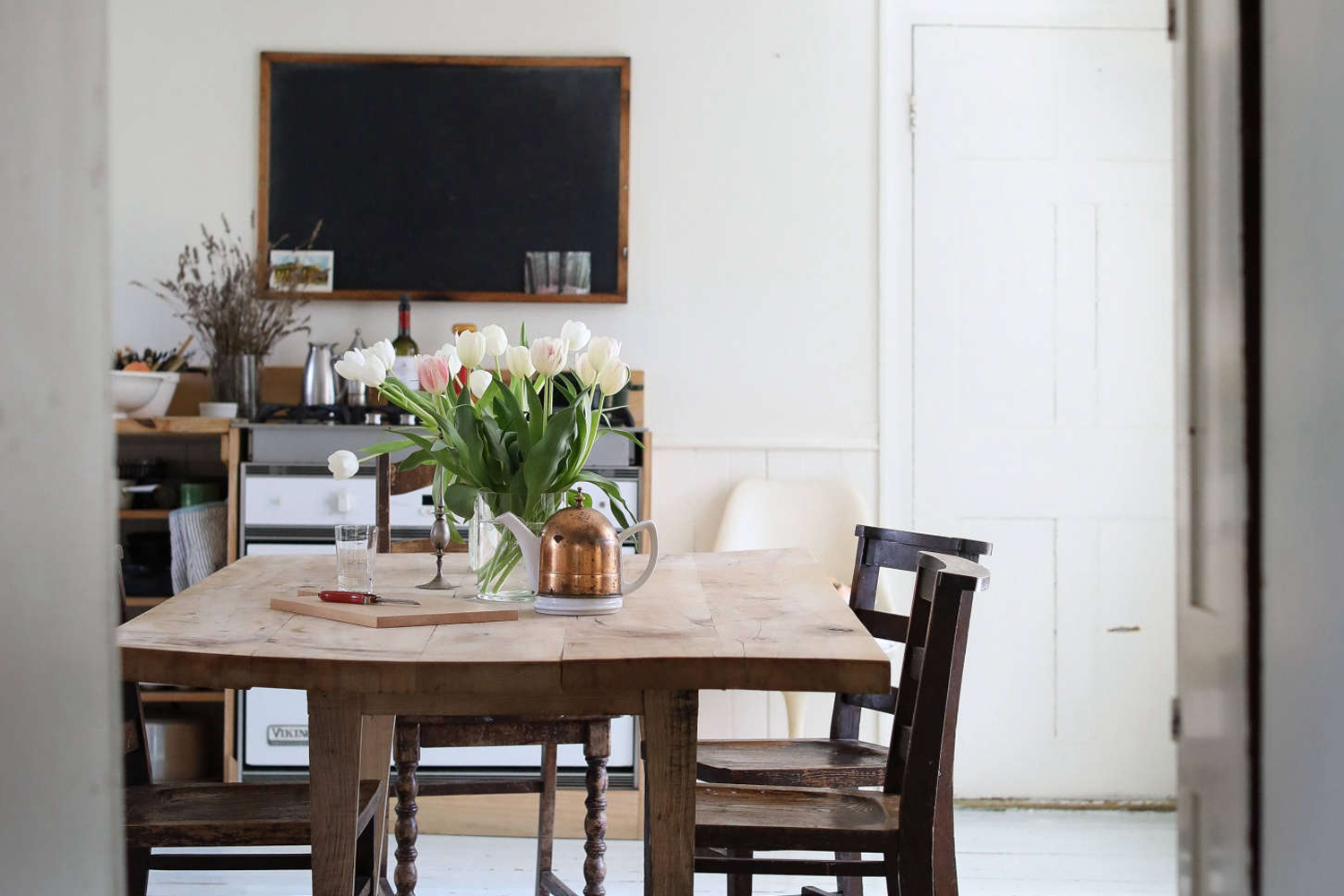

Some kitchens are designed to impress guests. Deborah Ehrlich’s Hudson Valley kitchen feels more like it was designed to impress herself—and the work she does there every day.
It’s calm but not precious, minimal but never cold, and filled with just enough handmade, timeworn, and secondhand pieces to look like real life instead of a showroom.
Set inside a 1722 farmhouse upstate, this minimalist DIY kitchen has become a quiet icon on design blogs and Pinterest boards. The magic isn’t about having the latest luxury finish;
it’s about a point of view: deconstruct instead of over-renovating, reuse rather than replace, and let every bowl, board, and pan earn its place out in the open.
If you’ve ever saved a picture of Ehrlich’s plywood counters, vintage utility sink, or open shelves stacked with simple white crockery and glassware and thought,
“I want that exact feeling,” this guide breaks down how the space works and how to recreate the look in your own kitchen, no matter where you live.
Who Is Deborah Ehrlich—and Why This Kitchen Matters
Deborah Ehrlich is best known for her ultra-refined crystal glassware and quiet, utilitarian home objects. She works from a studio in New York’s Hudson Valley,
thinking obsessively about proportion, line, and how things feel in the hand. That same design language shows up in her house: simple, functional, and finely tuned,
with nothing added just to fill space.
Her kitchen is the opposite of the high-gloss renovation. Instead of gutting everything and starting over, she opened up the floor plan, exposed beams and old plaster,
sanded the floors, and then moved the kitchen into a former wood-storage room attached to the stone house. The result is a light-filled clapboard addition that feels
both new and centuries old at the same time.
For design lovers, this room has become a case study in how “minimal” doesn’t have to mean empty. It means making deliberate choices: a few good tools, materials
that age well, and room for everyday life to stay visible.
Anatomy of the Minimalist DIY Hudson Valley Kitchen
The Deconstructed Farmhouse Shell
The bones of the room are almost shockingly simple:
- White painted walls that show the waviness of old plaster instead of hiding it behind drywall.
- Exposed beams overhead, kept light and unobtrusive, emphasizing the long, low proportions of the farmhouse.
- Sanded wood floors with a soft, matte finish rather than a glossy, new-build sheen.
- Lots of daylight from farmhouse windows, making even basic pine and plywood feel luminous.
This stripped-back envelope makes every object in the kitchen read as intentional: a copper teapot on the table, a row of white mixing bowls on the counter,
a cluster of glassware catching the sun. Nothing is competing with ornate trim or busy tile, so the everyday things you already own become the decoration.
Plywood Countertops and Open, Workshop-Style Storage
The most famous feature in Ehrlich’s kitchen is the humble plywood. Instead of marble or quartz, she uses hand-built plywood counters and shelving,
finished simply so the layered edge of the material becomes a design detail. It’s the kind of choice that says, “Yes, I know what solid-surface countertops are,
and no, I don’t need them to cook dinner.”
Below the counters, open cubbies and shelves hold everyday dishes, pots, and mixing bowls. There are no doors to hide behind, which does two things:
- It forces you to edit. Only the useful and beloved pieces stay.
- It turns storage into display. Simple stoneware, wood spoons, and cast-iron pans suddenly look like a curated collection.
This workshop-like layout isn’t just aesthetic; it’s functional. Everything you need to cook is within arm’s reach: a Staub-style Dutch oven above the oven,
bowls near the prep area, flatware out in the open instead of buried in a drawer. The room feels ready to be used at a moment’s notice.
Secondhand Appliances with Subtle Tweaks
Instead of a wall of matching stainless steel, Ehrlich mixes reclaimed and repaired appliances.
A secondhand gas cooktop sits over a wall oven that’s been subtly customized: the original factory handle was swapped for a simple wooden pull that ties in with the plywood around it.
The upgrade is small but transformative—the oven looks less like a machine and more like a built-in tool in a workshop.
This approach is a masterclass in spending where it matters. You don’t need designer appliances to get a high-end feeling; you need thoughtful placement,
a light hand with customization, and a willingness to give older pieces a second life.
The Vintage Utility Sink and Quiet Fixtures
On one wall, a deep vintage utility sink anchors the space. It has rounded corners, a tall backsplash, and classic wall-mounted taps—the kind of sink you might expect
in a laundry room or an old schoolhouse, not a styled kitchen shoot.
Above it hangs a small, simple pendant with a dark shade and exposed cord. There’s nothing oversized or theatrical here. The lighting is scaled to the room,
casting a warm circle over the sink and leaving the rest of the kitchen gently lit.
Cutting boards double as wall art. A single bottle of dish soap and a striped dish towel are enough “styling” on that wall.
Design Principles Behind the Look
Reduction Over Decoration
Ehrlich’s guiding principle is reduction. Instead of asking, “What else can I add?” she asks, “What can I remove and still have this room work beautifully?”
That mindset produces a kitchen where:
- Cabinets are replaced by shelves.
- Upper storage becomes a single high ledge for a handful of favorite objects.
- Most surfaces stay clear so the few items left out really shine.
Minimalism here isn’t about owning almost nothing; it’s about owning the right things and giving them breathing room.
Warm White, Natural Wood, and Honest Materials
The kitchen leans heavily on a classic trio: white, wood, and metal. White walls and ceilings bounce light around, while raw or lightly finished woods—pine, maple, plywood—
keep the space from feeling stark. Metals appear in small, hardworking doses: the stove top, the sink fixtures, a copper kettle, a few silver candlesticks.
Design magazines consistently point out that white kitchens age well because they provide a neutral backdrop for changing trends. Layering in honest, natural materials
(instead of faux finishes) gives the room soul and makes wear and tear look intentional rather than tragic.
Open Shelving That Actually Works
Open shelving can be polarizing, but this kitchen shows how to make it realistic:
- Keep it low and reachable. Most open storage lives below counter height or on a single shelf/ledge, not stacked to the ceiling.
- Repeat simple shapes. White bowls, crock-style utensil holders, and stacks of plates create visual rhythm.
- Rotate what’s visible. Everyday pieces live front and center, seasonal or rarely used items hide elsewhere.
The result is a room that looks styled but not staged. If you pulled out a pot mid-dinner, nothing would collapse like a Jenga tower.
Handmade Details: Glassware, Cutting Boards, and Textiles
Look closely and you’ll notice that many of the objects are quietly elevated versions of everyday basics: finely proportioned drinking glasses,
slim maple cutting boards, sturdy stoneware, striped cotton towels. Each item feels like it was chosen once and then used for years,
rather than swapped out every season.
This is where the kitchen’s personality really lives. The architecture is calm on purpose so that a bunch of wild-patterned dishes or neon plastic containers don’t shout at you.
Instead, the room is filled with pieces that are neutral but not boring—soft whites, pale wood tones, and the occasional olive or copper accent.
How to Steal This Look in Your Own Kitchen
1. Start with a Simplified Envelope
You may not have a 300-year-old farmhouse, but you can fake the feeling of one by simplifying what’s already there:
- Paint walls and ceilings a warm, not-too-bright white.
- Choose a matte finish for walls and floors to avoid glare and make imperfections charming instead of annoying.
- Remove fussy trim, busy backsplashes, or random shelves that don’t serve a clear purpose.
The goal is to create a calm backdrop so that your everyday objects become the focal point.
2. Consider DIY Plywood Counters or a Plywood Island
If you’re feeling handy, plywood counters are a surprisingly chic and budget-friendly move. Use high-quality birch or maple plywood,
double up the thickness at the front edge to show off the layered profile, and seal it thoroughly with a durable clear finish.
If committing to all-new counters feels intimidating, try a plywood-topped worktable or island first.
The key is embracing the material for what it is. Don’t try to disguise it as stone. Let the grain and the stacked plies be part of the design story.
3. Swap Some Cabinets for Open Storage
You don’t have to rip out every cabinet door to get the deconstructed feel. Start small:
- Remove doors from one lower cabinet and add a horizontal divider to turn it into open cubbies.
- Install a single wall ledge just below the ceiling for pitchers, vases, or teapots you love.
- Use sturdy hooks or a rail for frequently used pans, sieves, or cutting boards.
As you live with the openness, you’ll naturally declutter and learn what deserves a permanent spot in the “on display” zone.
4. Embrace Secondhand and Lightly Customized Appliances
Instead of saving for a full suite of new appliances, consider the Ehrlich method:
- Hunt for gently used, quality appliances with clean lines.
- Update small details—a new knob or pull, a custom wood handle, a fresh coat of high-heat paint on a panel.
- Build your counters and shelves around what you find, rather than forcing everything into a rigid, preplanned layout.
This approach not only saves money; it also keeps your kitchen from looking like everyone else’s brand-new install.
5. Curate Everyday Objects with Care
The easiest (and most fun) way to channel this kitchen is to look at what’s already in your cupboards:
- Group similar items together: all your mixing bowls on one shelf, all your wooden spoons in one crock.
- Edit down mugs and glassware so every piece is one you enjoy seeing daily.
- Add one or two “special” pieces—a handmade platter, a sculptural teapot, a favorite vase—and give them space.
Over time, you’ll find that you reach for the same high-quality basics again and again. Those should earn the front-row seats.
6. Keep Color Soft and Seasonal
In a mostly white-and-wood kitchen, color comes in through:
- Bowls of citrus or seasonal fruit on the table.
- Herbs in simple terracotta pots on the sill.
- Fresh flowers or foraged branches in a clear glass vase.
- Striped or checked dish towels draped over the sink edge.
Because the permanent elements are neutral, you can change the mood with almost no effort: moody plums and brass in fall,
pale tulips and green glass in spring, deep blue linens in winter.
Pros and Cons of Living with a Deconstructed DIY Kitchen
The Upsides
- Everyday efficiency. With everything visible, you don’t waste time hunting for tools.
- Built-in visual inventory. You immediately see what you own too much of (hello, duplicate spatulas) and what you actually need.
- Budget flexibility. DIY counters, secondhand appliances, and simple shelving free up money for really good cookware or handmade objects.
- Timelessness. Honest materials tend to age more gracefully than heavily patterned or trend-driven finishes.
The Trade-Offs
- Dust and visual clutter. Open shelves need a quick wipe now and then, and messy stacks will show.
- Commitment to editing. You can’t hoard gadgets and also have a serene, open-storage kitchen.
- Maintenance on DIY surfaces. Plywood counters or scrubbed wood floors may need resealing over the years, especially near the sink.
For most people drawn to this look, those trade-offs are acceptable. The payback is a kitchen that feels deeply personal, grounded, and ready for real cooking.
What It’s Like to Live with a Minimalist DIY Hudson Valley Kitchen
Imagine walking into the kitchen first thing in the morning. The room is quiet, and the light is soft.
You don’t flip on a bank of harsh overhead cans; instead, you get a warm pool of light from a small pendant above the sink and a glow from the window over the table.
The kettle is already sitting on the stove, a favorite mug waiting on the plywood counter. Nothing feels fussy, but everything feels cared for.
A deconstructed, minimalist kitchen like Ehrlich’s encourages rituals. You return the same whisk to the same crock.
You stack the same bowls in the same cubby after dinner. Because there are no doors to hide chaos behind, your habits subtly improve.
You wash dishes more quickly, wipe down counters more often, and think twice before buying something new you don’t truly need.
Hosting in a space like this is also different from entertaining in a more formal, closed-off kitchen. Guests can see where everything lives,
so they jump in naturally: chopping vegetables at the big wooden table, stirring a pot on the stove, refilling water from a pitcher on the counter.
The room invites participation, not polite hovering at the doorway.
The DIY elements—especially the plywood counters and open shelves—age along with your life. A faint ring from a forgotten mug, a scratch from sliding
a cast-iron pan, a sun-faded patch where a cutting board used to hang: these become part of the story instead of flaws to cover up.
The more you cook, the better the kitchen looks, which is the opposite of what happens with ultra-delicate finishes.
There are practical lessons, too. You quickly learn where water splashes and make sure those areas are well sealed.
You notice which zones get the heaviest use and protect them with trivets, boards, or stone slabs if needed.
You rearrange shelves until the flow feels effortless: knives near the cutting surface, mixing bowls near the pantry staples,
plates close to the table so setting up for meals is one smooth motion.
Perhaps the biggest surprise is how freeing a minimalist kitchen can be for creativity. With fewer things in the way, you see your ingredients more clearly,
think more about what you’re cooking, and feel more relaxed when you try something new. The room becomes a studio for everyday life—quiet, functional, and deeply human.
Stealing this look isn’t about copying every product or paint color; it’s about adopting the mindset that shaped the space.
Edit ruthlessly, choose materials you’re not afraid to use, let handmade and secondhand pieces shine, and allow your kitchen to look like it belongs to someone who actually cooks.
Do that, and you’ll end up with a room that feels a little bit like a Hudson Valley farmhouse, even if your view is more city street than rolling meadow.
Conclusion
Deborah Ehrlich’s minimalist DIY Hudson Valley kitchen proves that a truly inspiring space doesn’t require a huge renovation budget,
exotic stone, or a wall of brand-new appliances. It asks for clarity: a clear sense of what matters to you, a willingness to pare back,
and the patience to live with simple materials long enough for them to develop character.
If you love the idea of a kitchen that feels calm, hardworking, and quietly beautiful, start small.
Clear a counter. Open up a cabinet. Hang a single cutting board where you’ll reach for it every day.
Layer in plywood, open shelves, vintage finds, and handmade pieces over time. In the end, you won’t just be stealing a look;
you’ll be building a kitchen that tells your story as clearly as Ehrlich’s does hers.