
Writing electron configurations can feel like trying to seat a chaotic crowd at a wedding: everyone has a
preferred spot, some seats fill before others, and there are rules (yes, rules) that keep the whole thing from
turning into a physics-themed food fight. Noble gas configurationalso called shorthand electron configuration
is the “VIP guest list” version of that seating chart. Instead of writing every single electron from the beginning
of time (a.k.a. 1s), you start with the nearest noble gas before your element and then write only the
remaining electrons.
This method is fast, clean, and genuinely useful: it highlights the valence electrons (the ones most involved in bonding
and chemistry drama) while tucking the core electrons neatly into a bracketed noble gas “base.” If you’re doing homework,
teaching, prepping for an exam, or just trying to impress someone at a periodic-table-themed party (these exist in spirit),
this guide will walk you through the process step by stepwith real examples and common pitfalls.
What Is a Noble Gas Configuration?
A noble gas configuration is an abbreviated way to write the electron configuration of an element by replacing
the core electrons with the symbol of the nearest preceding noble gas in brackets (like [Ne] or [Ar]).
Then you add the remaining electrons in their proper orbitals.
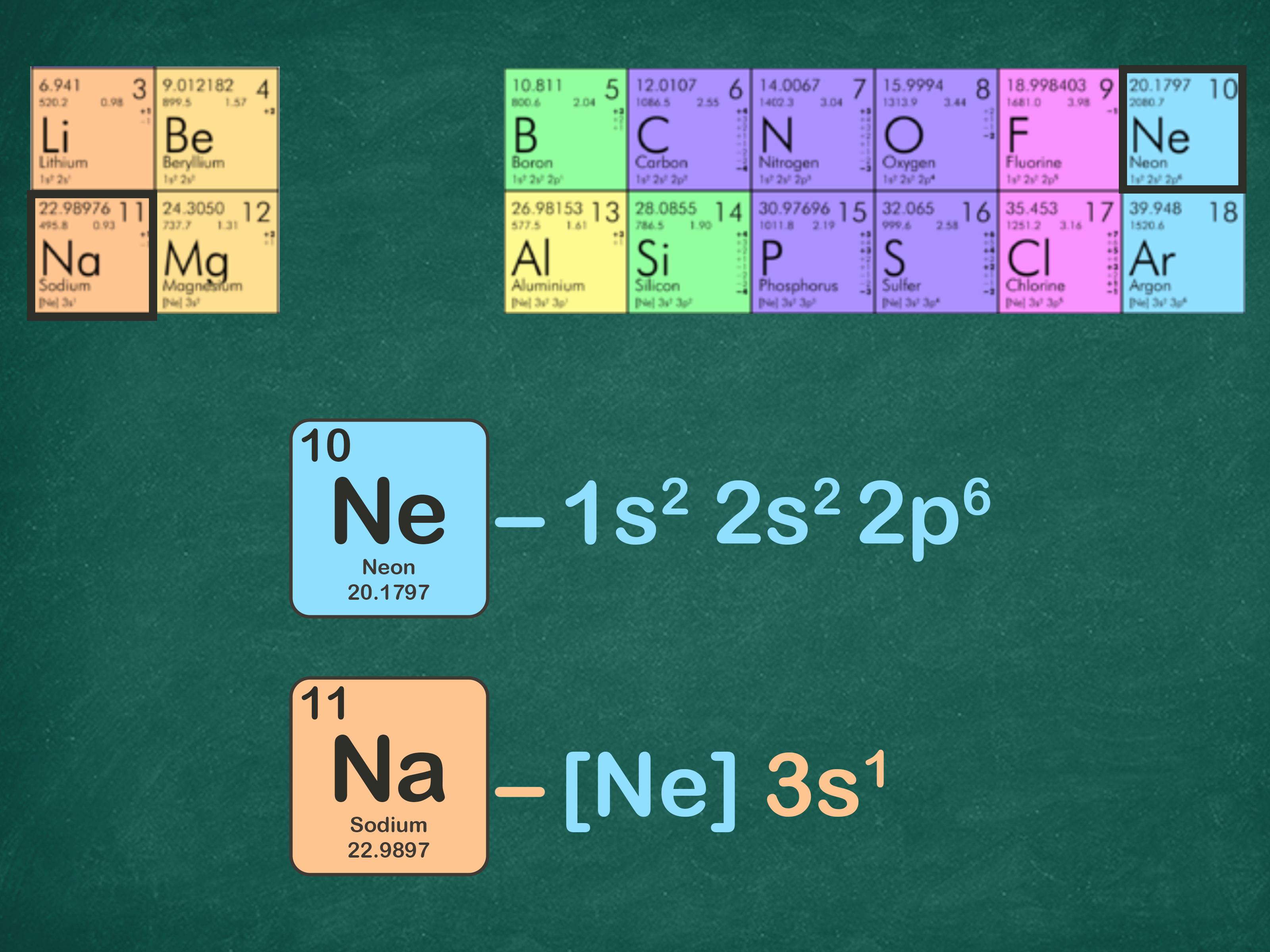
Example idea (we’ll do the full steps later): Sodium (Na) has 11 electrons. Neon (Ne) has 10 electrons.
So sodium can be written as [Ne] 3s1. Same electrons, fewer characters, less hand cramping.
Before You Start: The Three Rules That Keep Electrons Behaving
Noble gas notation is a shortcut, but it still relies on the same ground-state rules as full electron configurations.
Think of these as the “house rules” electrons follow when they move in:
1) Aufbau Principle: Lowest Energy First
Electrons fill the lowest-energy orbitals available before moving to higher-energy orbitals. That’s why
1s fills before 2s, and 2s fills before 2p.
2) Pauli Exclusion Principle: Two Per Orbital, Max
Each orbital can hold at most two electrons, and they must have opposite spins. Translation:
no overcrowdingelectrons are not fans of sharing personal space.
3) Hund’s Rule: Spread Out Before Pairing Up
In a set of equal-energy orbitals (like the three p orbitals), electrons occupy each orbital singly
before pairing. It’s the “everyone gets their own chair before anyone shares a chair” rule.
The Orbital Filling Order You’ll Use Most
To write noble gas configurations, you need the standard filling order (sometimes remembered with a diagonal “stair-step”
diagram). Here’s the common sequence up through the elements most students encounter early on:
1s → 2s → 2p → 3s → 3p → 4s → 3d → 4p → 5s → 4d → 5p → 6s → 4f → 5d → 6p → 7s → 5f → 6d → 7p
Quick capacities (how many electrons each subshell can hold):
s = 2, p = 6, d = 10, f = 14.
Step-by-Step: How to Write a Noble Gas Configuration
Here’s a reliable method you can use for basically any neutral atom (and it scales well when things get spicyhello,
transition metals).
Step 1: Find the atomic number
The atomic number tells you how many protons the element has. For a neutral atom, it also tells you how many
electrons it has. (Neutral means electrons = protons, so nobody’s “electron-rich” or “electron-poor.”)
Step 2: Identify the noble gas immediately before the element
Look left on the periodic table until you hit a noble gas (Group 18). That noble gas becomes your core in brackets.
Important: it must be the noble gas before your element, not after it. Using the noble gas after your element
is like claiming you already finished next week’s homework. Bold strategy. Incorrect, but bold.
Step 3: Subtract to find the “leftover” electrons
Leftover electrons = (atomic number of your element) − (atomic number of noble gas).
Those are the electrons you’ll place after the bracket.
Step 4: Start filling orbitals after the noble gas
Begin with the next subshell in the filling order and add electrons until you place all leftovers.
Step 5: Use subshell capacities
Don’t put 7 electrons in a p subshell. A p maxes out at 6. Electrons have limitsand surprisingly healthy boundaries.
Step 6: Write using standard notation
Format looks like: [NobleGas] nℓx nℓy ...
Example: [Ar] 4s2 3d6
Step 7: Sanity-check the electron count
Add up the electrons after the bracket. Make sure they equal the leftover electrons you calculated in Step 3.
Step 8: Watch for common exceptions (mostly in the d-block)
A handful of elements (famously chromium and copper) “cheat” a little for stability by shifting an electron between
s and d subshells. We’ll cover this in a dedicated section so you don’t accidentally memorize the wrong thing.
Worked Examples (With the Exact Thought Process)
Example 1: Sodium (Na)
Atomic number: 11 → 11 electrons
Nearest preceding noble gas: Neon (Ne), atomic number 10
Leftover electrons: 11 − 10 = 1
After neon, the next subshell is 3s. Put 1 electron there:
[Ne] 3s1
Example 2: Chlorine (Cl)
Atomic number: 17
Nearest preceding noble gas: Neon (10)
Leftover electrons: 17 − 10 = 7
After [Ne], we fill 3s then 3p:
3sholds 2 →3s2(leftover now 5)3pholds up to 6 → put 5 →3p5
Final: [Ne] 3s2 3p5
Example 3: Iron (Fe)
Atomic number: 26
Nearest preceding noble gas: Argon (Ar), atomic number 18
Leftover electrons: 26 − 18 = 8
After [Ar], the filling order goes 4s then 3d:
- Fill
4swith 2 →4s2(leftover now 6) - Put the remaining 6 into
3d→3d6
Final: [Ar] 4s2 3d6
Example 4: Bromine (Br)
Atomic number: 35
Nearest preceding noble gas: Argon (18)
Leftover electrons: 35 − 18 = 17
Fill in order: 4s, 3d, 4p:
4s2uses 2 (leftover 15)3d10uses 10 (leftover 5)4p5uses 5 (leftover 0)
Final: [Ar] 4s2 3d10 4p5
Transition Metals: The “4s Then 3d” Plot Twist
If you’ve heard that transition metals are confusing, congratulationsyou’ve been correctly warned.
Here’s the key idea for neutral atoms: electrons typically fill 4s before 3d in the building-up process,
which is why many configurations look like [Ar] 4s2 3dx.
But when transition metals form ions, the 4s electrons are usually removed first. That detail matters more for ions than for
the “atoms of an element” focus of this article, but it’s a common source of confusionso now you know why your classmate
looked haunted during the transition metal chapter.
Exceptions You Should Actually Know (Without Panicking)
Most elements behave nicely with the standard filling order. A few, especially in the d-block, adopt slightly different
configurations because half-filled or fully filled d subshells can be a bit more stable.
Chromium (Cr), atomic number 24
Expected by basic filling: [Ar] 4s2 3d4
Observed commonly taught ground-state: [Ar] 4s1 3d5
Copper (Cu), atomic number 29
Expected by basic filling: [Ar] 4s2 3d9
Observed commonly taught ground-state: [Ar] 4s1 3d10
Practical advice: for most intro chemistry and general chemistry courses, chromium and copper are the “famous exceptions.”
If your course goes deeper, you may meet a few more, but don’t pre-memorize a whole zoo of edge cases unless your instructor
explicitly wants that.
How to Self-Check Like You Mean It
- Electron count check: The electrons after the bracket must equal (atomic number − noble gas atomic number).
- Subshell capacity check: Never exceed s(2), p(6), d(10), f(14).
-
Periodic table reality check: The final subshell often matches the element’s block:
s-block ends ins, p-block ends inp, d-block ends ind, f-block ends inf.
Common Mistakes (And How to Avoid Them)
Mistake 1: Picking the wrong noble gas
Always choose the noble gas immediately before your element. If your element is bromine, the base is [Ar], not [Kr].
Your goal is shorthand, not time travel.
Mistake 2: Forgetting the 4s-before-3d fill order
For neutral atoms, the filling order goes ... 3p → 4s → 3d → 4p .... If you skip 4s and jump straight into 3d,
your configuration will look suspiciously like it got lost on the way to the right orbital.
Mistake 3: Overstuffing a subshell
If you write 3p7, a chemistry teacher somewhere senses a disturbance in the force.
p tops out at 6. Always.
Mistake 4: Mixing up atoms and ions
This article focuses on neutral atoms. If you’re asked about ions, the electron count changes, and for transition metals the
electrons removed often come from the s subshell first. Read the question carefullychemistry exams love hiding points in plain sight.
Quick Practice (With Answers)
Try these without looking at the answers first. Yes, this is the chemistry equivalent of eating vegetables.
- 1) Magnesium (Mg, 12)
- 2) Sulfur (S, 16)
- 3) Nickel (Ni, 28)
Answers
- 1) Mg:
[Ne] 3s2 - 2) S:
[Ne] 3s2 3p4 - 3) Ni:
[Ar] 4s2 3d8
Field Notes: of Real-World “Experience” With Noble Gas Configurations
If you’ve ever watched a roomful of students write electron configurations at the same time, you’ll notice a funny pattern:
everyone starts confident, then the d-block shows up and the vibe shifts from “I got this” to “I have made a huge mistake.”
Noble gas notation is usually the turning pointthe moment people realize electron configurations don’t have to be a full novel.
They can be a clean, readable summary… like the movie trailer version of an element’s electron life story.
One of the most common “aha” moments happens when learners connect noble gas shorthand to the periodic table’s layout.
Suddenly, the table stops being a colorful rectangle of intimidation and starts acting like a map: the s-block tells you
about s electrons, the p-block tells you about p electrons, and the d-block warns you (politely, at first) that
transition metals come with bonus content. Once that click happens, writing configurations becomes less about memorizing
a diagonal rule and more about reading the periodic table like a seating chart: you can see where electrons “should” go next.
Another real classroom classic: students will often choose the wrong noble gas. Not because they don’t understand the concept,
but because their brains are optimized for speed, not accuracy. They spot a noble gas near the element and grab it like a
life raft. The fix is surprisingly simple: say out loud (yes, out loud), “the noble gas before the element.” That tiny phrase
prevents a ton of errorsespecially with elements near krypton and xenon, where it’s easy to accidentally hop to the next row.
Then there’s the “4s vs 3d” confusionarguably the greatest hit single of the transition metal unit. Students learn the
filling order and correctly place 4s before 3d, then later they hear that 4s electrons get removed first in ions,
and suddenly they feel betrayed by the universe. What helps is reframing it: filling order is about building a neutral atom’s
lowest-energy arrangement, while ion formation is about what happens when electrons are removed and the energy landscape shifts.
It’s not that you were lied to; it’s that chemistry is a layered story, and the sequel adds plot twists.
Finally, the famous exceptions (chromium and copper) tend to become memorable because they feel like electrons are “breaking rules.”
But experienced chemistry learners treat them like pronunciation quirks in English: most words follow patterns, and then “colonel”
shows up and everyone just agrees to move on. The best strategy is to learn the main process first, get fluent with typical cases,
and then add the exceptions as a small, manageable list. That’s how people actually get good at configurationsby building confidence
with the standard method, then sprinkling in the weirdos without letting the weirdos run the whole show.
Conclusion: The Shortcut That Still Shows You the Chemistry
Noble gas configuration is the best of both worlds: it’s faster than writing full configurations, but it still captures the electron
arrangement that drives chemical behavior. When you can quickly write something like [Ne] 3s2 3p5 and understand what it means,
you’re not just filling orbitalsyou’re predicting bonding patterns, reactivity trends, and why the periodic table is organized the way it is.
Keep the workflow simple: find the atomic number, pick the preceding noble gas, subtract, then fill the remaining electrons in order.
Add a quick self-check, watch for the big-name exceptions, and you’ll be writing noble gas configurations like it’s your side hustle.