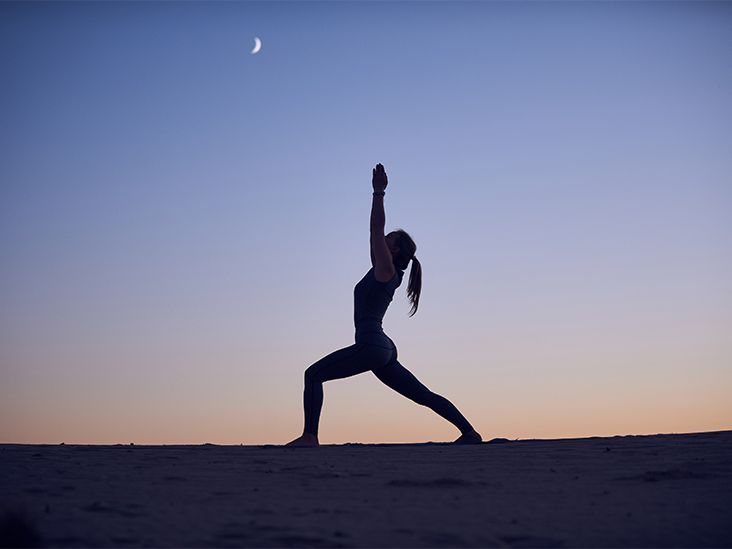

If you’ve ever noticed that your energy shows up on your mat like an unpredictable houseguestsometimes hyped, sometimes hibernatingyou’re not alone.
One simple way to build consistency (without turning yoga into a boot camp or a guilt spiral) is to use a cycle you can actually see: the Moon.
Syncing your yoga practice with the phases of the Moon doesn’t require crystal collections, complicated astrology apps, or the ability to howl on pitch.
It’s basically “periodization” for your nervous system: some days you build, some days you refine, and some days you rest so your practice can keep growing.
Why the Moon Works as a Practice Planner
The Moon moves through eight commonly recognized phases and completes a cycle about every 29.5 days.
That rhythm (new → waxing → full → waning) creates a built-in structure that’s perfect for yoga: intention, momentum, peak, release, reset.
NASA describes these phases as a repeating sequence driven by the Moon’s orbit and how much of its sunlit half we can see from Earth.
(Translation: the Moon isn’t changing shape; our perspective is.)
Think of it like this
- New Moon: quiet start, inward focus, set intentions
- Waxing: build heat, strength, skills, consistency
- Full Moon: peak energy, balance, expressive flows
- Waning: slow down, stretch, restore, release what’s not working
Bonus: a lunar cycle is short enough to feel motivating (unlike “I’ll be consistent all year”), but long enough to see real progress.
A Quick Reality Check: Moon Effects Are Personal (and Science Is Mixed)
Some people swear they sleep worse or feel “wired” around the full moon, and there’s research exploring whether sleep timing and duration shift with lunar light.
One well-known lab study reported differences around the full moon, and later work in real-world settings found sleep can start later and be shorter on nights before the full moon when moonlight is available after dusk.
But other large population studies have found no meaningful relationship.
The practical takeaway is refreshingly non-mystical:
use the Moon as a helpful rhythm, not a strict rulebook.
If full moons make you feel like you drank an invisible espresso, choose grounding and longer exhales.
If you feel totally normal, congratulationsyou may be Moon-proof.
Either way, you still get a smart monthly framework.
How to Start: Your 3-Step Lunar Yoga Setup
1) Track the phase (keep it simple)
Use a standard calendar, a weather app that shows moon phases, or a basic “moon phase” widget.
You’re not trying to earn a PhD in cratersjust identify: new, quarter, full, and the “in-between” weeks.
2) Choose your “default practice style” for each half of the cycle
- New → Full (waxing): strength + learning + consistency
- Full → New (waning): mobility + yin/restorative + reflection
3) Pick a “minimum viable practice” for busy days
This is your “I showed up” option: 8 minutes of breath + a short flow + savasana.
Lunar syncing works best when it reduces decision fatigue.
When your brain asks, “What should I do today?” the Moon answers for you.
The Lunar Phase-by-Phase Yoga Guide
Below is a practical way to align your yoga practice with the eight phases.
Each section includes: (1) how it often feels, (2) what to practice, and (3) a concrete mini-sequence idea.
Adjust intensity for your body, injuries, and experience level.
1) New Moon: Intention + Stillness
The new moon begins the cycle. It’s a natural “blank page” momentgreat for clarifying what you want from practice this month:
strength? flexibility? calmer mornings? less doom-scrolling before bed?
Practice focus: restorative, yin, yoga nidra, gentle hatha, breathwork, longer savasana.
Many traditions treat new moon as a quieter day; some Ashtanga lineages traditionally rest on new moon and full moon days.
Mini-sequence idea (15–30 minutes):
- Seated breath (4-count inhale, 6-count exhale) – 3 minutes
- Child’s Pose – 1–2 minutes
- Cat-Cow – 8 slow rounds
- Low Lunge (each side) – 5 breaths
- Supported Forward Fold (with blocks or chair) – 1–2 minutes
- Legs Up the Wall – 3–8 minutes
- Savasana – 3–5 minutes
Journal prompt: “This month, I’m practicing to feel more ______.”
2) Waxing Crescent: Build the Habit (Gently)
This is the “seedling” phasesmall, steady, not dramatic.
Think consistency over heroics.
Practice focus: short vinyasa flows, foundational strength, posture clean-up, learning a new skill.
Mini-sequence idea (20–35 minutes):
- Sun A (slow) – 3 rounds
- Warrior I → Warrior II (each side) – 3 breaths each
- Plank holds – 3 x 20 seconds
- Bridge Pose – 3 x 5 breaths
- Easy twist + savasana
Practical goal: “Move 4 days this week, even if it’s short.”
3) First Quarter: Meet Resistance (Without Starting a Fight)
Quarter moons are “decision points.” Motivation can wobble.
This is where your practice becomes less about vibes and more about showing up anyway.
Practice focus: strength, core, standing poses, balance drills, technique.
Mini-sequence idea (30–45 minutes):
- Warm-up flow – 5–8 minutes
- Chair Pose – 3 x 5 breaths
- High Lunge → Crescent Lunge twist – 2 rounds each side
- Tree Pose or Eagle – 2 rounds each side
- Pigeon or Figure-4 stretch – 1–2 minutes each side
- Savasana
Mindset cue: “Strong and steady beats intense and inconsistent.”
4) Waxing Gibbous: Refine + Expand
You’re close to the full moon. Energy and confidence often increase, which is greatunless it turns into rushing.
This phase is perfect for refining alignment and breath control while expanding capacity.
Practice focus: longer flows, skill work (arm balances prep, backbends), endurance with good form.
Mini-sequence idea (35–60 minutes):
- Flow with lunges and warriors – 15 minutes
- Half Moon Pose (Ardha Chandrasana) prep at the wall – 3 rounds each side
- Locust or Bow Pose – 2–3 rounds
- Seated forward fold – 1–2 minutes
- Savasana
Skill tip: Film one pose (yes, really) to spot habits like collapsed arches or shruggy shoulders.
5) Full Moon: Peak Energy + Balance
The full moon is the brightest point of the cycle.
In many modern yoga spaces it’s treated as a time for celebration, heart opening, and release practices.
Some practitioners feel extra energized or emotionally “turned up” here, so balancing effort with grounding can be a win.
Practice focus: expressive vinyasa, heart openers, gentle backbends, and/or a “release” themed flow with grounding finishes.
Mini-sequence idea (25–45 minutes):
- Wide-Legged Forward Fold – 5 breaths
- Goddess Pose pulses – 8 slow pulses
- Warrior II → Reverse Warrior – 3 rounds each side
- Low Lunge with chest lift – 5 breaths each side
- Supported Fish Pose (block under upper back) – 1 minute
- Long exhale breathing in savasana – 5 minutes
Reflection prompt: “What’s working in my practice right nowand what’s ready to be adjusted?”
6) Waning Gibbous: Gratitude + Gentle Unwinding
After the full moon, the light begins to decrease. This is a sweet spot for “digesting” your effort:
let your body absorb training, let your mind absorb lessons.
Practice focus: yin-style holds, hip openers, slow mobility, breath-led movement, longer cool-down.
Mini-sequence idea (20–40 minutes):
- Supine twist – 1 minute each side
- Dragonfly (wide-legged seated fold) – 2 minutes
- Sphinx Pose – 1 minute
- Reclined bound angle – 2 minutes
- Yoga Nidra or body scan – 8–15 minutes
7) Third/Last Quarter: Release + Simplify
The last quarter is where you clean housephysically and mentally.
This is a great time for twists, hamstring lengthening, and simplifying your goals for next cycle.
Practice focus: twists, forward folds, gentle strength maintenance, mobility resets.
Mini-sequence idea (30–45 minutes):
- Cat-Cow + thread-the-needle – 6 rounds
- Revolved lunge (easy version) – 5 breaths each side
- Seated twist – 1 minute each side
- Half split (hamstring stretch) – 1 minute each side
- Supported forward fold – 2 minutes
- Savasana
Prompt: “What do I want to stop doing because it doesn’t help anymore?”
8) Waning Crescent: Rest + Restore (The “Do Less, Better” Phase)
The days before the new moon are ideal for rest and restoration.
This isn’t quittingit’s strategic recovery.
If you’ve been pushing hard, your body often responds beautifully to softness here.
Practice focus: restorative yoga, breathwork, gentle walking, early bedtime routines, long savasana.
Mini-sequence idea (15–25 minutes):
- Supported child’s pose – 2 minutes
- Reclined hamstring stretch (strap) – 1 minute each side
- Supported bridge (block under sacrum) – 2 minutes
- Legs up the wall – 5–10 minutes
- 3-part breath – 3 minutes
Where Moon Salutations Fit In (Chandra Namaskar)
If Sun Salutations are your morning coffee, Moon Salutations are your evening herbal tea.
Chandra Namaskar is often taught as a cooling, inward-moving flowgreat for late afternoon/evening practice and for days when you want to move without revving your system.
Different schools teach different versions, but the “moon vibe” usually includes side bends, wide stances, hip opening, and a calmer cadence than a typical Surya Namaskar.
A simple “Moon Salutation-inspired” loop you can repeat 3–6 times
- Mountain Pose → overhead reach
- Side bend (right/left)
- Wide stance → Goddess Pose (slow breaths)
- Turn to one side → Warrior II → Reverse Warrior
- Triangle Pose (optional block)
- Wide-legged forward fold
- Step back to Downward Dog (or table-top if you want gentler)
- Return to Mountain Pose and pause
Use this flow during the new moon for quiet movement and during the full moon as a grounding “container” for bigger feelings.
Sample 29-Day Lunar Yoga Plan (Flexible, Not Bossy)
Here’s a simple way to map practice intensity across a lunar month.
Swap days as neededyour life schedule matters more than lunar perfection.
- New Moon (1–2 days): restorative/yin + intention setting
- Waxing Crescent (5–6 days): short strength + fundamentals
- First Quarter (2–3 days): stronger flow + balance
- Waxing Gibbous (5–6 days): longer practice + skill refinement
- Full Moon (1–2 days): expressive flow or release practice + grounding finish
- Waning Gibbous (5–6 days): yin/mobility + longer cool-down
- Last Quarter (2–3 days): twists + simplify goals
- Waning Crescent (5–6 days): restorative + sleep-supportive routines
Common Mistakes (and How to Avoid Them)
Mistake #1: Treating the full moon like a fitness test
“Peak phase” doesn’t mean “PR day.” If you feel amped, balance it with longer exhales, hip openers, and a slower cooldown.
Think: strong start, soft landing.
Mistake #2: Skipping rest phases because they look “easy”
Waning phases are where recovery happensand recovery is where you actually improve.
If your body feels cranky, sleep is messy, or motivation is fading, the answer is often less intensity, not more.
Mistake #3: Using the Moon as a reason to ignore your body
The Moon is a schedule, not a supervisor.
If you’re injured, sick, or exhausted, scale down.
If you’re feeling great during a waning phase, you can still enjoy a stronger flowjust keep it mindful.
Practical Add-Ons That Make Lunar Yoga Actually Stick
Pair each phase with one tiny ritual
- New Moon: write 1 intention + 1 micro-step
- First Quarter: choose 1 pose to improve and practice it 3 times
- Full Moon: list 3 wins from the past two weeks
- Last Quarter: delete 1 habit from your routine that drains you
Use breath as your “Moon dial”
Want to make any practice more lunar (calming)?
Lengthen the exhale. Want more solar (energizing)?
Use a slightly stronger inhale and keep the pace brisk (without rushing).
Breath is the quickest way to steer the nervous system.
Conclusion: Your Practice, Now with a Monthly Rhythm
Syncing your yoga practice with the phases of the Moon is less about superstition and more about structure.
The lunar cycle gives you a repeating pattern to follow: start fresh, build steadily, peak mindfully, and release on purpose.
Over time, you’ll likely notice something wonderful:
you stop asking “Should I practice today?” and start asking “What kind of practice fits today?”
That’s how consistency gets quietly unstoppable.
Experiences: What Practitioners Commonly Notice When They Go “Lunar” (Extra )
Since I can’t claim personal lived experience, what follows is a synthesis of the kinds of experiences yoga teachers and students commonly describe when they experiment
with lunar-aligned practiceespecially in communities that already emphasize cyclical living, restorative work, and monthly intention-setting.
Treat these as real-world patterns and anecdotes, not promises.
1) Decision fatigue drops fast. A surprisingly big win is mental: people report that having a “phase-based default” eliminates the daily negotiation.
Instead of scrolling for the perfect class or overthinking what their body “should” do, they pick the practice style that matches the phase and move on.
Over a few months, that alone can increase consistency more than any motivational quote ever could.
2) The new moon becomes a reset button that actually gets used. Many yogis say they love the idea of intention-setting but rarely do it.
When it’s tied to the new moon, it becomes a recurring appointment with themselves: light a candle, do a short restorative sequence, write a few lines, done.
People often describe this as calminglike organizing a messy desk, but for the brain.
The key experience isn’t “magic,” it’s clarity: one intention and one tiny action step tends to feel doable, which makes it more likely to happen.
3) Waxing phases feel like “training season.” Practitioners often say the first half of the lunar month becomes a natural time to build strength or learn something:
maybe holding plank longer, improving Warrior II alignment, or finally making peace with Half Moon Pose using a wall.
Because the plan already expects more effort here, people report less guilt about working hardand less burnoutbecause they know softer days are coming.
4) Full moon practices reveal what needs balancing. A common observation is that full moon days highlight extremes:
if someone is already stressed, they might feel extra buzzy; if they’re emotionally tender, they may feel more sensitive.
Teachers often suggest leaning into groundinglonger exhales, slower transitions, strong standing poses with steady gaze.
People who try this frequently report that the full moon becomes less chaotic and more like an honest “check-in” on their nervous system.
5) Waning phases improve recovery (and sometimes sleep routines). Many practitioners say the second half of the month helps them take recovery seriously.
Instead of treating yin and restorative as “lesser” yoga, they start seeing it as a performance enhancer: fewer aches, better mobility, calmer evenings.
Some people also report building better nighttime habits hereshorter screens, longer savasana, and more consistent wind-down routines.
Whether or not the moon itself affects sleep, the behavioral shift can be meaningful.
6) The biggest long-term experience is self-trust. After several cycles, many yogis describe feeling more “in sync” with themselvesnot because the Moon controls them,
but because they’ve practiced listening: pushing when it’s supportive, softening when it’s wise, and letting the practice evolve.
In the end, lunar yoga tends to work best as a friendly guide that keeps you practicing for months… instead of sprinting for a week.