
Your cat needs eye drops. Your cat also believes eye drops are a personal attack on their freedom, dignity, and (possibly) the entire concept of medicine.
The good news: with a calm setup, safe handling, and a few “cat psychology” tricks, you can get those drops in without turning your living room into a tiny
feline wrestling arena.
This guide walks you through how to give your cat eye drops in 11 clear steps, plus real-world troubleshooting and safety tips. It’s written
for standard at-home dosing, but it doesn’t replace your veterinarian’s instructionsbecause your vet has met your cat, and I have only met the idea of your cat.
Before You Start: A Quick Reality Check
Use only the medication your veterinarian prescribed
Cats are not small humans in adorable fur coats. Many human over-the-counter products (including some eye drops) can be unsafe for pets. If you’re not 100% sure
the drop is intended for your cat, call your vet before using it.
Know what “success” looks like
A perfect drop lands on the eye. A “still pretty good” drop lands in the lower eyelid pocket and spreads when your cat blinks. A “nope” drop lands on fur and
accomplishes… hydration. If you miss, don’t panic. You’ll learn how to recover without doubling the dose.
Plan for speed, not drama
Most cats tolerate eye drops better when it’s quick, predictable, and followed by something they love (treats, a meal, a favorite brush, or their best “you may
worship me now” chin scratch).
The Supplies You’ll Want Nearby
- Prescribed cat eye drops (check label for dosage and which eye)
- Clean towel (for the “purrito” wrap, if needed)
- Gauze or soft tissue (to wipe away dischargeno poking!)
- Treats or a spoon of wet food (high-value bribery is ethical here)
- Good lighting (you’re aiming for a small moving target)
- Timer or phone reminder (consistency matters for eye medication)
How to Give Your Cat Eye Drops: 11 Steps
-
Read the label like it’s the final exam
Confirm the right medication, the right eye (left/right), the number of drops, and the schedule.
If your cat has more than one eye medication, follow your vet’s order. (In many cases, drops go before ointment, and spacing between meds is recommended.) -
Pick a calm location and set the stage
Choose a spot where your cat can’t easily launch into another dimensionlike a bathroom, hallway, or small room. Close doors, remove distractions, and keep your
supplies within arm’s reach. The goal is: one trip, one drop, done. -
Wash your hands (yes, every time)
Eye medications should stay clean. Wash hands before and after to reduce contamination and prevent spreading infection between pets (or between your cat’s eyes).
-
Prep the bottle properly
If the label says “shake well,” shake it. Remove the cap only when you’re ready. Avoid touching the tipyour hands, your cat’s fur, and the counter are all
trying to join the bacteria Olympics. -
Gently clean any crust or discharge
If there’s gunk around the eye, soften it first with a dampened piece of gauze or a soft tissue (use warm water unless your vet advised otherwise). Wipe outward
from the corner, and use a fresh piece for repeat wipes. Don’t scrub, and don’t press on the eyeball. -
Choose your hold: solo, helper, or “purrito”
Option A (solo): Sit your cat in your lap facing away from you, with their back against your belly.
Option B (helper): One person calmly holds and stabilizes the head; the other administers the drops.
Option C (purrito wrap): Wrap your cat snugly in a towel with only the head exposed, keeping paws tucked. This reduces scratching and sudden escapes.Whichever method you choose, keep it gentle. The purpose of restraint is safety and stability, not winning a contest.
-
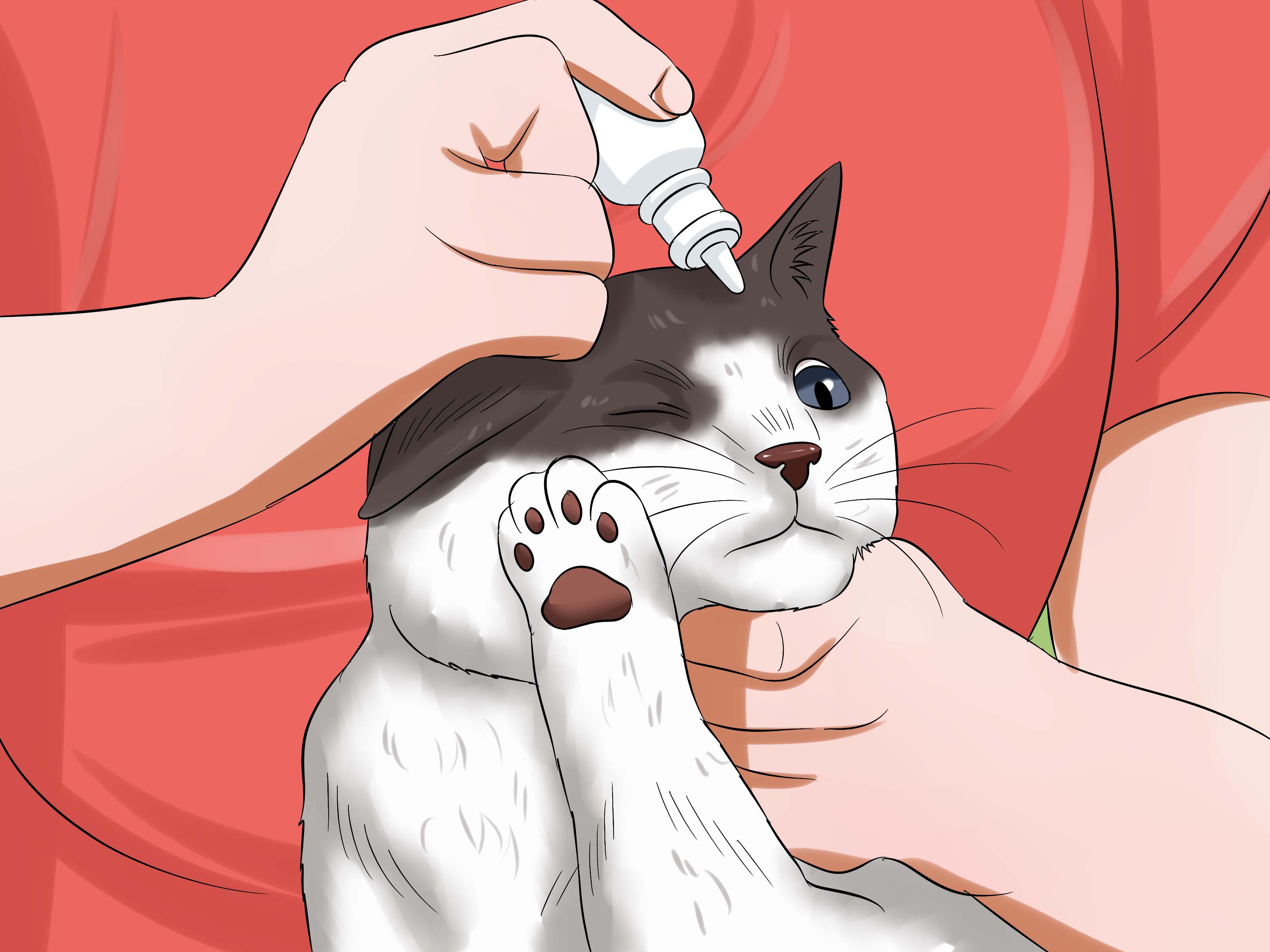
Position the head: “chin up, eyes up”
With one hand, support your cat’s head under the chin and gently tilt upward. A stable head makes the drop easier and faster. Keep your posture relaxedcats notice
tension like it’s their job (and honestly, it is). -
Create a landing zone (the lower lid pocket)
If you can, use your thumb to pull down the lower eyelid slightly. This makes a small pocket where the drop can land even if your cat tries the “instant blink”
technique. -
Hold the bottle closebut don’t touch the eye
Bring the bottle above the eye. Keep the tip close enough for accuracy, but never let it touch the eye, lashes, or fur. Touching can contaminate
the bottle and can also startle your catleading to the classic “head whip + drop on your shirt” outcome. -
Deliver the drop, then let your cat blink
Squeeze the prescribed number of drops. Aim for the center of the eye if you can, but landing in the lower lid pocket is also effective. Then release the head and
let your cat blink naturally to spread the medication.If you miss: If the drop lands on fur or the cat clamps shut before it lands, wait a moment and try again. Don’t immediately “rapid-fire” multiple drops out of frustration.
-
Praise, reward, and record
Immediately follow with a treat, a meal, or a favorite activity. This builds a predictable routine: “Drop happens → good thing happens.” If you’re managing a multi-day
course, jot down the time given to avoid missed or doubled dosesespecially in multi-person households where everyone assumes “someone else did it.”Finally, recap the bottle and store it as directed. Some eye drops should be stored in a cool, dry place; others may need refrigeration. Follow the label and your vet’s instructions.
Troubleshooting: When Your Cat Acts Like a Tiny Drama Critic
My cat runs when they see the bottle
Try “neutralizing the trigger.” Leave the closed bottle out (out of reach of pets and kids) for a day or two, and occasionally give treats nearby without dosing.
You’re teaching your cat that the bottle’s presence doesn’t always mean The Event.
My cat clamps their eyes shut
Use the lower lid pocket method and aim for the corner where the lid opens slightly. Some cats relax when you approach from the side rather than straight-on.
Keep your motions slow, then commit quickly.
My cat thrashes or scratches
Move to the towel wrap (“purrito”) and consider the two-person method. If you’re consistently struggling, talk to your vetsometimes technique adjustments, different formulations,
or behavioral strategies can make a big difference.
I have to give more than one eye medication
Follow your vet’s instructions for order and timing. In many cases, spacing medications helps one product avoid washing out the next, and drops are often given before ointments.
If you’re unsure, call your vet’s office and ask for the exact sequence.
Safety Notes You Shouldn’t Skip
- Do not share medications between pets or use old leftovers unless your vet specifically instructed you to.
- Keep the tip sterile: don’t touch the eye, lashes, fur, your fingers, or countertops with the dropper tip.
- Don’t “make up” a dose if you missed onecall your vet for guidance on what to do next.
- Stop and call the vet if you notice severe squinting, worsening redness, swelling, cloudiness, significant discharge, or if your cat seems very painful or suddenly worse.
Conclusion: Make It Boring (That’s the Goal)
The best way to give your cat eye drops is to make the process so calm and routine that it becomes… uninteresting. Read the label, set up your space, keep the bottle tip clean,
stabilize the head, land the drop, reward immediately, and move on with your day like nothing happened. Your cat may still glare at you, but that’s just part of the brand.
Real-World Experiences: What Cat Parents Say Works (And What Doesn’t)
If you’ve never given a cat eye drops before, it’s easy to assume the challenge is “getting the medicine into the eye.” In real life, the challenge is often
everything around that moment: timing, routine, your own nerves, and the cat’s ability to sense hesitation like a psychic with whiskers.
A common experience: the first attempt takes ten minutes and three apologies. Then someone discovers the magical power of “prep first.” Cat parents often report that once
the cap is already loosened, the towel is already spread out, the treats are already open, and the lighting is good, the whole process drops to under thirty seconds. The cat
doesn’t have time to escalate because you don’t have time to fumble. It’s not about being sneaky; it’s about being efficient.
Another frequent lesson is that your emotional vibe matters more than you’d like it to. People describe a cycle: they tense up, the cat tenses up, and suddenly
both parties are auditioning for a reality show called Extreme Eyedrops. The fix is surprisingly practical: take two slow breaths, lower your shoulders, and talk to your cat
in a normal voice. Not a guilty voice. Not a “please don’t hate me” voice. A “we do this every day” voice. Cats may not understand English, but they understand “this human is calm
and predictable.”
The towel wrap is another crowd favorite, mostly because it protects both of you. Cat owners who resisted the purrito at first often end up loving it after a few
chaotic sessions. The key detail people emphasize: the wrap has to be snug enough to prevent a paw from slipping out. A loose wrap can actually make a cat more frantic because they
feel trapped but still able to struggle. When done well, a purrito feels like a secure swaddlehead out, paws tucked, and fewer surprise scratches.
Many also mention the value of pairing drops with a “jackpot reward”something your cat only gets after eye meds. Not the everyday kibble. Not the “I guess this is fine”
treat. The good stuff. Some households use a tiny spoonful of wet food, a squeeze-up treat, or a special toy that appears for two minutes and then vanishes like a rare comet. Over time, cats
may still dislike the drops, but they start showing up because the after-party is worth it.
One more experience that comes up a lot: people feel discouraged when they “miss” a drop. In practice, cat parents often discover that a drop landing on the lower lid pocket is still a win,
and that blinking does a lot of the work. Perfection isn’t required; consistency is. And if you truly can’t get the drops inday after daymany owners say the best turning point was simply
calling the vet and admitting, “We are struggling.” Clinics can demonstrate technique, suggest a different hold, or sometimes adjust the medication plan. You’re not the first person to lose a
staring contest with a cat.
The overall theme from real households is refreshingly simple: make the routine short, predictable, and rewarding. When it’s done the same
way, at the same time, with the same calm energy and the same payoff, many cats stop escalating. They may never love eye dropsbut they can learn that it’s a brief, boring event followed by
something wonderful. Which, honestly, is also how most humans feel about dentist appointments.