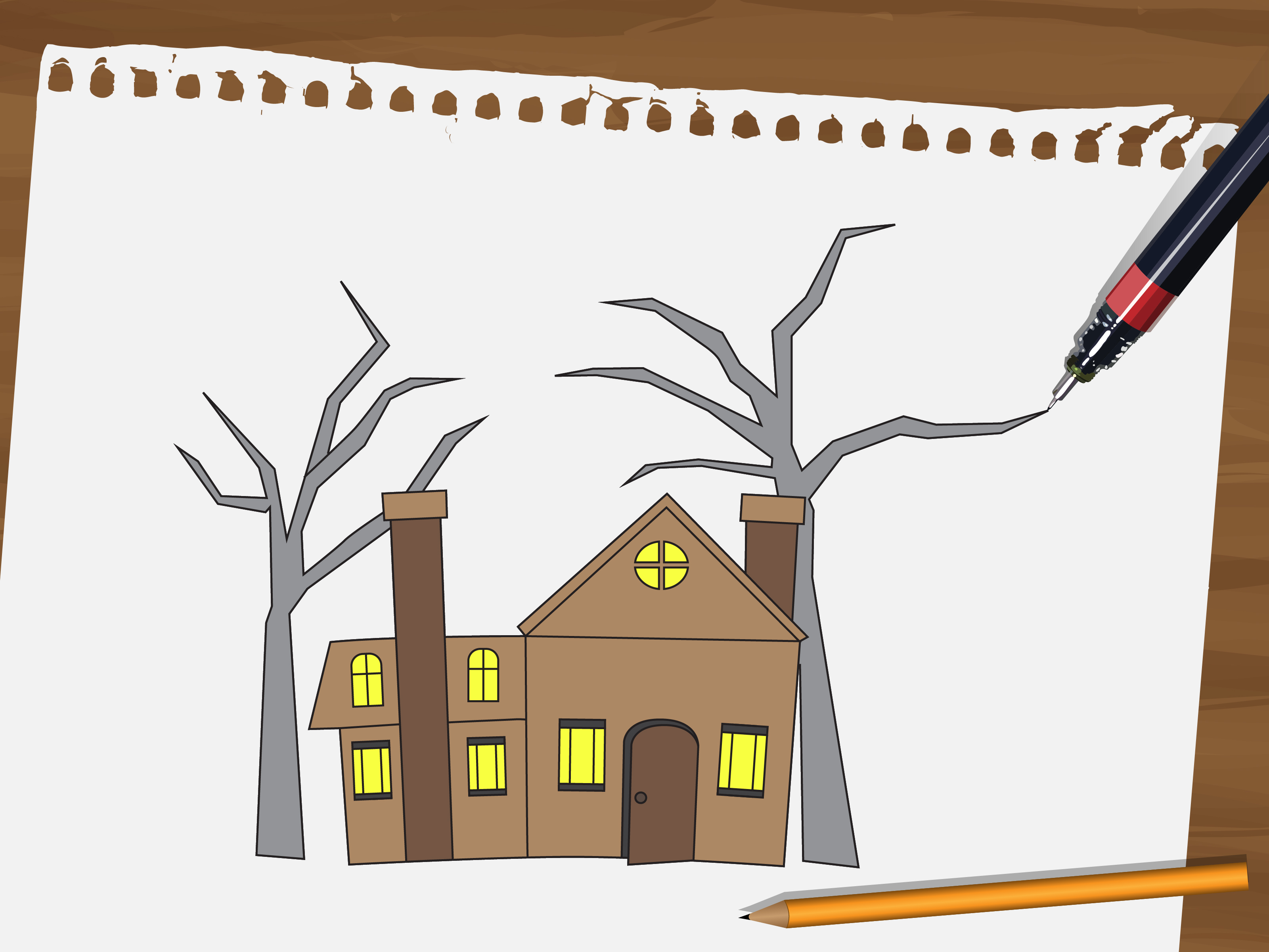

Want to learn how to draw a haunted house that looks spooky, believable, and just a little bit like it pays taxes in screams?
Perfect. A great haunted house drawing is basically a regular house… with bad vibes, crooked architecture, and lighting that says,
“Don’t go in there,” even if the door is technically adorable.
I pulled together the most useful tips from a bunch of U.S.-based drawing lessons and art-education resourcesthen rewrote the whole thing into a
fun, practical guide you can actually follow. You’ll get a clean 15-step process, plus tricks for perspective, shading, and creepy details that sell
the scene (without turning your page into a keyword-stuffed haunted real estate listing).
What You’ll Need
Keep it simple. You can make a killer spooky house sketch with basic supplies:
- Pencil (HB for sketching; 2B/4B for deeper shadows if you have them)
- Eraser (a kneaded eraser is great for soft highlights, but any eraser works)
- Paper (plain printer paper is fine; thicker paper is nicer for shading)
- Optional: ruler (for quick perspective lines), fineliner/marker (for clean outlines), colored pencils or watercolor
How to Draw a Haunted House: 15 Steps
These steps work whether you want a cute Halloween house drawing or a full-on creepy mansion illustration. Go light at firstyour eraser is your
friendly ghost.
-
Step 1: Pick the Mood (and Commit)
Decide your haunted vibe: cartoony (fun Halloween), gothic (dramatic), or realistic (uh-oh).
This choice affects everythingshape, detail, and how intense your shadows get. If you’re unsure, go “storybook spooky.” It forgives mistakes like
a polite vampire. -
Step 2: Sketch the Ground Line or Hill
Lightly draw a curved hill or a slightly uneven ground line. Haunted houses almost never sit on perfectly flat landbecause stability is for
emotionally healthy buildings. -
Step 3: Block In the Main House Shape
Draw a large rectangle (or two stacked rectangles) for the main structure. Keep it simplethis is your “skeleton.” If your house is going to lean,
make it a tiny lean now, not a full collapse later. -
Step 4: Add a Side Wing or Tower
Attach a smaller rectangle to one side for an extra wing, or add a tall narrow rectangle for a tower. Haunted houses love asymmetry. Symmetry is
cheerfuland we’re not here to draw a house that hands out full-size candy bars. -
Step 5: Set Up Simple Perspective (So It Looks 3D)
Choose an easy approach: front-facing (flat, simplest) or one-point perspective (better depth).
For one-point perspective, imagine a “vanishing point” on the horizon; roof edges and side walls subtly angle toward it. You don’t need a math
degreejust keep angles consistent. -
Step 6: Draw the Rooflines (Make Them a Little Wrong)
Add triangular or slanted roof shapes on top of each section. Then “haunt” them: slightly uneven angles, sagging edges, or a roofline that looks
like it’s tired of being a roof. Small imperfections = spooky charm. -
Step 7: Add Eaves, Overhangs, and Roof Layers
Give the roof thickness by adding a second line under the roof edge. Layered roofs (one roof overlapping another) instantly make your haunted house
drawing feel more complex and believable. -
Step 8: Place the Door (The Portal of Bad Decisions)
Draw a tall doorarched, crooked, or too narrow (narratively suspicious). Add a frame and a knob. If you want extra creep factor, tilt the door
slightly or add cracked boards like it’s been “renovated” by raccoons. -
Step 9: Add Windows (Broken, Crooked, or Glowing)
Windows sell the haunted vibe fast. Try tall gothic windows, small square ones, or a round attic window. Make a few uneven or cracked.
Want instant Halloween energy? Add a couple windows with a warm glowlike something inside is reading your thoughts. -
Step 10: Add Architectural Details
Add a chimney, columns, railings, steps, or a porch. Keep lines slightly imperfect. You can also add boards across a window, a bent weather vane,
or a crooked sign. These details turn “house” into “story.” -
Step 11: Texture the House (Wood, Brick, Stone… Regret)
Choose one main texture so it doesn’t get visually chaotic:
- Wood siding: uneven vertical lines, a few gaps, subtle knots
- Bricks: suggest clusters of bricks instead of drawing every single one
- Stone: irregular shapes with small cracks and shading between stones
Tip: texture should be quieter than your big shapes. Let the silhouette do the talking; let the texture whisper ominously.
-
Step 12: Add the Haunted Yard
Draw a crooked fence, a winding path, dead grass tufts, or a few leaning tombstones. A path leading to the door is great compositionit pulls the
viewer in like a horror movie character who definitely heard the warning. -
Step 13: Add Spooky Props (Choose 3–7)
This is where your Halloween house drawing becomes unforgettable. Pick a few:
- Bats near a moon
- Spiderwebs in corners or porch rails
- A black cat silhouette in a window
- Ghost shapes peeking from behind the house
- Hanging lantern, creepy tree, or broken sign
Don’t add everything. “Too many spooky things” becomes “party store exploded.”
-
Step 14: Choose a Light Source, Then Shade Like You Mean It
Decide where the light comes from: moon behind the house? lantern by the door? glowing windows? Then shade consistently:
- Darken under roof overhangs, porch ceilings, and window interiors
- Add cast shadows on the ground from the house, fence, and trees
- Use hatching or cross-hatching for controlled darkness
Pro vibe: make the side facing away from the light noticeably darker. Depth = instant credibility.
-
Step 15: Ink, Erase, and Finish the Scene
Once you like your sketch, darken the final lines (pencil or pen). Erase construction lines. Add finishing touches:
more contrast, tiny cracks, and maybe a bit of fog or drifting clouds. Step back and ask, “Would I enter this house?”
If the answer is “Absolutely not,” congratulationsyou nailed it.
Spooky Upgrades That Make Your Drawing Look Pro
Use Silhouettes for Instant Drama
A strong silhouette is the cheat code of creepy art. Try a dead tree with claw-like branches, bats as simple “M” shapes, or a fence with uneven posts.
Silhouettes read clearly even from far away, which is great for posters, cards, and thumbnails.
Add Atmospheric Effects (Fog, Clouds, and “Nope”)
Lightly shade fog as soft bands near the ground or behind the house. For clouds, use gentle smudging or loose pencil circles.
Keep edges softfog shouldn’t look like a bedsheet unless you’re literally drawing a ghost doing laundry.
Make Windows Tell a Story
Mix window styles: one boarded up, one shattered, one glowing. A few uneven window frames imply age and neglect.
If you want a subtle scare: draw a tiny silhouette shape in one window. Not a full monster. Just… a “maybe.”
Common Mistakes (and How to Fix Them Fast)
- Everything is the same angle: Add a tower, a wing, or vary roof heights so the building feels layered.
- It looks flat: Push the shadows darker and add roof thickness plus a cast shadow on the ground.
- Too many details: Pick one “hero area” (door + porch, or tower + moon) and simplify elsewhere.
- Perspective feels off: Lightly sketch guidelines and keep window bottoms aligned on the same “level” if they’re on the same floor.
Quick Variations for Any Style
Easy Haunted House Drawing (Beginner-Friendly)
Use simple shapes (rectangle + triangle roof), then add spooky details: crooked fence, moon, a few bats, and dark windows.
Keep textures minimal and focus on bold shadows.
Creepy Mansion Illustration (More Advanced)
Add multiple roof layers, detailed porch rails, brick suggestions, and a stronger light source (moonlight or lantern).
Use cross-hatching to deepen shadows under eaves and inside windows for that moody, cinematic look.
Conclusion
Drawing a haunted house isn’t about perfect architectureit’s about personality. Crooked lines, layered roofs, dramatic shadows, and
a few well-chosen spooky props can turn a basic house shape into a scene that feels alive (or… tastefully undead).
Follow the 15 steps, keep your light source consistent, and remember: if your house looks slightly “wrong,” that’s not a mistakethat’s the haunting
doing its job.
Field Notes: of Haunted House Drawing Experience
The first haunted house I ever drew looked like a regular suburban home that had simply heard one too many ghost stories. It was upright, polite, and
honestly kind of reassuringlike it would offer you hot cocoa instead of a cursed amulet. The fix wasn’t “more detail.” The fix was attitude.
As soon as I tilted the roofline a few degrees and made the windows slightly uneven, the whole drawing snapped into “spooky mode.”
Over time, I learned that haunted house art is basically a balancing act between structure and chaos. Too much structure and it looks like a blueprint.
Too much chaos and it looks like a pile of shapes having a disagreement. My favorite approach is to start with clean, simple building blocks (rectangles,
roof triangles, a tower), then add tiny “errors” on purpose: a sagging porch, a chimney that leans, or a fence post that’s clearly given up on life.
Those small imperfections read as age and neglectwhich is exactly what you want in a spooky house sketch.
Shading was my other big “aha” moment. Early on, I’d shade everything lightly and wonder why the drawing didn’t feel eerie. The trick is contrast.
Haunted houses need committed shadows: under the eaves, inside windows, behind trees, and along the side that faces away from your moon or
lantern. Once I started pushing darks darkerand leaving a few crisp highlightsmy haunted houses suddenly looked three-dimensional, like you could
walk right up the path (you shouldn’t, but you could).
I’ve also learned that props are powerful, but restraint is power. The temptation is to add bats, ghosts, pumpkins, cobwebs, graveyards, lightning,
ravens, and maybe a dramatic fog machine. But the drawings I like best use three to seven strong details that support the story. For example: a full moon,
two bats, one crooked tree, and glowing windows can be creepier than twenty different Halloween icons fighting for attention.
My favorite “real life” haunted house drawing sessions happen when people draw togetherkids, friends, or a classroom. Everyone starts with the same
steps, but the results are wildly different. One person makes a cute haunted cottage. Another draws a gothic mansion that looks like it owns a pipe organ.
Someone inevitably draws a tiny ghost with the expression of a stressed accountant. And that’s the best part: a haunted house is a setting, but it’s also
a character. Once you understand that, you stop trying to make it perfectand start making it memorable.