
If you’ve ever walked into your living room, seen your dog sitting like a
broken potato statue, and thought, “Hey, uh… what’s wrong with my dog?”
congratulations, you’ve unlocked one of the great universal experiences of
pet parenthood.
The Bored Panda-style “Hey Pandas” threads tap into that exact feeling:
thousands of dog owners proudly posting photographic evidence that their
pups are, in fact, fuzzy little weirdos. From dogs stuck halfway through a
couch cushion to majestic derp faces mid-sneeze, the internet has proven
one thing: our dogs are fine… they’re just gloriously strange.
In this article, we’ll unpack the spirit of “Hey Pandas, What’s Wrong With
Your Dog?” and use real-world veterinary insights to explain why your pup
zooms, sploots, derps, and occasionally behaves like a tiny malfunctioning
dragon. We’ll talk about which behaviors are normal (and hilarious), when
you actually should worry, and why your weird dog is probably perfect just
the way they are.
Why Everyone Thinks Their Dog Is Broken (In the Best Way)
The reason a thread like “What’s Wrong With Your Dog?” hits so hard is
simple: dogs do stuff that doesn’t make sense to our human brains. They
freeze mid-step, stare at walls, sleep upside down with their teeth out,
and sprint around the house like someone pressed fast-forward on their
paws.
Behavior experts point out that a lot of this “malfunction” is just normal
dog behavior seen out of context. Zoomies happen when dogs release pent-up
energy in short, wild bursts. Head tilts can help them hear better or focus
on your facial expressions. Rolling in something disgusting is, weirdly,
a throwback to their wild ancestors trying to mask their scent. In other
words, your dog probably isn’t broken; they’re just running on the
wonderfully chaotic operating system called “Canine 1.0.”
Common “What’s Wrong With Your Dog” Moments (That Are Totally Normal)
Let’s walk through some of the most screenshot-worthy dog behaviors that
look alarming or ridiculous, but are usually harmless. Think of this as a
guided tour of your dog’s internal comedy show.
The Zoomies: When Your Dog Turns Into a Furry Comet
One moment your dog is lying peacefully. The next, they’re sprinting
laps through the house, bouncing off furniture, and doing NASCAR turns
around the coffee table. This high-speed chaos has a name: the zoomies,
or “FRAPs” (frenetic random activity periods).
Vets explain that zoomies help dogs blow off steam and reset their nervous
system. They’re common after a bath, at sunset, or when your dog suddenly
realizes they have feelings and must run about it. As long as your dog
isn’t crashing into walls or injuring themselves, zoomies are normal and
honestly, pretty great content for your next “What’s wrong with my dog”
post.
The Legendary Head Tilt
You ask, “Who’s a good boy?” and your dog tilts their head so hard you
briefly consider quitting your job to become a full-time dog photographer.
That iconic head tilt isn’t just cute; it’s functional. Dogs may tilt their
heads to adjust their ears for better sound localization or to see your
face more clearly around their muzzle.
Some research suggests head tilting may be a sign of focus, curiosity, or
trying to decode your words. So no, there’s nothing wrong with your dog
they’re just processing your nonsense like, “You said ‘walk’ and ‘vet’ in
the same sentence. Clarify, human.”
Splooting and Cursed Sitting Positions
Few things look more “broken” than a dog sitting like a person, legs
stretched straight out in front, or lying flat with their back legs
splayed behind them in a full sploot.
Many dogs, especially flexible breeds or younger pups, sploot because
it’s comfortable and cooling on hard floors. Odd-looking sitting positions
can be completely normal too. The main thing to watch: if your dog seems
stiff, reluctant to move, or suddenly stops sitting or lying in ways they
used to enjoy, that could be a sign of hip or joint discomfort rather than
pure comedy.
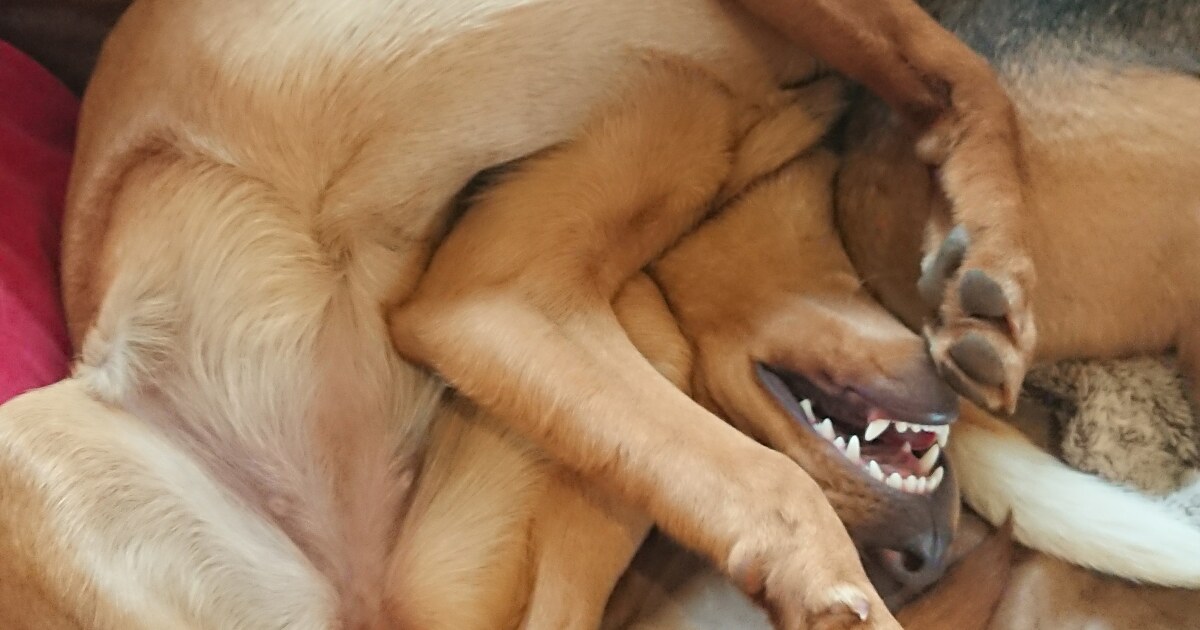
Sleeping Like a Broken Toy
Upside down, paws in the air, tongue hanging out, eyes half-open like a
haunted doll dog sleep positions are peak “What’s wrong with your dog?”
energy. In most cases, this is just your dog choosing whatever position
feels safe and comfy.
Dogs that sleep on their backs with their belly exposed may feel especially
secure and are cooling off by exposing less insulated areas. The half-open
eyes and twitching paws? That’s REM sleep. Dogs dream, and sometimes that
dream apparently involves chasing ghost squirrels.
Chasing Their Tail Like They’ve Just Met It
Watching a dog spin in circles after their own tail is undeniably funny,
and yes, a little questionable. Often, tail chasing is just boredom,
curiosity, or a way to burn extra energy. Puppies especially may only
recently realize that the tail is attached to them and must be investigated
immediately.
However, if your dog is chasing or chewing their tail obsessively, or if
the area looks irritated, it can signal fleas, allergies, anal gland
issues, or compulsive behavior. Funny is fine; frantic is not. When in
doubt, ask your vet to take a look.
Rolling in Gross, Unspeakable Things
If your dog has ever located the single smelliest object within a mile
radius and rolled in it like they were being paid, you’ve probably
wondered, “Seriously, what is wrong with my dog?”
Behavior experts think this habit goes back to wild canines masking their
scent. Rolling in strong odors could help them blend into the environment
or bring information back to the pack. To us, it’s revolting. To them,
it’s “Eau de Decomposed Mystery.” While gross, it’s usually normal though
you’ll want to keep up with parasite prevention and, of course, emergency
bath supplies.
Eating Grass and Other Questionable Snacks
Dogs munching grass is a classic “What are you doing?” moment. Many healthy
dogs occasionally nibble grass with no issue. Some may do it because they
like the texture, are mildly nauseous, or just… because they’re dogs.
Poop eating (coprophagia) is another extremely on-brand but alarming
behavior. It can be related to boredom, learned habits, or, less commonly,
nutritional issues. If it’s frequent, talk to your vet about diet,
deworming, and ways to manage the behavior. You don’t have to accept
“organic yard snacks” as a personality trait.
Butt Scooting Across the Floor
The butt scoot: hilarious, deeply embarrassing, and very much a “What’s
wrong with your dog?” moment when guests are over.
Unlike many goofball behaviors, scooting usually means something actually
needs attention. Common culprits include full or irritated anal glands,
allergies, or worms. It makes a great meme, but it also makes a great
reason to call your vet for a check-up.
Barking at Invisible Things
No, your dog probably isn’t seeing ghosts (probably). Dogs hear and smell
far more than we do, so that “random” bark at the doorway might be a car
you can’t hear or a whiff of another animal outside.
Occasional barking at “nothing” is normal. But if your dog suddenly
becomes hypervigilant, anxious, or can’t settle down, you may be looking
at stress, cognitive changes in older dogs, or a shift in their
environment that’s making them uneasy.
When Weird Dog Behavior Actually Means Something Is Wrong
Most odd dog antics are harmless. Still, some “What’s wrong with your dog?”
moments have real medical or behavioral roots. Instead of panicking at
every derp face, watch for patterns and context.
Red Flags You Shouldn’t Ignore
- Sudden behavior change. A normally playful dog that
becomes withdrawn, clingy, or unusually aggressive may be in pain or
distress. - Loss of appetite or thirst changes. Skipping a single
meal might be nothing, but ongoing changes can signal illness. - Lethargy or collapse. If your dog goes from zoomies to
“can’t get up” or seems weak, that’s not a personality quirk that’s an
emergency. - Persistent pacing, whining, or restlessness. Sudden
anxiety can be triggered by pain, cognitive decline, or environmental
changes. - Seizure-like episodes. Stiffening, paddling, or
unresponsiveness require prompt veterinary attention, even if your dog
“seems fine afterward.”
Think of it this way: if the behavior is new, intense, or interfering with
your dog’s normal life (eating, sleeping, moving, interacting), it’s no
longer a cute quirk. It’s data your vet needs.
Normal vs. Not-So-Normal: Quick Gut Check
Ask yourself a few questions:
- Has my dog always done this, and does it come with a relaxed body and
happy mood? That’s likely normal. - Did this behavior appear out of nowhere and stick around? That needs a
closer look. - Is there any sign of pain limping, yelping, flinching, or avoiding
touch? Time for a vet visit.
It’s perfectly fine to laugh first and investigate second. Just don’t skip
the “investigate” part if your gut says something’s off.
How to Respond When Your Dog Is Gloriously Weird
Step one: take a photo. You’re basically obligated by the internet at this
point. Step two: give your dog a second to reset. Step three: think like a
detective.
Check the Context
Did your dog get the zoomies after being cooped up all day? They probably
just needed exercise. Are they rolling on the grass after a bath? They
might be trying to get your suspicious “clean” smell off their fur.
Weirdness often has a simple trigger: new sounds, new smells, new people,
or too much energy. Once you spot the pattern, you can change the
situation more walks, more mental stimulation, or a quieter space during
stressful events like thunderstorms or fireworks.
Give Them Healthy Outlets
Many “What’s wrong with your dog” behaviors shrink when your dog’s basic
needs are met:
- Daily exercise tailored to their age and breed
- Interactive toys and puzzle feeders
- Training sessions that work their brain, not just their legs
- Quiet, safe places to rest away from household chaos
A satisfied dog will still be weird just in a more manageable,
less-destructive way.
When in Doubt, Record and Ask a Pro
One of the best things you can do when your dog does something concerning
(or confusing) is grab a quick video. Many veterinarians and trainers find
it much easier to assess behaviors when they can see them rather than rely
on our “So, he looked kind of like a malfunctioning Roomba?” description.
If something about your dog’s behavior is nagging at you, don’t talk
yourself out of calling your vet. You’re not being dramatic; you’re being
a responsible animal guardian. And if it turns out that your dog is fine
and simply has a talent for interpretive carpet dancing, at least you’ll
sleep better.
The Spirit of the “What’s Wrong With Your Dog?” Thread
The magic of a Bored Panda-style “Hey Pandas” thread is that it turns
worry into connection. Instead of silently panicking that your dog is the
only one who sits like a cursed Victorian child in a portrait, you discover
thousands of people with equally odd dogs.
These threads are essentially a global support group for dog parents:
- “Here’s my dog mid-yawn. He looks like a tiny demon.”
- “Mine sleeps with his teeth out. I paid for a dog and got a fuzzy
skeleton.” - “She insists on carrying three toys at once and then cries because she
can’t pick up a fourth.”
Underneath the jokes is something surprisingly wholesome: a reminder that
these animals are individuals with quirks, preferences, and absurd habits.
The question isn’t really “What’s wrong with your dog?” It’s “Isn’t it
amazing that this little creature shares your life and is exactly this
weird?”
Extra: Real-Life “What’s Wrong With Your Dog?” Experiences
To really capture the vibe of this topic, let’s walk through some
experience-style stories the kind you’d see in a closed “Hey Pandas”
thread, shared by dog parents who’ve made peace with (and memes from)
their dogs’ glorious strange behavior.
The Couch That Growled Back
One evening, imagine you’re scrolling on your phone when you hear a low,
ominous growl from the couch. You look up, expecting to see your dog
defending the household from a deadly dust bunny. Instead, you see…
nothing. Just a throw blanket and a suspicious lump.
You approach, the growling gets louder, and suddenly the blanket shifts.
Out pops your dog’s head, eyes squinting, lips curled in what looks like a
snarl. You think, “Oh no, something’s wrong. Is he in pain?” Then you lift
the blanket and realize he’s just chewing his favorite toy, which is
wedged underneath him. The “growling” is his muffled play noise, echoing
through the cushions.
Panic level: high. Actual problem: zero. Lesson learned: your dog enjoys
dramatic acoustics, and you now have an excellent story for the internet.
The Grass Salad Era
Another classic scenario: your dog goes through a “grass salad” phase.
Every walk turns into an all-you-can-eat lawn buffet. You start
catastrophizing. Is their food lacking something? Are they sick? Are they
planning to become a cow?
A conversation with your vet reassures you that occasional grass nibbling
is common in healthy dogs. You learn to watch for vomiting, lethargy, or
obsessive eating but otherwise accept that your dog simply enjoys
sprinkling a little roughage into their diet.
Suddenly, the panicked “What’s wrong with my dog?” morphs into a running
joke: “Ah yes, Chef Barkley has chosen his artisanal sidewalk greens for
tonight’s appetizer.”
Zoomies at 3 A.M.
Few experiences are as humbling as being jolted awake at 3 a.m. by the
sound of your dog doing parkour off the furniture. You stumble out of bed
to discover your usually sleepy pup tearing around the house like they just
snorted a line of invisible espresso.
It’s annoying in the moment, but once you zoom out (no pun intended), it
makes sense. Maybe your day was busier than usual and walk time got
shortened. Maybe there were lots of visitors, and your dog held in their
energy until everyone left. That late-night zoomie session is their nervous
system finally dumping the day’s backlog.
Over time, you adjust by adding a pre-bed play session or puzzle toy. The
night chaos settles down, and you get your sleep back plus a mental file
labeled “Remember when he used to sprint down the hallway at 3 a.m.
like a furry race car?”
The Dog Who Stared at the Wall
Then there’s the hauntingly common “wall-staring dog” episode: your pup
stands in a corner, gazing intently at nothing. Naturally, you jump
straight to: “Ghosts. It’s definitely ghosts.”
A more practical explanation might be a tiny sound in the wall, like pipes
or critters, or a reflection of light that catches their eye. Still, if
this comes with confusion, pacing, or other changes, especially in an older
dog, it can hint at cognitive issues that deserve a vet visit.
That’s the heart of these experiences: a mix of comedy, curiosity, and
care. We laugh, we share the weird photos, and we also pay attention
because behind every “What’s wrong with your dog?” joke is a human who
loves that dog enough to ask the question in the first place.
Final Thoughts: Your Dog Isn’t Broken They’re Just Themselves
At the end of the day, the funniest thing about “Hey Pandas, What’s Wrong
With Your Dog?” is that the answer is almost always “Nothing. That’s just
who they are.” Dogs chew air, sleep upside down, get the zoomies, stare at
corners, and roll in things that should honestly require a hazmat suit.
Our job isn’t to turn them into perfectly predictable little robots; it’s
to learn which quirks are harmless and which deserve a call to the vet,
then love them through all of it. So keep taking the ridiculous photos.
Keep telling the stories. Keep laughing at the way your dog chooses to sit
like a melted marshmallow on the rug.
Because if there’s one thing those “What’s wrong with your dog?” threads
prove, it’s this: there’s absolutely nothing wrong with your dog being a
little bit weird. In fact, that might be the very best thing about them.